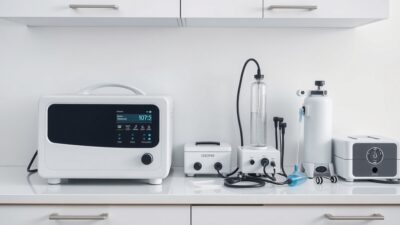
Contrast oxygen therapy, more formally known as Intermittent Hypoxic-Hyperoxic Training (IHHT), is a breathing protocol that alternates between low-oxygen (hypoxic) and high-oxygen (hyperoxic) air to stimulate cellular adaptation. The concept borrows from altitude training science: brief, controlled exposure to reduced oxygen triggers the body to produce more mitochondria, improve oxygen utilization, and strengthen antioxidant defenses. Adding hyperoxic intervals (breathing oxygen-enriched air) between the hypoxic periods accelerates recovery and amplifies the training effect.
This guide explains how contrast oxygen therapy works, what the clinical evidence shows, who uses it, what the devices cost, and how it compares to other oxygen-based therapies.
Key Takeaways
- IHHT alternates between breathing low-oxygen air (9-14% O2) and high-oxygen air (30-40% O2) in timed intervals while the patient rests
- The primary mechanism is mitochondrial biogenesis: controlled hypoxic stress triggers cells to produce new, healthier mitochondria1
- A 2019 RCT of elderly patients showed IHHT improved cognitive function and exercise tolerance over 5 weeks2
- Research on metabolic syndrome shows improvements in blood pressure, cholesterol, and fasting glucose after IHHT protocols3
- Sessions are passive (patient sits or lies down breathing through a mask), last 30 to 45 minutes, and cost $75 to $200 per session
- IHHT is not FDA-approved for any medical condition and is primarily offered at longevity and integrative medicine clinics
What Is Contrast Oxygen Therapy?
Contrast oxygen therapy uses a biofeedback-controlled device to deliver alternating periods of hypoxic (low-oxygen) and hyperoxic (high-oxygen) air through a face mask. A typical session looks like this:
- Hypoxic phase: 3 to 7 minutes breathing air at 9 to 14% oxygen (equivalent to an altitude of 10,000 to 22,000 feet)
- Hyperoxic phase: 1 to 3 minutes breathing air at 30 to 40% oxygen
- Cycles: 5 to 8 cycles per session
- Total session time: 30 to 45 minutes
- Monitoring: Continuous pulse oximetry tracks blood oxygen saturation in real time
The patient sits comfortably in a chair or reclines during the session. No chamber, no pressure changes, no physical exertion required. The device does the work by switching between gas mixtures at programmed intervals, adjusted based on the patient’s real-time oxygen saturation response.
The therapy goes by several names in clinical and commercial settings:
| Term | What It Refers To |
|---|---|
| IHHT | Intermittent Hypoxic-Hyperoxic Training (the clinical term) |
| IHT | Intermittent Hypoxic Training (hypoxic intervals only, no hyperoxic phase) |
| Contrast oxygen therapy | Commercial/marketing term emphasizing the “contrast” between low and high oxygen |
| Altitude simulation therapy | Emphasizes the hypoxic component’s similarity to high-altitude exposure |
| CellAir / ReOxy / Cellgym | Brand names of IHHT devices commonly used in clinics |
How It Works: The Science of Mitochondrial Biogenesis
The primary mechanism behind IHHT is hormesis: a controlled stress that triggers an adaptive response stronger than the stress itself. In this case, the stress is brief oxygen deprivation.
When oxygen levels drop during the hypoxic phase, cells activate a transcription factor called hypoxia-inducible factor 1-alpha (HIF-1α). HIF-1α triggers a cascade of adaptations:1
- Mitochondrial biogenesis: The body produces new mitochondria to improve energy production efficiency under oxygen-limited conditions
- Selective mitophagy: Damaged, dysfunctional mitochondria are identified and recycled, improving the overall quality of the mitochondrial pool
- Erythropoietin (EPO) release: Stimulates red blood cell production, improving oxygen-carrying capacity
- Vascular endothelial growth factor (VEGF): Promotes new blood vessel formation
- Antioxidant enzyme upregulation: Increases superoxide dismutase, catalase, and glutathione peroxidase production
The hyperoxic intervals serve two purposes: they allow recovery between hypoxic exposures, and the contrast itself (rapid shift from low to high oxygen) amplifies the HIF-1α signaling cascade.
Think of it as a workout for your cells. Just as muscle fibers strengthen through cycles of stress and recovery during exercise, mitochondria become more numerous and efficient through cycles of oxygen deprivation and oxygen abundance.
“Intermittent hypoxic-hyperoxic training promotes mitochondrial renewal by selectively destroying damaged mitochondria while stimulating the production of new, efficient ones.”
Serebrovska et al., 2019, Frontiers in Physiology
What the Clinical Evidence Shows
Cognitive Function in Elderly Patients
Serebrovska et al. (2019) conducted a randomized controlled trial of 41 elderly patients (60 to 75 years old) with mild cognitive impairment. The IHHT group received sessions three times per week for five weeks (15 sessions total). The protocol alternated between 12% O2 (hypoxic) and 33% O2 (hyperoxic) phases.
Results showed significant improvements in cognitive test scores (attention, memory, executive function) and exercise tolerance compared to the sham group. The researchers attributed the improvement to enhanced cerebral oxygen delivery and mitochondrial function.2
Metabolic Syndrome and Cardiovascular Health
Bestavashvili et al. (2022) studied IHHT in patients with metabolic syndrome. Three weeks of IHHT (five sessions per week) resulted in significant reductions in systolic blood pressure, total cholesterol, and fasting glucose compared to a control group. Heart rate variability also improved, suggesting better autonomic nervous system function.3
Athletic Performance
The altitude training community has used intermittent hypoxic training for decades. The addition of hyperoxic intervals is newer. Studies in athletes show improvements in VO2 max, hemoglobin levels, and endurance performance, though the magnitude of benefit varies between studies and the optimal protocols are still being refined.4
| Application | Evidence Level | Key Studies |
|---|---|---|
| Cognitive function (elderly) | Moderate (1 RCT) | Serebrovska et al. 2019 |
| Metabolic syndrome | Moderate (1 RCT) | Bestavashvili et al. 2022 |
| Athletic performance | Moderate (multiple small trials) | Various altitude training studies |
| Chronic fatigue | Limited (pilot studies) | Small uncontrolled studies |
| Post-COVID recovery | Limited (observational) | Case series from European clinics |
How IHHT Compares to Other Therapies
| Feature | IHHT | HBOT | EWOT |
|---|---|---|---|
| Mechanism | Mitochondrial biogenesis via hypoxic stress | Hyperoxygenation under pressure | Enhanced O2 during exercise |
| Patient effort | Passive (resting) | Passive (resting in chamber) | Active (exercising) |
| Session time | 30 to 45 min | 60 to 90 min | 15 to 20 min |
| Cost/session | $75 to $200 | $150 to $350 | $50 to $150 |
Devices and Cost
IHHT devices are manufactured primarily in Europe and range significantly in price:
- Clinical devices (ReOxy, CellAir, Cellgym): $15,000 to $40,000. These are medical-grade units with biofeedback, customizable protocols, and continuous pulse oximetry integration.
- Home devices: Entry-level altitude simulation devices start around $3,000 to $5,000, but most lack the hyperoxic component and biofeedback that define true IHHT.
- Clinical sessions: $75 to $200 per session. Most protocols recommend 10 to 15 sessions as an initial course, with maintenance sessions every 1 to 2 weeks.
A 15-session introductory course at a clinic runs approximately $1,125 to $3,000.
Insurance does not cover IHHT for any indication.
Safety and Contraindications
IHHT is generally well-tolerated. The hypoxic phases are brief and monitored continuously via pulse oximetry. If blood oxygen saturation drops below a programmed threshold (typically 80 to 85%), the device automatically switches to the hyperoxic phase.
Common side effects include mild dizziness, lightheadedness, and fatigue during or after sessions. These typically resolve within minutes.
Contraindications include:
- Severe, uncontrolled cardiovascular disease
- Acute respiratory failure
- Severe anemia
- Pregnancy
- Epilepsy (hypoxia may lower seizure threshold)
- Acute febrile illness
The Bottom Line
Contrast oxygen therapy (IHHT) is an intriguing modality with a sound biological rationale and growing but still limited clinical evidence. The mitochondrial biogenesis mechanism is well-established in exercise physiology and altitude medicine. The early RCTs in elderly cognitive decline and metabolic syndrome are promising. But the field needs larger, multi-center trials to determine optimal protocols, identify which patients benefit most, and establish long-term outcomes.
For patients interested in mitochondrial health, longevity optimization, or non-exercise-based performance enhancement, IHHT is worth investigating. It is not a replacement for exercise, medical treatment, or lifestyle interventions. But as a complement to those approaches, the science supports cautious optimism.
References
- Semenza GL. Hypoxia-inducible factors in physiology and medicine. Cell. 2012;148(3):399-408. doi:10.1016/j.cell.2012.01.021
- Serebrovska ZO, Serebrovska TV, Kholin VA, et al. Intermittent hypoxia-hyperoxia training improves cognitive function and decreases circulating biomarkers of Alzheimer’s disease in patients with mild cognitive impairment. Front Aging Neurosci. 2019;11:352. doi:10.3389/fnagi.2019.00352
- Bestavashvili A, Glazachev O, Bestavashvili A, et al. Intermittent hypoxic-hyperoxic training in patients with metabolic syndrome. Vasc Health Risk Manag. 2022;18:467-480. doi:10.2147/VHRM.S367515
- Millet GP, Roels B, Schmitt L, et al. Combining hypoxic methods for peak performance. Sports Med. 2010;40(1):1-25. doi:10.2165/11317920-000000000-00000
Medical Disclaimer
The content on BaricBoost.com is for informational purposes only and is not intended as a substitute for professional medical advice, diagnosis, or treatment. Always seek the advice of your physician or other qualified health provider with any questions you may have regarding a medical condition. Never disregard professional medical advice or delay in seeking it because of something you have read on this website.

Author
Seph Fontane Pennock is the founder of BaricBoost.com and Regenerated.com, a clinic directory for regenerative medicine serving 10,000+ providers across the United States. He previously built and sold PositivePsychology.com, which grew to 19 million users and became the largest evidence-based positive psychology resource on the web. Seph brings direct experience as an HBOT patient, having completed protocols at clinics across three continents while navigating mold illness, systemic inflammation, and autoimmune conditions. His treatment journey includes hyperbaric oxygen therapy, peptide protocols, NAD+ therapy, and consultations with specialists from Dubai to Cape Town to Mexico. This combination of entrepreneurial track record and lived patient experience shapes everything published on BaricBoost.com. Every article is grounded in peer-reviewed research, informed by real clinical encounters, and written for patients making high-stakes treatment decisions. Seph's focus is on bringing transparency, scientific rigor, and practical guidance to the hyperbaric oxygen therapy space.