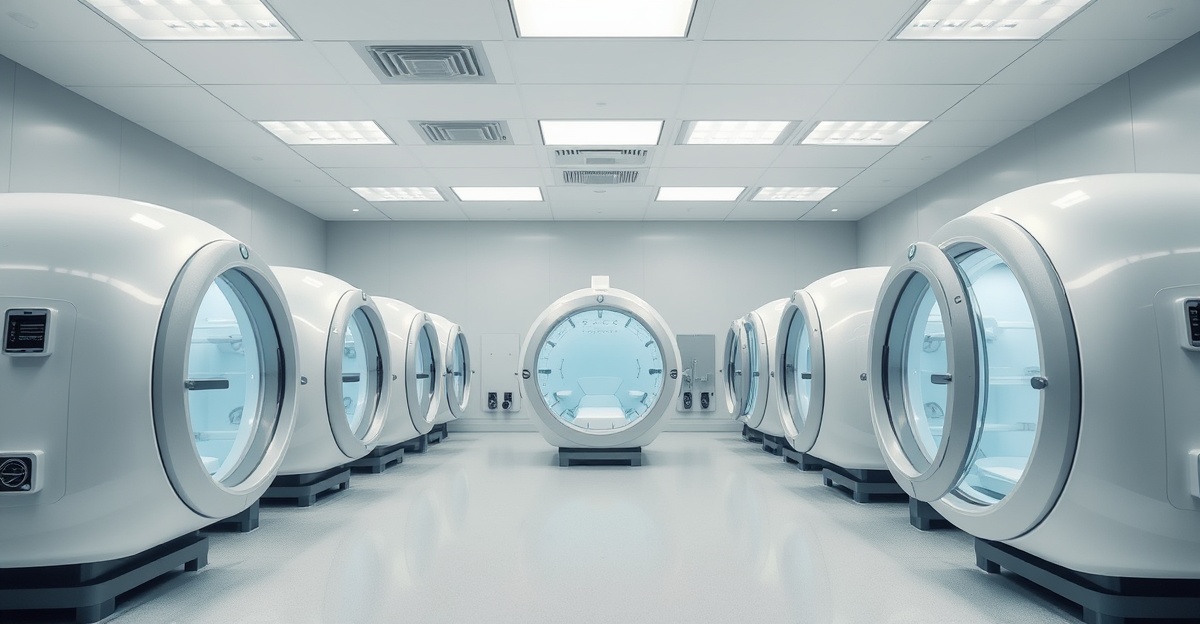
The global HBOT market is worth $3.98 to $7.96 billion in 2025, depending on whether you count devices only or include therapy services. It is growing at 5-10% annually, outpacing overall healthcare spending. The US devices market alone sits at $820 million to $1.0 billion, with wound care driving 35-40% of revenue. North America holds 31% of global share; Asia-Pacific is growing fastest at 6.5% CAGR.12
Global HBOT Market Size: Current Estimates
The variation between estimates is largely explained by what each research firm includes. Devices-only estimates run $3.41-3.98 billion for 2025. Estimates that include therapy services (clinical treatments billed to insurance) run $4.9-7.96 billion.1
| Research Firm | 2025 Estimate | Forecast | CAGR | Scope |
|---|---|---|---|---|
| Fortune Business Insights | $7.96B | $14.79B (2034) | 7.13% | HBOT market (broad) |
| Research and Markets | $4.9B | $7.89B (2030) | 9.7% | Therapy market |
| Precedence Research | $3.98B | $6.71B (2034) | 5.96% | Therapy market |
| Technavio | — | +$177.6M growth (2030) | 6% | Therapy market |
| NovaOne Advisor | $3.41B | $5.53B (2035) | 4.95% | Devices only |
“The global hyperbaric oxygen therapy market was valued at approximately $3.98 billion in 2025 and is projected to reach $6.71 billion by 2034, growing at a compound annual growth rate of 5.96%.” — Precedence Research4
US Market Data
Three research firms provide US-specific estimates:2
- Precedence Research: $1.00 billion (2025), growing to $1.72 billion by 2034 at 6.22% CAGR
- Nova One Advisor: $0.82 billion (2025), growing to $1.34 billion by 2035 at 5.03% CAGR
- Grand View Research: $0.92 billion (2024, devices), growing to $1.27 billion by 2030
North America accounts for approximately 31% of the global HBOT market, with the United States representing the largest national market. Medicare HBOT treatments peaked at 31,389 in 2021, with an average facility cost of $19,488 per patient (40 treatments) in 2022.5
Clinic and Chamber Counts
The UHMS reported “well over 1,000 hyperbaric programs” in the United States as of its 2025 Q1 report.3 For historical context:
| Year | Chambers/Programs (US) | Source |
|---|---|---|
| 1977 | ~27 | JAMA 1981 |
| 1981 | ~93+ | JAMA 1981 |
| 2025 | 1,000+ programs | UHMS 2025 Q1 Report |
As of 2020, China had 1,924 institutions offering HBOT with a total of 2,699 chambers and 11,266 practitioners, according to a nationwide survey published in Undersea and Hyperbaric Medicine.6
“According to the UHMS, there are well over 1,000 hyperbaric oxygen therapy programs in the United States as of 2025, each typically operating multiple chambers.” — UHMS 2025 Q1 Report3
Market Segmentation
By Product Type
Monoplace chambers (single-person units) dominate the market by revenue, accounting for approximately 55-60% of device sales. These are the standard in hospital wound care centers and freestanding clinics. Multiplace chambers (walk-in units serving multiple patients simultaneously) represent a smaller but high-value segment, with individual units costing $500,000 to over $2 million.
The portable and home chamber segment is the fastest-growing category. Consumer-grade soft chambers have made HBOT accessible at prices from $4,495 to $42,999, driving adoption among biohackers, athletes, and longevity enthusiasts.
By Application
Wound care remains the largest application segment, accounting for approximately 35-40% of the market. This includes diabetic foot ulcer treatment, venous stasis ulcers, and surgical wound complications. Off-label applications for long COVID, stroke recovery, and anti-aging are growing rapidly but harder to quantify in market data since they typically involve out-of-pocket payments.
By End User
Hospitals and wound care centers account for approximately 65% of the market, followed by freestanding HBOT clinics (20-25%), and home/personal use (10-15%). The home segment is growing fastest in percentage terms.
Regional Breakdown
- North America: ~31% market share. Largest installed base of chambers globally. Established Medicare reimbursement for approved indications. Strong consumer wellness demand.
- Europe: ~25-30%. Israel punches above its weight due to the Efrati/Sagol Center research program. Greater emphasis on hospital-based treatment.
- Asia-Pacific: Fastest-growing region at 6.5% CAGR. China is investing heavily in hyperbaric facilities. Japan has a well-established HBOT market particularly for sports medicine.
Key Growth Drivers
- Aging population: The global population aged 65+ is projected to double by 2050, directly increasing demand for wound care and anti-aging interventions
- Expanding off-label evidence: Clinical trials for HBOT in long COVID, TBI, and stroke recovery are generating positive results that drive patient demand
- Home chamber accessibility: Entry-level soft chambers now start under $5,000, opening HBOT to a mass consumer market
- Longevity medicine: HBOT has become a cornerstone protocol in the longevity movement, popularized by Bryan Johnson and backed by telomere lengthening research
- Sports medicine adoption: Professional sports teams across the NFL, NBA, Premier League, and Olympic programs have adopted HBOT for injury recovery
Market Restraints
- Insurance coverage gaps: Off-label use is almost entirely out-of-pocket. Treatment courses cost $4,000-$12,000 without reimbursement.
- Regulatory complexity: State-level licensing requirements vary significantly across the US
- Safety concerns: High-profile incidents like chamber fires receive disproportionate media coverage
Market Outlook: 2026-2034
The HBOT market is positioned for sustained growth driven by an aging population, expanding clinical evidence for off-label uses, falling home chamber prices, and growing consumer interest in longevity and recovery. The market is projected to reach $5.53-14.79 billion by 2034-2035, depending on scope.
The most significant upside catalyst would be FDA clearance or insurance coverage expansion for high-demand off-label indications like long COVID or TBI. If even one major indication receives coverage, it could add billions in addressable market virtually overnight.
- Fortune Business Insights. “HBOT Market Size 2026-2034.” fortunebusinessinsights.com. 2026.
- Nova One Advisor. “Hyperbaric Oxygen Therapy Devices Market 2026-2035.” novaoneadvisor.com. 2026.
- UHMS 2025 Q1 Report. uhms.org/component/tags/tag/2025-1st-quarter.html
- Precedence Research. “Hyperbaric Oxygen Therapy Market Size 2025-2034.” precedenceresearch.com. 2025.
- UHMS Journal. “Trends in Medicare Costs of HBO2 Therapy, 2013-2022.” 2024. uhms.org
- Zhang Y, Yang J, Li JS. “Clinical application of HBO2 therapy in China: A 2020 baseline survey.” Undersea and Hyperbaric Medicine. 2022. doi:10.22462/03.04.2022.3
- Gunby P. “HBO: new chambers, some growing pains.” JAMA. 1981. doi:10.1001/jama.1981.03320110005003
- Fife CE, Eckert KA. “The Hyperbaric Oxygen Therapy Registry.” Undersea and Hyperbaric Medicine. 2018. doi:10.22462/01.02.2018.1
- Research and Markets. “Hyperbaric Oxygen Therapy Market Report 2026.” researchandmarkets.com. 2026.
Medical Disclaimer
The content on BaricBoost.com is for informational purposes only and is not intended as a substitute for professional medical advice, diagnosis, or treatment. Always seek the advice of your physician or other qualified health provider with any questions you may have regarding a medical condition. Never disregard professional medical advice or delay in seeking it because of something you have read on this website.

Author
Seph Fontane Pennock is the founder of BaricBoost.com and Regenerated.com, a clinic directory for regenerative medicine serving 10,000+ providers across the United States. He previously built and sold PositivePsychology.com, which grew to 19 million users and became the largest evidence-based positive psychology resource on the web. Seph brings direct experience as an HBOT patient, having completed protocols at clinics across three continents while navigating mold illness, systemic inflammation, and autoimmune conditions. His treatment journey includes hyperbaric oxygen therapy, peptide protocols, NAD+ therapy, and consultations with specialists from Dubai to Cape Town to Mexico. This combination of entrepreneurial track record and lived patient experience shapes everything published on BaricBoost.com. Every article is grounded in peer-reviewed research, informed by real clinical encounters, and written for patients making high-stakes treatment decisions. Seph's focus is on bringing transparency, scientific rigor, and practical guidance to the hyperbaric oxygen therapy space.