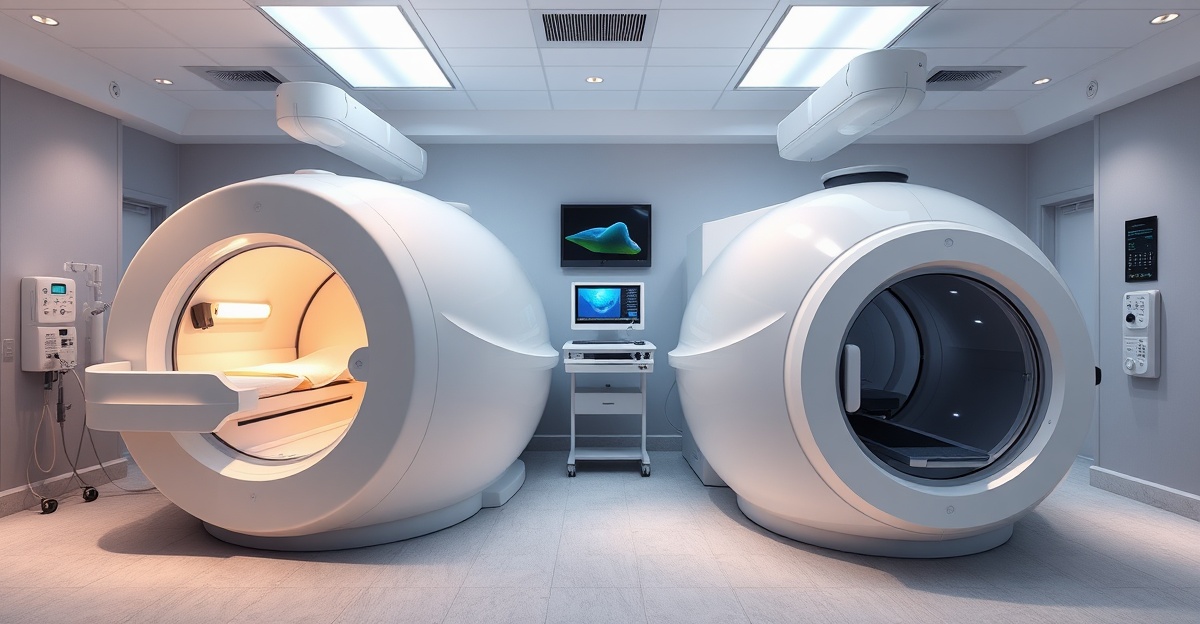
Hard chambers deliver roughly 1,824 mmHg arterial oxygen at 2.4 ATA with 100% oxygen. Soft chambers deliver roughly 230 mmHg at 1.3 ATA with air. That is close to an 8x difference, and it shows in the research: every major positive HBOT trial for wound and neurological outcomes used a hard chamber at 1.5 ATA or above, and no randomized trial has ever shown those outcomes from a 1.3 ATA soft chamber. This is not a preference. It is physics.
- ATA (atmospheres absolute): total pressure inside the chamber. Sea level is 1.0 ATA.
- Arterial pO2: the partial pressure of oxygen dissolved in arterial blood, in mmHg. It rises with both pressure and inspired oxygen fraction.
- Bacteriostatic threshold: the tissue oxygen level, reached only above roughly 1.5 ATA on 100% oxygen, at which oxygen begins suppressing bacterial and fungal growth.
Is a soft or hard hyperbaric chamber better?
For any condition with published clinical evidence, the hard chamber is the one the evidence was built on. The soft vs hard chamber decision determines whether you receive a therapy backed by randomized controlled trials or an intervention with limited published evidence at dramatically lower oxygen delivery. Soft chambers have real, narrow uses. They do not reproduce the pressures the trials used.
What does Henry’s Law say about oxygen delivery?
Oxygen dissolves into blood plasma according to Henry’s Law: the amount of dissolved gas is directly proportional to the partial pressure of that gas above the liquid. Here is what that means in practice for each chamber type.1
| Chamber Type | Pressure (ATA) | O2 Content | Arterial O2 (mmHg) | Relative Delivery |
|---|---|---|---|---|
| Normal breathing | 1.0 | 21% | ~100 | 1x (baseline) |
| Soft chamber (ambient air) | 1.3 | ~24% | ~230 | 2.3x |
| O2 mask at sea level | 1.0 | ~90% | ~600 | 6x |
| Hard chamber (standard) | 2.0 | 100% | ~1,520 | 15x |
| Hard chamber (clinical) | 2.4 | 100% | ~1,824 | 18x |
At 1.3 ATA with ambient air, a soft chamber produces arterial oxygen of about 230 mmHg. A hard chamber at 2.4 ATA with 100% oxygen produces about 1,824 mmHg. Burman’s 2019 analysis makes the practical point bluntly: a mild exposure on air delivers no more oxygen than breathing oxygen through a mask at sea level.1
Why can’t soft chambers treat infected wounds?
The dividing line is the bacteriostatic threshold. Oxygen suppresses bacterial and fungal growth only at the tissue oxygen tensions produced above roughly 1.5 ATA on 100% oxygen.1 A soft chamber at 1.3 ATA on air cannot reach it. Burman’s SAUHMA analysis states that exposure below 2.0 ATA while breathing air does not meet the definition of therapeutic hyperbaric oxygen therapy at all.1
This is why soft chambers have no role in wound healing for infected tissue, gas gangrene, or necrotizing soft tissue infections, the conditions that most clearly benefit from clinical HBOT. The UHMS issued a formal consumer warning that soft-sided bag chambers do not meet clinical HBOT standards and are cleared only for acute mountain sickness.3
What pressure did the clinical trials use?
Every major HBOT trial demonstrating positive outcomes for neurological conditions used a hard chamber. The pressures were not incidental. They were the intervention.
- Long COVID (Zilberman-Itskovich et al., 2022): 2.0 ATA, 100% O2, 40 sessions, hard chamber (full results)5
- TBI (Harch et al., 2012): 1.5 ATA, 100% O2, 40 sessions, hard chamber (full results)6
- Stroke (Efrati et al., 2013): 2.0 ATA, 100% O2, hard chamber (full results)7
- Fibromyalgia (Efrati et al., 2015): 2.0 ATA, 100% O2, 60 sessions, hard chamber8
- Anti-aging and telomeres (Hachmo et al., 2020): 2.0 ATA, 100% O2, 60 sessions, hard chamber9
No randomized controlled trial has compared soft-shell to hard-shell chambers head to head for any medical condition. Burman’s review of the low-pressure category concluded these units fall outside the definition of therapeutic HBOT, which is why the comparison trials were never run at 1.3 ATA in the first place.1 For the detailed protocol comparison between the two leading neurological research programs, see our Efrati vs Harch protocol comparison.
Monoplace vs multiplace hard chambers: what is the difference?
Hard chambers come in two subtypes with important clinical differences.10 A 2024 study measuring tissue oxygenation in 130 chronic ulcer patients found levels at 1.4 ATA (161 mmHg) were roughly half those at 2.0 ATA (333 mmHg), which is why even the lowest clinical pressures still sit far above soft chamber territory.2
| Feature | Monoplace | Multiplace |
|---|---|---|
| Capacity | 1 patient | 2-20+ patients + attendant |
| O2 delivery | 100% O2 fills chamber | Air-pressurized; O2 via mask |
| Max pressure | Typically 3.0 ATA | Up to 6.0 ATA |
| Critical care capability | Limited (no inside attendant) | Full ICU-level care possible |
| Purchase cost | $50,000-$150,000 | $500,000-$2,000,000+ |
What are soft chambers actually good for?
This is not an argument that soft chambers are worthless. They offer real value for specific use cases:
- Mild pressurization effects: the 1.3 ATA pressure provides a modest increase in plasma oxygen
- Relaxation and recovery: many users report improved sleep, reduced stress, and subjective well-being
- Athletic recovery: the modest oxygen increase may support recovery from intense training, though evidence is limited (athletic recovery data)
- Accessibility: at $4,495 to $12,000, soft chambers make pressurized therapy available to people who cannot access clinical HBOT
How do the prices compare?
| Option | Purchase Cost | Per-Session Cost (40 sessions amortized) |
|---|---|---|
| Soft chamber (home purchase) | $4,495-$12,000 | $112-$300 |
| Hard chamber clinic sessions | N/A (per-session) | $150-$400 per session |
| Hard chamber home purchase | $25,000-$42,999 | $625-$1,075 |
The Bottom Line
If you are pursuing HBOT for a specific condition with published clinical evidence (long COVID, TBI, stroke, wound healing, fibromyalgia, anti-aging), that evidence was generated in hard chambers at 1.5 to 2.4 ATA. Expecting soft chamber results to match is not supported by published data. The 2024 chronic ulcer oximetry study is a useful reminder of the scale: even 1.4 ATA delivered only half the tissue oxygen of 2.0 ATA, and a soft chamber sits well below 1.4.2
If you want a wellness device for general health support, athletic recovery, and relaxation, a home-use soft chamber can be a reasonable investment, with the understanding that you are receiving a fundamentally different intervention than what the clinical trials studied.
Sources
- Burman F. “Low-pressure fabric hyperbaric chambers.” South African Medical Journal. 2019;109(4):232-233. PMID: 31084683. Link
- Sack RA, et al. “Transcutaneous oximetry values in chronic ulcer patients during hyperbaric treatment at 1.4 ATA compared to 2 ATA.” Undersea and Hyperbaric Medicine. 2024;51(1):9-16. PMID: 38615347. Link
- Undersea and Hyperbaric Medical Society. “Consumer Warning: The Dangers of Soft-Sided Bag Chambers.” Link
- U.S. Food and Drug Administration. “Hyperbaric Oxygen Therapy: Get the Facts.” Link
- Zilberman-Itskovich S, et al. “Hyperbaric oxygen therapy improves neurocognitive functions and symptoms of post-COVID condition: randomized controlled trial.” Scientific Reports. 2022;12:11252. PMID: 35821512. Link
- Harch PG, et al. “A Phase I Study of Low-Pressure Hyperbaric Oxygen Therapy for Blast-Induced Post-Concussion Syndrome and Post-Traumatic Stress Disorder.” Journal of Neurotrauma. 2012;29(1):168-185. PMID: 22026588. Link
- Efrati S, et al. “Hyperbaric Oxygen Induces Late Neuroplasticity in Post Stroke Patients: Randomized, Prospective Trial.” PLoS One. 2013;8(1):e53716. Link
- Efrati S, et al. “Hyperbaric oxygen therapy can diminish fibromyalgia syndrome: prospective clinical trial.” PLoS One. 2015;10(5):e0127012. PMID: 26010952. Link
- Hachmo Y, et al. “Hyperbaric oxygen therapy increases telomere length and decreases immunosenescence in isolated blood cells: a prospective trial.” Aging. 2020;12(22):22445-22456. Link
- Lind F. “A pro/con review comparing the use of mono- and multiplace hyperbaric chambers for critical care.” Diving and Hyperbaric Medicine. 2015;45(1):56-60. PMID: 25964041. Link
Medical Disclaimer
The content on BaricBoost.com is for informational purposes only and is not intended as a substitute for professional medical advice, diagnosis, or treatment. Always seek the advice of your physician or other qualified health provider with any questions you may have regarding a medical condition. Never disregard professional medical advice or delay in seeking it because of something you have read on this website.

Author
Seph Fontane Pennock is the founder of BaricBoost.com and Regenerated.com, a clinic directory for regenerative medicine serving 10,000+ providers across the United States. He previously built and sold PositivePsychology.com, which grew to 19 million users and became the largest evidence-based positive psychology resource on the web. Seph brings direct experience as an HBOT patient, having completed protocols at clinics across three continents while navigating mold illness, systemic inflammation, and autoimmune conditions. His treatment journey includes hyperbaric oxygen therapy, peptide protocols, NAD+ therapy, and consultations with specialists from Dubai to Cape Town to Mexico. This combination of entrepreneurial track record and lived patient experience shapes everything published on BaricBoost.com. Every article is grounded in peer-reviewed research, informed by real clinical encounters, and written for patients making high-stakes treatment decisions. Seph's focus is on bringing transparency, scientific rigor, and practical guidance to the hyperbaric oxygen therapy space.