Intra-articular ozone injections reduce joint pain in the short term, with the best evidence in knee osteoarthritis. A 2018 systematic review of 5 RCTs (428 patients) found ozone eased pain at one month, but control injections held up better past three months. Head-to-head, ozone matches hyaluronic acid and trails platelet-rich plasma, while costing the least of the three. It is not FDA-approved and rarely covered by insurance.
Joint pain is one of the most common reasons patients seek ozone therapy. The honest picture is that ozone works in the short term for some joints, mainly the knee, but the durability and comparative benefit are weaker than promotional claims suggest. This guide covers how the injections work, what the trials found joint by joint, how ozone compares to cortisone, PRP, and hyaluronic acid, typical protocols, and cost. For the full modality overview, see our pillar guide to ozone therapy, and for arthritis specifically, our guide to ozone therapy for arthritis.
Key Takeaways
- Intra-articular ozone reduces knee OA pain in the short term, but a 2018 meta-analysis of 5 RCTs found control injections gave more durable relief past three months.2
- In a head-to-head trial, ozone matched hyaluronic acid and trailed PRP for knee OA, while being the cheapest of the three.3
- For shoulder impingement, an RCT found corticosteroid injection outperformed ozone.5
- Ozone injections avoid the cartilage-volume loss seen with repeated corticosteroid injections.4
- Costs run $150 to $400 per injection, with most protocols using 3 to 5 injections per joint. It is not FDA-approved and is rarely covered by insurance.
How Do Ozone Injections Work for Joint Pain?
When ozone gas is injected into a joint, it sets off several biological effects that plausibly reduce pain. The mechanisms are well described in the laboratory; the clinical benefit is where the evidence is more mixed.
Anti-inflammatory action. Ozone modulates the NF-kB inflammatory pathway, reducing pro-inflammatory cytokines (IL-1, IL-6, TNF-alpha) that drive joint pain and cartilage degradation. Sagai and Bocci describe this as a core mechanism of ozone therapy.1
Antioxidant upregulation. Through Nrf2 activation, ozone raises endogenous antioxidants such as superoxide dismutase and glutathione peroxidase, countering the oxidative stress that contributes to cartilage breakdown.1
Improved oxygen delivery. Ozone increases 2,3-DPG in red blood cells, which enhances oxygen release to hypoxic joint tissue and supports chondrocyte and synovial health.
Analgesic effect. Ozone appears to reduce pain by dampening local nociceptor sensitivity through prostaglandin and bradykinin pathways.
Possible chondroprotection. Some laboratory work indicates ozone may stimulate chondrocyte activity and glycosaminoglycan synthesis, but this has not been confirmed in clinical cartilage outcomes and remains unproven in patients.
McAlindon and colleagues, in a 2017 JAMA randomized trial, found that repeated intra-articular corticosteroid (triamcinolone) caused significantly greater cartilage volume loss than saline over two years, with no pain advantage. That is the specific basis for the concern about repeated steroid injections, and it is one reason patients look at ozone as an alternative.4 Ozone reduces inflammation without that documented cartilage cost, though it should not be presented as a proven cartilage-building treatment.
Which Joints Respond Best to Ozone Injections?
Evidence quality varies sharply by joint. The knee has the most data; everything else is thinner, and at least one shoulder RCT favored the standard alternative.
| Joint | Evidence Level | Key Studies | What the Data Shows |
|---|---|---|---|
| Knee | Moderate (RCTs + meta-analysis) | Raeissadat 2018, Duymus 201723 | Short-term pain relief; not durable past 3 months; comparable to HA, below PRP |
| Spine (disc herniation) | Moderate (systematic review) | Magalhaes 20126 | Positive results with low morbidity, but small studies with methodological limits |
| Shoulder | Emerging / mixed | Babaei-Ghazani 20195 | RCT found corticosteroid improved pain and disability more than ozone |
| Hip | Limited (mostly observational) | Case series | Some relief reported; deep anatomy makes injection more complex |
| Small joints (hands, feet) | Limited (case series) | Practitioner reports | Anecdotal improvement only |
For back and disc-related pain, our guide to ozone therapy for back pain covers the intradiscal evidence in more detail.
How Does Ozone Compare to Cortisone, PRP, and Hyaluronic Acid?
Patients weighing ozone usually want to know how it stacks up against the more familiar injection options. The comparison below combines mechanism, typical duration, cost, and the main drawback of each.
| Treatment | Mechanism | Duration of Relief | Cost per Injection | Key Concern |
|---|---|---|---|---|
| Cortisone | Anti-inflammatory (suppresses immune response) | 4-12 weeks | $100-$300 (often covered) | Greater cartilage volume loss with repeated use4 |
| Hyaluronic acid | Viscosupplementation (lubricates joint) | 3-6 months | $300-$800 | Debated efficacy; may not beat placebo in all trials |
| PRP | Growth factor delivery (promotes tissue repair) | 6-12 months | $500-$2,000 | Variable platelet quality; no standardized prep |
| Ozone | Anti-inflammatory + antioxidant + analgesic | Weeks to ~3 months (per series) | $150-$400 | Not FDA-approved; short-lived benefit; limited coverage |
| Prolozone | Ozone + procaine + nutrients (combined) | Variable | $200-$500 | Much less studied than pure ozone; no large RCTs |
Duymus and colleagues directly compared intra-articular ozone, hyaluronic acid, and PRP in 102 patients with mild-to-moderate knee OA. All three eased pain at one month, but PRP delivered the most durable benefit through 12 months, while ozone and hyaluronic acid faded sooner. Ozone was the lowest-cost option of the three.3
What Is Prolozone, and Is It Different From Ozone?
Intra-articular ozone: pure oxygen-ozone gas injected into the joint. This is the form studied in the RCTs and meta-analyses cited here.
Prolozone: ozone combined with a local anesthetic (procaine or lidocaine), B vitamins, and sometimes homeopathic anti-inflammatories, injected before the gas. Developed by Frank Shallenberger, it is widely used in integrative practice but has far less published evidence than pure ozone, with no large RCTs.7
The rationale is that the anesthetic opens local blood vessels and numbs the area, the nutrients supply repair substrate, and the ozone triggers the anti-inflammatory cascade. That is a reasonable mechanism, but the combined formulation has not been tested against pure ozone in controlled trials, so treat prolozone claims with more caution than knee-OA ozone data.
Typical Protocols and Injection Numbers
| Joint | Injections per Course | Frequency | Expected Timeline |
|---|---|---|---|
| Knee | 3 to 5 | Weekly or biweekly | 3-10 weeks |
| Shoulder | 3 to 5 | Weekly or biweekly | 3-10 weeks |
| Hip | 3 to 5 (ultrasound-guided) | Biweekly | 6-10 weeks |
| Small joints | 2 to 4 | Weekly | 2-4 weeks |
| Multiple joints | 3 to 5 per joint (can combine per visit) | Weekly or biweekly | 4-10 weeks |
Most patients who respond notice improvement after the second or third injection, with maximum benefit 2 to 4 weeks after the final injection in a series. Because the benefit is often short-lived, maintenance injections every 3 to 6 months are common for chronic joints. Our guide to ozone therapy protocols covers dosing in more depth.
What Happens During the Procedure?
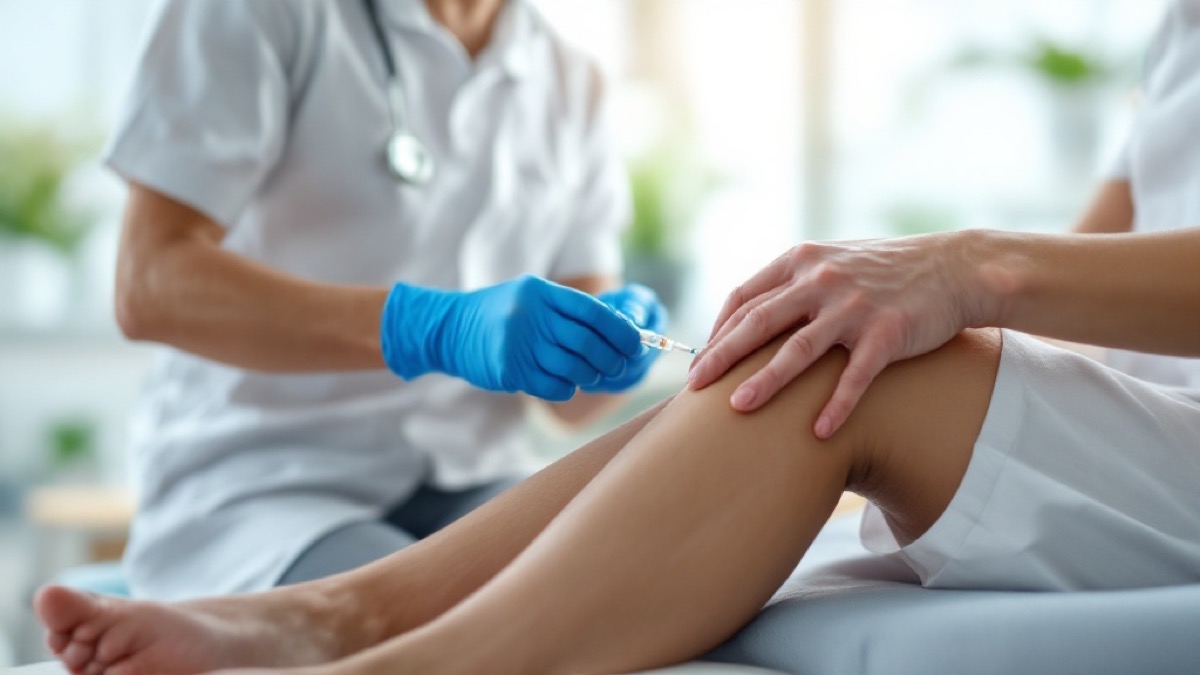
An intra-articular ozone injection is a clinic-based procedure that takes 15 to 30 minutes.
- Preparation: the site is cleaned and sterilized; a small amount of local anesthetic may be used, though many practitioners skip it given the small needle gauge.
- Injection: for prolozone, the anesthetic and nutrient solution goes first, followed by ozone gas. For pure ozone, the gas is injected directly. Volume depends on the joint: 5 to 15 mL for knees, 3 to 10 mL for shoulders, less for smaller joints.
- Post-injection: a sensation of pressure or fullness is normal as gas fills the joint space and usually resolves within minutes to hours.
- Recovery: most patients resume normal activity immediately; some are advised to avoid heavy exercise for 24 to 48 hours.
Most patients report minimal pain, comparable to or less than a cortisone injection.
What Does Ozone for Joint Pain Cost?
- Pure ozone injection (per joint): $150 to $300
- Prolozone injection (per joint): $200 to $500
- Full course (3 to 5 injections per joint): $450 to $2,500
- Multiple joints (same visit): most practitioners discount 2+ joints
- Insurance: not covered, since ozone is not FDA-approved for joint injection
Compared to PRP ($500 to $2,000) and stem cell injections ($3,000+), ozone is the most affordable regenerative-style option, which is a large part of its appeal. Compared to cortisone (often insurance-covered), ozone costs more out of pocket. For a fuller breakdown, see our ozone therapy cost guide, and for how ozone stacks up against other regenerative routes, our comparison of HBOT vs ozone therapy vs IV NAD.
Is Ozone Injection Safe?
Intra-articular ozone has a reassuring short-term safety profile. In the knee OA meta-analysis, adverse events occurred at similar rates in ozone and control groups (about 4% versus 5%), with no serious complications.2 The most common effects are:
- Temporary joint swelling or pressure (resolves within hours)
- Mild soreness at the injection site (24 to 48 hours)
- Transient warmth in the joint
Serious adverse events are rare. Infection risk exists with any joint injection but is minimized with sterile technique. Reactions to procaine or other prolozone components are possible even though ozone itself rarely triggers allergy. Ozone’s broader anti-inflammatory role is covered in our guide to ozone therapy for inflammation.
The Bottom Line
Intra-articular ozone is a low-cost option with real but modest evidence, strongest for short-term knee osteoarthritis pain and lumbar disc herniation. The honest caveats matter: the pooled data shows the benefit fades within a few months, ozone underperforms PRP head-to-head, and a shoulder RCT favored corticosteroid. It also avoids the cartilage-volume loss documented with repeated steroid injections, which is a genuine point in its favor.
For patients with joint pain who have not responded to conservative measures, ozone injections are a reasonable option to discuss with a physician who offers regenerative injection therapies, with realistic expectations about duration. Set the bar at short-term relief that may need repeating, not a cure.
Sources
- Sagai M, Bocci V. “Mechanisms of action involved in ozone therapy: is healing induced via a mild oxidative stress?” Medical Gas Research, 2011;1(1):29. doi:10.1186/2045-9912-1-29
- Raeissadat SA, Tabibian E, Rayegani SM, et al. “An investigation into the efficacy of intra-articular ozone (O2-O3) injection in patients with knee osteoarthritis: a systematic review and meta-analysis.” Journal of Pain Research, 2018;11:2537-2550. doi:10.2147/JPR.S175441
- Duymus TM, Mutlu S, Dernek B, et al. “Choice of intra-articular injection in treatment of knee osteoarthritis: platelet-rich plasma, hyaluronic acid or ozone options.” Knee Surgery, Sports Traumatology, Arthroscopy, 2017;25(2):485-492. doi:10.1007/s00167-016-4110-5
- McAlindon TE, LaValley MP, Harvey WF, et al. “Effect of intra-articular triamcinolone vs saline on knee cartilage volume and pain in patients with knee osteoarthritis: a randomized clinical trial.” JAMA, 2017;317(19):1967-1975. doi:10.1001/jama.2017.5283
- Babaei-Ghazani A, Karimi N, Forogh B, et al. “A Randomized Control Trial of Comparing Ultrasound-Guided Ozone (O2-O3) vs Corticosteroid Injection in Patients With Shoulder Impingement.” American Journal of Physical Medicine & Rehabilitation, 2019;98(11):1018-1025. doi:10.1097/PHM.0000000000001240
- Magalhaes FN, Dotta L, Sasse A, Teixeira MJ, Fonoff ET. “Ozone therapy as a treatment for low back pain secondary to herniated disc: a systematic review and meta-analysis of randomized controlled trials.” Pain Physician, 2012;15(2):E115-E129. PMID: 22430658.
- Shallenberger F. “Prolozone: regenerating joints and eliminating pain.” Journal of Prolotherapy, 2011;3(2):630-638.
Medical Disclaimer
The content on BaricBoost.com is for informational purposes only and is not intended as a substitute for professional medical advice, diagnosis, or treatment. Always seek the advice of your physician or other qualified health provider with any questions you may have regarding a medical condition. Never disregard professional medical advice or delay in seeking it because of something you have read on this website.

Author
Seph Fontane Pennock is the founder of BaricBoost.com and Regenerated.com, a clinic directory for regenerative medicine serving 10,000+ providers across the United States. He previously built and sold PositivePsychology.com, which grew to 19 million users and became the largest evidence-based positive psychology resource on the web. Seph brings direct experience as an HBOT patient, having completed protocols at clinics across three continents while navigating mold illness, systemic inflammation, and autoimmune conditions. His treatment journey includes hyperbaric oxygen therapy, peptide protocols, NAD+ therapy, and consultations with specialists from Dubai to Cape Town to Mexico. This combination of entrepreneurial track record and lived patient experience shapes everything published on BaricBoost.com. Every article is grounded in peer-reviewed research, informed by real clinical encounters, and written for patients making high-stakes treatment decisions. Seph's focus is on bringing transparency, scientific rigor, and practical guidance to the hyperbaric oxygen therapy space.