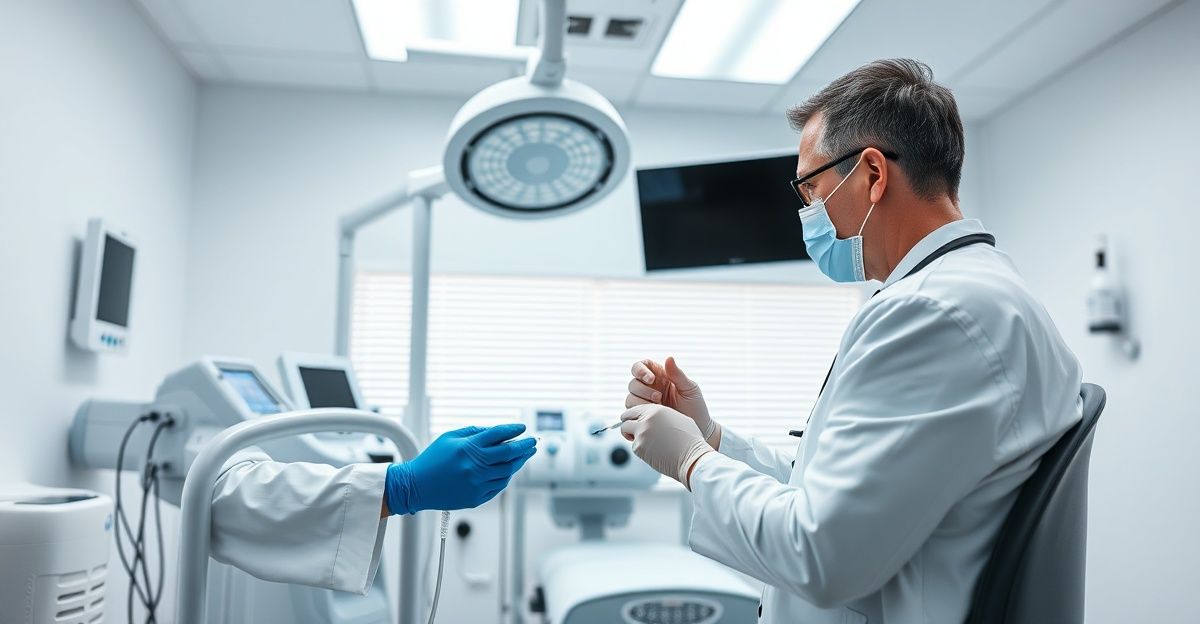
Intradiscal ozone injection delivers a 3 to 10 mL ozone-oxygen mixture at 20 to 30 mcg/mL directly into a herniated disc under imaging guidance. A meta-analysis of more than 8,000 patients reported a 79.7% improvement rate for contained lumbar disc herniation, with a complication rate below 0.1% (Steppan et al., 2010). Reported success rates across studies run 65% to 80%, though reviewers note the underlying randomized trials are of variable quality.
How does ozone shrink a herniated disc?
The nucleus pulposus of an intervertebral disc is mostly water, type II collagen, and proteoglycans (mainly aggrecan). Those proteoglycans are hydrophilic and draw water into the disc, maintaining its height and cushioning. When a disc herniates, this hydrated material protrudes and compresses adjacent nerve roots, producing radiculopathy. Ozone acts on the disc through three mechanisms.
1. Proteoglycan oxidation and disc shrinkage. Ozone oxidizes the glycosaminoglycan side chains of proteoglycans, reducing their water-binding capacity so the nucleus pulposus loses volume and retracts, easing pressure on the nerve root. MRI studies have documented measurable disc volume reduction after ozone injection (Muto et al., 2008).
2. Anti-inflammatory action. Ozone reduces phospholipase A2 and pro-inflammatory cytokines (IL-1, IL-6, TNF-alpha) in and around the disc (Bocci et al., 2015). Because much radicular pain is chemical rather than purely mechanical, this contributes substantially to relief.
3. Analgesic effect. Ozone stimulates release of endogenous enkephalins and endorphins and desensitizes local C-fiber nociceptors, raising the pain threshold at the treated level. For the cost side of this treatment, see our detailed ozone therapy for herniated disc cost breakdown.
How is intradiscal ozone injected?
Patient positioning and imaging
The patient lies prone on a fluoroscopy or CT table. The target disc level is identified and the skin entry point marked. The procedure is done under fluoroscopic guidance (more common, real-time) or CT guidance (better soft-tissue detail, preferred for cervical levels or complex anatomy).
Needle placement
A 20 to 22-gauge spinal needle is advanced using a posterolateral approach for lumbar discs or an anterolateral approach for cervical discs, with the tip placed in the center of the nucleus pulposus. Position is confirmed by injecting a small amount of contrast (discography) to visualize disc architecture.
Ozone injection parameters
Typical intradiscal ozone parameters
| Parameter | Typical range | Notes |
|---|---|---|
| Ozone concentration | 20 to 40 mcg/mL | Most protocols use 27 to 30 mcg/mL |
| Volume (intradiscal) | 3 to 10 mL | Injected slowly over 1 to 2 minutes |
| Volume (paravertebral) | 5 to 15 mL per side | Often combined with intradiscal injection |
| Total ozone-oxygen gas | 10 to 25 mL | Split between intradiscal and paravertebral |
| Needle gauge | 20G to 22G | Smaller gauge reduces post-procedure discomfort |
| Imaging guidance | Fluoroscopy or CT | CT preferred for cervical levels |
The ozone-oxygen gas is generated fresh at the point of care with a medical-grade generator, drawn into a syringe, and injected slowly. Patients typically feel pressure or fullness during injection, which subsides within minutes. Intradiscal ozone is a precise, targeted procedure: the gas contacts the herniated material directly, oxidizes the proteoglycans, and the disc retracts, which is a large part of why it is one of the more localized minimally invasive spine options.
Paravertebral component
Most practitioners combine the intradiscal injection with paravertebral injection of ozone-oxygen gas into the foraminal and epidural space next to the compressed nerve root, addressing the inflammatory component of radiculopathy. Typical volumes are 5 to 15 mL per side at 20 to 30 mcg/mL.
What does the research say?
Intradiscal ozone has more clinical study behind it than most ozone applications, though reviewers consistently flag the quality of the underlying trials. Steppan’s 2010 meta-analysis pooled 12 studies and over 8,000 patients, reporting a 79.7% improvement rate and a very low complication rate, while also noting the need for higher-quality randomized trials (Steppan et al., 2010).
Key studies on intradiscal ozone for disc herniation
| Study | Design | Key finding |
|---|---|---|
| Steppan et al., 2010 (meta-analysis) | 12 studies, 8,000+ patients | 79.7% improvement for lumbar disc herniation; reviewers note variable RCT quality |
| Magalhaes et al., 2012 (systematic review) | Ozone for low back pain from disc herniation | Moderate evidence for pain and function improvement |
| Muto et al., 2008 (Radiol Med) | Large prospective series | Good-to-excellent outcomes with MRI-confirmed disc reduction |
| Gallucci et al., 2007 (RCT, Radiology) | Ozone + steroid vs steroid alone | Ozone group had significantly better outcomes at 6 months |
Read together, the evidence supports intradiscal ozone as a reasonable option for contained disc herniation, but the 79.7% figure should not be read as settled: it comes from pooled studies of mixed methodological quality, and multiple reviewers call for better randomized trials before ozone is treated as equivalent to established procedures. See how it stacks up in our comparison of ozone therapy for joint pain.
What happens after the procedure?
Most patients go home 1 to 2 hours later. Standard aftercare:
- Day of procedure: rest, avoid heavy lifting, use ice if needed. Mild injection-site soreness is normal.
- Days 1 to 3: light activity, walking encouraged, avoid bending, twisting, or lifting over 10 pounds.
- Days 4 to 14: gradual return to normal activity; physical therapy can begin around day 7.
- Weeks 2 to 6: progressive strengthening. Full benefit typically develops over 2 to 6 weeks as inflammation resolves and disc volume stabilizes.
- Follow-up: clinical assessment at 4 to 6 weeks, MRI at 3 months if indicated.
Some patients have a temporary pain flare for 24 to 72 hours before improvement begins, related to the acute inflammatory response to ozone. It is usually self-limiting.
Is intradiscal ozone injection safe?
Intradiscal ozone has one of the lowest complication rates of any interventional spine procedure. A review of more than 40,000 documented cases reported a complication rate of about 0.1% (Bocci, 2006). Reported complications include:
- Transient post-procedural pain flare (most common, not a true complication).
- Vasovagal syncope during the procedure.
- Discitis (extremely rare with proper sterile technique).
- Pneumocephalus (reported in cervical cases, exceedingly rare).
The procedure is contraindicated in G6PD deficiency, active spinal infection, cauda equina syndrome, and severe spinal instability.
How much does intradiscal ozone injection cost?
Intradiscal ozone injection typically costs $1,500 to $5,000 per procedure in the United States. Most patients need 1 to 3 sessions spaced 2 to 4 weeks apart. Insurance coverage is generally unavailable in the US, though some insurers in Europe and Latin America cover it. For comparison, microdiscectomy costs $15,000 to $50,000 and spinal fusion $50,000 to $150,000, making ozone substantially cheaper if it delivers adequate relief. Full pricing detail is in our ozone therapy herniated disc cost guide.
Key terms
| Term | Meaning |
|---|---|
| Nucleus pulposus | The gel-like inner core of an intervertebral disc. |
| Radiculopathy | Nerve-root irritation producing pain, numbness, or weakness along the nerve’s path. |
| Discography | Injection of contrast dye to visualize disc architecture and confirm needle position. |
| Proteoglycan | Water-binding molecules in the disc that maintain its height and cushioning. |
The bottom line
Intradiscal ozone injection is a well-studied, minimally invasive option that sits between conservative care and surgery. The technical parameters (20 to 40 mcg/mL, 3 to 15 mL, fluoroscopy or CT guidance) are well established, and the procedure has a strong safety record across tens of thousands of cases. The efficacy evidence is supportive but not definitive: reviewers repeatedly call for higher-quality randomized trials. For a patient with a contained disc herniation who has failed 6 to 8 weeks of conservative treatment and wants to avoid surgery, it is a reasonable next step to discuss with an interventional specialist. Realistic expectations about ozone therapy protocols matter here.
Sources
- Steppan J, Meaders T, Muto M, Murphy KJ. A metaanalysis of the effectiveness and safety of ozone treatments for herniated lumbar discs. Journal of Vascular and Interventional Radiology. 2010;21(4):534-548. doi:10.1016/j.jvir.2009.12.393
- Magalhaes FN, Dotta L, Sasse A, Teixera MJ, Fonoff ET. Ozone therapy as a treatment for low back pain secondary to herniated disc: a systematic review and meta-analysis of randomized controlled trials. Pain Physician. 2012;15(2):E115-E129. PMID: 22430658
- Muto M, Ambrosanio G, Guarnieri G, et al. Low back pain and sciatica: treatment with intradiscal-intraforaminal O2-O3 injection. Our experience. La Radiologia Medica. 2008;113(5):695-706. doi:10.1007/s11547-008-0302-5
- Gallucci M, Limbucci N, Zugaro L, et al. Sciatica: treatment with intradiscal and intraforaminal injections of steroid and oxygen-ozone versus steroid only. Radiology. 2007;242(3):907-913. doi:10.1148/radiol.2423051934
- Bocci V, Borrelli E, Zanardi I, Travagli V. The usefulness of ozone treatment in spinal pain. Drug Design, Development and Therapy. 2015;9:2677-2685. doi:10.2147/DDDT.S74518
- Bocci V. Is it true that ozone is always toxic? The end of a dogma. Toxicology and Applied Pharmacology. 2006;216(3):493-504. doi:10.1016/j.taap.2006.06.009
Medical Disclaimer
The content on BaricBoost.com is for informational purposes only and is not intended as a substitute for professional medical advice, diagnosis, or treatment. Always seek the advice of your physician or other qualified health provider with any questions you may have regarding a medical condition. Never disregard professional medical advice or delay in seeking it because of something you have read on this website.

Author
Seph Fontane Pennock is the founder of BaricBoost.com and Regenerated.com, a clinic directory for regenerative medicine serving 10,000+ providers across the United States. He previously built and sold PositivePsychology.com, which grew to 19 million users and became the largest evidence-based positive psychology resource on the web. Seph brings direct experience as an HBOT patient, having completed protocols at clinics across three continents while navigating mold illness, systemic inflammation, and autoimmune conditions. His treatment journey includes hyperbaric oxygen therapy, peptide protocols, NAD+ therapy, and consultations with specialists from Dubai to Cape Town to Mexico. This combination of entrepreneurial track record and lived patient experience shapes everything published on BaricBoost.com. Every article is grounded in peer-reviewed research, informed by real clinical encounters, and written for patients making high-stakes treatment decisions. Seph's focus is on bringing transparency, scientific rigor, and practical guidance to the hyperbaric oxygen therapy space.