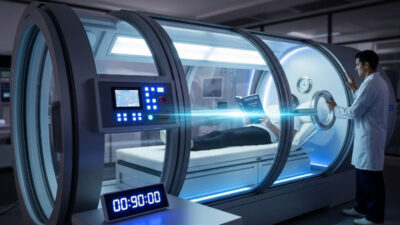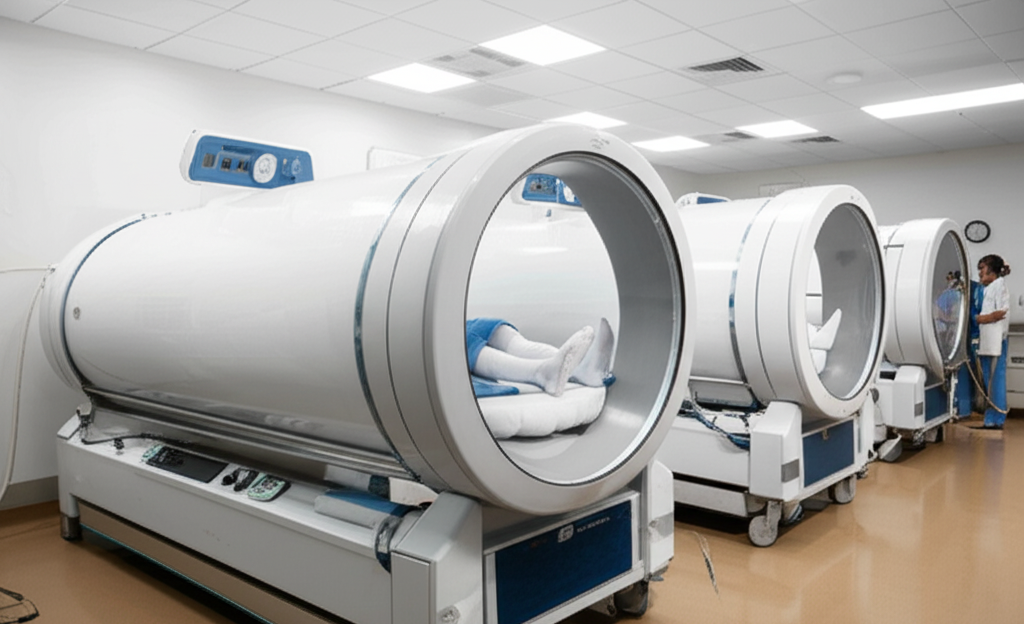
Finding the best HBOT therapy requires understanding what “best” means for your situation. Clinical HBOT at 2.0–3.0 ATA in a hard-shell chamber is the medically recognized standard for the 14 FDA-approved indications. Mild HBOT at 1.3–1.5 ATA in a soft or portable chamber is the consumer wellness standard. These are not equivalent treatments. This guide explains both, covers the evidence, and helps you choose the right setting for your goals.
- Air or gas embolism
- Carbon monoxide poisoning and smoke inhalation
- Clostridial myonecrosis (gas gangrene)
- Crush injury, compartment syndrome, and traumatic ischemia
- Decompression sickness
- Arterial insufficiency — enhancement of healing
- Exceptional blood loss anemia
- Intracranial abscess
- Necrotizing soft tissue infections
- Osteomyelitis (refractory)
- Delayed radiation injury (soft tissue and bony necrosis)
- Compromised skin grafts and flaps
- Thermal burns
- Idiopathic sudden sensorineural hearing loss
For these conditions, HBOT is administered at clinical facilities, typically in 40–60 session courses. Sessions last 90–120 minutes per session at 2.0–2.4 ATA.
None of the 14 FDA-approved HBOT indications recommends treatment below 1.4 ATA. No soft chamber at 1.3 ATA meets the minimum clinical threshold for any approved indication. Home chambers are wellness devices, not clinical treatment tools.1,4
Pressure and Evidence: What the Research Actually Shows
The evidence does not support a simple “more pressure equals better outcomes” relationship. The optimal pressure is condition-specific:3
- Post-concussion syndrome (mTBI): Strongest evidence at 1.5 ATA with O2 (four Level 1 RCTs). At 2.4 ATA: negative results. Higher pressure was not better for this condition.
- Radiation cystitis: 2.0 ATA and 2.4 ATA showed similar response rates (72.7% vs 78.3%, p=0.74 — not statistically different).7
- CO poisoning: 2.8 ATA vs 3.0 ATA showed no difference in outcomes.8
- Hearing loss: 2.0 ATA better for high frequencies, 2.5 ATA better for low frequencies — optimal pressure varies by frequency affected.
How Do You Find the Right HBOT Clinic?
For FDA-approved indications, HBOT should be delivered at a licensed clinical facility. How to find one:
- UHMS facility locator: uhms.org — lists accredited hyperbaric programs across the US
- Hospital wound care centers: Most major hospital systems have hyperbaric wound care programs. These are the most common access point for Medicare-covered HBOT.
- Integrative health clinics: For off-label uses (wellness, recovery, anti-aging), integrative clinics offer clinical-grade 2.0–2.4 ATA HBOT at $200–$400/session.
- Military and VA facilities: Active-duty and veteran HBOT programs for TBI are expanding.
What to Ask Before Your First Clinical Session
- What pressure protocol does this facility use for my condition?
- Is the treating physician board-certified in hyperbaric medicine (ABPM or UHM board certification)?
- Is the equipment a monoplace or multiplace chamber?
- How many sessions are in a standard course for my condition?
- Does my insurance cover this indication?
Home HBOT: When It Makes Sense
Home chambers make sense for specific situations:
- Maintenance after a clinical course: If you’ve completed a clinical protocol, a home chamber at 1.3 ATA can provide ongoing mild oxygen enrichment between clinical sessions.
- General wellness and recovery: Athletes and biohackers who want convenient daily access to mild pressure oxygen enrichment, with realistic expectations about clinical equivalence.
- Mobility or location constraints: Patients who cannot access a clinic regularly due to distance or physical limitations.
A $4,000–$6,000 home soft chamber breaks even vs clinic visits after 12–30 sessions — but the comparison is not apples to apples, since home chambers deliver 1.3 ATA with air, not 2.0–3.0 ATA with 100% O2.5
See our complete guides on home chambers, chamber costs, and full chamber rankings.
A $6,000 home chamber breaks even vs clinic visits after 12–30 sessions at $200–$500 each. But it delivers 1.3 ATA with air, not 2.0 ATA with 100% O2. You are buying convenience and unlimited access, not equivalent treatment.5
References
References
- UHMS. Hyperbaric Oxygen Therapy Indications, 14th ed. uhms.org. Accessed May 2026.
- Sack RA et al. Transcutaneous oximetry values in chronic ulcer patients at 1.4 ATA vs 2 ATA. Undersea & Hyperbaric Medicine. 2023. PMID: 38615347
- Harch P. Systematic Review and Dosage Analysis: HBOT Efficacy in mTBI Persistent Postconcussion Syndrome. Frontiers in Neurology. 2022. PMID: 35370898. DOI: 10.3389/fneur.2022.815056
- FDA. Hyperbaric Oxygen Therapy: Don’t Be Misled. fda.gov. Accessed May 2026.
- Monge G et al. Safety of HBOT and Evaluation of Clinical Parameters. Int J Translational Medical Research and Public Health. 2023. DOI: 10.21106/ijtmrph.430 Home cost analysis.
- Monge G et al. 2023. Adverse event data at 1.45 ATA.
- Ajayi OD et al. A comparison of two HBO regimens: 2.0 ATA vs 2.4 ATA in radiation cystitis. Undersea & Hyperbaric Medicine. 2020. PMID: 33227834
- Kim JY et al. Comparison of HBO pressures for acute CO poisoning. J Korean Society Clinical Toxicology. 2023. DOI: 10.22537/jksct.2023.00012
Related Guides
- Best Home Chambers – Home chamber rankings for all budgets
- Best Hyperbaric Chambers – Full clinical and home rankings
- Cost Guide – Full pricing: clinical sessions vs home purchase
- Baramed Clinical Chambers – The clinical monoplace standard
- OxyHealth Chambers – Premium home soft-shell option
Medical Disclaimer
The content on BaricBoost.com is for informational purposes only and is not intended as a substitute for professional medical advice, diagnosis, or treatment. Always seek the advice of your physician or other qualified health provider with any questions you may have regarding a medical condition. Never disregard professional medical advice or delay in seeking it because of something you have read on this website.

Author
Seph Fontane Pennock is the founder of BaricBoost.com and Regenerated.com, a clinic directory for regenerative medicine serving 10,000+ providers across the United States. He previously built and sold PositivePsychology.com, which grew to 19 million users and became the largest evidence-based positive psychology resource on the web. Seph brings direct experience as an HBOT patient, having completed protocols at clinics across three continents while navigating mold illness, systemic inflammation, and autoimmune conditions. His treatment journey includes hyperbaric oxygen therapy, peptide protocols, NAD+ therapy, and consultations with specialists from Dubai to Cape Town to Mexico. This combination of entrepreneurial track record and lived patient experience shapes everything published on BaricBoost.com. Every article is grounded in peer-reviewed research, informed by real clinical encounters, and written for patients making high-stakes treatment decisions. Seph's focus is on bringing transparency, scientific rigor, and practical guidance to the hyperbaric oxygen therapy space.