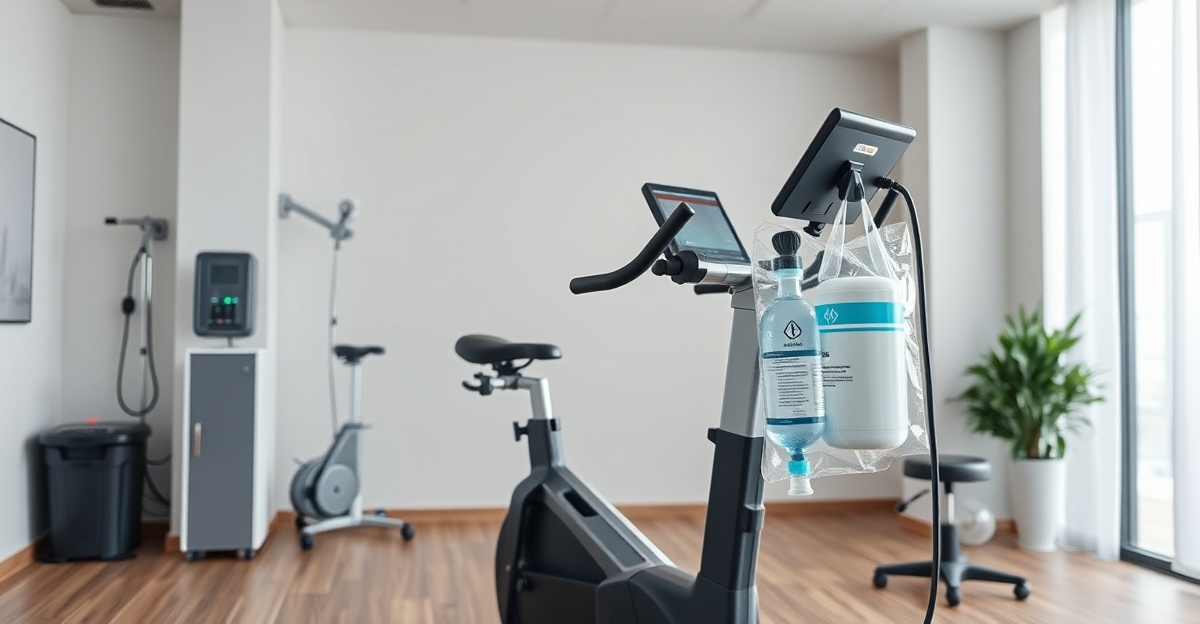
Exercise with Oxygen Therapy (EWOT) combines physical activity with breathing high-concentration oxygen. You exercise on a bike, treadmill, or rebounder while breathing 90-95% oxygen through a mask connected to a reservoir bag. The theory: exercising increases cardiac output and blood flow while the oxygen boost enhances delivery to tissues throughout the body. Proponents claim it improves VO2 max, speeds recovery, sharpens cognitive function, and increases energy. But what does the evidence actually support?
This guide breaks down the specific benefits attributed to EWOT, evaluates the evidence behind each claim, and helps you understand who stands to benefit most. For a full comparison of EWOT and hyperbaric oxygen therapy, see our complete EWOT guide.
Key Takeaways
- EWOT delivers 90-95% oxygen at ambient pressure (1.0 ATA) during exercise. It does not pressurize the body like HBOT.
- The strongest evidence for supplemental oxygen during exercise comes from COPD research, where it improves exercise endurance and blood oxygen levels.
- Claimed benefits for VO2 max improvement, faster recovery, and cognitive enhancement have physiological plausibility but limited clinical trial data specific to EWOT.
- EWOT is far cheaper than HBOT ($800-5,000 one-time purchase vs $150-400 per HBOT session) but is not FDA-cleared and has no peer-reviewed RCTs.
- Healthy athletes may see modest benefits; people with respiratory or circulatory conditions may see more pronounced effects.
How EWOT Works
At sea level, the air you breathe contains 21% oxygen. During EWOT, you breathe 90-95% oxygen from a reservoir bag while exercising for 15-20 minutes. Some advanced systems (like LiveO2 Adaptive Contrast) alternate between low-oxygen (hypoxic) and high-oxygen (hyperoxic) air to create a “contrast” effect.
The physiological reasoning behind EWOT is:
- Exercise increases cardiac output by 4-7x compared to rest, pumping more blood through the lungs and to peripheral tissues.
- Higher oxygen concentration means each breath delivers more O2 to the alveoli (air sacs in the lungs).
- Combined effect: More blood flow + more oxygen per breath = more total oxygen delivered to muscles, brain, and organs.
The limitation, and this is important, is that at ambient pressure (1.0 ATA), hemoglobin in red blood cells is already approximately 97% saturated with oxygen in healthy individuals breathing normal air. Supplemental oxygen pushes this toward 100% and adds a modest increase in dissolved plasma oxygen, but the additional capacity is physically limited by Henry’s Law. This is fundamentally different from HBOT, which uses pressure to dissolve 10-15x more oxygen into plasma.
Benefit #1: Improved VO2 Max
Claim: EWOT improves maximal oxygen consumption (VO2 max), the gold standard measure of aerobic fitness.
Evidence: No published studies have measured VO2 max changes from a structured EWOT program specifically. However, the related concept of hyperoxic training (exercising with supplemental oxygen) has been studied in athletic contexts.
Perry et al. (2005) found that training at higher work rates enabled by hyperoxia led to greater improvements in cycling performance compared to training at the same perceived effort with normal air. The logic: supplemental oxygen allows higher training intensity, which drives greater physiological adaptation over time.
A 2014 review in the British Journal of Sports Medicine concluded that acute hyperoxia improves exercise capacity by 2-10% depending on the concentration and the individual’s baseline fitness (Mallette et al., 2014). However, whether these acute improvements translate into long-term VO2 max gains from repeated EWOT sessions remains unconfirmed.
Verdict: Physiologically plausible. Supplemental oxygen allows higher training intensity, which could improve VO2 max over time. But no direct evidence from EWOT-specific studies exists.
Benefit #2: Faster Exercise Recovery
Claim: Breathing high-concentration oxygen during or after exercise accelerates recovery by clearing metabolic waste products and reducing inflammation.
Evidence: Multiple studies have examined supplemental oxygen for exercise recovery, with mixed results.
| Study | Protocol | Finding |
|---|---|---|
| Sperlich et al., 2011 | Hyperoxic recovery between intervals | Improved subsequent interval performance by 3-5% vs normoxic recovery |
| Maeda & Yasukouchi, 1997 | O2-enriched air during recovery | Accelerated heart rate recovery and reduced blood lactate clearance time |
| Nummela et al., 2002 | Hyperoxic recovery after sprints | No significant improvement in subsequent sprint performance |
The evidence suggests that supplemental oxygen during recovery between exercise bouts can help maintain performance across multiple intervals. The effect on next-day or long-term recovery from training is less clear.
Verdict: Moderate evidence for intra-session recovery benefits. Limited evidence for longer-term recovery enhancement.
EWOT operates at 1.0 ATA, where hemoglobin is already 97% saturated in healthy people. The additional oxygen dissolves modestly into plasma, which is meaningful during exercise when tissues are oxygen-hungry, but it is a different mechanism entirely from the pressure-driven hyperoxia of HBOT.
Benefit #3: Better Circulation
Claim: EWOT improves blood flow, capillary function, and oxygen delivery to tissues with poor circulation.
Evidence: Exercise itself is one of the most powerful interventions for improving cardiovascular function and capillary density. The question is whether adding supplemental oxygen enhances this effect.
In healthy individuals, the evidence is limited. Exercise already maximizes cardiac output and opens capillary beds that are closed at rest. Adding oxygen may provide marginal additional benefit.
In people with circulatory impairment (peripheral vascular disease, diabetes-related microvascular dysfunction, COPD), the picture changes. Supplemental oxygen during exercise prevents desaturation and may allow longer exercise duration, which itself improves vascular function over time. Willems et al. (2025) demonstrated that supplemental O2 (5 L/min) during exercise in COPD patients improved exercise endurance time by an average of 106 seconds (p=0.025) and improved cerebral oxygenation.
Verdict: For people with existing circulatory compromise, evidence supports that supplemental oxygen during exercise enables longer training sessions, indirectly improving vascular health. For healthy individuals, the incremental benefit over exercise alone is unproven.
Benefit #4: Increased Energy
Claim: EWOT boosts cellular energy production by increasing oxygen availability to mitochondria.
Evidence: This claim rests on basic biochemistry. Mitochondria require oxygen for the electron transport chain, which produces ATP (the cell’s energy currency). More oxygen theoretically supports higher ATP production.
In practice, oxygen is not the rate-limiting factor for mitochondrial function in healthy individuals at rest or during moderate exercise. Oxygen limitation becomes relevant during high-intensity exercise when metabolic demand outstrips delivery, which is precisely when EWOT provides its greatest acute benefit.
For people with mitochondrial dysfunction, chronic fatigue, or conditions that impair cellular oxygen utilization, supplemental oxygen during exercise could provide more noticeable energy benefits. However, no clinical trials have specifically measured energy or fatigue outcomes from an EWOT protocol.
Verdict: Physiologically reasonable, especially for individuals with compromised oxygen delivery or mitochondrial function. No direct clinical evidence from EWOT studies.
Benefit #5: Cognitive Function
Claim: EWOT improves mental clarity, focus, and cognitive performance.
Evidence: The brain consumes roughly 20% of the body’s oxygen despite representing only 2% of body mass. Both exercise and supplemental oxygen independently improve cognitive metrics.
Scholey et al. (1999) demonstrated that breathing supplemental oxygen improved memory performance and reaction time in healthy adults. The effect was dose-dependent and particularly notable for tasks requiring sustained attention.
Exercise itself is one of the most evidence-backed interventions for cognitive function, with benefits mediated through increased BDNF (brain-derived neurotrophic factor), improved cerebral blood flow, and reduced neuroinflammation. The combination of exercise and supplemental oxygen could theoretically amplify these effects.
Willems et al. (2025) found that supplemental oxygen during exercise improved cerebral oxygenation in COPD patients, suggesting a plausible mechanism for cognitive benefit in populations with impaired oxygen delivery.
Verdict: Both components (exercise and supplemental oxygen) independently support cognitive function. The combination is logical but has not been tested in a controlled EWOT-specific study.
Who Benefits Most from EWOT?
Based on the available evidence and physiological reasoning, EWOT is most likely to benefit:
| Population | Expected Benefit | Evidence Level |
|---|---|---|
| COPD / respiratory conditions | Improved exercise tolerance, reduced desaturation, better endurance | Moderate (supplemental O2 studies, not EWOT-specific) |
| Older adults with declining aerobic capacity | Ability to exercise at higher intensity, potentially improving fitness | Low (extrapolated from hyperoxia research) |
| Athletes seeking marginal gains | Higher training intensity, faster inter-session recovery | Low-moderate (hyperoxic training studies) |
| Chronic fatigue / mitochondrial dysfunction | Improved energy, better exercise tolerance | Very low (theoretical) |
| Post-surgical / post-injury recovery | Gentle exercise with enhanced oxygen delivery to healing tissues | Very low (theoretical) |
EWOT vs Exercise Alone
The honest question: does EWOT add enough benefit to justify the equipment cost?
For healthy individuals who exercise regularly, the evidence does not clearly demonstrate that EWOT provides dramatic benefits beyond what exercise alone delivers. The oxygen boost at ambient pressure is real but modest.
For individuals with respiratory compromise, poor circulation, or limited exercise capacity, the supplemental oxygen component may enable exercise that would otherwise be impossible or unsustainable. In these populations, the ability to exercise is the benefit, and oxygen makes that possible.
The cost-benefit calculation depends on your starting point. If you can already exercise comfortably, EWOT is a nice-to-have. If oxygen limitation prevents you from exercising effectively, EWOT could be a meaningful tool.
Equipment and Cost
- Basic EWOT setup: Oxygen concentrator (5-10 L/min) + reservoir bag + mask = $800-2,000
- Advanced systems (LiveO2, Maxx O2): $3,000-5,000 for adaptive contrast systems with hypoxic/hyperoxic switching
- Ongoing costs: Minimal (electricity for the concentrator, occasional mask/bag replacement)
- Per-session cost: Effectively free after initial purchase
Compared to HBOT ($150-400 per session, $5,000-15,000 per treatment course), EWOT is dramatically more affordable for home use. But the two therapies are not interchangeable. HBOT delivers pressure-driven hyperoxia that EWOT cannot replicate. EWOT adds supplemental oxygen to the cardiovascular benefits of exercise. They work through different mechanisms for different purposes.
The Bottom Line
EWOT is a legitimate wellness tool with a physiologically sound premise: exercise increases blood flow while supplemental oxygen increases the oxygen content of that blood. The benefits are most pronounced for people with respiratory or circulatory limitations who struggle to exercise at adequate intensity with room air alone. For healthy individuals, EWOT provides modest incremental benefit over exercise alone, with the strongest case being for high-intensity interval training where oxygen demand exceeds delivery. The evidence base is limited by a near-total absence of EWOT-specific clinical trials, but the supporting research on supplemental oxygen during exercise and the independent benefits of both exercise and oxygen supplementation are well established.
- Perry CG, et al. Effects of hyperoxic training on performance and cardiorespiratory response to exercise. Med Sci Sports Exerc. 2005;37(7):1175-1179. doi:10.1249/01.mss.0000170099.74737.50
- Mallette MM, et al. The effects of hyperoxia on sea-level exercise performance, training, and recovery: a meta-analysis. Sports Med. 2014;44(2):1-15. doi:10.1007/s40279-017-0791-1
- Sperlich B, et al. Effects of hyperoxia during recovery from 5×30-s bouts of maximal-intensity exercise. J Sports Sci. 2011;29(5):471-478. doi:10.1080/02640414.2010.536559
- Willems E, et al. Supplemental oxygen therapy during cycle endurance test in COPD. Eur Respir J. 2025. doi:10.1183/13993003.congress-2025.pa4870
- Scholey AB, et al. Cognitive demand and blood glucose. Physiol Behav. 1999;67(3):413-420. doi:10.1016/S0031-9384(99)00090-0
- Maeda T, Yasukouchi A. Blood lactate disappearance during breathing hyperoxic gas after exercise in two different physical fitness groups. Eur J Appl Physiol. 1997;76(3):256-261. doi:10.1007/s004210050246
- Faggian S, et al. Supplemental oxygen during exercise training in COPD. Med Sci Sports Exerc. 2025. doi:10.1249/MSS.0000000000003782
Medical Disclaimer
The content on BaricBoost.com is for informational purposes only and is not intended as a substitute for professional medical advice, diagnosis, or treatment. Always seek the advice of your physician or other qualified health provider with any questions you may have regarding a medical condition. Never disregard professional medical advice or delay in seeking it because of something you have read on this website.

Author
Seph Fontane Pennock is the founder of BaricBoost.com and Regenerated.com, a clinic directory for regenerative medicine serving 10,000+ providers across the United States. He previously built and sold PositivePsychology.com, which grew to 19 million users and became the largest evidence-based positive psychology resource on the web. Seph brings direct experience as an HBOT patient, having completed protocols at clinics across three continents while navigating mold illness, systemic inflammation, and autoimmune conditions. His treatment journey includes hyperbaric oxygen therapy, peptide protocols, NAD+ therapy, and consultations with specialists from Dubai to Cape Town to Mexico. This combination of entrepreneurial track record and lived patient experience shapes everything published on BaricBoost.com. Every article is grounded in peer-reviewed research, informed by real clinical encounters, and written for patients making high-stakes treatment decisions. Seph's focus is on bringing transparency, scientific rigor, and practical guidance to the hyperbaric oxygen therapy space.