Supplemental oxygen does not replace CPAP for obstructive sleep apnea. In the 318-patient HeartBEAT randomized trial, nocturnal oxygen raised overnight blood oxygen but did not lower blood pressure the way CPAP did, because oxygen treats the low blood oxygen that apnea causes, not the airway collapse that causes apnea (Gottlieb et al., 2014). Oxygen still has a defined role alongside CPAP for specific patients, which this guide maps out.
Key Takeaways
- Supplemental oxygen does not replace CPAP for obstructive sleep apnea (OSA). CPAP keeps the airway open. Oxygen only raises the blood oxygen that apnea drives down.
- Oxygen is most useful for patients with both OSA and a condition that causes chronic low blood oxygen (COPD, heart failure, obesity hypoventilation).
- Nocturnal oxygen saturation below 88% during a sleep study is the threshold that typically triggers a prescription for supplemental oxygen.
- Some patients use oxygen combined with CPAP when CPAP alone does not fully correct their oxygen levels.
- HBOT is not a treatment for sleep apnea. See our full guide on HBOT and sleep apnea for the evidence.
CPAP, supplemental oxygen, and BiPAP: what each one fixes
These three therapies are often confused, but they solve different problems. CPAP and BiPAP hold the airway open. Supplemental oxygen enriches the air you breathe. Only the first two address the mechanical obstruction that defines OSA.
What each therapy actually does
| Therapy | How it works | What it fixes | What it does not fix |
|---|---|---|---|
| CPAP | Delivers one continuous pressure through a mask to splint the airway open | The airway obstruction itself | Nothing directly, though some patients still desaturate from lung or heart disease |
| BiPAP | Delivers a higher pressure on inhalation and lower on exhalation | Airway obstruction plus poor ventilation (obesity hypoventilation, overlap syndrome) | Does not add oxygen unless bled in separately |
| Supplemental oxygen | Increases inhaled oxygen from 21% room air toward 100% | Low blood oxygen from lung or heart disease | Does not keep the airway open or stop apnea events |
Why oxygen alone cannot replace CPAP
Oxygen cannot replace CPAP because OSA is a mechanical problem. During sleep the throat muscles relax, the airway narrows or closes, airflow stops, and blood oxygen falls until the brain triggers an arousal to reopen the airway. This cycle can repeat 30, 50, or more than 100 times per hour in severe cases.
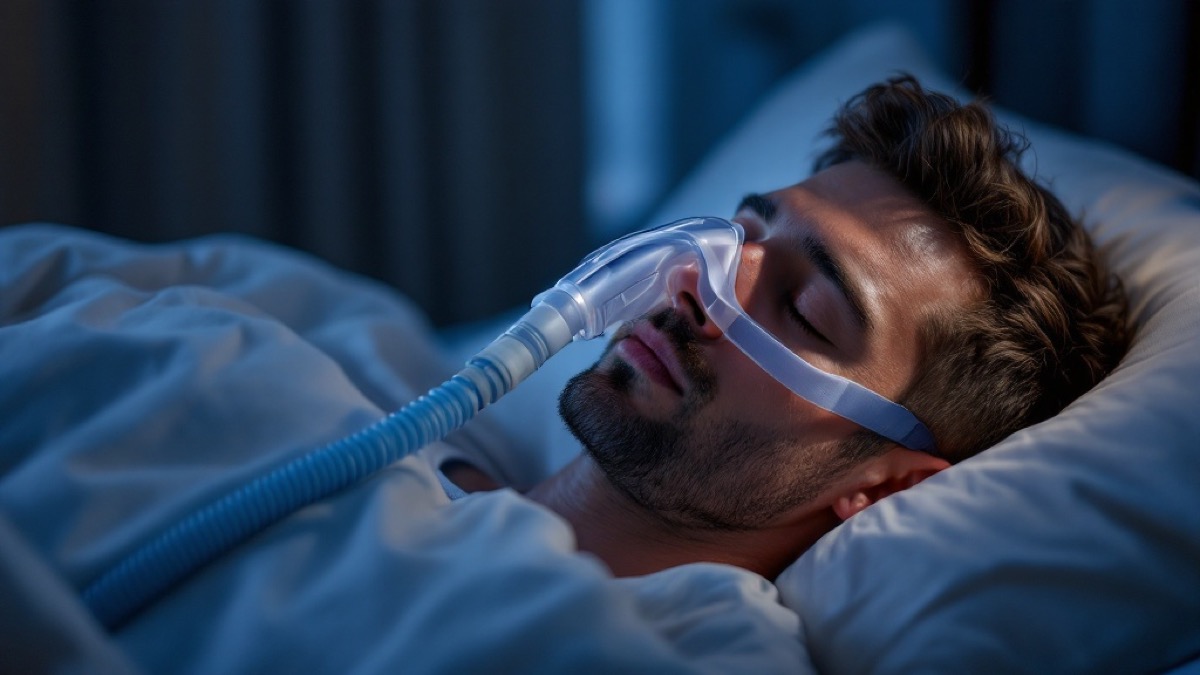
CPAP (Continuous Positive Airway Pressure) delivers pressurized air that physically splints the airway open, addressing the obstruction at its source. Supplemental oxygen raises the oxygen concentration of the air you breathe but does nothing to keep the airway open. When the airway collapses, richer air cannot get through, so the apnea events continue.
This is why the American Academy of Sleep Medicine positions CPAP as first-line treatment for moderate to severe OSA and does not endorse oxygen therapy as a standalone alternative. The HeartBEAT randomized trial tested this directly in 318 patients with cardiovascular risk: CPAP lowered 24-hour blood pressure, while nocturnal supplemental oxygen raised overnight oxygen levels but produced no blood pressure benefit (Gottlieb et al., 2014).
When is oxygen prescribed for sleep apnea patients?
Supplemental oxygen is prescribed for sleep apnea in defined scenarios, almost always alongside CPAP or BiPAP rather than instead of it. The common thread is a second condition that lowers blood oxygen independently of the apnea.
Persistent nocturnal desaturation despite CPAP
Some patients use CPAP correctly and eliminate their apnea events, yet their oxygen still drops below safe thresholds during sleep. This happens when a patient has coexisting lung disease, obesity hypoventilation, or cardiovascular disease that impairs oxygenation on its own. In these cases oxygen is added to the CPAP circuit, typically at 1 to 4 L/min through the humidifier or a bleed-in adapter.
COPD-OSA overlap syndrome
Overlap syndrome, the coexistence of COPD and OSA, was first described by Flenley in 1985. Reported prevalence of OSA among COPD patients varies widely with how it is defined, commonly cited in the 10 to 30% range (McNicholas, 2017). These patients face a high risk of nocturnal desaturation, pulmonary hypertension, and cardiovascular events. Guidelines support supplemental oxygen for patients whose resting or nocturnal saturation stays at or below 88% despite adequate airway pressure therapy.
Central sleep apnea in heart failure
Central sleep apnea (CSA) involves the brain failing to signal the breathing muscles, rather than a physical obstruction. Supplemental oxygen benefits some CSA subtypes. The CANPAP trial studied CPAP (not oxygen) for CSA in heart failure and found it improved nocturnal oxygenation and reduced central apnea events without improving survival (Bradley et al., 2005). Oxygen is used adjunctively in this population where CPAP does not fully correct central events.
Patients who cannot tolerate CPAP
CPAP adherence is a persistent problem. Across studies, non-adherence commonly runs near half of prescribed patients (Weaver and Grunstein, 2008). For patients who genuinely cannot tolerate CPAP and are not candidates for oral appliances or surgery, some sleep specialists prescribe oxygen to reduce nocturnal desaturation, even though it does not address the obstructive events. This is a compromise, not an optimal treatment.
What is the oxygen desaturation threshold for a prescription?
Sleep specialists monitor oxygen during sleep studies with pulse oximetry. The standard threshold for prescribing nocturnal oxygen is sustained SpO2 below 88%, or time below 88% exceeding 5 minutes during the study. This mirrors the criteria established for long-term oxygen therapy in COPD (Nocturnal Oxygen Therapy Trial Group, 1980).
Nocturnal oxygen metrics and action thresholds
| Metric | Normal range | Concerning | Action threshold |
|---|---|---|---|
| Mean SpO2 during sleep | 95-98% | 90-94% | <90% |
| Minimum SpO2 | >90% | 85-89% | <85% |
| Time spent below 88% | <5 min | 5-30 min | >30 min |
| Oxygen Desaturation Index (ODI) | <5/hour | 5-15/hour | >15/hour |
Does oxygen improve sleep apnea outcomes?
Oxygen improves overnight oxygen levels in OSA but does not reduce the apnea-hypopnea index (AHI), daytime sleepiness, or, on current evidence, cardiovascular events. A systematic review and meta-analysis of oxygen therapy in OSA found that supplemental oxygen raised minimum and mean SpO2 and cut the desaturation index, but did not meaningfully lower the AHI, and could lengthen individual apnea events (Mehta et al., 2013).
What the trials found
| Study | Design | Key finding |
|---|---|---|
| Gottlieb et al., 2014 (HeartBEAT) | RCT, 318 patients with cardiovascular risk and OSA | CPAP lowered 24-hour blood pressure. Nocturnal oxygen improved oxygen levels but produced no blood pressure benefit. |
| Mehta et al., 2013 | Systematic review and meta-analysis | Oxygen improved minimum SpO2 and reduced the desaturation index but did not significantly reduce AHI, and may prolong apnea events. |
| Gold et al., 1986 | Crossover study | Oxygen improved oxygenation without resolving apnea or daytime sleepiness. Benefits reversed when oxygen was stopped. |
| McEvoy et al., 2016 (SAVE) | RCT, 2,717 patients (CPAP vs usual care) | Even CPAP did not reduce cardiovascular events in moderate-to-severe OSA, so oxygen alone is even less likely to. |
A finding worth attention comes from Gold et al. (1986) and is echoed in the Mehta meta-analysis: keeping blood oxygen artificially high can lengthen individual apnea events, because the brain receives a weaker hypoxic signal to wake and restart breathing. Each event desaturates less but can last longer. The clinical significance of that trade-off remains debated.
How is oxygen delivered for sleep apnea?
When oxygen is prescribed for use during sleep, delivery depends on whether the patient also uses positive airway pressure.
- Nasal cannula: 1 to 4 L/min. The simplest approach, used when oxygen is prescribed without CPAP.
- CPAP with oxygen bleed-in: Oxygen is fed into the CPAP circuit through an adapter, adding it to the pressurized airflow. Typical flow 1 to 4 L/min.
- BiPAP with oxygen: For patients who need both bilevel pressure support and oxygen, common in overlap syndrome and obesity hypoventilation.
- Home oxygen concentrator: Supplies concentrated oxygen (90 to 95% purity) continuously, connected to CPAP/BiPAP or used with a nasal cannula. See our oxygen flow rate chart for how flow maps to delivered concentration.
Whichever route is used, home oxygen carries fire and handling risks that make setup a medical decision, not a consumer purchase. Our guide to oxygen therapy safety precautions covers storage, ignition sources, and flow settings.
What are the better alternatives if CPAP is not working?
If CPAP is not working, oxygen is rarely the best next step because it leaves the obstruction untreated. More effective options address the airway directly.
- Oral appliances (mandibular advancement devices): Custom-fitted by a dentist to reposition the jaw and hold the airway open. Effective for mild to moderate OSA.
- Positional therapy: For patients whose apnea is much worse on their back, devices that keep them on their side.
- Hypoglossal nerve stimulation (Inspire): An implanted device that stimulates the tongue muscle to keep the airway open. The STAR trial reported a median 68% drop in AHI at 12 months, and the device is FDA-approved for moderate-to-severe OSA in CPAP-intolerant patients (Strollo et al., 2014).
- Weight loss: Weight reduction lowers AHI. A longitudinal study found roughly a 10% weight loss predicted about a 26% fall in AHI, with larger losses giving larger gains (Peppard et al., 2000).
- Surgery: UPPP, maxillomandibular advancement, or other procedures to restructure the airway, generally reserved for patients who fail other treatments.
Can HBOT treat sleep apnea?
Hyperbaric oxygen therapy (HBOT) is not a treatment for sleep apnea. No clinical trial has shown that HBOT reduces apnea events or relieves airway obstruction. A 2026 systematic review in Pulmonary Therapy examined the physiological mechanisms by which HBOT might theoretically affect sleep breathing, including upper airway inflammation and pulmonary function, but it was a mechanistic review, not evidence of clinical benefit, and the authors called the data preliminary (Duong-Quy et al., 2026).
For the full picture, read our guide on HBOT for sleep apnea.
The bottom line
Oxygen therapy has a place in sleep apnea management as a supporting player, not a substitute for CPAP. It cannot keep the airway open, so it cannot replace CPAP, oral appliances, or the other treatments that address obstruction. Oxygen earns its keep for patients who still desaturate below 88% despite adequate CPAP, those with COPD-OSA overlap syndrome, and select central sleep apnea cases. The right starting point is your sleep specialist and an overnight study that documents your oxygen levels through the night.
Sources
- Gottlieb DJ, Punjabi NM, Mehra R, et al. CPAP versus oxygen in obstructive sleep apnea. N Engl J Med. 2014;370(24):2276-2285. doi:10.1056/NEJMoa1306766
- Mehta V, Vasu TS, Phillips B, Chung F. Obstructive sleep apnea and oxygen therapy: a systematic review of the literature and meta-analysis. J Clin Sleep Med. 2013;9(3):271-279. doi:10.5664/jcsm.2500
- Gold AR, Schwartz AR, Bleecker ER, Smith PL. The effect of chronic nocturnal oxygen administration upon sleep apnea. Am Rev Respir Dis. 1986;134(5):925-929. doi:10.1164/arrd.1986.134.5.925
- McEvoy RD, Antic NA, Heeley E, et al. CPAP for prevention of cardiovascular events in obstructive sleep apnea (SAVE). N Engl J Med. 2016;375(10):919-931. doi:10.1056/NEJMoa1606599
- Bradley TD, Logan AG, Kimoff RJ, et al. Continuous positive airway pressure for central sleep apnea and heart failure (CANPAP). N Engl J Med. 2005;353(19):2025-2033. doi:10.1056/NEJMoa051001
- Nocturnal Oxygen Therapy Trial Group. Continuous or nocturnal oxygen therapy in hypoxemic chronic obstructive lung disease. Ann Intern Med. 1980;93(3):391-398. doi:10.7326/0003-4819-93-3-391
- McNicholas WT. COPD-OSA overlap syndrome: update on prevalence, mechanisms, and management. Chest. 2017;152(6):1318-1326. PMID 28442310
- Weaver TE, Grunstein RR. Adherence to continuous positive airway pressure therapy: the challenge to effective treatment. Proc Am Thorac Soc. 2008;5(2):173-178. doi:10.1513/pats.200708-119MG
- Strollo PJ Jr, Soose RJ, Maurer JT, et al. Upper-airway stimulation for obstructive sleep apnea (STAR). N Engl J Med. 2014;370(2):139-149. doi:10.1056/NEJMoa1308659
- Peppard PE, Young T, Palta M, Dempsey J, Skatrud J. Longitudinal study of moderate weight change and sleep-disordered breathing. JAMA. 2000;284(23):3015-3021. PMID 11122588
- Duong-Quy S, Hoc TV, Nguyen-Duy T, et al. Hyperbaric oxygen therapy and its physio-mechanical effects on sleep breathing disorder. Pulm Ther. 2026;12(1):39-55. doi:10.1007/s41030-025-00335-w
Medical Disclaimer
The content on BaricBoost.com is for informational purposes only and is not intended as a substitute for professional medical advice, diagnosis, or treatment. Always seek the advice of your physician or other qualified health provider with any questions you may have regarding a medical condition. Never disregard professional medical advice or delay in seeking it because of something you have read on this website.

Author
Seph Fontane Pennock is the founder of BaricBoost.com and Regenerated.com, a clinic directory for regenerative medicine serving 10,000+ providers across the United States. He previously built and sold PositivePsychology.com, which grew to 19 million users and became the largest evidence-based positive psychology resource on the web. Seph brings direct experience as an HBOT patient, having completed protocols at clinics across three continents while navigating mold illness, systemic inflammation, and autoimmune conditions. His treatment journey includes hyperbaric oxygen therapy, peptide protocols, NAD+ therapy, and consultations with specialists from Dubai to Cape Town to Mexico. This combination of entrepreneurial track record and lived patient experience shapes everything published on BaricBoost.com. Every article is grounded in peer-reviewed research, informed by real clinical encounters, and written for patients making high-stakes treatment decisions. Seph's focus is on bringing transparency, scientific rigor, and practical guidance to the hyperbaric oxygen therapy space.