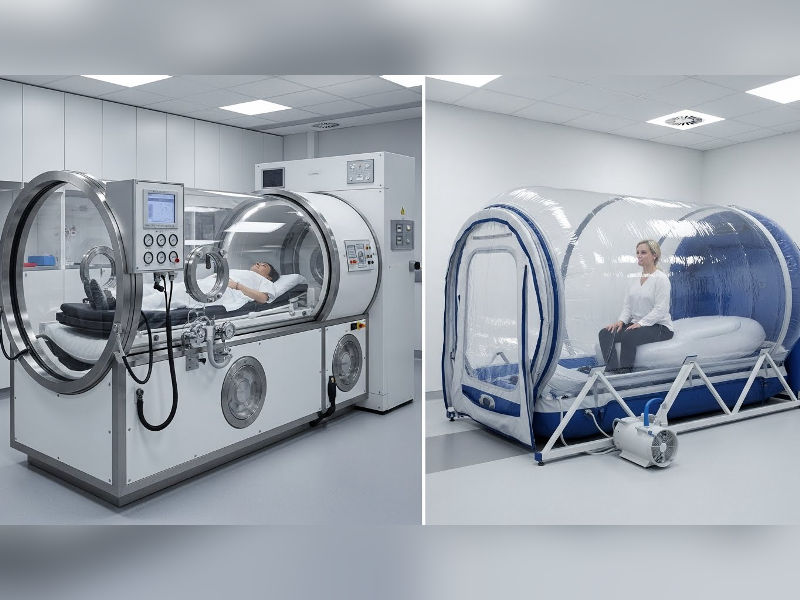
The hard shell vs soft shell hyperbaric chamber debate comes down to physics, not preference. Hard shells deliver 2.0 to 3.0 ATA with 100% medical-grade oxygen. Soft shells deliver 1.3 ATA with ambient air or concentrator-supplied oxygen at roughly 90 to 95% purity via mask. The arterial oxygen difference is approximately 8x : 1,824 mmHg versus 230 mmHg.1
This is not a matter of one option being slightly better. It is two separate device categories with different regulatory status, different evidence bases, and different clinical applications. Matching the right chamber to your goals requires understanding exactly what each type delivers.
Pressure and Oxygen Delivery: The Fundamental Difference
Soft chambers are limited by their materials to a maximum of 1.3 ATA. Most operate with ambient room air. Approximately 21% oxygen. Compressed to that pressure. Even when paired with an oxygen concentrator delivering 90 to 95% O₂ via face mask, the effective oxygen partial pressure remains far below clinical thresholds.1
- 2.0-3.0 ATA pressure
- 100% medical-grade oxygen
- 1,824 mmHg arterial O2 at 2.4 ATA
- 14 FDA-cleared indications
- ASME PVHO-1 / ISO 13485 certified
- 1.3 ATA maximum pressure
- Ambient air or concentrator O2
- ~230 mmHg arterial O2
- FDA-cleared for altitude sickness only
- Portable, home use
Hard chambers use rigid steel or aluminum construction to reach 2.0 to 3.0 ATA with 100% medical-grade oxygen filling the chamber (monoplace) or delivered by mask in a pressurized air environment (multiplace). A 2023 study measuring tissue oxygen directly in chronic wound patients found that TcPO₂ at 1.4 ATA averaged 161 mmHg, while at 2.0 ATA it averaged 333 mmHg. More than double (p<0.001).2
Hard Shell vs Soft Shell: Full Comparison
| Criterion | Soft Shell | Hard Shell |
|---|---|---|
| Max pressure | 1.3 ATA | 2.0–3.0 ATA clinical; 1.5–2.0 ATA home models |
| Oxygen source | Ambient air (~21%) or concentrator (~90–95% via mask) | 100% medical-grade O₂ |
| Arterial O₂ | ~230 mmHg | ~1,824 mmHg at 2.4 ATA |
| FDA status | Cleared for altitude sickness only | FDA-registered (clinical) or cleared (home) |
| UHMS-approved conditions | None (0 of 14) | All 14 |
| Bacteriostatic capability | No. Below 1.5 ATA threshold | Yes. Exceeds threshold |
| Clinical evidence base | Very limited. Small studies, no RCTs | Extensive. Hundreds of peer-reviewed studies |
| Cost | $3,500–$15,000 | $50,000–$150,000+ (clinical) |
| Home use feasibility | High. Portable, no O₂ supply needed | Low for clinical units; possible for home hard shells |
| Fire risk | Very low. No concentrated O₂ atmosphere | Low but real. O₂ toxicity, fire protocols required |
The Clinical Evidence Gap
No randomized controlled trials have directly compared soft shell and hard shell chambers for any medical condition. Every clinical trial supporting UHMS-approved indications used hard shell chambers at 2.0 ATA or higher.3
For mild traumatic brain injury (mTBI), a 2022 systematic review by Harch found the strongest evidence at 1.5 ATA with 100% oxygen. Four RCTs meeting Level 1 evidence criteria. At 1.3 ATA with ambient air, results were mixed (one positive, one negative study). At 2.4 ATA, results were negative for mTBI specifically.4 The relationship between pressure and outcomes is condition-specific, not linear.
Not a single randomized controlled trial has compared soft shell and hard shell hyperbaric chambers for any medical condition. All clinical evidence for UHMS-approved indications comes from hard shell chambers at 2.0 ATA or higher.
The Bacteriostatic Threshold
One critical but often-overlooked difference is antimicrobial capability. Oxygen becomes bacteriostatic. Suppressing bacterial and fungal growth. Only above 1.5 ATA. Soft chambers operating at 1.3 ATA cannot reach this threshold under any oxygen delivery configuration. Hard chambers operating at 2.0+ ATA routinely exceed it, which is why wound healing, gas gangrene, and necrotizing infections are treated exclusively in hard chambers.2
Regulatory Status: What FDA Clearance Actually Means
Soft shell chambers are FDA-cleared Class II medical devices. But cleared specifically for one indication: acute mountain sickness. This is the correct term. No chamber is “FDA approved.” The 510(k) clearance pathway requires showing substantial equivalence to a legally marketed device, not clinical efficacy data for therapeutic use.
Hard shell clinical chambers are FDA-registered devices from ISO-certified manufacturers. The UHMS has issued a formal consumer warning about soft-sided chambers, stating they do not meet clinical HBOT standards and pose safety risks including the potential to promote microbial growth at sub-1.5 ATA pressures.3
When to Choose Each Type
Choose a hard shell chamber when treating any UHMS-approved medical condition, when clinical supervision is available, or when treatment requires pressures above 1.5 ATA. Hard shells are the only appropriate choice for wound healing, radiation injury, decompression illness, CO poisoning, and serious infections.
Soft shells are appropriate for home wellness use, general recovery, or maintenance sessions where the goal is modest oxygen elevation rather than clinical-grade therapy. With the clear understanding that 1.3 ATA with air is not equivalent to clinical HBOT. For athletes and wellness users, a portable hyperbaric chamber or home hyperbaric chamber guide covers the soft shell options in full.
FAQs
Can a soft shell chamber treat the same conditions as a hard shell?
No. Soft chambers cannot reach the pressures required for any UHMS-approved medical indication. All clinical trial evidence comes from hard shell chambers at 2.0 ATA or higher.
Is the oxygen delivery actually that different?
Yes. At 1.3 ATA with ambient air, the oxygen increase is roughly equivalent to breathing supplemental O₂ by mask at sea level. At 2.4 ATA with 100% O₂, arterial oxygen is approximately 8 times higher.
Which is safer for home use?
Soft shells have lower inherent fire risk because they do not use concentrated oxygen as a chamber atmosphere. Hard shells at clinical pressures require formal safety protocols and trained operators.
References
References
- Burman F. Low-pressure fabric hyperbaric chambers. S Afr Med J. 2019;109(4). PMID: 31084683. https://doi.org/10.7196/SAMJ.2019.v109i4.13934
- Sack RA et al. Transcutaneous oximetry in chronic ulcer patients at 1.4 vs 2.0 ATA. Undersea Hyperb Med. 2023. PMID: 38615347.
- UHMS Consumer Warning: The Dangers of Soft-Sided Bag Chambers. uhms.org/pressure-other-articles/1542-consumer-warning.html
- Harch P. Systematic review and dosage analysis: HBOT efficacy in mTBI persistent postconcussion syndrome. Front Neurol. 2022. PMID: 35370898. https://doi.org/10.3389/fneur.2022.815076
- Laspro M et al. HBOT regimens, treated conditions, and adverse effect profile: UHMS survey. Undersea Hyperb Med. 2024. PMID: 39821765.
Medical Disclaimer
The content on BaricBoost.com is for informational purposes only and is not intended as a substitute for professional medical advice, diagnosis, or treatment. Always seek the advice of your physician or other qualified health provider with any questions you may have regarding a medical condition. Never disregard professional medical advice or delay in seeking it because of something you have read on this website.

Author
Seph Fontane Pennock is the founder of BaricBoost.com and Regenerated.com, a clinic directory for regenerative medicine serving 10,000+ providers across the United States. He previously built and sold PositivePsychology.com, which grew to 19 million users and became the largest evidence-based positive psychology resource on the web. Seph brings direct experience as an HBOT patient, having completed protocols at clinics across three continents while navigating mold illness, systemic inflammation, and autoimmune conditions. His treatment journey includes hyperbaric oxygen therapy, peptide protocols, NAD+ therapy, and consultations with specialists from Dubai to Cape Town to Mexico. This combination of entrepreneurial track record and lived patient experience shapes everything published on BaricBoost.com. Every article is grounded in peer-reviewed research, informed by real clinical encounters, and written for patients making high-stakes treatment decisions. Seph's focus is on bringing transparency, scientific rigor, and practical guidance to the hyperbaric oxygen therapy space.