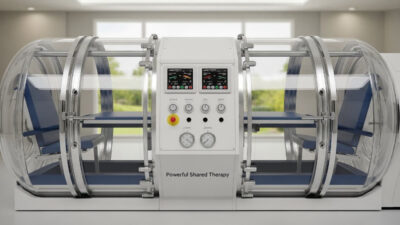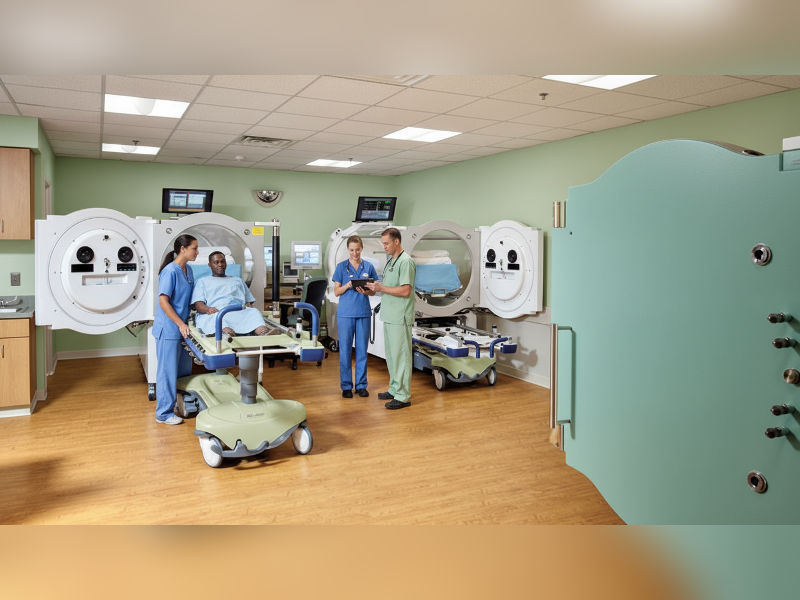
A multiplace hyperbaric chamber is a walk-in pressure vessel that treats 2 to 24 patients at once, with a trained attendant inside for the entire session. The chamber is pressurized with air while patients breathe 100% oxygen through hoods or masks. Hospitals, military dive units, and trauma centers use them for the most serious hyperbaric cases.
Key Takeaways
- Multiplace chambers are Class A chambers under NFPA 99: room for two or more occupants, always staffed by an inside attendant.
- The chamber is compressed with air, not oxygen. Patients receive 100% oxygen through a hood or mask, which sharply lowers fire risk.
- Most treatments run at 2.0 to 2.8 ATA, but clinical multiplace chambers are typically rated to 6.0 ATA for severe decompression sickness protocols.
- They are the only chamber type that supports ventilators, IV lines, and hands-on nursing during treatment, which is why critical patients and injured divers go to multiplace facilities.
- Installed cost runs roughly $500,000 to $2,000,000 or more, which is why only larger hospitals and specialty centers operate them.
How a Multiplace Chamber Works
A multiplace chamber is a steel or steel-and-acrylic pressure vessel large enough to walk into. Patients sit in seats along the walls or lie on gurneys. An operator at an external control console raises the internal pressure using compressed air, usually to between 2.0 and 2.8 atmospheres absolute (ATA) for routine treatments.
The oxygen delivery is the defining design choice. Because the chamber atmosphere is ordinary air, each patient breathes 100% oxygen through a built-in breathing system (BIBS): a clear hood that seals at the neck, or a tight-fitting aviator-style mask. Exhaled gas is vented outside the chamber so oxygen does not accumulate in the room. The inside attendant breathes chamber air during normal operations.
This air-pressurized design does two things. It keeps the fire risk far lower than in a chamber filled with pure oxygen, and it lets staff work inside at pressure. Nurses can start IVs, suction airways, and respond to emergencies without ending the treatment. A pro/con review in Diving and Hyperbaric Medicine concluded that multiplace chambers are better suited for critically ill patients with failing vital functions precisely because ICU equipment and staff can be inside the chamber.
Most hospital multiplace systems have two compartments: a main treatment lock and a smaller entry lock. The entry lock lets staff or supplies move in and out mid-treatment without depressurizing the patients. If you are new to the technology, start with the basics in our guide to what a hyperbaric chamber is.
Multiplace vs Monoplace: The Practical Differences
Monoplace chambers treat one patient in a clear acrylic tube pressurized with 100% oxygen. Multiplace chambers treat groups in an air environment. The differences matter for safety, patient selection, and cost. For readers weighing a personal unit rather than a hospital system, our guide to the best hyperbaric chambers for home use compares the smaller models patients actually buy.
| Feature | Multiplace (Class A) | Monoplace (Class B) |
|---|---|---|
| Pressurization | Compressed air; O2 by hood or mask | 100% oxygen fills the chamber |
| Capacity | 2 to 24 patients plus attendant | 1 patient |
| Inside attendant | Required, present for every session | None; operator monitors from outside |
| Critical care capability | Ventilators, IV drips, monitoring, hands-on care | Limited; patient cannot be touched during treatment |
| Claustrophobia | Walk-in space, other people present, less confining | Narrow tube; some patients cannot tolerate it |
| Typical setting | Large hospitals, military and dive medicine centers | Wound care clinics, community hospitals |
Typical maximum pressure also differs. Monoplace chambers generally top out at 3.0 ATA. Clinical multiplace systems are commonly rated to 6.0 ATA, which is required for certain emergency decompression protocols.
For most routine indications such as diabetic wounds and radiation injury, published outcomes are comparable between the two chamber types. The choice is driven by patient acuity and facility resources, not by effectiveness. One measured difference: a 2016 study found temporary visual acuity changes were more common in monoplace patients (32% reached 20/40 or worse) than in multiplace patients (18%), attributed to the continuous pure-oxygen atmosphere in monoplace units.
Who Gets Treated in a Multiplace Chamber
Multiplace chambers handle the full list of FDA-cleared HBOT indications, but several patient groups specifically need one:
- Injured divers. Severe decompression sickness and arterial gas embolism are treated with US Navy Treatment Table 6, which starts at 2.8 ATA (60 feet of seawater) and runs close to five hours, with extensions as needed. Table 6A goes deeper still. Only multiplace chambers deliver these profiles with a tender at the patient’s side. Our guide to hyperbaric chambers in diving covers this in detail.
- Carbon monoxide poisoning. Severely poisoned patients often arrive obtunded or intubated. A multiplace chamber lets the care team continue ventilation and monitoring at pressure.
- Critically ill patients. Necrotizing soft tissue infections, gas gangrene, and crush injuries frequently involve unstable patients on drips and ventilators. These patients cannot be sealed alone in a monoplace tube.
- Children and anxious patients. Young children can be accompanied by a parent or attendant. Patients who fail monoplace treatment because of claustrophobia usually tolerate the walk-in environment.
- Multiple casualties. Military and dive-industry facilities use multiplace chambers to recompress several divers from the same incident simultaneously.
Inside a Session: What Patients Experience
Patients change into 100% cotton clothing and surrender lighters, electronics, petroleum-based products, and anything that could spark or fuel a fire. They walk through the chamber door and take a seat. The attendant, typically a hyperbaric-trained nurse, technologist, or corpsman, enters with them.
Compression takes about 10 to 15 minutes. Patients feel pressure build in their ears, the same sensation as descending in an airplane, and clear their ears by swallowing or gently blowing against a pinched nose. The chamber warms slightly during compression. The attendant watches every patient and coaches anyone struggling to equalize.
At treatment depth, patients put on their hoods or masks and breathe oxygen for the prescribed periods, usually 90 minutes broken up by short air breaks that reduce the risk of oxygen toxicity. Patients can talk to each other, read, or watch a screen through the viewports. The attendant checks vital signs, adjusts hoods, and handles any problems directly.
Decompression takes another 10 to 15 minutes, with the chamber cooling slightly as pressure drops. A standard wound care session lasts about two hours door to door. Emergency dive treatments run much longer.
Standards and Safety
Multiplace chambers are among the most heavily regulated devices in medicine. Several overlapping standards apply:
- NFPA 99, Chapter 14. The National Fire Protection Association’s Health Care Facilities Code classifies multiplace units as Class A chambers and sets requirements for construction, ventilation, grounding, fire suppression, prohibited materials, and staffing. Class A chambers must have one or more qualified inside attendants for every session.
- ASME PVHO-1. The pressure vessel itself is built and certified to the American Society of Mechanical Engineers standard for Pressure Vessels for Human Occupancy.
- UHMS accreditation. The Undersea and Hyperbaric Medical Society runs a voluntary facility accreditation program that surveys staffing, training, equipment maintenance, and patient safety practices. Accreditation is a strong quality signal when choosing a facility.
Fire safety drives most of the operational rules. Because the chamber atmosphere is air rather than oxygen, the intrinsic fire risk is lower than in a monoplace chamber, but oxygen spilling from hoods can locally raise oxygen concentration. Chambers monitor internal O2 levels, vent exhaled gas overboard, ban ignition sources entirely, and larger installations include built-in deluge fire suppression systems. The inside attendant also carries a decompression obligation on deeper treatments and follows staff exposure limits, the same physiology that applies to working divers.
Cost and Why Hospitals Choose Them
A new clinical multiplace system costs roughly $500,000 to $2,000,000 or more before installation. Site work adds a further $200,000 to $500,000: reinforced flooring, compressed air plant, oxygen supply, fire suppression, and a dedicated room. Annual maintenance and certification typically run $50,000 to $100,000. Compare that with $50,000 to $150,000 for a monoplace unit, and see our full hyperbaric chamber cost breakdown for context across chamber types.
Staffing costs are also higher. Every session requires an outside operator plus at least one inside attendant, and insurance reimbursement is the same regardless of chamber type. That economic reality is why the US installed base of multiplace chambers has been shrinking; an estimated 100 to 150 remain in clinical operation, concentrated in academic medical centers, military facilities, and regional referral hospitals.
Hospitals that keep them do so for capability, not economics. A multiplace chamber is the only way to treat an intubated patient, run a Navy Table 6, treat several casualties at once, or offer hyperbaric care to patients who need a caregiver at their side. It also processes higher patient volume per session for routine wound care. Because so few facilities operate one, most hospitals do not have a hyperbaric chamber of any kind, and severe cases are transferred to regional multiplace centers.
Manufacturers serving the hospital market include Perry Baromedical and Sechrist Industries in the US, Environmental Tectonics Corporation (which builds computer-controlled clinical multiplace systems), Fink Engineering in Australia, and HAUX Life Support in Germany. All build to ASME PVHO-1 or equivalent pressure vessel standards, and lead times for new installations typically run 6 to 12 months.
Frequently Asked Questions
How many people fit in a multiplace hyperbaric chamber?
Capacity ranges from 2 to 24 occupants depending on the model. The most common hospital configuration seats 8 to 12 patients plus one or two attendants. Rectangular walk-in designs hold more people than cylindrical hulls, and every configuration reserves space and a breathing connection for the inside attendant.
Is a multiplace chamber safer than a monoplace chamber?
Both are safe when operated to NFPA 99 and UHMS standards. The multiplace design has a lower intrinsic fire risk because the chamber holds air, not pure oxygen, and an attendant is present to manage problems immediately. Monoplace chambers offset their oxygen atmosphere with strict material bans and grounding requirements.
Why do divers with decompression sickness go to multiplace chambers?
Serious decompression sickness is treated with US Navy Treatment Table 6, which requires 2.8 ATA, nearly five hours of treatment, and often a tender assisting the diver inside. Monoplace chambers cannot support an inside tender, and many cannot run the deeper extensions, so dive emergencies are routed to multiplace facilities.
Does insurance pay differently for multiplace treatment?
No. Medicare and private insurers reimburse hyperbaric oxygen therapy by the treatment session and indication, not by chamber type. A covered diagnosis is paid the same in either chamber. That flat reimbursement, set against much higher equipment and staffing costs, is the main reason multiplace chambers are becoming less common.
Sources
- Lind F. A pro/con review comparing the use of mono- and multiplace hyperbaric chambers for critical care. Diving and Hyperbaric Medicine, 2015. pubmed.ncbi.nlm.nih.gov/25964041
- Churchill S, et al. Rates of visual acuity change in monoplace and multiplace chamber patients. Undersea and Hyperbaric Medicine, 2016. pubmed.ncbi.nlm.nih.gov/27416689
- Undersea and Hyperbaric Medical Society. Clinical Hyperbaric Facility Accreditation Manual. uhms.org accreditation manual
- Undersea and Hyperbaric Medical Society. Standards and codes for hyperbaric facilities (NFPA 99, ASME PVHO-1). uhms.org standards and codes
- Divers Alert Network. Treating decompression sickness (US Navy Treatment Table 6). dan.org
- NOAA. Recompression chamber operations, operating standards for hyperbaric chambers. omao.noaa.gov
- Environmental Tectonics Corporation. Hyperbaric chamber systems. etcusa.com
- Sechrist Industries. Hyperbaric chambers. sechristusa.com
Medical Disclaimer
The content on BaricBoost.com is for informational purposes only and is not intended as a substitute for professional medical advice, diagnosis, or treatment. Always seek the advice of your physician or other qualified health provider with any questions you may have regarding a medical condition. Never disregard professional medical advice or delay in seeking it because of something you have read on this website.

Author
Seph Fontane Pennock is the founder of BaricBoost.com and Regenerated.com, a clinic directory for regenerative medicine serving 10,000+ providers across the United States. He previously built and sold PositivePsychology.com, which grew to 19 million users and became the largest evidence-based positive psychology resource on the web. Seph brings direct experience as an HBOT patient, having completed protocols at clinics across three continents while navigating mold illness, systemic inflammation, and autoimmune conditions. His treatment journey includes hyperbaric oxygen therapy, peptide protocols, NAD+ therapy, and consultations with specialists from Dubai to Cape Town to Mexico. This combination of entrepreneurial track record and lived patient experience shapes everything published on BaricBoost.com. Every article is grounded in peer-reviewed research, informed by real clinical encounters, and written for patients making high-stakes treatment decisions. Seph's focus is on bringing transparency, scientific rigor, and practical guidance to the hyperbaric oxygen therapy space.