In 1.5 million tracked HBOT sessions, only 0.68% caused any adverse event. The most common side effect is ear barotrauma, hitting 9 to 15% of patients, most cases mild and self-resolving. Oxygen toxicity seizures, the complication patients fear most, occurred zero times across 16,430 sessions at 2.0 ATA. Risk is real but quantifiable, and lower than most patients expect.
Key Takeaways
- Across 1.5 million tracked HBOT sessions, 0.68% caused any adverse event, with serious events far rarer, per Jokinen-Gordon et al. (2017).
- Ear barotrauma is the leading side effect, affecting 9.2% of patients in a 2,334-patient safety analysis; women and children under 16 carry higher risk, per Hadanny et al. (2016).
- Oxygen toxicity seizures scale with pressure: zero per 16,430 sessions at 2.0 ATA, rising to 51 per 10,000 at 2.8 ATA, per Heyboer et al. (2014).
- Temporary myopia affects roughly 75% of patients on multi-week courses and reverses within days to months after treatment ends.
- Untreated tension pneumothorax is the only absolute contraindication; pneumothorax appeared once in 1.5 million treatments.
How Common Are Hyperbaric Chamber Side Effects?
Side effects are common but almost always minor. The largest dataset, 1.5 million treatments analyzed by Jokinen-Gordon and colleagues in 2017, found an adverse event in just 0.68% of sessions, and most of those were ear or sinus discomfort rather than anything serious. A separate 2,334-patient analysis put the per-session rate at 0.72%.
Those two figures anchor the whole safety picture. Jokinen-Gordon’s Healogics dataset covered 1,529,859 treatments across 53,371 courses, and the events they logged were dominated by otic barotrauma and confinement anxiety, not seizures or lung injury.1 Hadanny’s 2016 single-center analysis of 2,334 patients reported a matching per-session incidence of 721 per 100,000 (0.72%), with middle ear barotrauma the leading complication.2 When rates are measured per patient rather than per session they look higher, because a patient sits through 20 to 40 sessions: Zhang’s 2023 meta-analysis of 24 randomized trials found adverse effects in 30.11% of HBOT patients versus 10.43% of controls, but classified the large majority as mild and self-limiting, with ear discomfort the single most frequent event.3
The distinction between per-session and per-patient rates matters when you read scary-sounding statistics. A 30% per-patient figure and a 0.68% per-session figure describe the same reality: most people feel some ear pressure at least once over a multi-week course, and almost no single session produces a serious problem. For the granular breakdown, see our HBOT side effects statistics.
To put 0.68% in perspective, it works out to roughly 7 adverse events per 1,000 sessions, and nearly all of those are minor ear or sinus discomfort. Serious events, the seizures and pneumothoraces patients worry about, are another order of magnitude rarer, sitting well under 1 in 10,000 sessions in supervised centers.1 That safety record depends on the setting: it reflects accredited chambers with medical screening, controlled compression, and in-chamber monitoring, none of which apply to unsupervised low-pressure home units. The numbers on this page describe clinical HBOT, not a rented soft-shell bag used at home.
HBOT Side Effect Frequency and Severity (2026)
| Side effect | Incidence | Severity | Reversible? | Source |
|---|---|---|---|---|
| Middle ear barotrauma | 9.2% of patients (up to ~15% in some series) | Usually mild (Grade 1) | Yes | Hadanny 2016; Voigt 2025 |
| Temporary myopia (nearsightedness) | ~75% on courses of 20 or more sessions | Mild | Yes, days to months | Riedl 2019; StatPearls |
| Confinement anxiety / claustrophobia | ~0.4% of sessions; up to 12-15% of patients feel some anxiety | Mild to moderate | Yes | StatPearls Hyperbaric Complications |
| Fatigue, headache, nausea | Headache ~1.6% of patients; fatigue common early | Mild | Yes | Lee 2024; Hadanny 2016 |
| CNS oxygen toxicity (seizure) | 1 in 2,121 treatments overall; 0 at 2.0 ATA, 51 per 10,000 at 2.8 ATA | Serious but transient | Yes, self-limiting | Heyboer 2014 |
| Pulmonary oxygen toxicity | Rare; dose-dependent, prevented by air breaks | Moderate | Yes | Costa 2019 |
| Pneumothorax | ~1 in 1.5 million treatments | Serious | Treatable (tension type is a contraindication) | Jokinen-Gordon 2017 |
| Accelerated nuclear cataract | ~2% with prolonged courses (20-40+ exposures) | Moderate | Often not reversible | StatPearls Myopia/Cataract |
What Are the Most Common Hyperbaric Chamber Side Effects?
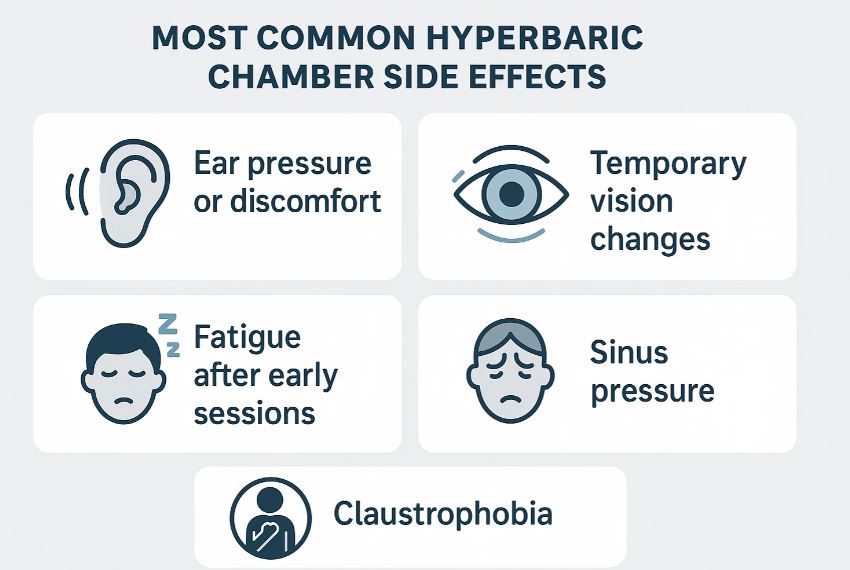
The three most common side effects are ear barotrauma, temporary nearsightedness, and general fatigue or headache. Ear barotrauma leads by a wide margin, affecting roughly 9 to 15% of patients, while a myopic shift appears in about three quarters of people on multi-week courses. All three are mild and reverse after treatment.
Ear Pressure and Barotrauma
Middle ear barotrauma is ear pain or pressure caused by difficulty equalizing as the chamber compresses. In Hadanny’s 2,334-patient analysis it occurred in 9.2% of patients, and it is consistently the single most common HBOT complication across large datasets.2 A 2024 monoplace-chamber study of 247 patients reported otalgia (ear pain) in 33.2%, higher because that cohort skewed toward acute and carbon monoxide cases treated at higher pressure, and 11.7% of those patients stopped treatment because of it.4 Carbon monoxide cohorts run higher still: a 2025 monoplace study of CO-poisoning patients recorded middle ear barotrauma in 67.7%, versus the 13.6% to 43.2% seen in prior series, which reflects rapid compression and often altered mental status rather than a different chamber danger.13 If terms like barotrauma are unfamiliar, the HBOT glossary defines them.
Most cases are mild. Voigt’s 2025 systematic review of otologic adverse events concluded that the large majority of ear complications are low-grade and resolve, with only a small fraction severe.5 Higher-risk groups include women, patients over 55, children under 16, and anyone with a recent upper respiratory infection or prior ear surgery.2 The practical fix is simple: learn the Valsalva maneuver, yawning, and swallowing before your first session, tell the technician the moment you cannot equalize, and use a slow compression rate. Barotrauma is graded on severity, and the difference between a Grade 1 case (mild redness, resolves on its own) and a rare severe case is largely about how quickly compression is stopped when a patient cannot clear their ears, which is why the technician’s instruction to speak up is not a formality. Patients presenting with altered mental status, such as some carbon monoxide cases, cannot signal ear pain reliably, which partly explains the higher barotrauma rates in those cohorts.13 Whether barotrauma can cause lasting damage is covered in can a hyperbaric chamber cause hearing loss.
Vision Changes
Temporary myopia is the most predictable HBOT side effect, appearing in roughly 75% of patients on courses of 20 or more sessions. High-pressure oxygen alters the shape and refractive index of the crystalline lens, so distance vision blurs enough that some patients briefly need a different prescription. It reverses within days to months after the course ends.6
Riedl’s 2019 prospective cohort documented a measurable myopic shift and mild lens turbidity that tracked with cumulative oxygen exposure.6 The one genuinely lasting eye risk is different: prolonged courses of 20 to 40 or more exposures can accelerate nuclear cataract formation in about 2% of patients, and unlike the myopic shift, cataract changes may not reverse.7 This is why hyperbaric physicians cap unnecessary session counts and why anyone with early cataracts should raise it before starting.
Fatigue, Headache, and Confinement Anxiety
Fatigue after sessions is common in the first week and fades as patients acclimate. Headache and occasional nausea occur but are mild: the 2024 monoplace study logged headache in 1.6% and dyspnea and anxiety in about 1.2% each.4 Confinement anxiety is more common than true claustrophobia. Estimates range from about 0.4% of sessions in one monoplace series to 12 to 15% of patients reporting some anxiety, and the large majority still complete their course.8 Coaching, gradual exposure, and clear communication with the technician resolve most cases, as discussed in hyperbaric chamber claustrophobia.
What Are the Serious Risks of HBOT?
The serious risks are oxygen toxicity seizures, pulmonary oxygen toxicity, and pneumothorax. All three are rare at properly supervised pressures. Seizures run about 1 in 2,000 treatments and are near-zero at 2.0 ATA, pulmonary toxicity is prevented by scheduled air breaks, and confirmed pneumothorax appeared once in 1.5 million treatments.
Oxygen Toxicity Seizures
CNS oxygen toxicity presents as a seizure, and its frequency depends almost entirely on treatment pressure. Heyboer’s 2014 analysis of 23,328 treatments found an overall rate of 1 in 2,121 (5 per 10,000), and when broken out by pressure the gradient was stark: zero seizures across 16,430 sessions at 2.0 ATA, 15 per 10,000 at 2.4 to 2.5 ATA, and 51 per 10,000 at 2.8 ATA, a statistically significant difference (p<0.001).9 The seizure itself is self-limiting and, managed correctly, leaves no lasting injury; the standard response is to stop oxygen and let the patient breathe chamber air.
Air breaks are the main preventive tool. Costa’s 2019 single-center analysis of more than 180,000 sessions over 20 years found that adding a short air break during oxygen breathing significantly lowered seizure frequency.10 Even a history of seizures is not an automatic disqualifier: a 2025 cohort study reported just one seizure across 634 sessions in non-emergent patients with prior seizure history treated under appropriate protocols.11 A separate analysis of 62,614 sessions found a clear oxygen-toxicity seizure in just 1 case (roughly 1 in 62,600 sessions), reinforcing how rare the event is at contemporary protocols.14
Pulmonary Oxygen Toxicity
Pulmonary oxygen toxicity presents as chest tightness, a persistent cough, or difficulty breathing, and it develops with very high cumulative oxygen doses rather than a single session. Standard clinical protocols build in air breaks specifically to keep the pulmonary oxygen dose below the threshold where symptoms appear, which is why it is rare in routine wound-care and elective courses.10 Objective testing supports this: Brenna’s 2023 longitudinal study measured lung function in 86 patients before and after every 20 sessions and found the changes small and clinically minor across a full course at 2.0 to 2.4 ATA.15
Pneumothorax
Pneumothorax, or lung collapse, is the rarest serious complication. In the 1.5 million-treatment dataset only one confirmed case was documented.1 An untreated tension pneumothorax is the single absolute contraindication to HBOT, because pressurizing and then depressurizing the chamber can expand trapped air and worsen the collapse. Once treated with a chest tube, HBOT can proceed.
Are Hyperbaric Side Effects Permanent or Reversible?
Almost all HBOT side effects are reversible. Ear pressure, temporary myopia, fatigue, and confinement anxiety resolve during or shortly after the treatment course. The rare exceptions are accelerated cataract formation from prolonged courses and the uncommon serious event such as an untreated pneumothorax, which is why supervision and session limits matter.
Permanent hearing loss from HBOT is not documented in large clinical studies; the barotrauma that causes ear symptoms is a middle-ear pressure problem, not inner-ear nerve damage. The myopic shift reverses because it comes from a temporary change in lens shape, while the small cataract risk is the one vision change that can persist.67 Lung function is similarly reassuring: Brenna’s 2023 cohort tracked spirometry across full HBOT courses and found the changes small and clinically unimportant, so the pulmonary toxicity that patients read about does not translate into measurable long-term breathing problems at standard protocols.15 Framed against the overall numbers, the per-session risk of any serious, lasting harm sits well under 1 in 10,000 in supervised settings.1
Who Should Not Use a Hyperbaric Chamber?
Only one condition is an absolute contraindication: an untreated tension pneumothorax. Everything else is a relative contraindication that calls for individual physician evaluation rather than an automatic no. That includes severe COPD with CO2 retention, uncontrolled seizure disorders, pregnancy, active upper respiratory infection, and certain chemotherapy drugs.
Absolute contraindication:
- Untreated tension pneumothorax
Relative contraindications (require individual evaluation):
- Severe COPD with CO2 retention
- Uncontrolled seizure disorders (a 2025 study found HBOT reasonably safe in patients with seizure history under proper protocols: 1 seizure in 634 sessions)11
- Active upper respiratory infection or acute viral illness
- Pregnancy (limited safety data)
- Recent ear or sinus surgery
- Certain chemotherapy agents: bleomycin, cisplatin, doxorubicin, disulfiram
- Optic neuritis and untreated high fever
Home and portable soft-shell units complicate this picture, because they operate without medical screening or monitoring. If you are considering unsupervised use, read DIY hyperbaric chamber risks and understand what a hyperbaric chamber actually does before starting, and note that none of the medical safety data above was generated in low-pressure home units.
How Can You Minimize HBOT Side Effects?
Most side effects are preventable with a few habits: master ear-equalization before session one, report ear pain the instant it starts, disclose every medication and condition, skip sessions when congested, and follow the personal-item rules exactly. These steps target the two most common problems, barotrauma and anxiety, directly.
- Learn equalization techniques first. Practice the Valsalva maneuver, yawning, and swallowing before entering. Slow compression plus active equalizing is what keeps barotrauma mild.2
- Report ear pain immediately. Pausing compression for a few seconds prevents discomfort from becoming injury.
- Disclose all medications and conditions. Screening only works if the information is complete, especially for chemotherapy drugs and seizure history.
- Do not enter congested. Upper respiratory infections sharply raise barotrauma risk. Reschedule if unwell.
- Follow personal-item protocols. No electronics, synthetic clothing, deodorant, or petroleum products. These rules exist for fire safety, not bureaucracy.
Is the Fire Environment a Side Effect?
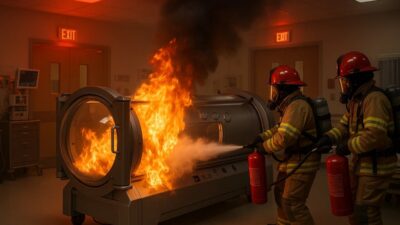
Fire risk is a facility hazard, not a physiological side effect, but it drives many of the rules patients notice. An oxygen-enriched chamber makes any spark dangerous, so facilities follow NFPA 99 Chapter 14, which bans electronics, synthetic fabrics, and petroleum-based products inside the chamber.12 That single hazard explains why you cannot wear deodorant and whether you can bring your phone into a chamber. The absolute scale of the risk is small but real, and our hyperbaric chamber fire incidents data and fire safety guide catalog the recorded cases. In emergency contexts such as HBOT for drowning, clinicians weigh these low risks against a life-threatening oxygen deficit. The full list of approved medical uses is covered in our FDA-cleared and UHMS-approved indications guide.
Are hyperbaric chamber side effects permanent?
Almost never. Vision changes, ear pressure, fatigue, and anxiety are transient and resolve during or shortly after the course. Permanent hearing loss from HBOT is not documented in large clinical studies. The rare serious complication such as an untreated pneumothorax can have lasting effects, but occurs at well under 1 in 10,000 sessions in supervised settings. Accelerated cataract from very long courses is the one vision change that may persist.1
Is HBOT safe for someone with a history of seizures?
With precautions, usually yes. A 2025 cohort study found only 1 seizure across 634 HBOT sessions in non-emergent patients with a seizure history treated under proper protocols. Uncontrolled seizure disorders remain a relative contraindication, so the decision needs individual evaluation by a physician familiar with both the patient’s history and hyperbaric medicine, typically at lower pressure with scheduled air breaks.11
Do children have more side effects from HBOT?
Yes, for ear barotrauma specifically. Hadanny’s 2016 analysis found children under 16 and women had a higher barotrauma risk than other patients. Pediatric HBOT requires extra attention to ear-pressure management and in-chamber monitoring. Clinical programs treat children routinely, but with additional safeguards and slower compression to reduce the chance of ear complications.2
Sources
- Jokinen-Gordon H, Barry RC, Watson B, Covington DS. A retrospective analysis of adverse events in hyperbaric oxygen therapy (2012-2015): lessons learned from 1.5 million treatments. Adv Skin Wound Care. 2017;30(3):125-129. DOI: 10.1097/01.ASW.0000508712.86959.c9. PMID: 28198743
- Hadanny A, Meir O, Bechor Y, et al. The safety of hyperbaric oxygen treatment: retrospective analysis in 2,334 patients. Undersea Hyperb Med. 2016;43(2):113-122. PMID: 27265988
- Zhang Y, Zhou Y, Jia Y, Wang T, Meng D. Adverse effects of hyperbaric oxygen therapy: a systematic review and meta-analysis. Front Med. 2023;10:1160774. DOI: 10.3389/fmed.2023.1160774. PMID: 37275378
- Lee HY, et al. Characteristics of side effects in non-emergency indications using computer-controlled pressurized monoplace hyperbaric chambers: a retrospective multicenter study. J Clin Med. 2024. PMC11595125
- Chiu ES, Jethanamest D, Laspro M, Thys E, Voigt A. Systematic review of otologic adverse events in hyperbaric oxygen therapy. Undersea Hyperb Med. 2025;52(4):537-547. PMID: 41429031
- Riedl P, et al. Myopic shift and lens turbidity following hyperbaric oxygen therapy: a prospective, longitudinal, observational cohort study. Acta Ophthalmol. 2019. DOI: 10.1111/aos.14010
- Hyperbaric Related Myopia and Cataract Formation. StatPearls (NCBI Bookshelf, NLM). NBK430855
- Hyperbaric Complications. StatPearls (NCBI Bookshelf, NLM). NBK459191
- Heyboer M, Jennings S, Grant WD, et al. Seizure incidence by treatment pressure in patients undergoing hyperbaric oxygen therapy. Undersea Hyperb Med. 2014;41(5):379-385. PMID: 25558546
- Costa DA, Ganilha JS, Barata PC, Guerreiro FG. Seizure frequency in more than 180,000 treatment sessions with hyperbaric oxygen therapy: a single-centre 20-year analysis. Diving Hyperb Med. 2019;49(3):167-174. DOI: 10.28920/dhm49.3.167-174. PMID: 31523791
- Park S, et al. Safety of hyperbaric oxygen therapy in non-emergent patients with a history of seizures: a retrospective cohort study. PLoS One. 2025;20(1):e0317586. DOI: 10.1371/journal.pone.0317586. PMID: 39808603
- National Fire Protection Association. NFPA 99 Health Care Facilities Code, Chapter 14: Hyperbaric Facilities. nfpa.org
- Risk factors for middle ear barotrauma in patients with carbon monoxide poisoning undergoing monoplace hyperbaric oxygen therapy: a retrospective cohort study. 2025. PMC12072356
- Seizures during hyperbaric oxygen therapy: retrospective analysis of 62,614 treatment sessions. Undersea Hyperb Med. 2016. Sagol Center analysis
- Brenna CTA, et al. Pulmonary function following hyperbaric oxygen therapy: a longitudinal observational study. PLoS One. 2023;18(5):e0285830. DOI: 10.1371/journal.pone.0285830. PMID: 37256885
Medical Disclaimer
The content on BaricBoost.com is for informational purposes only and is not intended as a substitute for professional medical advice, diagnosis, or treatment. Always seek the advice of your physician or other qualified health provider with any questions you may have regarding a medical condition. Never disregard professional medical advice or delay in seeking it because of something you have read on this website.

Author
Seph Fontane Pennock is the founder of BaricBoost.com and Regenerated.com, a clinic directory for regenerative medicine serving 10,000+ providers across the United States. He previously built and sold PositivePsychology.com, which grew to 19 million users and became the largest evidence-based positive psychology resource on the web. Seph brings direct experience as an HBOT patient, having completed protocols at clinics across three continents while navigating mold illness, systemic inflammation, and autoimmune conditions. His treatment journey includes hyperbaric oxygen therapy, peptide protocols, NAD+ therapy, and consultations with specialists from Dubai to Cape Town to Mexico. This combination of entrepreneurial track record and lived patient experience shapes everything published on BaricBoost.com. Every article is grounded in peer-reviewed research, informed by real clinical encounters, and written for patients making high-stakes treatment decisions. Seph's focus is on bringing transparency, scientific rigor, and practical guidance to the hyperbaric oxygen therapy space.