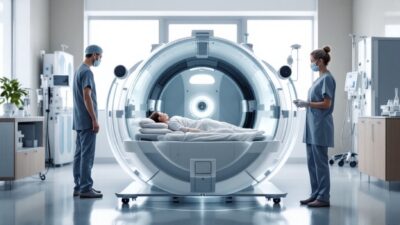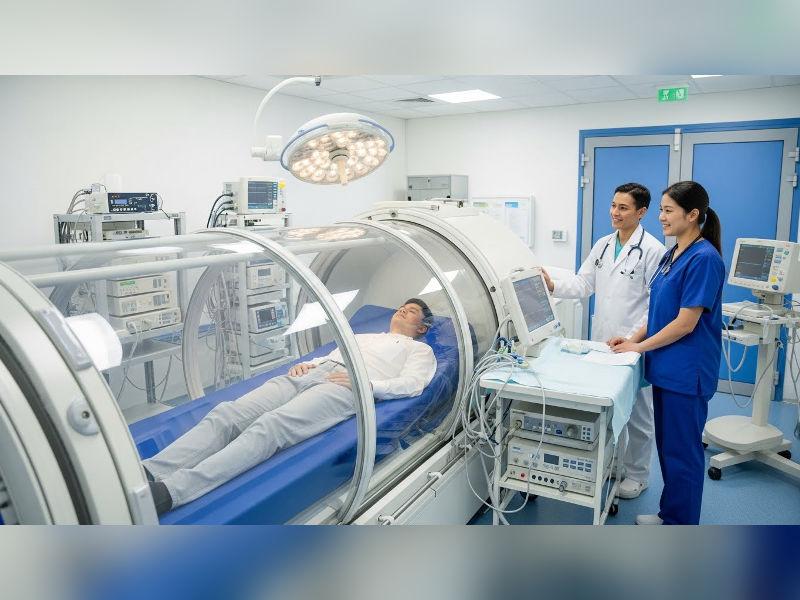
The definitive academic analysis of hyperbaric chamber fires, covering 73 years from 1923 to 1996, documented 77 human fatalities in 35 hyperbaric chamber fires worldwide (Sheffield and Desautels, 1997).1 Every fatal fire happened in an oxygen-enriched atmosphere above 28%. Chambers pressurized with air produced the only survivors. Broader databases that count non-fire incidents and all chamber types report higher totals, which this page reconciles below.
How many people have died in hyperbaric chambers?
There is no single worldwide death toll, because different sources count different things. The most-cited peer-reviewed figure is 77 deaths in 35 hyperbaric chamber fires (1923 to 1996). Widen the scope to include the pressurized Apollo module and hypobaric chambers, or to count non-fire incidents, and the number rises. The table below shows why the totals differ.
Reconciling the death-count figures
| Source | Years | Scope | Fires / incidents | Deaths |
|---|---|---|---|---|
| Sheffield & Desautels 1997 (headline) | 1923 to 1996 | Hyperbaric chamber fires only | 35 | 77 |
| Sheffield & Desautels 1997 (full paper) | 1923 to 1996 | Plus pressurized Apollo module and hypobaric chambers | 39 | 82 |
| UHMS Chamber Experience & Mishap Database2 | Through late 1990s | All chamber incident types, fire and non-fire | 113 | 135 |
The Sheffield and Desautels paper remains the foundation.1 Within its 73-year window it recorded, by chamber category:
| Category | Fires |
|---|---|
| Diving bells | 2 |
| Recompression / decompression chambers | 8 |
| Clinical hyperbaric chambers | 25 |
| Hyperbaric chamber fires (77 deaths) | 35 |
| Pressurized Apollo Command Module (3 deaths) | 1 |
| Hypobaric chambers (2 deaths) | 3 |
| Full-paper total | 39 fires, 82 deaths |
The paper does not break the 77 deaths down by chamber category, so no per-category death count is given here. One point the authors do make is important for US readers: within the 1923 to 1996 window, no fire fatalities were reported in the clinical hyperbaric chambers of North America.1 That record did not hold afterward. A 2009 Florida death and the two 2025 US deaths described below all occurred after the study closed.
Deaths in 35 hyperbaric chamber fires over 73 years (1923 to 1996), the most-cited peer-reviewed figure (Sheffield and Desautels)
Undersea and Hyperbaric Medicine, 1997
What causes fatal hyperbaric chamber fires?
Sheffield and Desautels identified two conditions present in every fatal fire: an oxygen-enriched atmosphere above 28% oxygen, and abundant burnable material inside the chamber.1 Chambers pressurized with air (below 23.5% oxygen) produced the only survivors. This is why clinical hard chambers running 100% oxygen carry a fundamentally different fire risk than soft chambers operating on ambient air.
“Each fatal chamber fire has occurred in an enriched oxygen atmosphere (above 28% oxygen) and in the presence of abundant burnable material. Chambers pressurized with air had the only survivors.”
Sheffield and Desautels, Undersea and Hyperbaric Medicine, 1997
The ignition source changed over time. Before 1980, fires were principally caused by electrical malfunction. Since 1980, they have been caused mainly by prohibited sources of ignition that an occupant carried into the chamber.1 In other words, most modern chamber deaths trace to a preventable protocol failure, not an equipment defect.
Which hyperbaric chamber fire deaths are on record?
Individual fatal incidents span multiplace hospital chambers and unregulated clinics. The most severe recorded event was the 1997 Milan fire; the most recent were two US deaths in 2025.
| Date | Location | Deaths | Details |
|---|---|---|---|
| 1997 | Milan, Italy | 11 | Fire in a multiplace HBOT chamber (10 patients and 1 nurse) |
| 2009 | Lauderdale-by-the-Sea, Florida, USA | 2 | A boy and his grandmother, in a non-hospital chamber during off-label cerebral palsy treatment |
| January 31, 2025 | Oxford Center, Troy, Michigan, USA | 1 | Thomas Cooper, age 5; his mother was injured. Four people, including the CEO, were charged; a judge ordered them to stand trial in February 2026.9 |
| July 9, 2025 | Lake Havasu City, Arizona, USA | 1 | Walter Foxcroft, 43, a physical therapist, died in a flash fire inside a chamber at his own clinic |
For deeper US-specific incident data, see our hyperbaric chamber fire and safety incidents data.
What did the FDA warn about HBOT fires in 2025?
After the 2025 Michigan and Arizona deaths, the FDA issued a letter to health care providers in August 2025 warning about fire risks with HBOT devices, citing recent reports of fires that caused serious injuries and deaths.6 The letter reinforced the need to follow all instructions for safe use and to confirm that patients remove every prohibited item before entering a chamber.
How common are non-fatal HBOT side effects?
Deaths are the most extreme outcome but not the most common risk. In the largest safety analysis conducted, covering 1,529,859 HBOT treatments at Healogics wound-care centers from 2012 to 2015, the overall adverse-event rate was 0.68% per treatment, with zero deaths (Jokinen-Gordon et al., 2017).3
Adverse-event rate per treatment across 1.5 million HBOT sessions, with zero deaths in that dataset
Jokinen-Gordon et al., 2017
The most common adverse events are mild and reversible:
- Middle ear barotrauma: the most frequent event; most cases are mild and many resolve on their own (Voigt et al., 2025)4
- Ear pain or fullness: transient, from pressure equalization
- Oxygen toxicity seizure: rare at standard pressures (Hadanny et al., 2016)5
- Temporary visual changes (myopia): reversible over weeks after a course ends
For the full breakdown of rates, see our HBOT side effects statistics.
How do modern chambers prevent fire deaths?
NFPA 99 Chapter 14 requirements for accredited HBOT facilities directly target the causes Sheffield identified.7 A review of the chamber-fire literature reaches the same conclusion: fatal fires cluster where these controls are absent (Zielinski et al., 2023).8
- Fire suppression systems that activate within seconds
- Fire-rated construction materials
- 100% cotton or approved fabric only, no synthetics
- Screening for prohibited items before every session
- Continuous oxygen monitoring with automatic shutoff
- A designated on-site hyperbaric safety director
The pattern across fatal incidents is consistent: deaths occur when these protocols are absent, ignored, or bypassed. At facilities in full compliance with NFPA 99 and PVHO-1 standards, the fire-fatality risk is extraordinarily low.
Sources
- Sheffield PJ, Desautels DA. Hyperbaric and hypobaric chamber fires: a 73-year analysis. Undersea Hyperb Med. 1997;24(3):153-164. PMID: 9308138
- Undersea and Hyperbaric Medical Society. Chamber Experience and Mishap Database report. uhms.org
- Jokinen-Gordon H, Barry RC, Watson B, Covington DS. A retrospective analysis of adverse events in hyperbaric oxygen therapy (2012-2015): lessons learned from 1.5 million treatments. Adv Skin Wound Care. 2017;30(3):125-129. DOI: 10.1097/01.ASW.0000508712.86959.c9 (PMID: 28198743)
- Voigt A et al. Systematic review of otologic adverse events in hyperbaric oxygen therapy. Undersea Hyperb Med. 2025. PMID: 41429031
- Hadanny A et al. The safety of hyperbaric oxygen treatment: retrospective analysis in 2,334 patients. Undersea Hyperb Med. 2016. PMID: 27265988
- U.S. Food and Drug Administration. Follow instructions for safe use of hyperbaric oxygen therapy devices: letter to health care providers. August 2025. fda.gov
- National Fire Protection Association. NFPA 99 Health Care Facilities Code, Chapter 14 (Hyperbaric Facilities). 2024 Edition.
- Zielinski E et al. Fire in the hyperbaric chamber: review of the literature. Polish Hyperbaric Research. 2023. DOI: 10.2478/phr-2023-0020
- Michigan Department of Attorney General. Four charged in connection to death of 5-year-old after hyperbaric chamber explosion at Oxford Center. March 11, 2025. michigan.gov
Medical Disclaimer
The content on BaricBoost.com is for informational purposes only and is not intended as a substitute for professional medical advice, diagnosis, or treatment. Always seek the advice of your physician or other qualified health provider with any questions you may have regarding a medical condition. Never disregard professional medical advice or delay in seeking it because of something you have read on this website.

Author
Seph Fontane Pennock is the founder of BaricBoost.com and Regenerated.com, a clinic directory for regenerative medicine serving 10,000+ providers across the United States. He previously built and sold PositivePsychology.com, which grew to 19 million users and became the largest evidence-based positive psychology resource on the web. Seph brings direct experience as an HBOT patient, having completed protocols at clinics across three continents while navigating mold illness, systemic inflammation, and autoimmune conditions. His treatment journey includes hyperbaric oxygen therapy, peptide protocols, NAD+ therapy, and consultations with specialists from Dubai to Cape Town to Mexico. This combination of entrepreneurial track record and lived patient experience shapes everything published on BaricBoost.com. Every article is grounded in peer-reviewed research, informed by real clinical encounters, and written for patients making high-stakes treatment decisions. Seph's focus is on bringing transparency, scientific rigor, and practical guidance to the hyperbaric oxygen therapy space.