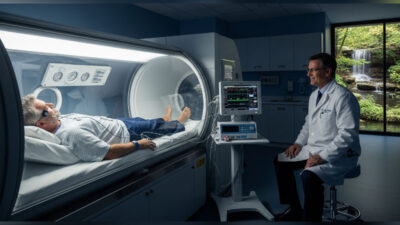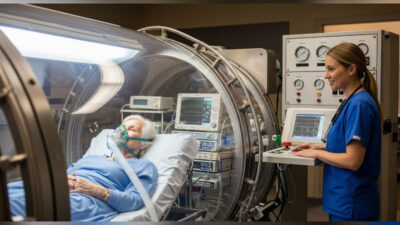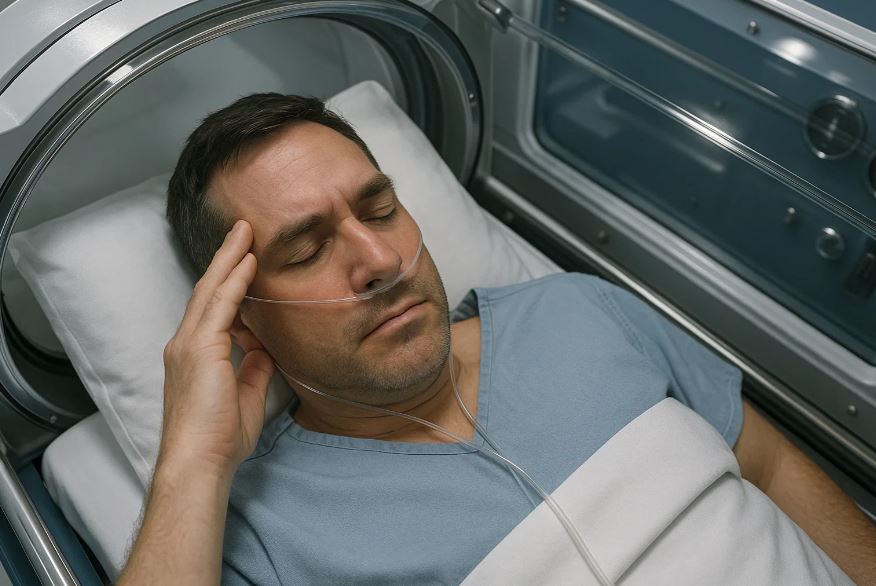
Clinical trials show HBOT can improve symptoms in post-concussion patients months or years after injury. A 2013 Israeli study found 40 sessions at 1.5 ATA significantly improved cognitive function and quality of life in patients with persistent post-concussion syndrome. The evidence is strongest for chronic cases where standard rehab has plateaued. It is one of several other brain conditions being explored with HBOT currently being explored in clinical research.
Concussion recovery can be frustrating because you look fine on the outside, but inside your brain is still struggling. Traditional treatments like rest, physical therapy, and medications help some people, but others continue feeling terrible months or even years after their injury. That’s where hyperbaric oxygen therapy (HBOT) comes in. A 2022 dose analysis reviewing all available trials found that 40 sessions at 1.5 ATA (atmospheres absolute) consistently produced significant improvements across four separate randomized trials, meeting Level 1 clinical evidence criteria.6
Table of Contents
How Hyperbaric Chambers Work for Concussion Recovery
A hard chamber increases the air pressure around you while you breathe 100% oxygen. Your brain normally uses about 20% of your body’s oxygen supply. But inside a chamber at 1.5 ATA breathing 100% oxygen, the plasma itself becomes oxygen-saturated, reaching brain tissue that damaged blood vessels can no longer supply through red blood cells alone.
The treatment also reduces swelling in brain tissue, helps damaged brain cells work better, improves blood flow to injured areas, and supports your brain’s natural healing process. One RCT found HBOT reduced serum MMP-9 (a marker of blood-brain barrier breakdown) by approximately 20 ng/mL (p<0.001), with parallel reductions in post-concussion symptom scores.5
What Does the Research Say?
The research on hyperbaric chambers and concussions has become more convincing over the past few years. Multiple solid studies show that HBOT at 1.5 ATA creates real, measurable improvements in symptoms and thinking abilities for people with persistent post-concussion syndrome (PPCS).
“In a crossover trial, patients with post-concussion syndrome lasting 1-5 years showed significant cognitive improvements after HBOT that correlated with increased brain activity on SPECT imaging – improvements that did not occur during the no-treatment control period.”
Boussi-Gross et al., 2013, PLOS ONE
A 2025 double-blind RCT published in Scientific Reports enrolled 47 participants with persistent symptoms after brain injury and randomized them to 40 HBOT sessions (1.5 ATA, 60 min) or sham over 12 weeks. The HBOT group improved 10.6 points on the Neurobehavioral Symptom Inventory vs 3.6 points in the sham group (mean difference 7.0, 95% CI 1.7-12.3, p=0.01). Secondary improvements were seen in olfaction, anxiety, sleep difficulties, and vestibular complaints.1
The landmark Boussi-Gross 2013 trial enrolled 56 mild TBI patients who were 1 to 5 years post-injury with prolonged post-concussion syndrome. After 40 HBOT sessions at 1.5 ATA, significant cognitive improvements were documented on the Mindstreams battery, quality of life improved on the EQ-5D, and SPECT imaging showed elevated brain activity correlating directly with cognitive gains. No improvement occurred during the no-treatment control period.3
A 2020 crossover RCT of 63 civilian and military subjects with mild TBI and PPCS found 40 sessions at 1.5 ATA produced significant improvements across the Neurobehavioral Symptom Inventory, Memory Index, Hamilton Depression Scale, Hamilton Anxiety Scale, PTSD Checklist, Pittsburgh Sleep Quality Index, and Quality of Life after Brain Injury. Improvements persisted at least 2 months after sessions ended.2 When the control group later crossed over to HBOT, they experienced “near-identical” improvements.
The first sham-controlled trial in pediatric PPCS enrolled 25 children aged 8-15. After 60 sessions, the HBOT group showed significant improvements in general cognitive score (d=0.598, p=0.01), executive function (d=0.739, p=0.003), and emotional regulation (d=-0.676, p=0.04), with MRI confirming microstructural brain changes in key regions.4
“A dose-analysis of all available evidence found that 40 HBOT sessions at 1.5 ATA consistently produced significant improvements across four randomized trials, meeting the highest level of clinical evidence.”
Harch, 2022, Frontiers in Neurology
On the negative side: US Department of Defense trials at 2.0 ATA found no benefit over sham, and the VA/DOD clinical practice guideline currently recommends against HBOT for mild TBI. The pressure matters: 1.5 ATA consistently shows benefit while 2.0-2.4 ATA does not.7
| Study | Population | Protocol | Result |
|---|---|---|---|
| Weaver 2025 | Chronic brain injury (n=47) | 1.5 ATA, 40 sessions | Positive: NSI improved 10.6 vs 3.6 (p=0.01) |
| Harch 2020 | mTBI/PPCS civilian + military (n=63) | 1.5 ATA, 40 sessions | Positive: multiple outcomes, persisted 2+ months |
| Boussi-Gross 2013 | mTBI/PPCS 1-5 years post (n=56) | 1.5 ATA, 40 sessions | Positive: cognition + SPECT imaging |
| Hadanny 2022 | Pediatric PPCS ages 8-15 (n=25) | 60 sessions (sham-controlled) | Positive: cognition, executive function, MRI changes |
| Cifu 2014 | Military PCS (n=60) | 2.0 ATA, 40 sessions | Negative: no benefit over sham |
Treatment Protocols: What Happens During Your Sessions
Most hyperbaric chamber sessions for concussion follow protocols tested in clinical trials. The typical course involves 40 sessions spread over 8 weeks, though some newer data suggests 80 sessions may produce superior long-term outcomes.1
You’ll usually go 5 days a week for about two months. Each session lasts 60 minutes at pressure. The chamber pressure is set to 1.5 ATA while you breathe 100% oxygen through a mask or hood. This is a hard chamber setup – soft chambers at 1.3 ATA have not been validated for concussion in published research.
Your session starts with a quick health check. Then you get into the chamber. The pressure goes up slowly over about 10 to 15 minutes so your ears can adjust, similar to taking off in an airplane but more gradual. Most people learn to equalize their ears easily after the first few sessions. At the end, pressure comes down just as slowly.
Your medical team will help you pick the best plan based on your specific symptoms. Read our HBOT sessions guide for a full walkthrough of what to expect.
Benefits You Might Experience from Hyperbaric Treatment
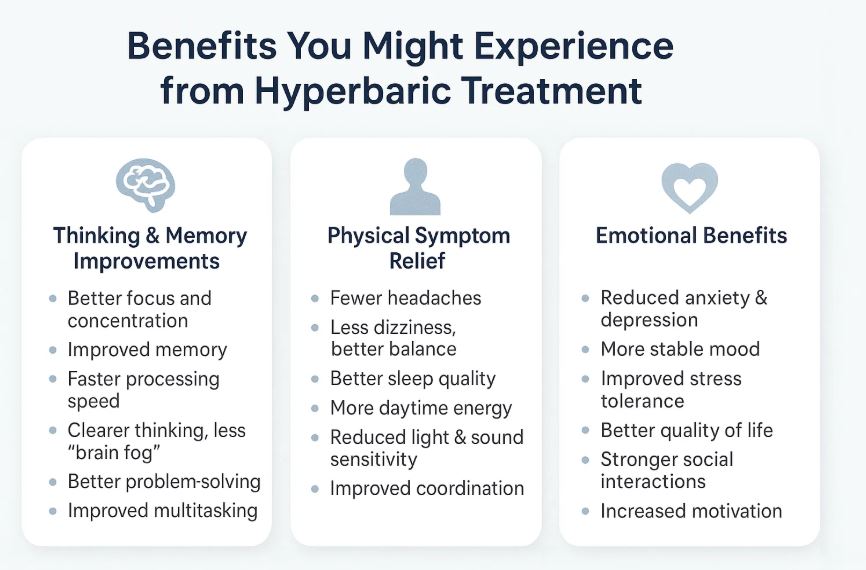
Patients using hyperbaric chambers for concussion often report improvements in multiple areas. Our mental health benefits page breaks this down further.
Many people notice better focus and concentration that lasts throughout the day. Short-term and long-term memory improve. Mental processing speeds up, thinking gets clearer, and the frustrating brain fog starts lifting. Problem-solving becomes easier and multitasking doesn’t feel impossible anymore.
Physical symptoms often improve too. Headaches become less frequent and less intense. Dizziness decreases and balance gets better. Sleep quality improves. Energy levels go up during the day. Sensitivity to light and sound often decreases. Coordination gets better. The 2021 Oley study documented that HBOT reduced MMP-9 – a biomarker of blood-brain barrier damage – by approximately 20 ng/mL alongside significant symptom score reductions.5
The emotional benefits can be just as significant. Anxiety and depression symptoms often reduce. Mood becomes more stable. Most patients notice their biggest improvements during weeks 4 through 6 of sessions. Benefits often continue improving after sessions end, consistent with ongoing neuroplasticity.
What Are the Side Effects and Risks?
Hyperbaric chamber therapy for concussion is generally safe when done at certified facilities with trained staff. Like any medical treatment, there can be side effects.
Most side effects are mild and temporary: ear pressure or temporary ear pain as you adjust to pressure changes, fatigue after sessions especially in the first week or two, claustrophobia in the enclosed chamber, and temporary vision changes that usually resolve after sessions end.
Less common but more serious risks include lung problems in people with certain pre-existing conditions, seizures in people with existing seizure disorders, and middle ear injuries if pressure changes aren’t handled properly. Always tell your treatment team about all medications, any lung problems, previous ear surgeries, and any anxiety about enclosed spaces.
Timeline: When Will You See Results?
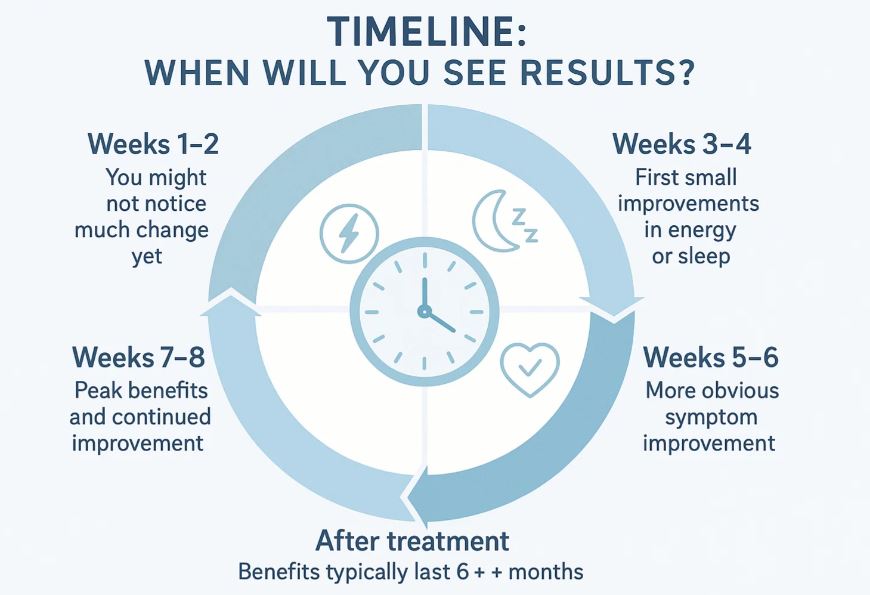
Understanding when to expect improvements helps you stay motivated. Most people don’t see dramatic changes after just a few sessions. The benefits build gradually over time, which mirrors the neuroplasticity mechanisms driving the improvements.
Typical Timeline:
Weeks 1-2: You might not notice much change yet. Weeks 3-4: First small improvements in energy or sleep. Weeks 5-6: More obvious symptom improvement. Weeks 7-8: Peak benefits and continued improvement. After sessions: The Harch 2020 trial found benefits persisted at least 2 months post-treatment.
Your treatment team will likely use questionnaires and cognitive tests to measure improvements objectively. Keeping a daily symptom diary can help you notice gradual changes. Track headache frequency and severity, energy levels, sleep quality, mood, and your ability to concentrate.
Conclusion
Research consistently shows that people who complete their full course of sessions get the best results. While hyperbaric chamber therapy for concussion isn’t a cure-all, it offers real hope for people whose symptoms have lasted despite trying other treatment options.
The treatment works by addressing root causes – getting more healing oxygen to damaged brain tissue, reducing neuroinflammation, and inducing neuroplasticity. As research continues, we’re learning more about who benefits most and how to optimize protocols. The emerging consensus points to 1.5 ATA as the optimal pressure, with 40-80 sessions as the effective range.
If you’re considering hyperbaric sessions for concussion, talk with a doctor experienced in HBOT. They can help you understand if you’re a good candidate and what to expect during HBOT.
Who Should Not Try HBOT
HBOT is generally safe when administered by trained professionals, but it is not appropriate for everyone. Discuss your full medical history with your provider before starting.
Absolute Contraindications
HBOT should not be used if you have:
- Untreated pneumothorax (collapsed lung) – pressure changes can worsen this condition and become life-threatening
- Certain chemotherapy drugs – bleomycin, cisplatin, doxorubicin, and disulfiram may interact dangerously with high-oxygen environments
Relative Contraindications
Your provider may need to take extra precautions or postpone if you have:
- Upper respiratory infection or sinus congestion – difficulty equalizing pressure can cause ear or sinus barotrauma
- Seizure disorder – high-pressure oxygen can lower seizure threshold in susceptible individuals
- Chronic obstructive pulmonary disease (COPD) – altered breathing drive may require modified protocols
- High fever – increases the risk of oxygen toxicity
- History of ear surgery or chronic ear problems – pressure equalization may be difficult or risky
- Claustrophobia – may require sedation or use of a multiplace chamber instead
- Pregnancy – insufficient safety data exists for routine use during pregnancy
Talk to Your Doctor First
Even if you do not have the conditions listed above, always consult your physician before starting HBOT, especially if you take insulin, have a pacemaker or implanted device, or are currently taking any medications. For a full overview of HBOT side effects and risks, see our detailed guide.
References
- Weaver LK, Ziemnik R, Deru K, Russo AA. “A double-blind randomized trial of hyperbaric oxygen for persistent symptoms after brain injury.” Scientific Reports. 2025;15. DOI: 10.1038/s41598-025-86631-6
- Harch PG, Andrews SR, Rowe CJ, et al. “Hyperbaric oxygen therapy for mild traumatic brain injury persistent postconcussion syndrome: a randomized controlled trial.” Medical Gas Research. 2020;10(1):8-20. DOI: 10.4103/2045-9912.279978
- Boussi-Gross R, Golan H, Fishlev G, et al. “HBOT Can Improve Post Concussion Syndrome Years after Mild TBI – Randomized Prospective Trial.” PLOS ONE. 2013;8(11):e79995. DOI: 10.1371/journal.pone.0079995
- Hadanny A, Catalogna M, Yaniv S, et al. “Hyperbaric oxygen therapy in children with post-concussion syndrome improves cognitive and behavioral function: a randomized controlled trial.” Scientific Reports. 2022;12:15233. DOI: 10.1038/s41598-022-19395-y
- Oley MH, Oley MC, Prasetyo E, et al. “Hyperbaric oxygen therapy ameliorates the symptoms of post-concussion syndrome by inhibiting MMP-9 activity.” F1000Research. 2021;10:501. DOI: 10.12688/f1000research.53289.1
- Harch PG. “Systematic Review and Dosage Analysis: HBOT Efficacy in Mild TBI Persistent Postconcussion Syndrome.” Frontiers in Neurology. 2022;13:815056. DOI: 10.3389/fneur.2022.815056
- Cifu DX, et al. “The Effect of Hyperbaric Oxygen on Persistent Postconcussion Symptoms.” J Head Trauma Rehabil. 2014. DOI: 10.1097/HTR.0b013e3182a6aaf0
- Dong Y, et al. “Effect of HBO therapy on post-concussion syndrome.” Experimental and Therapeutic Medicine. 2018. DOI: 10.3892/etm.2018.6463
Medical Disclaimer
The content on BaricBoost.com is for informational purposes only and is not intended as a substitute for professional medical advice, diagnosis, or treatment. Always seek the advice of your physician or other qualified health provider with any questions you may have regarding a medical condition. Never disregard professional medical advice or delay in seeking it because of something you have read on this website.

Author
Seph Fontane Pennock is the founder of BaricBoost.com and Regenerated.com, a clinic directory for regenerative medicine serving 10,000+ providers across the United States. He previously built and sold PositivePsychology.com, which grew to 19 million users and became the largest evidence-based positive psychology resource on the web. Seph brings direct experience as an HBOT patient, having completed protocols at clinics across three continents while navigating mold illness, systemic inflammation, and autoimmune conditions. His treatment journey includes hyperbaric oxygen therapy, peptide protocols, NAD+ therapy, and consultations with specialists from Dubai to Cape Town to Mexico. This combination of entrepreneurial track record and lived patient experience shapes everything published on BaricBoost.com. Every article is grounded in peer-reviewed research, informed by real clinical encounters, and written for patients making high-stakes treatment decisions. Seph's focus is on bringing transparency, scientific rigor, and practical guidance to the hyperbaric oxygen therapy space.