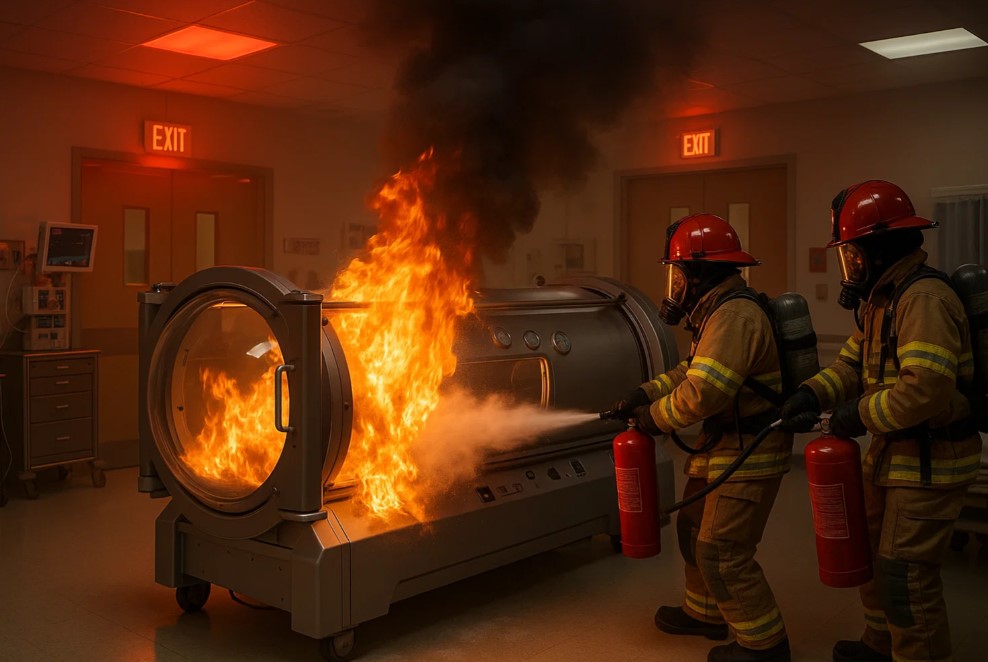
Hyperbaric chamber fires are rare but catastrophic when they occur. From 1923 to 1996, 77 people died in 35 chamber fires worldwide. Every single fatal fire occurred in an oxygen-enriched atmosphere above 28% oxygen. In 2025, two additional deaths in the US reignited scrutiny of facility safety standards. This guide covers how these fires happen, what NFPA 99 requires to prevent them, and what to look for in a safe facility.
Why are hyperbaric chamber fires so dangerous?

A fire in a hyperbaric chamber creates conditions unlike fire in any other enclosed space. Three factors combine to create extreme danger.
Oxygen enrichment above normal atmosphere. Standard air contains 21% oxygen. Inside a monoplace chamber filled with 100% oxygen, materials that resist combustion in normal air ignite easily. At elevated pressure, the partial pressure of oxygen rises sharply, making even more materials combustible. Combustion risk is the most serious entry in our review of hyperbaric chamber side effects, which also covers the far more common ear and sinus issues.
Elevated atmospheric pressure. Fire in a pressurized environment burns more intensely and spreads faster. What would be a small spark in normal air becomes a flash fire in a pressurized oxygen atmosphere.
Sealed enclosure. Patients are inside the chamber during treatment, and emergency decompression takes time. Unlike other medical emergencies where a patient can be moved quickly, hyperbaric patients cannot escape instantly.
How often do hyperbaric chamber fires happen?
They are rare. Sheffield and Desautels published the most comprehensive analysis in 1997, covering 73 years of incidents from 1923 to 1996.[1]
- 35 hyperbaric chamber fires documented
- 77 deaths total
- Zero fatalities in clinical hyperbaric chambers in North America during this period
- All fatal fires: oxygen-enriched atmosphere above 28%
- All fatal fires: abundant burnable material present
How the cause shifted over time: before 1980, chamber fires were primarily caused by electrical ignition from equipment malfunction. After 1980, the primary cause shifted to prohibited sources of ignition that occupants carried into the chamber, meaning phones, electronics, synthetic clothing, and personal care products.[1]
What does the record of documented fatal fires show?
The table below sets out the documented fatal-fire data from the Sheffield dataset alongside the two 2025 US incidents. It reports only what published sources and official records state, with no inferred causes.
Documented Fatal Hyperbaric Chamber Fire Data
| Period / Incident | Location | Deaths | Oxygen environment | Reported cause |
|---|---|---|---|---|
| 1923 to 1996 (aggregate) | Asia, Europe, North America | 77 (in 35 fires) | All above 28% oxygen | Pre-1980 electrical ignition; post-1980 prohibited items carried into the chamber (Sheffield & Desautels) |
| Jan 31, 2025 | Troy, Michigan (Oxford Center) | 1 (5-year-old patient) | Oxygen-enriched chamber | Under investigation; criminal charges allege improper safety protocols |
| July 2025 | Lake Havasu City, Arizona | 1 (clinic operator) | Oxygen-enriched chamber | Cause not publicly established at time of writing |
For the fuller incident dataset and analysis, see our hyperbaric chamber fire incident data, and for the physics of pressure-vessel failure see how a hyperbaric chamber can explode.
What happened in the 2025 incidents?
January 31, 2025, Troy, Michigan: five-year-old Thomas Cooper died and his mother was injured when a chamber at the Oxford Center caught fire. The facility’s CEO, safety manager, and others were charged with second-degree murder and involuntary manslaughter, with the charges alleging improper safety protocols.[3]
July 2025, Lake Havasu City, Arizona: Walter Foxcroft, a 43-year-old physical therapist, died in a fire inside a chamber at his own clinic.[3]
On August 25, 2025, the FDA issued a Letter to Health Care Providers on the safe use of hyperbaric oxygen therapy devices, citing recent reports of fires that resulted in serious injuries and deaths and urging strict fire-prevention protocols, staff training, and oxygen-compatible patient attire.[3]
What safety standards prevent hyperbaric chamber fires?
NFPA 99, the Health Care Facilities Code, Chapter 14, governs hyperbaric facility safety in the United States. The 2024 edition sets these requirements.[2]
Fire suppression: primary and secondary fire suppression systems are required. Deluge fire suppression must activate within 3 seconds.
Construction: 2-hour fire-rated construction. Noncombustible or limited-combustible finishes. Lockable rooms for exclusive hyperbaric use.
Ventilation: Class A chambers require a minimum 3 cubic feet per minute per occupant; Class B a minimum 1 cubic foot per minute.
Clothing: only approved garments are permitted. Approved materials include 100% cotton or specific approved blends. No synthetic fibers (nylon, polyester, rayon, wool, Gore-Tex).
Personnel: every program must designate an on-site Hyperbaric Safety Director responsible for equipment oversight and operational safety.
Electrical: all electrical equipment inside the chamber must meet strict isolation requirements, and all circuitry entering the chamber must be de-energizable in emergencies. Oxygen monitoring is required for shared spaces.
What is prohibited inside a hyperbaric chamber?
The following items are prohibited in all hyperbaric chambers regardless of type.
- All electronic devices: smartphones, tablets, smartwatches, hearing aids (unless specifically approved), e-cigarettes, cameras, Bluetooth headphones
- Synthetic fabrics: nylon, polyester, rayon, wool, spandex, lycra, Gore-Tex
- Petroleum-based products: petroleum jelly, lip balm, sunscreen, oil-based cosmetics
- Alcohol-based products: deodorants, body spray, hair spray, perfume, nail polish
- Wigs and hair extensions (fire risk from synthetic materials)
- Hand warmers and heating pads
Any facility that does not enforce these prohibitions at intake is operating outside NFPA 99 standards. That is a direct red flag for patient safety.
How can I tell if a hyperbaric facility is safe?
Before your first session at any hyperbaric facility, ask or observe the following.
- Does the facility conduct thorough intake screening? Every patient should be screened for contraindicated items before entering the chamber.
- What is the staff’s certification? Look for CHT (Certified Hyperbaric Technologist) or CHRN credentials. UHMS-accredited facilities meet the highest safety standard.
- Is the facility UHMS-accredited? UHMS Hyperbaric Facility Accreditation is the only hyperbaric-specific accreditation recognized by The Joint Commission.[4]
- What fire suppression system is in place? Ask directly. A legitimate facility will explain its fire suppression, emergency decompression, and evacuation procedures.
- When was the last safety inspection? NFPA 99 compliance requires regular inspection and maintenance. Ask for documentation.
Frequently Asked Questions
Can you survive a hyperbaric chamber fire?
History shows it depends on the oxygen concentration. The only survivors in Sheffield’s 73-year analysis were in chambers pressurized with air below 23.5% oxygen. In 100% oxygen monoplace chambers, fires are far more intense and survival is much less likely.[1]
Are soft-shell home chambers also a fire risk?
Soft-shell chambers at 1.3 ATA present a different risk profile. The lower pressure and typically lower oxygen concentration reduce, but do not eliminate, fire risk compared with clinical 100% oxygen monoplace chambers. The same item prohibitions apply: no electronics, no synthetics, no petroleum-based products. A fire in a sealed fabric enclosure at any pressure is dangerous.
What should I do if I witness a chamber fire?
In a clinical setting, immediately alert all staff and activate the emergency system. Do not attempt to open a pressurized chamber manually without proper emergency decompression. Follow the facility’s emergency procedures. Rapid decompression before opening is required to prevent catastrophic pressure release.
Sources
- Sheffield PJ, Desautels DA. Hyperbaric and hypobaric chamber fires: a 73-year analysis. Undersea Hyperb Med. 1997;24(3):153-164. PMID: 9308138
- National Fire Protection Association. NFPA 99 Health Care Facilities Code, Chapter 14 (Hyperbaric Facilities), 2024 edition. nfpa.org
- US Food and Drug Administration. Letter to Health Care Providers: Follow Instructions for Safe Use of Hyperbaric Oxygen Therapy Devices. August 25, 2025. fda.gov
- Undersea and Hyperbaric Medical Society. Hyperbaric Facility Accreditation. uhms.org/accreditation
Medical Disclaimer
The content on BaricBoost.com is for informational purposes only and is not intended as a substitute for professional medical advice, diagnosis, or treatment. Always seek the advice of your physician or other qualified health provider with any questions you may have regarding a medical condition. Never disregard professional medical advice or delay in seeking it because of something you have read on this website.

Author
Seph Fontane Pennock is the founder of BaricBoost.com and Regenerated.com, a clinic directory for regenerative medicine serving 10,000+ providers across the United States. He previously built and sold PositivePsychology.com, which grew to 19 million users and became the largest evidence-based positive psychology resource on the web. Seph brings direct experience as an HBOT patient, having completed protocols at clinics across three continents while navigating mold illness, systemic inflammation, and autoimmune conditions. His treatment journey includes hyperbaric oxygen therapy, peptide protocols, NAD+ therapy, and consultations with specialists from Dubai to Cape Town to Mexico. This combination of entrepreneurial track record and lived patient experience shapes everything published on BaricBoost.com. Every article is grounded in peer-reviewed research, informed by real clinical encounters, and written for patients making high-stakes treatment decisions. Seph's focus is on bringing transparency, scientific rigor, and practical guidance to the hyperbaric oxygen therapy space.