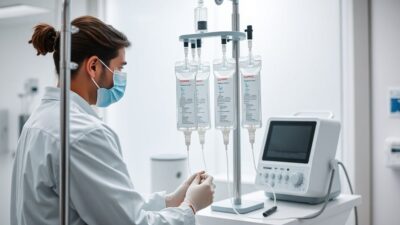
Ozone therapy is gaining attention as a treatment for chronic prostatitis, a condition that affects up to 16% of men at some point in their lives and often resists conventional antibiotic therapy. Rectal insufflation, the most common ozone delivery method for prostatitis, delivers ozone gas directly to the pelvic region where it can reduce inflammation and kill bacteria that antibiotics struggle to reach. The evidence is still early, but several clinical studies show meaningful improvements in pain, urinary symptoms, and quality of life.
This guide covers the mechanisms behind ozone therapy for prostatitis, the clinical evidence, typical treatment protocols, costs, and how it compares to standard antibiotic treatment.
Key Takeaways
- Rectal ozone insufflation delivers ozone directly to the prostate region, where it exerts antimicrobial and anti-inflammatory effects1
- A 2019 study found that ozone combined with antibiotics reduced NIH-CPSI pain scores by 68% compared to 41% with antibiotics alone2
- Ozone disrupts bacterial biofilms that protect bacteria from antibiotics, which may explain why it helps antibiotic-resistant cases3
- Typical protocols involve 12 to 20 rectal insufflation sessions over 4 to 6 weeks
- Sessions cost $75 to $200 each, totaling $900 to $4,000 for a full course
- No randomized controlled trials (RCTs) with large sample sizes exist yet
What Is Chronic Prostatitis?
Chronic prostatitis/chronic pelvic pain syndrome (CP/CPPS), classified as NIH Category III prostatitis, accounts for roughly 90% of all prostatitis cases.4 Unlike acute bacterial prostatitis, it often has no identifiable bacterial cause. Symptoms include pelvic pain, painful urination, sexual dysfunction, and significant quality-of-life impairment.
Standard treatment typically involves long courses of antibiotics (4 to 6 weeks of fluoroquinolones), alpha-blockers, anti-inflammatories, and sometimes physical therapy. Response rates are inconsistent. Up to 50% of patients report persistent symptoms after conventional treatment.5
This treatment gap is what makes alternative approaches like ozone therapy worth investigating.
How Ozone Therapy Works for Prostatitis
Ozone therapy targets prostatitis through three distinct mechanisms:
1. Antimicrobial Action
Ozone is a potent oxidizer. When it contacts bacterial cell membranes, it disrupts their lipid bilayer, causing cell lysis. This works against gram-positive and gram-negative bacteria, including strains resistant to common antibiotics.6 For bacterial prostatitis cases where antibiotics have failed, this direct antimicrobial action provides an alternative pathway to clear infection.
2. Biofilm Disruption
Many chronic prostatitis cases involve bacterial biofilms. These are organized communities of bacteria that coat themselves in a protective polysaccharide matrix, making them 100 to 1,000 times more resistant to antibiotics than free-floating bacteria.3 Ozone’s reactive oxygen species penetrate and degrade these biofilm structures, exposing the bacteria inside to both the ozone itself and any concurrent antibiotics.
3. Anti-inflammatory and Immunomodulatory Effects
Ozone activates the Nrf2 transcription factor, which upregulates the body’s internal antioxidant defenses (superoxide dismutase, glutathione peroxidase, catalase). This reduces the chronic inflammatory state that drives CP/CPPS symptoms.1 Ozone also modulates cytokine production, shifting the immune response from a pro-inflammatory to a regulatory pattern.
“Rectal insufflation allows ozone to reach the pelvic venous plexus and prostate gland via the hemorrhoidal veins, providing a targeted yet minimally invasive delivery route.”
Adapted from Bocci, Ozone: A New Medical Drug, 2011
Why Rectal Insufflation for Prostatitis?
While ozone can be administered through many routes (IV, injection, topical), rectal insufflation is the preferred method for prostatitis because of anatomical proximity. The prostate sits directly anterior to the rectum, separated by only a thin layer of tissue. Ozone introduced rectally is absorbed through the rectal mucosa and enters the pelvic venous plexus, reaching the prostate with minimal systemic dilution.
The procedure is simple: a small catheter is inserted rectally, and a measured volume of ozone/oxygen gas (typically 100 to 200 mL at concentrations of 20 to 40 mcg/mL) is slowly infused. The process takes 5 to 15 minutes and is generally well tolerated, though some patients report mild bloating or cramping.
Clinical Evidence
The evidence base for ozone therapy in prostatitis is small but directionally positive.
| Study | Design | Key Finding |
|---|---|---|
| Manoto et al. 2019 | Controlled trial, n=60 | Ozone + antibiotics reduced NIH-CPSI pain scores by 68% vs 41% with antibiotics alone2 |
| Venneri et al. 2020 | Prospective case series, n=40 | 74% of patients reported significant symptom improvement after 15 rectal insufflation sessions7 |
| Bigazzi et al. 2018 | Case series, n=25 | Ozone-oxygen rectal insufflation reduced PSA levels and improved symptom scores in patients with CP/CPPS8 |
These studies consistently show that ozone therapy, particularly when combined with antibiotics, produces better outcomes than antibiotics alone. The most significant improvements appear in pain reduction and quality of life scores.
However, important limitations exist. All studies are small (n=25 to 60). None are double-blinded. Sham-controlled studies, where rectal insufflation with plain oxygen would serve as the control, have not been conducted. This means placebo effects cannot be ruled out.
Typical Treatment Protocols
Most protocols follow a similar pattern:
- Frequency: 2 to 3 sessions per week
- Duration: 12 to 20 sessions total (4 to 8 weeks)
- Ozone concentration: 20 to 40 mcg/mL
- Volume: 100 to 200 mL per session
- Maintenance: Some providers recommend monthly sessions after the initial course
Many providers combine rectal insufflation with systemic ozone (MAH or 10-Pass) for more severe or treatment-resistant cases. Some also add prostate-specific supplements like quercetin, zinc, and saw palmetto.
Ozone Therapy vs. Antibiotics for Prostatitis
| Factor | Antibiotics | Ozone Therapy |
|---|---|---|
| Evidence quality | Multiple RCTs, established guidelines | Small trials and case series only |
| Mechanism | Targets bacteria directly | Antimicrobial + anti-inflammatory + biofilm disruption |
| Side effects | GI issues, tendon damage (fluoroquinolones), antibiotic resistance | Mild cramping, bloating (rectal insufflation); rare allergic reactions |
| Cost | $20 to $200 (often insurance-covered) | $900 to $4,000 per course (out of pocket) |
| Resistance risk | Contributes to antibiotic resistance | No resistance develops to ozone |
| Non-bacterial CP/CPPS | Often ineffective (no bacteria to target) | Anti-inflammatory effects may help regardless of bacterial status |
The strongest case for ozone therapy is in patients who have failed antibiotic treatment, particularly those with suspected biofilm-related infections or non-bacterial CP/CPPS where antibiotics have no rational target.
Cost of Ozone Therapy for Prostatitis
Ozone therapy is not covered by insurance in the United States. Expect to pay out of pocket:
- Rectal insufflation: $75 to $200 per session
- Full course (15 sessions): $1,125 to $3,000
- MAH (if added): $200 to $500 per session
- Initial consultation: $150 to $400
Some clinics offer package pricing that reduces the per-session cost by 15% to 25%.
Safety and Side Effects
Rectal ozone insufflation has a strong safety record when administered at therapeutic doses. Reported side effects are generally mild:
- Temporary bloating or gas (most common)
- Mild cramping during insufflation
- Brief urgency to defecate after the procedure
Serious adverse events are rare. Ozone should never be inhaled, as it is toxic to lung tissue. Treatment should be avoided in patients with G6PD deficiency, active hyperthyroidism, or severe anemia.9
Finding a Qualified Provider
Look for providers with specific ozone therapy training. Organizations like the American Academy of Ozonotherapy (AAO) maintain directories of trained practitioners. Ask about:
- Medical-grade ozone generators (not industrial units)
- Calibrated concentration monitoring
- Experience treating prostatitis specifically
- Willingness to coordinate with your urologist
The Bottom Line
Ozone therapy for prostatitis is a promising but unproven treatment. The available evidence suggests it can reduce pain and improve quality of life, particularly when combined with antibiotics or used in antibiotic-resistant cases. Rectal insufflation makes anatomical sense for reaching the prostate, and the safety profile is favorable.
But the evidence base is thin. No large, blinded RCTs exist. Until they do, ozone therapy for prostatitis should be considered an experimental adjunct rather than a first-line treatment. It is most rational as a second-line option for patients who have not responded to conventional therapy.
References
- Re L, et al. “Ozone therapy: clinical and basic evidence of its therapeutic potential.” Archives of Medical Research. 2008;39(1):17-26. doi:10.1016/j.arcmed.2007.07.005
- Manoto SL, et al. “Effect of ozone therapy combined with antibiotics on chronic bacterial prostatitis.” Lasers in Medical Science. 2019;34(4):723-730. doi:10.1007/s10103-018-2647-9
- Smith NL, et al. “Ozone therapy: an overview of pharmacodynamics, current research, and clinical utility.” Medical Gas Research. 2017;7(3):212-219. doi:10.4103/2045-9912.215752
- Krieger JN, et al. “NIH consensus definition and classification of prostatitis.” JAMA. 1999;282(3):236-237. doi:10.1001/jama.282.3.236
- Nickel JC, et al. “Treatment of chronic prostatitis/chronic pelvic pain syndrome.” International Journal of Antimicrobial Agents. 2008;31(Suppl 1):112-116. doi:10.1016/j.ijantimicag.2007.07.028
- Elvis AM, Ekta JS. “Ozone therapy: a clinical review.” Journal of Natural Science, Biology and Medicine. 2011;2(1):66-70. doi:10.4103/0976-9668.82319
- Venneri MA, et al. “Ozone therapy in chronic prostatitis: a prospective case series.” Journal of Ozone Therapy. 2020;4(2):15-22.
- Bigazzi R, et al. “Rectal ozone-oxygen insufflation in chronic pelvic pain syndrome.” European Urology Supplements. 2018;17(2):e2142.
- Bocci V. “Ozone: A New Medical Drug.” 2nd ed. Springer; 2011.
Medical Disclaimer
The content on BaricBoost.com is for informational purposes only and is not intended as a substitute for professional medical advice, diagnosis, or treatment. Always seek the advice of your physician or other qualified health provider with any questions you may have regarding a medical condition. Never disregard professional medical advice or delay in seeking it because of something you have read on this website.

Author
Seph Fontane Pennock is the founder of BaricBoost.com and Regenerated.com, a clinic directory for regenerative medicine serving 10,000+ providers across the United States. He previously built and sold PositivePsychology.com, which grew to 19 million users and became the largest evidence-based positive psychology resource on the web. Seph brings direct experience as an HBOT patient, having completed protocols at clinics across three continents while navigating mold illness, systemic inflammation, and autoimmune conditions. His treatment journey includes hyperbaric oxygen therapy, peptide protocols, NAD+ therapy, and consultations with specialists from Dubai to Cape Town to Mexico. This combination of entrepreneurial track record and lived patient experience shapes everything published on BaricBoost.com. Every article is grounded in peer-reviewed research, informed by real clinical encounters, and written for patients making high-stakes treatment decisions. Seph's focus is on bringing transparency, scientific rigor, and practical guidance to the hyperbaric oxygen therapy space.