Affiliate Disclosure
This article contains affiliate links. If you purchase through these links, we may earn a commission at no additional cost to you. This does not influence our evaluations or rankings.
Duke University’s Center for Hyperbaric Medicine and Environmental Physiology treats all 14 FDA-cleared HBOT indications using UHMS-accredited monoplace and multiplace chambers at pressures of 2.0 to 3.0 ATA. It is one of the oldest and most research-active hyperbaric programs in the United States, and its physicians have contributed to landmark trials on diabetic wound healing and carbon monoxide poisoning. For diabetic foot ulcers, the Cochrane evidence Duke’s protocols rest on shows improved short-term wound healing (RR 2.35 at six weeks).
Duke’s team delivers care while advancing the science, a dual role that reflects academic medicine at its best. This guide covers what the program treats, the evidence behind it, how to get seen there, and how an academic center compares to a commercial HBOT clinic.
Table of Contents
What Makes Duke’s Hyperbaric Program Different?
Duke’s hyperbaric medicine center sits inside Duke University Health System, so patients are treated by physicians who are also researchers and educators. The team includes wound care specialists, diving medicine experts, and physicians board-certified in undersea and hyperbaric medicine.
The program holds accreditation from the Undersea and Hyperbaric Medical Society (UHMS), the body that sets treatment standards across the field. UHMS accreditation requires demonstrated adherence to evidence-based protocols, rigorous safety procedures, and qualified medical oversight. Not all hyperbaric facilities meet this standard. Duke does.
The center operates both monoplace (single-patient) and multiplace (multi-patient) chambers. That flexibility matters clinically, because some conditions and patient populations respond better to specific chamber configurations. Multiplace chambers let a medical professional stay inside with the patient during treatment, which is particularly relevant for acute or emergency indications.
UHMS accreditation requires demonstrated adherence to evidence-based protocols, qualified physician oversight, and strict safety standards. It is not granted automatically. It is earned through audit and review. Duke maintains this accreditation, which is meaningful when selecting a hyperbaric facility.
BaricBoost editorial note
Accreditation and Safety Standards Duke Meets
| Standard | What it certifies |
|---|---|
| UHMS accreditation | Evidence-based protocols, qualified physician oversight, and facility safety review |
| ASME PVHO-1 | Engineering standard for pressure vessels for human occupancy |
| NFPA 99 | Fire and facility safety code for hyperbaric facilities in health care settings |
| Joint Commission | Hospital-wide accreditation for quality and patient safety |
What Conditions Does Duke Treat With HBOT?
Duke treats patients across all FDA-cleared HBOT indications. It does not offer HBOT for unproven applications, and the team is explicit about the line between approved and investigational uses. Primary treatment areas include:
- Diabetic foot ulcers and non-healing wounds
- Delayed radiation injury to soft tissue and bone (osteoradionecrosis, soft tissue radionecrosis)
- Carbon monoxide poisoning
- Decompression sickness and arterial gas embolism
- Compromised skin grafts and surgical flaps
- Refractory osteomyelitis
- Necrotizing soft tissue infections
| Condition | Typical Sessions | Key Outcome Target |
| Diabetic foot ulcers | 20-40 sessions | Wound closure, reduced amputation risk |
| Radiation tissue injury | 30-60 sessions | Angiogenesis, pain reduction, tissue restoration |
| Carbon monoxide poisoning | 1-3 sessions | CO displacement, neurological protection |
| Compromised grafts and flaps | 10-20 sessions | Tissue perfusion, graft survival |
| Osteomyelitis (refractory) | 30-40 sessions | Reduced bacterial load, bone healing |
For the full approved list and where these indications come from, see our guide to the FDA-cleared indications for HBOT.
The Clinical Evidence Behind Duke’s Approach
Duke’s protocols are grounded in a substantial body of peer-reviewed literature. For diabetic wound care, the 2015 Cochrane review (Kranke et al.) pooled five trials and found HBOT increased the rate of ulcer healing at six weeks (RR 2.35; 95% CI 1.19 to 4.62; P=0.01) compared with standard care.1 The review was careful about limits: that healing benefit was not evident at one-year follow-up, and the pooled effect on major amputation did not reach statistical significance (RR 0.36; 95% CI 0.11 to 1.18). The honest read is that HBOT improves short-term healing for diabetic foot ulcers, while its effect on preventing amputation remains uncertain in the trial data.
Higher rate of diabetic foot ulcer healing at six weeks with HBOT versus standard care (95% CI 1.19 to 4.62; P=0.01); benefit not sustained at one year
Kranke et al., 2015, Cochrane Database
The healing mechanism is well established. HBOT at 2.0 to 2.5 ATA raises dissolved oxygen in plasma by 10 to 15 times, delivering therapeutic oxygen to hypoxic wound tissue that normal blood flow cannot adequately perfuse. This drives angiogenesis (new vessel formation), fibroblast proliferation, collagen synthesis, and antimicrobial activity against anaerobic bacteria.2
Increase in dissolved plasma oxygen at 2.0 to 2.5 ATA, the basis for HBOT’s effect on hypoxic wound tissue
Thom, 2011, Plast Reconstr Surg
For radiation injury, HBOT is one of the few interventions with meaningful evidence, working by stimulating new blood vessel growth in hypoxic, radiation-damaged tissue. Reported outcomes include improved healing, reduced pain, and better tissue function across head and neck, jaw, and pelvic radiation sites. If you are researching wound applications specifically, see our overview of the hyperbaric chamber for wound healing.
How Do You Get Treated at Duke?
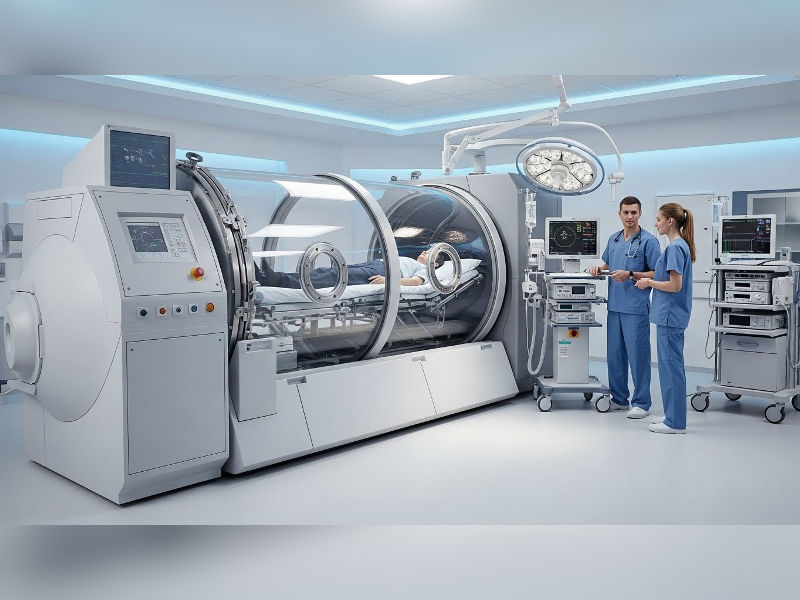
Treatment at Duke begins with a physician evaluation and medical clearance. HBOT is not available without a proper referral and assessment. The clinical team reviews your complete medical history, current medications, and any conditions that might affect eligibility or require protocol modification. Most patients arrive through a physician referral, though you can also contact the center directly.
Common considerations during evaluation include lung conditions (which affect pressure tolerance), cardiac history, ear and sinus anatomy, and current medications. Certain chemotherapy drugs are contraindicated with HBOT. The medical team addresses these factors before any sessions begin.
During sessions, patients breathe 100% oxygen at pressures between 2.0 and 3.0 ATA depending on the indication, for 60 to 90 minutes. Ear pressure equalization is required during pressurization and feels similar to descending in an aircraft. Duke’s staff trains patients in equalization techniques before the first session, and in the multiplace chamber a trained attendant can accompany them inside.
Treatment courses vary widely by indication. Carbon monoxide poisoning may need only 1 to 3 emergency sessions. Diabetic foot ulcers typically require 20 to 40 scheduled sessions. Radiation injury protocols often run 30 to 60 sessions. The team tracks outcomes between sessions and adjusts accordingly.
Research Contributions
Duke’s hyperbaric program has contributed to the scientific literature for decades. Its physicians have published on wound healing mechanisms, optimal treatment pressures, carbon monoxide toxicology, and the physiological effects of elevated pressure on human tissue. That published work informs protocols at facilities across the country.
The academic environment drives quality in a way commercial facilities cannot fully replicate. When physicians are responsible for both patient outcomes and published research, the incentives favor rigorous measurement and honest reporting. Duke’s record in both areas is part of why the program is a reference standard.
Medical training is another dimension. Residents and fellows who train in hyperbaric medicine at Duke carry evidence-based protocols to facilities across the country when they finish, an educational multiplier effect that raises the broader standard of care.
Safety Standards
HBOT involves pressurized oxygen inside an enclosed hyperbaric chamber, so safety is non-negotiable. Duke’s chambers meet ASME PVHO-1 standards for pressure vessels used for human occupancy and comply with NFPA 99 requirements for hyperbaric facilities in health care settings.
Equipment undergoes regular inspection and testing. Staff are trained in emergency procedures specific to hyperbaric environments, including fire safety (oxygen-enriched atmospheres require particular precautions), emergency depressurization, and management of uncommon adverse events including oxygen toxicity seizures. A 2024 review confirmed that HBOT has a well-established safety profile when administered by trained personnel following established protocols.3
Patient screening is thorough. Patients with untreated pneumothorax, certain cardiac conditions, severe claustrophobia, or specific medication combinations require additional evaluation or protocol modification before treatment. Duke’s physician-led screening identifies these factors before any sessions begin.
Is an Academic Center Better Than a Commercial HBOT Clinic?
Not all hyperbaric facilities operate at the same standard. Academic medical centers like Duke differ from standalone commercial clinics in several meaningful ways:
- Physician oversight: Academic programs require board-certified hyperbaric medicine physicians. Some commercial facilities are supervised by physicians with limited HBOT-specific training.
- Scope of practice: Duke treats only FDA-approved indications with evidence-based protocols. Some commercial facilities offer HBOT for unapproved uses including autism, Lyme disease, and general wellness, which the FDA has specifically warned against.
- Equipment: Academic centers use clinical-grade hard chambers at therapeutic pressures. Some commercial wellness facilities use soft-shell chambers near 1.3 ATA that cannot deliver clinical-grade HBOT.
- Insurance integration: Academic programs have established billing relationships with insurers for approved indications. Commercial wellness facilities typically operate cash-pay only for off-label applications.
For a physician-referred medical need with an FDA-approved indication, an academic center like Duke is generally the most appropriate choice. For general wellness curiosity without a specific diagnosis, the evidence base does not currently support clinical HBOT for that purpose at any facility. For context on how academic programs compare to celebrity-driven media narratives, see our post on the Michael Jackson hyperbaric chamber story.
Making an Informed Decision
If you or a family member are considering HBOT for a medical condition, the path starts with your treating physician. HBOT is most appropriate when a physician who knows your full medical history determines that your condition is one of the FDA-cleared indications and that the benefits outweigh the risks for your situation.
Duke’s program typically accepts patients via physician referral, and its evaluation process is thorough, which serves both your safety and the quality of your treatment plan. The commitment is significant: daily sessions five days a week for weeks to months, depending on the indication.
Insurance typically covers HBOT for approved indications at facilities like Duke. The billing team can verify coverage and obtain pre-authorizations before treatment begins. For what treatment can cost by location, see our breakdown of HBOT cost by state and our guide to hyperbaric oxygen therapy insurance.
FAQ
What conditions does Duke’s hyperbaric program treat?
Duke treats all 14 FDA-cleared HBOT indications. Primary clinical volumes are wound care (diabetic foot ulcers), radiation tissue injury, and emergency indications including carbon monoxide poisoning and decompression sickness.
Does insurance cover HBOT at Duke?
Insurance covers HBOT for approved medical indications. Duke’s billing department works with major insurance providers to verify coverage and obtain pre-authorizations. Off-label applications are typically not covered.
What makes Duke different from other hyperbaric facilities?
Duke combines clinical treatment with active research and medical education. Physicians contribute to peer-reviewed literature, train the next generation of hyperbaric medicine specialists, and coordinate care across specialty departments. Its UHMS accreditation and academic environment create quality controls that standalone commercial facilities cannot easily replicate.
How do I get evaluated for treatment at Duke’s hyperbaric center?
Most patients begin with a physician referral. You can also contact Duke’s Center for Hyperbaric Medicine directly. The evaluation includes a medical history review, physical examination, and assessment of whether your condition meets criteria for HBOT under FDA-cleared indications.
Sources
- Kranke P, Bennett MH, Martyn-St James M, Schnabel A, Debus SE, Weibel S. Hyperbaric oxygen therapy for chronic wounds. Cochrane Database Syst Rev. 2015;(6):CD004123. DOI: 10.1002/14651858.CD004123.pub4
- Thom SR. Hyperbaric oxygen: its mechanisms and efficacy. Plast Reconstr Surg. 2011;127(Suppl 1):131S-141S. DOI: 10.1097/PRS.0b013e3181fbe2bf
- Mago V. Safety of hyperbaric medicine in clinical scenarios. Annals of African Medicine. 2024. PMC10922184
- Kindwall EP, Whelan HT. Hyperbaric Medicine Practice. NCBI Bookshelf. NBK557686
- Undersea and Hyperbaric Medical Society. Approved HBO Indications and Accreditation Standards. uhms.org
Medical Disclaimer
The content on BaricBoost.com is for informational purposes only and is not intended as a substitute for professional medical advice, diagnosis, or treatment. Always seek the advice of your physician or other qualified health provider with any questions you may have regarding a medical condition. Never disregard professional medical advice or delay in seeking it because of something you have read on this website.

Author
Seph Fontane Pennock is the founder of BaricBoost.com and Regenerated.com, a clinic directory for regenerative medicine serving 10,000+ providers across the United States. He previously built and sold PositivePsychology.com, which grew to 19 million users and became the largest evidence-based positive psychology resource on the web. Seph brings direct experience as an HBOT patient, having completed protocols at clinics across three continents while navigating mold illness, systemic inflammation, and autoimmune conditions. His treatment journey includes hyperbaric oxygen therapy, peptide protocols, NAD+ therapy, and consultations with specialists from Dubai to Cape Town to Mexico. This combination of entrepreneurial track record and lived patient experience shapes everything published on BaricBoost.com. Every article is grounded in peer-reviewed research, informed by real clinical encounters, and written for patients making high-stakes treatment decisions. Seph's focus is on bringing transparency, scientific rigor, and practical guidance to the hyperbaric oxygen therapy space.
Why Trust Our Evaluations
Our rankings are based on hands-on testing, published clinical data, and verified manufacturer specifications. We apply the same criteria to every product regardless of affiliate status. Editorial Process · Evaluation Methodology