Affiliate Disclosure
This article contains affiliate links. If you purchase through these links, we may earn a commission at no additional cost to you. This does not influence our evaluations or rankings.
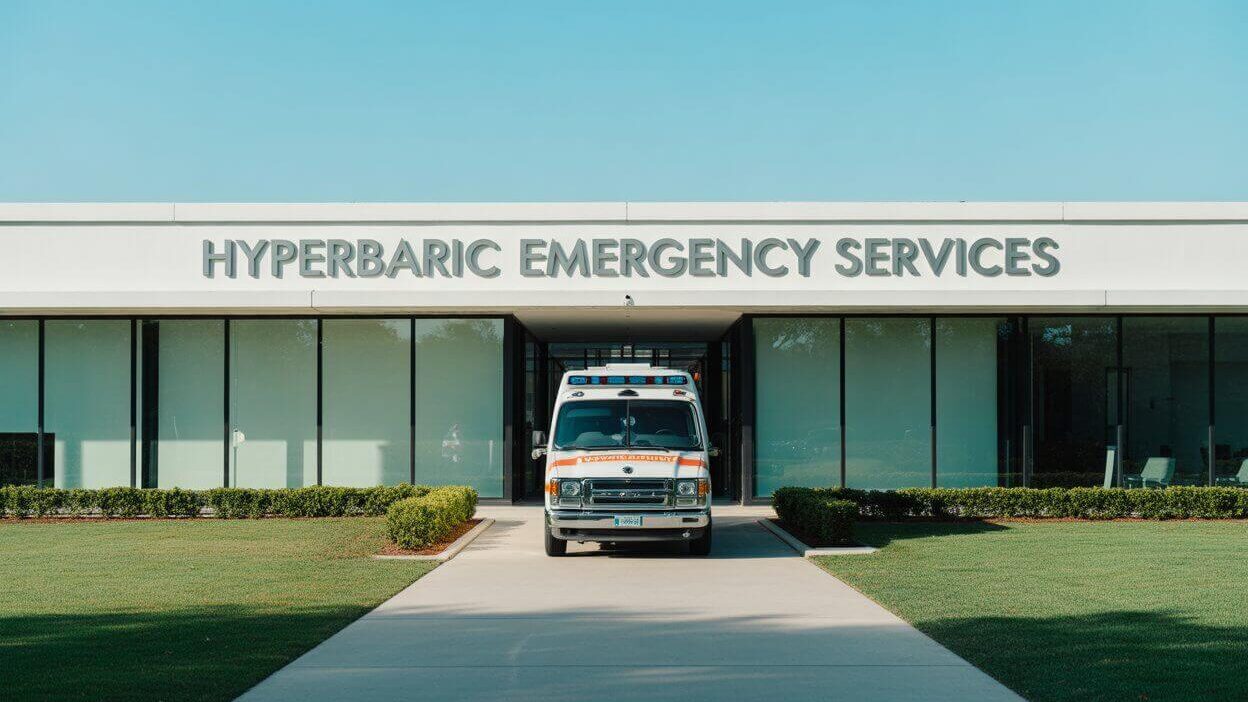
If you have a diving injury, carbon monoxide poisoning, or a gas-forming infection, call 911 first, and for dive emergencies call the Divers Alert Network (DAN) 24/7 hotline at 1-919-684-9111. Most US hyperbaric facilities run only during business hours: in a national survey of 361 centers, just 43 (about 12%) were equipped and staffed to treat high-acuity emergencies around the clock. Do not try to locate a chamber yourself. Emergency dispatch and DAN route you to the nearest capable center.
What Should You Do Right Now?
In a suspected hyperbaric emergency, the fastest route to the right chamber is through emergency services and DAN, not a web search. Work through these steps in order:
- Call 911 for any life-threatening symptoms. Dispatch knows which regional hospitals can treat emergencies and can arrange transport.
- For a diving injury, call DAN at 1-919-684-9111 (24/7). DAN physicians help triage the case and identify the nearest chamber ready to accept an emergency patient.
- For carbon monoxide poisoning, move to fresh air immediately and let 911 or the emergency department arrange hyperbaric treatment if it is indicated.
- Have the details ready: for diving, your depth, bottom time, ascent rate, and when symptoms began; for CO, the source and how long you were exposed.
For planning routine, non-urgent sessions instead, our directory of hyperbaric chamber treatment near you is the right starting point.
When Do You Need Emergency Hyperbaric Treatment?
A handful of conditions are true hyperbaric emergencies, where high-pressure oxygen is a primary treatment and delay worsens the outcome. These are recognized indications under the Undersea and Hyperbaric Medical Society and are covered by Medicare and most insurers when treated as emergencies.14
Hyperbaric Emergencies and Who to Call First
| Indication | Time-sensitivity | First call |
|---|---|---|
| Decompression sickness (the bends) | Hours matter; treat as soon as possible | 911 + DAN |
| Arterial gas embolism | Immediate, minutes to hours | 911 + DAN |
| Carbon monoxide poisoning | Same day; sooner is better | 911 / emergency department |
| Gas gangrene / necrotizing infection | Urgent surgery plus HBOT | 911 / emergency department |
Decompression sickness happens when a diver ascends too quickly and nitrogen bubbles form in the blood and tissue, causing pain, neurological symptoms, and, in severe cases, paralysis.
Carbon monoxide poisoning occurs when CO from faulty heaters, car exhaust, or fires binds hemoglobin and blocks oxygen delivery. In the Weaver 2002 randomized trial of 152 patients, three HBOT sessions within 24 hours reduced cognitive problems at six weeks (25% with HBOT versus 46% with normobaric oxygen).2 Our guide to oxygen therapy for carbon monoxide poisoning covers this in depth.
Arterial gas embolism is air entering the bloodstream during diving ascent, surgery, or trauma, where bubbles can block flow to the brain or heart.
Gas gangrene and other necrotizing soft-tissue infections spread rapidly; HBOT is used alongside surgery and antibiotics to slow bacterial growth in the tissue.
How Do I Find an Emergency Hyperbaric Chamber Near Me?
Use two authoritative resources rather than a general search, because chamber availability changes hour to hour with staffing, maintenance, and ongoing treatments. The Divers Alert Network 24/7 hotline (1-919-684-9111) is the fastest option for dive injuries: DAN maintains current information on which chambers can accept emergency patients and helps coordinate transport. The UHMS chamber directory lists hyperbaric facilities nationally, useful for planning but not a substitute for a live emergency call.
We do not publish a fixed list of named hospitals as emergency chambers. A center that treated emergencies last year may run business hours only today, and acting on outdated information costs time you do not have. Not every hospital has a chamber at all, as our explainer on whether every hospital has a hyperbaric chamber details, and only a minority run 24/7 emergency programs. Let 911 and DAN identify the nearest capable facility in real time.
Why Emergency Access Is Limited
Although hyperbaric centers have grown common (the US has well over a thousand facilities, most attached to wound-care programs), few are set up for high-acuity emergencies.3 Emergency capability requires in-chamber ventilators and infusion pumps, staff trained for critically ill patients, and 24/7 coverage. The Chin 2016 survey found only 43 of 361 surveyed centers met that bar, which is why transport to a distant center is often necessary and why the number of hyperbaric chambers in the US overstates how many can help in a true emergency.
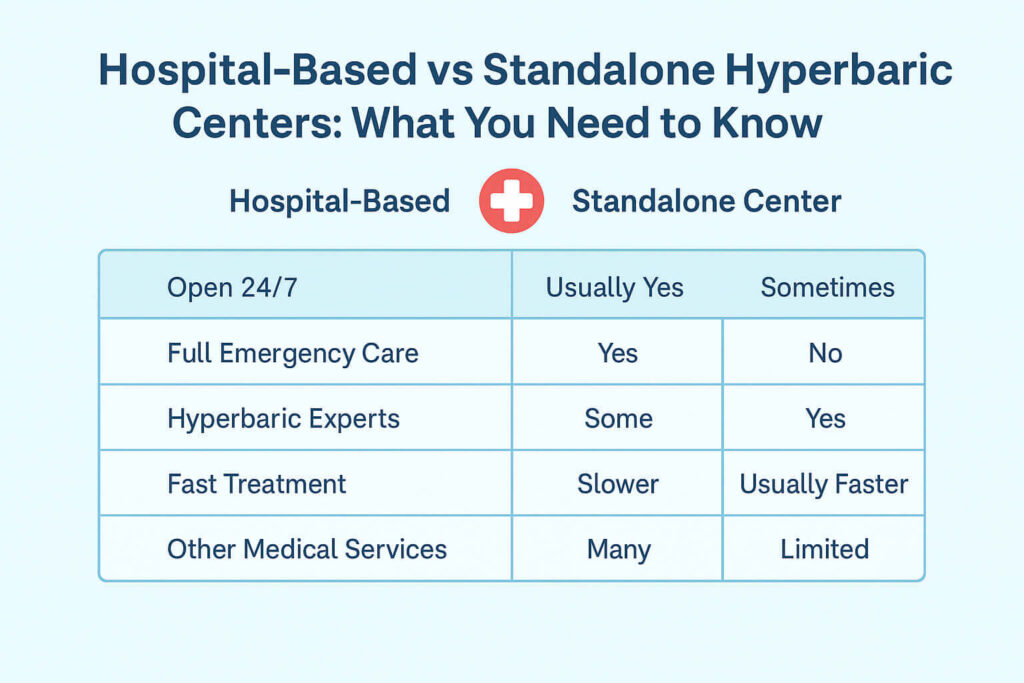
Hospital-Based or Standalone Center?
Hospital-Based vs. Standalone Emergency HBOT Centers
| Feature | Hospital-Based | Standalone |
|---|---|---|
| Emergency room access | On-site | Transfer required |
| ICU availability | Yes | No |
| Surgical backup | Yes | No |
| 24/7 staffing | Some facilities | Rare |
| Critical-care equipment | Usually | Often not |
| Specialist focus | General plus HBOT | HBOT-specific, often outpatient |
For a genuine emergency (decompression sickness with neurological signs, CO poisoning, air embolism, or a spreading infection), a hospital-based program is almost always the right destination because it has the emergency department, ICU, and surgical backup that these conditions can require. Standalone centers are generally outpatient wound-care operations and are not equipped for critically ill patients. This is one more reason to let dispatch and DAN choose the facility.
What Happens During Emergency Treatment?
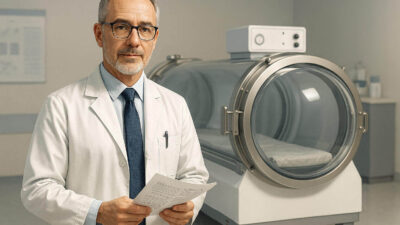
Once you reach a chamber, staff seal the pressure vessel and gradually raise the pressure while you breathe 100% oxygen. Your ears will feel pressure like the descent of an airplane, and staff coach you through equalizing. Treatment length depends on the condition: carbon monoxide protocols typically run 60 to 90 minutes, while decompression sickness may require several hours and repeat sessions. Staff monitor you continuously and communicate through an intercom, and in multiplace chambers a nurse may be inside with you.
Does Insurance Cover Emergency HBOT?
Yes, for recognized emergency indications. Medicare and most commercial plans cover HBOT for carbon monoxide poisoning, decompression sickness, air or gas embolism, and gas gangrene under the CMS national coverage determination.4 In-network facilities cost less, but in a true emergency you go to the nearest capable center regardless of network, and emergency-care protections generally apply. Ask the treating hospital about financial assistance if cost is a concern.
How Can You Prepare Before an Emergency?
If you dive, work with combustion equipment, or have gas appliances at home, a small amount of preparation pays off:
- Save the DAN emergency number (1-919-684-9111) in your phone now.
- If you dive, consider DAN membership, which includes emergency assistance and evacuation coverage.
- Keep a note of your medical history, medications, and allergies where a family member can find it.
- For divers, log depth, bottom time, and ascent details for each dive so you can report them quickly.
The goal is not to memorize chamber locations, which change, but to reach 911 and DAN fast with the right information.
Sources
- Undersea and Hyperbaric Medical Society. Indications for Hyperbaric Oxygen Therapy (14th Edition). uhms.org
- Weaver LK, Hopkins RO, Chan KJ, et al. Hyperbaric oxygen for acute carbon monoxide poisoning. New England Journal of Medicine. 2002;347(14):1057-1067. DOI: 10.1056/NEJMoa013121
- Chin W, Jacoby L, Simon O, et al. Hyperbaric programs in the United States: locations and capabilities of treating decompression sickness, arterial gas embolisms, and acute carbon monoxide poisoning: survey results. Undersea Hyperb Med. 2016;43(1):29-43. PMID: 27000011
- Centers for Medicare & Medicaid Services. National Coverage Determination 20.29: Hyperbaric Oxygen Therapy. cms.gov
- Divers Alert Network. Emergency Hotline and Chamber Assistance. dan.org
Medical Disclaimer
The content on BaricBoost.com is for informational purposes only and is not intended as a substitute for professional medical advice, diagnosis, or treatment. Always seek the advice of your physician or other qualified health provider with any questions you may have regarding a medical condition. Never disregard professional medical advice or delay in seeking it because of something you have read on this website.

Author
Seph Fontane Pennock is the founder of BaricBoost.com and Regenerated.com, a clinic directory for regenerative medicine serving 10,000+ providers across the United States. He previously built and sold PositivePsychology.com, which grew to 19 million users and became the largest evidence-based positive psychology resource on the web. Seph brings direct experience as an HBOT patient, having completed protocols at clinics across three continents while navigating mold illness, systemic inflammation, and autoimmune conditions. His treatment journey includes hyperbaric oxygen therapy, peptide protocols, NAD+ therapy, and consultations with specialists from Dubai to Cape Town to Mexico. This combination of entrepreneurial track record and lived patient experience shapes everything published on BaricBoost.com. Every article is grounded in peer-reviewed research, informed by real clinical encounters, and written for patients making high-stakes treatment decisions. Seph's focus is on bringing transparency, scientific rigor, and practical guidance to the hyperbaric oxygen therapy space.
Why Trust Our Evaluations
Our rankings are based on hands-on testing, published clinical data, and verified manufacturer specifications. We apply the same criteria to every product regardless of affiliate status. Editorial Process · Evaluation Methodology