Affiliate Disclosure
This article contains affiliate links. If you purchase through these links, we may earn a commission at no additional cost to you. This does not influence our evaluations or rankings.
LeBron James reportedly spends about $1.5 million a year on his body, and a soft-shell hyperbaric chamber is one of his visible recovery tools, used in roughly 90-minute sessions. The catch is that the best evidence does not back it for recovery: a 2021 meta-analysis of 10 studies found no significant benefit of HBOT on athletic performance or post-exercise recovery. Celebrity use is not proof, and this article separates the two.
When LeBron posted videos of himself relaxing in what looks like a clear sleeping bag, curiosity followed. At 39 he was still dominating a league most players leave a decade earlier. Visibility, though, is not the same as proof, and the gap between the two is the whole point.
Why does LeBron use a hyperbaric chamber?
LeBron treats sleep, nutrition, and body maintenance as non-negotiable, and HBOT entered that toolkit as it gained traction among NBA trainers for muscle soreness and between-game recovery. The rationale is straightforward: pressurized oxygen raises the amount of oxygen dissolved in blood plasma, which in theory reaches tissue that normal blood flow does not fully saturate after hard exertion.
Whether that rationale produces a measurable benefit in a professional basketball context is a separate question. Elite athletes face a selection problem: they will invest in anything that might help, so they often adopt interventions before the evidence catches up. The same pattern shows up with other high-profile biohackers, such as Bryan Johnson.
What type of chamber does LeBron use?
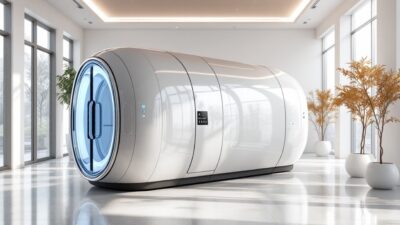
The chamber in LeBron’s widely shared photos is a soft-shell portable unit, the type that reaches about 1.3 to 1.5 ATA. That matters clinically, because the most rigorous HBOT research on cognition and telomere biology uses hard-shell chambers at 2.0 ATA with 100% oxygen. Soft chambers deliver far less dissolved oxygen and sit below the pressure most clinical protocols use.
| Feature | Soft chamber (LeBron’s type) | Hard clinical chamber |
|---|---|---|
| Pressure | 1.3 to 1.5 ATA | 2.0 to 2.4 ATA |
| Oxygen | Often ambient air or concentrator | 100% medical oxygen |
| Used in the main research | No | Yes |
It is possible a soft-shell chamber at 1.3 ATA helps post-exercise recovery, but the published evidence does not support it at that pressure. This distinction matters most for anyone about to buy home equipment after seeing his posts. Our full breakdown of hard-shell versus soft-shell chambers covers the trade-offs.
Does HBOT actually improve athletic recovery?
The most directly relevant evidence says no, or at least not measurably. A 2021 systematic review and meta-analysis pooled 10 studies covering 166 participants and found that pre-exercise and post-exercise HBOT had no statistically significant effect on athletic performance or recovery markers (p>0.05 across outcomes).1 Intra-exercise HBOT showed a possible effect on muscle endurance, but the data were too thin for formal meta-analysis. The authors’ conclusion was that the best available evidence does not support HBOT as a routine sports recovery tool.
A 2025 narrative review reached a similar verdict: in animal models, HBOT accelerates muscle healing after soft-tissue injury, but human evidence remains inconclusive.2 The review flagged specific safety concerns about mild hyperbaric chambers at 1.3 ATA marketed aggressively for recovery without clinical evidence. HBOT is not banned in competitive sport, but not-banned is not the same as effective.
pooled in a 2021 meta-analysis found no significant benefit of HBOT for athletic performance or post-exercise recovery
Huang et al., 2021, Frontiers in Physiology
Where HBOT does have stronger footing is injury recovery: acute soft-tissue damage, bone healing, and wound care. If LeBron uses it to recover from a specific injury rather than as a general wellness habit, that application has more backing, though still not from large controlled human trials. That is rarely the story the headlines tell.
Does LeBron’s use mean it will work for you?
No. LeBron’s durability is almost certainly the product of world-class genetics, decades of disciplined training, elite nutrition, exceptional sleep, and outstanding medical support. Isolating any single tool’s contribution from that stack is impossible, and HBOT is one item in a very large stack. Attributing his career length to a chamber is not supported by evidence.
Celebrity endorsements of health technology are marketing events. They build awareness and sell products; they do not generate clinical evidence. For anyone weighing HBOT, the meta-analysis and peer-reviewed literature carry far more weight than an Instagram post.
What is HBOT actually proven to do?
HBOT has solid evidence for a defined set of indications recognized by the Undersea and Hyperbaric Medical Society, including decompression sickness, carbon monoxide poisoning, diabetic foot ulcers, delayed radiation injury, and necrotizing soft-tissue infections.4 Athletic recovery and general performance enhancement are not among them, and the FDA has specifically warned consumers against marketing that oversells unproven uses.5
indications recognized by UHMS for hyperbaric oxygen therapy; athletic recovery and performance are not on the list
Undersea and Hyperbaric Medical Society
The marketing around celebrity HBOT use often blurs these categories. A therapy proven for wound healing is not automatically proven for recovery optimization, because the two involve different mechanisms, pressures, and evidence standards.
What happens during a session, and is it safe?
A clinical HBOT session uses a hard-shell monoplace or multiplace chamber pressurized to 1.5 to 2.4 ATA, with the patient breathing 100% oxygen through a mask or hood for 60 to 90 minutes and short air breaks every 20 minutes to limit oxygen toxicity. Soft chambers like LeBron’s pressurize to about 1.3 ATA and usually deliver ambient air, so the physiological effect is milder.
HBOT is generally safe when supervised by trained staff in a maintained chamber. The most common adverse effect is ear barotrauma, with temporary myopia and mild claustrophobia also reported, while oxygen-toxicity seizures are rare at standard clinical pressures, estimated at roughly 1 in 10,000 sessions.3 Risks rise with unsupervised soft-shell use, and compressed oxygen in any form carries fire risk. For a fuller picture, see our guide to HBOT side effects and the athletic recovery data.
approximate rate of oxygen-toxicity seizures at standard clinical HBOT pressures
Heyboer et al., 2017, Advances in Wound Care
What chamber does LeBron James use?
Based on his own posted photos and videos, LeBron uses a soft-shell portable chamber that operates at roughly 1.3 to 1.5 ATA, not a hard clinical chamber at 2.0 to 2.4 ATA. Soft chambers deliver less dissolved oxygen and sit below the pressure used in the main HBOT research, which is why buying similar home equipment does not reproduce the conditions studied in clinical trials.
Does hyperbaric therapy improve sports recovery?
The best available evidence says no. A 2021 meta-analysis of 10 studies found no significant effect of pre- or post-exercise HBOT on performance or recovery.1 A 2025 review found human evidence inconclusive even though animal models show faster muscle healing.2 HBOT has firmer footing for treating specific acute injuries than for general recovery.
Is HBOT banned in professional sports?
No. HBOT is not prohibited in competitive sport, so athletes can use it without a doping violation. Being allowed is not evidence that it works, though. The performance and recovery data remain negative or inconclusive, so its legality says nothing about whether it delivers the benefit celebrity marketing implies.
Sources
- Huang X, Wang R, Zhang Z, Wang G, Gao B. “Effects of Pre-, Post- and Intra-Exercise Hyperbaric Oxygen Therapy on Performance and Recovery: A Systematic Review and Meta-Analysis.” Frontiers in Physiology. 2021;12:791872. DOI: 10.3389/fphys.2021.791872
- Johnson-Arbor K. “Hyperbaric oxygen therapy for high performance athletes: a narrative review.” Undersea and Hyperbaric Medicine. 2025. DOI: 10.22462/694
- Heyboer M 3rd, Sharma D, Santiago W, McCulloch N. “Hyperbaric Oxygen Therapy: Side Effects Defined and Quantified.” Advances in Wound Care. 2017;6(6):210-224. DOI: 10.1089/wound.2016.0718
- Undersea and Hyperbaric Medical Society. “Hyperbaric Oxygen Therapy Indications.” uhms.org
- U.S. Food and Drug Administration. “Hyperbaric Oxygen Therapy: Don’t Be Misled.” fda.gov
Medical Disclaimer
The content on BaricBoost.com is for informational purposes only and is not intended as a substitute for professional medical advice, diagnosis, or treatment. Always seek the advice of your physician or other qualified health provider with any questions you may have regarding a medical condition. Never disregard professional medical advice or delay in seeking it because of something you have read on this website.

Author
Seph Fontane Pennock is the founder of BaricBoost.com and Regenerated.com, a clinic directory for regenerative medicine serving 10,000+ providers across the United States. He previously built and sold PositivePsychology.com, which grew to 19 million users and became the largest evidence-based positive psychology resource on the web. Seph brings direct experience as an HBOT patient, having completed protocols at clinics across three continents while navigating mold illness, systemic inflammation, and autoimmune conditions. His treatment journey includes hyperbaric oxygen therapy, peptide protocols, NAD+ therapy, and consultations with specialists from Dubai to Cape Town to Mexico. This combination of entrepreneurial track record and lived patient experience shapes everything published on BaricBoost.com. Every article is grounded in peer-reviewed research, informed by real clinical encounters, and written for patients making high-stakes treatment decisions. Seph's focus is on bringing transparency, scientific rigor, and practical guidance to the hyperbaric oxygen therapy space.
Why Trust Our Evaluations
Our rankings are based on hands-on testing, published clinical data, and verified manufacturer specifications. We apply the same criteria to every product regardless of affiliate status. Editorial Process · Evaluation Methodology