Affiliate Disclosure
This article contains affiliate links. If you purchase through these links, we may earn a commission at no additional cost to you. This does not influence our evaluations or rankings.
Hyperbaric oxygen therapy does not treat sleep apnea. No randomized controlled trial has tested HBOT as a primary treatment for obstructive or central sleep apnea, and a 2025 systematic review in Pulmonary Therapy rated the evidence insufficient for clinical recommendations. Any role is indirect and unproven: HBOT may ease inflammation and improve daytime oxygenation, but it does not correct the airway collapse that drives apnea. This guide covers what the research actually says and where HBOT might sit alongside standard care, one of several chronic conditions researchers are investigating with HBOT.
Table of Contents
Why Traditional Sleep Apnea Treatments Aren’t Always Enough
Continuous positive airway pressure (CPAP) keeps the airway open with a constant stream of air, and it carries the strongest evidence base in sleep medicine. The 2019 American Academy of Sleep Medicine clinical practice guideline (Patil et al., J Clin Sleep Med) recommends CPAP as first-line therapy for adults with obstructive sleep apnea. The problem is not efficacy. It is tolerance. Some people find the mask intrusive, others cannot settle at the prescribed pressure, and even faithful users can still see oxygen saturation dip overnight. That gap is why people search for adjuncts like a hyperbaric chamber.
| Challenge with Traditional Therapy | What It Looks Like in Real Life | Consequence | How Adjuncts Can Help (incl. HBOT) |
| CPAP non-adherence/intolerance | Mask feels intrusive; device noise; difficulty sleeping with gear | Under-treated apnea, persistent symptoms | Refit mask, desensitization, pressure re-titration; HBOT may support daytime oxygenation as an adjunct under medical guidance |
| Mask leaks & claustrophobia | Frequent reseating; air blowing into eyes; panic when masked | Fragmented sleep, lower therapeutic pressure at the airway | Alternative mask styles, leak coaching, behavioral strategies; HBOT may address inflammation as a complement, not a CPAP replacement |
| Residual hypoxemia despite good AHI | AHI improved, but overnight O2 still dips on oximetry | Daytime fatigue, cardiovascular strain persist | Check titration, add supplemental O2 if indicated; HBOT may improve tissue oxygen reserves between nights |
| Central/complex sleep apnea | Centrals emerge on CPAP; irregular breathing persists | Incomplete control with standard CPAP | Consider ASV/BiPAP; optimize comorbidities; HBOT strictly as complementary care if a clinician approves |
| Persistent airway inflammation/edema | Sore throat, swollen tissues, and snoring continue | Narrow airway, higher collapsibility | Anti-inflammatory care, reflux control; HBOT’s anti-inflammatory effects may complement primary therapy |
| Cardiometabolic comorbidities | Hypertension, insulin resistance remain stubborn | Elevated long-term risk despite CPAP | Medication optimization, exercise, nutrition; HBOT may assist tissue oxygenation while lifestyle changes take effect |
The table above frames HBOT the way the evidence allows: as a possible complement to standard care, never a substitute. The value of naming these gaps is that it clarifies what a hyperbaric chamber can and cannot do for someone already struggling with CPAP.
Why Would Oxygen Therapy Affect Sleep Apnea?
Sleep apnea, whether obstructive or central, repeatedly starves the body of oxygen overnight. These cycles of intermittent hypoxemia drive sympathetic activation, oxidative stress, and systemic inflammation, which is the pathway linking untreated apnea to cardiovascular and metabolic disease (Dewan, Nieto, and Somers, Chest, 2015). The theory behind HBOT targets that downstream damage, not the airway obstruction itself.
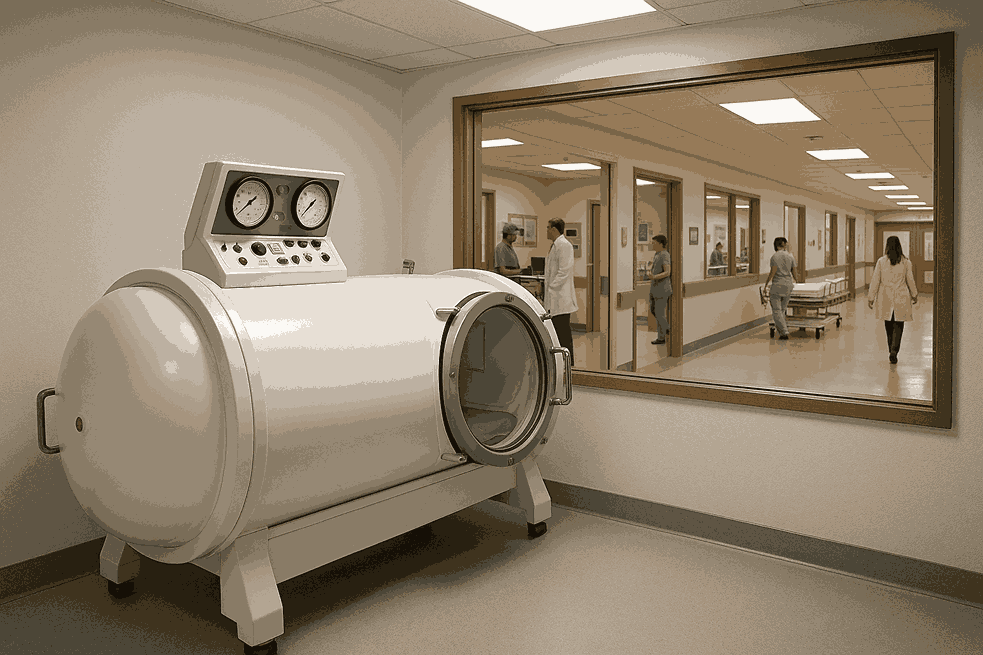
In a hard hyperbaric chamber, you breathe 100% oxygen at pressures above normal atmospheric levels. This dissolves extra oxygen directly into blood plasma rather than relying only on red blood cells. For someone with sleep apnea, the proposed (and still unproven) effects include:
- Faster recovery of airway tissues from nightly mechanical stress.
- Lower systemic inflammation between sleep periods.
- Better daytime oxygen delivery to support a strained cardiovascular system.
None of these mechanisms addresses the root cause of obstructive apnea, which is airway collapse. For a deeper look at how pressure and oxygen concentration combine, see our guide to hard-shell vs soft-shell chambers.
Potential Benefits Of A Hyperbaric Chamber For Sleep Apnea
The potential benefits below are grounded in physiology and indirect data. They are not confirmed by any randomized controlled trial in sleep apnea. Read each one as a hypothesis, not a result.
1. Theoretical stabilization of oxygen saturation. Starting the night with oxygen-rich tissues might blunt the severity of oxygen dips during apnea events. Plausible, but untested in this population.
2. Airway inflammation reduction. Repeated airway collapse can cause chronic swelling. HBOT’s anti-inflammatory effects may reduce that swelling over time, though this has not been measured in sleep apnea patients specifically.
3. Cellular repair support. HBOT stimulates angiogenesis and tissue regeneration, which could improve the resilience of structures involved in breathing.
4. Better daytime function. Patients treated with HBOT for other conditions sometimes report less fatigue and clearer thinking, which may have secondary relevance for the daytime impairment apnea causes.
5. Cardiovascular support. Because apnea stresses the heart through repeated hypoxia, improving daytime oxygen delivery could ease part of that burden. This remains unproven as a mechanism in sleep apnea.
What Does The Research Say About HBOT For Sleep Apnea?
The honest answer is that the evidence for HBOT in sleep apnea is weak. No trial has tested it as a treatment. What exists is indirect, drawn from adjacent interventions and mechanistic reasoning.
0 RCTs
As of 2025, no randomized controlled trial has tested HBOT for obstructive or central sleep apnea. Evidence is limited to indirect data, supplemental oxygen studies, and theoretical mechanisms.
Duong-Quy et al., Pulmonary Therapy, 2025
A 2025 systematic review by Duong-Quy and colleagues in Pulmonary Therapy examined HBOT’s effects on sleep breathing disorders, including OSA, central sleep apnea, and altitude-related breathing disorders. The authors noted that HBOT could in theory reduce the apnea-hypopnea index (AHI) through improved oxygenation, lower inflammation and oxidative stress, and modulate neural pathways involved in sleep regulation. They also concluded that the evidence is limited by small sample sizes, heterogeneous protocols, and no long-term follow-up, and is insufficient for clinical recommendations.
Studies on supplemental normobaric oxygen do show a measurable AHI reduction in obstructive sleep apnea. Mehta and colleagues (J Clin Sleep Med, 2013) pooled the data and found nocturnal supplemental oxygen lowered AHI compared with no oxygen, while cautioning it did not resolve the underlying obstruction or match CPAP on daytime symptoms. Normobaric supplemental oxygen and hyperbaric oxygen therapy are different interventions, so a result from one cannot be transferred to the other without dedicated study.
The bottom line stays the same: no large randomized trial focused on sleep apnea exists. Until one does, HBOT for sleep apnea sits in the “biologically plausible but not clinically supported” category. CPAP, oral appliances, positional therapy, and weight management all carry far stronger evidence for OSA.
Evidence: Insufficient
A 2025 systematic review classified the evidence for HBOT in sleep breathing disorders as insufficient for clinical recommendations. CPAP, by contrast, has decades of high-quality RCT evidence in this indication.
Duong-Quy et al., 2025; Patil et al., 2019
How Does HBOT Compare To Standard Sleep Apnea Treatments?
Ranked by evidence strength, HBOT sits at the bottom of the list for sleep apnea. The treatments with randomized-trial support all act on the airway or on the factors that narrow it. HBOT acts on neither. The table below compares the main options by evidence level, clinical role, and insurance status.
Sleep Apnea Treatments by Evidence Strength
| Treatment | Evidence level | Role | Insurance |
|---|---|---|---|
| CPAP | Strong (AASM first-line, Patil 2019) | Primary therapy for moderate to severe OSA | Typically covered |
| Oral appliance | Moderate to strong | Alternative for mild to moderate OSA or CPAP-intolerant patients | Often covered |
| Weight management | Moderate | Reduces AHI in patients with obesity; adjunct or partial treatment | Varies |
| Positional therapy | Moderate | Helps positional (supine-dependent) OSA | Sometimes covered |
| HBOT | Insufficient (0 RCTs) | Not a treatment; unproven adjunct at best | Not covered for sleep apnea |
Myths And Misconceptions About HBOT For Sleep Apnea
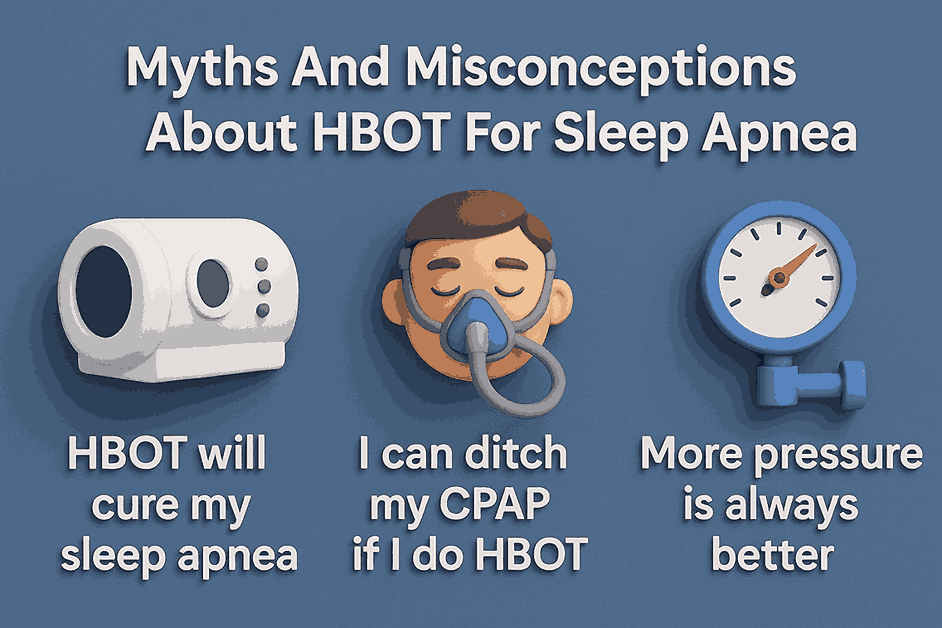
- “HBOT will cure my sleep apnea.” No. HBOT addresses oxygenation and inflammation. It does not correct the airway anatomy that causes obstructive sleep apnea.
- “I can replace my CPAP with HBOT.” This is potentially dangerous. Adjust CPAP use only with direct medical supervision, and only on the basis of documented improvement in a sleep study.
- “More pressure is always better.” HBOT protocols are carefully titrated. Excess pressure adds risk. A higher ATA is not more therapeutic for every condition.
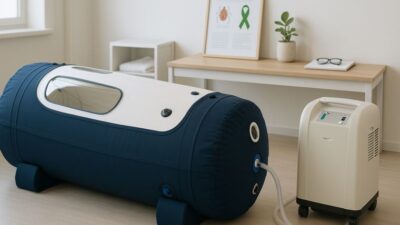
- “A soft chamber at home will fix it.” Home soft chambers do not reach the pressures used in research or clinical HBOT. They are not the same intervention as medical-grade hard-chamber therapy.
What To Expect In A Session
If you book an HBOT session, the process is the same regardless of indication:
- Initial consultation: Medical history and relevant test results reviewed.
- Getting inside: You sit or recline in a chamber, either a single-person monoplace hard chamber or a multiplace unit.
- Pressurization: A gradual increase to the prescribed pressure. Ear-pressure sensations are normal.
- Breathing oxygen: For 60 to 90 minutes, you breathe concentrated oxygen while relaxing.
- Decompression: Pressure returns to normal over a few minutes. No downtime afterward.
What Are The Side Effects And Risks?
HBOT is considered safe when performed at accredited facilities by trained staff. It is not suitable for everyone, especially people with untreated pneumothorax, certain ear or sinus problems, or uncontrolled high fevers. Common minor effects include ear pressure and temporary vision changes.
Any clinician should integrate HBOT into your existing care plan rather than substitute it for proven treatment. Sessions typically cost $150 to $300 at medical-grade facilities, and HBOT session costs vary widely by location and chamber type. Insurance does not cover HBOT for sleep apnea, because it is not an FDA-cleared indication (FDA, Safe Use of Hyperbaric Oxygen Therapy Devices). For a full breakdown of what to watch for, see our guide to hyperbaric chamber side effects.
Integrating HBOT Into A Sleep Apnea Wellness Plan
If you decide to try a hyperbaric chamber alongside sleep apnea management, the highest-value move is to pair it with the interventions that actually carry evidence:
- CPAP therapy keeps the airway open and remains the standard of care with decades of RCT support.
- Weight management can reduce airway collapsibility in obesity-related OSA.
- Myofunctional therapy strengthens the muscles that hold the airway open.
- Sleep hygiene with consistent bedtimes and a dark, cool room helps consolidate sleep stages.
- Monitoring with overnight oximetry tracks changes in oxygen saturation over time.
The Bottom Line
A hyperbaric chamber is not a treatment for sleep apnea and not a replacement for CPAP. The biological mechanisms are plausible, and a 2025 systematic review found preliminary theoretical support, but no dedicated randomized controlled trial exists for obstructive or central sleep apnea, and the evidence base is insufficient for clinical recommendations. If you are weighing HBOT as an adjunct to your existing management, talk it through with your sleep specialist first, and use it with clear eyes about the evidence, not as a primary treatment.
FAQs
Can HBOT replace CPAP for sleep apnea?
No. CPAP is the first-line, evidence-based therapy for obstructive sleep apnea per the 2019 AASM clinical practice guideline (Patil et al., J Clin Sleep Med). HBOT has no randomized-trial support in sleep apnea and does not correct airway collapse. Use HBOT, if at all, only as an adjunct under medical supervision, and never discontinue CPAP without documented improvement on a repeat sleep study.
How soon would I notice results from HBOT for sleep apnea?
There is no established timeline, because no clinical trial has measured HBOT for sleep apnea. The 2025 Pulmonary Therapy review (Duong-Quy et al.) found the evidence insufficient to define an expected response. Any benefit would likely be gradual and secondary, related to inflammation or daytime oxygenation, rather than a direct treatment effect on apnea events.
Is HBOT effective for both obstructive and central sleep apnea?
The mechanisms differ between obstructive and central sleep apnea, and the evidence is insufficient for either. The 2025 systematic review by Duong-Quy and colleagues grouped both under sleep breathing disorders and found no adequately powered trials. Discuss HBOT with your specialist in the context of your specific diagnosis rather than assuming a shared benefit.
Can I do HBOT at home with a soft chamber for sleep apnea?
Home soft chambers do not reach medical-grade pressures and are not the intervention studied in research. Because HBOT is unproven for sleep apnea to begin with, a lower-pressure home unit has even less basis. If you are weighing at-home options, read our hyperbaric chamber rental guide for safety and cost details first.
Sources
Sources
- Duong-Quy S, et al. “Hyperbaric Oxygen Therapy and Its Physio-Mechanical Effects on Sleep Breathing Disorder: A Systematic Review.” Pulmonary Therapy, 2025. doi.org/10.1007/s41030-025-00335-w
- Mehta V, Vasu TS, Phillips B, Chung F. “Obstructive Sleep Apnea and Oxygen Therapy: A Systematic Review of the Literature and Meta-Analysis.” Journal of Clinical Sleep Medicine, 2013. doi.org/10.5664/jcsm.2500
- Patil SP, Ayappa IA, Caples SM, et al. “Treatment of Adult Obstructive Sleep Apnea with Positive Airway Pressure: An American Academy of Sleep Medicine Clinical Practice Guideline.” Journal of Clinical Sleep Medicine, 2019. doi.org/10.5664/jcsm.7640
- Dewan NA, Nieto FJ, Somers VK. “Intermittent Hypoxemia and OSA: Implications for Comorbidities.” Chest, 2015. doi.org/10.1378/chest.14-0500
- U.S. Food and Drug Administration. “Follow Instructions for Safe Use of Hyperbaric Oxygen Therapy Devices: Letter to Health Care Providers,” 2021. fda.gov
- Undersea and Hyperbaric Medical Society. “UHMS Approved Indications for Hyperbaric Oxygen Therapy” (13th Edition reference). uhms.org
Medical Disclaimer
The content on BaricBoost.com is for informational purposes only and is not intended as a substitute for professional medical advice, diagnosis, or treatment. Always seek the advice of your physician or other qualified health provider with any questions you may have regarding a medical condition. Never disregard professional medical advice or delay in seeking it because of something you have read on this website.

Author
Seph Fontane Pennock is the founder of BaricBoost.com and Regenerated.com, a clinic directory for regenerative medicine serving 10,000+ providers across the United States. He previously built and sold PositivePsychology.com, which grew to 19 million users and became the largest evidence-based positive psychology resource on the web. Seph brings direct experience as an HBOT patient, having completed protocols at clinics across three continents while navigating mold illness, systemic inflammation, and autoimmune conditions. His treatment journey includes hyperbaric oxygen therapy, peptide protocols, NAD+ therapy, and consultations with specialists from Dubai to Cape Town to Mexico. This combination of entrepreneurial track record and lived patient experience shapes everything published on BaricBoost.com. Every article is grounded in peer-reviewed research, informed by real clinical encounters, and written for patients making high-stakes treatment decisions. Seph's focus is on bringing transparency, scientific rigor, and practical guidance to the hyperbaric oxygen therapy space.
Why Trust Our Evaluations
Our rankings are based on hands-on testing, published clinical data, and verified manufacturer specifications. We apply the same criteria to every product regardless of affiliate status. Editorial Process · Evaluation Methodology