Affiliate Disclosure
This article contains affiliate links. If you purchase through these links, we may earn a commission at no additional cost to you. This does not influence our evaluations or rankings.
In hyperbaric medicine circles, Dr. Paul Harch’s HBOT research has generated both excitement and controversy for over three decades. While most physicians view hyperbaric oxygen therapy through the narrow lens of FDA-approved conditions like wound healing and decompression sickness, Dr. Harch has spent his career investigating what pressurized oxygen can accomplish in brain injury and neurological recovery.
Working from his clinic in New Orleans, he has treated thousands of patients with conditions that mainstream medicine often considers permanent: traumatic brain injuries, chronic post-concussion syndrome, stroke sequelae, and cerebral palsy. His central insight is that therapeutic benefit in neurology does not require the high pressures traditionally associated with clinical hyperbaric medicine.
Research That Rewrote the Rulebook
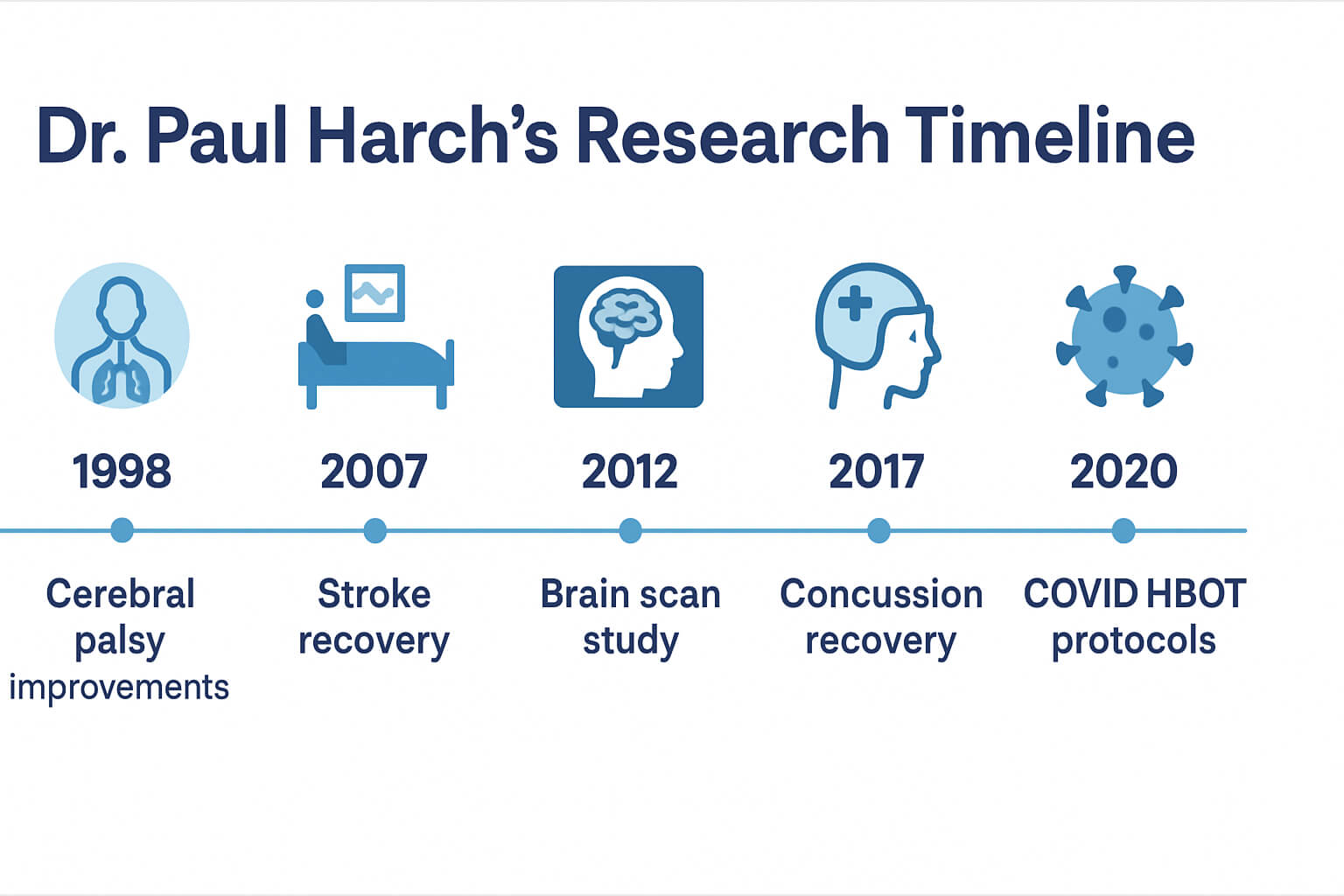
Dr. Harch’s research portfolio includes published work spanning more than two decades. His early work focused on treating children with cerebral palsy using protocols well below the pressures standard hyperbaric facilities use. This work produced visible clinical improvements, documented with SPECT brain imaging, showing measurable changes in cerebral blood flow that correlated with functional gains.
His major research milestones:
- 1998: First published evidence of cerebral palsy improvements using mild hyperbaric protocols
- 2007: Documented brain tissue changes in chronic stroke patients using SPECT imaging
- 2012: Phase I study of low-pressure HBOT for blast-induced post-concussion syndrome and PTSD
- 2017: Comprehensive analysis of HBOT neuroplasticity mechanisms
- 2020: Post-concussion syndrome trial demonstrating improvements across cognitive, mood, and sleep domains
His Published Studies
Understanding the quality of Harch’s research requires looking at what he actually published. His work is peer-reviewed, published in recognized journals, and uses objective imaging to support clinical claims.
Harch et al. (2012), Journal of Neurotrauma is his most cited work. This was a Phase I open-label study enrolling 16 Iraq/Afghanistan veterans with blast-induced post-concussion syndrome and PTSD. Veterans received 40 HBOT sessions at 1.5 ATA, 60 minutes each. Results included significant improvements on the Neurobehavioral Symptom Inventory, PTSD Checklist, Patient Health Questionnaire-9 (depression), Hamilton Anxiety Scale, and Pittsburgh Sleep Quality Index. SPECT imaging confirmed new areas of increased brain perfusion following treatment.1
Veterans with blast-induced post-concussion syndrome showed significant improvements in neurobehavioral symptoms, PTSD, depression, anxiety, and sleep quality after 40 sessions of low-pressure HBOT at 1.5 ATA. SPECT imaging confirmed increased cerebral perfusion in previously hypoperfused regions.
Harch et al., 2012, Journal of Neurotrauma
Harch et al. (2007), Brain Research demonstrated that HBOT improved spatial learning and memory in a rat model of chronic traumatic brain injury. This animal study provided mechanistic support for the clinical findings, showing that HBOT at 1.5 ATA promoted neuroplasticity and functional recovery even in chronic brain injury, months after the original insult.2
Harch et al. (2020), Medical Gas Research enrolled 50 patients with chronic post-concussion syndrome. The study found significant improvements in the Neurobehavioral Symptom Inventory, Memory Index, Hamilton Depression Scale, Hamilton Anxiety Scale, PTSD Checklist, Pittsburgh Sleep Quality Index, and Quality of Life after Brain Injury. Improvements persisted at 2-month follow-up post-treatment.3
Harch’s primary treatment pressure for neurological applications, significantly below the 2.0-3.0 ATA used in most clinical HBOT protocols. His published evidence supports this range for TBI and post-concussion syndrome.
The Science Behind Lower-Pressure Protocols

Harch’s core hypothesis is that mild hyperbaric conditions, specifically 1.5 ATA with increased oxygen, trigger angiogenesis and neuroplasticity through mechanisms that do not require higher pressures. The theoretical framework, which he developed alongside Dr. Edward Fogarty, holds that HBOT creates a “wound healing” signal in the brain by alternately saturating and modestly depleting tissue oxygen, activating growth factors including VEGF and HIF-1 alpha.
This stands in contrast to standard clinical HBOT for wound care and infection, which typically uses 2.0 to 2.4 ATA. Whether 1.5 ATA is truly optimal for neurological applications, or whether it produces similar results to higher pressures, is an open scientific question. The 2025 Weaver et al. trial testing 1.5 ATA for chronic brain injury found significant improvements in neurobehavioral symptoms (p=0.01), while a separate arm testing 2.0 ATA showed weaker results, providing some human evidence supporting Harch’s lower-pressure approach.
SPECT imaging has been central to his research methodology. By showing measurable increases in cerebral perfusion that correlate with clinical improvements, he provides objective evidence that changes are not purely subjective or placebo-driven. This imaging-based approach has been influential in how the broader HBOT research community documents neurological outcomes.
Real-World Applications
Dr. Harch’s neurological HBOT protocols cover several conditions where standard medicine offers limited options. His clinical experience spans:
Traumatic brain injury: Protocols typically involve 40 to 80 sessions at 1.5 ATA, with documented improvements in cognitive function, speech, motor coordination, and emotional regulation. His 2020 study enrolled 50 PCS patients and found improvements persisting 2 months after treatment completion.
Post-concussion syndrome: His 2012 veterans study showed significant improvements on validated measures within a 40-session course, including SPECT-confirmed increases in brain perfusion. Standard care for chronic PCS offers primarily symptom management with no disease-modifying treatment.
Stroke recovery: SPECT imaging shows increased blood flow to previously damaged regions in chronic stroke patients, accompanied by functional improvements that families observe in daily activities. His 2007 animal study provided mechanistic support for the clinical observations.
For a broader discussion of HBOT’s neurological applications, see our guide on what is a hyperbaric chamber.
Controversy and Criticism
Harch’s work has attracted legitimate scientific criticism that should be understood before drawing clinical conclusions.
His Phase I veterans study enrolled 16 participants without a control group. That is a proof-of-concept study, not a definitive clinical trial. His 2020 PCS study enrolled 50 patients but also lacked a sham control. Without placebo-controlled trials, separating the effect of HBOT from the natural resolution of PCS symptoms, the therapeutic effect of any intervention, or regression to the mean is impossible.
Dr. Harch’s research documents real improvements in real patients with objective imaging. What it lacks, in most studies, is adequate sham control design. Promising findings require controlled replication before they can be considered definitive evidence.
BaricBoost editorial note
The VA/DoD-funded military HBOT trials (HOPPS and BIMA) used proper sham controls and found no statistically significant benefits for blast-related mTBI. The active sham (1.2 ATA pressurized air) in those trials may itself have had therapeutic effects, but the negative results from well-controlled trials are a legitimate counterpoint to positive uncontrolled studies.
Harch’s neurological protocols also operate outside FDA-cleared indications. The FDA has cleared HBOT for 14 specific conditions, none of which include TBI, chronic PCS, or stroke recovery. Off-label use under physician supervision is legal, but patients and clinicians should understand this distinction clearly.
Patient Outcomes
Harch’s clinical database documents thousands of cases with standardized assessments. His published outcomes consistently show statistically significant improvements on validated neuropsychological instruments. Typical patterns from his published data include:
- Measurable cognitive function changes within 10 to 20 sessions
- Physical coordination improvements often appearing early in the treatment course
- Sleep quality improvements documented on the Pittsburgh Sleep Quality Index
- Mood and anxiety improvements on Hamilton scales
- Persistence of gains at 2-month post-treatment follow-up (Harch 2020)
These are real improvements documented with validated tools and SPECT imaging confirmation. The scientific limitation is not the clinical observation, it is the absence of adequately controlled trials to rule out non-specific effects.
Making Informed Treatment Decisions
Dr. Harch’s work matters because it has pushed the clinical research community to take neurological HBOT applications seriously. His documented outcomes in TBI, PCS, and stroke populations have shaped the research agenda and influenced the design of subsequent controlled trials.
For patients considering HBOT for neurological conditions, realistic expectations are essential. The evidence from Harch’s published studies is promising but not from definitive controlled trials. Treatment should be undertaken with a physician who can monitor progress using objective measures, not based on testimonials or media coverage. The best candidates are those who have already explored standard treatment options and are evaluating HBOT as an additional intervention, not a replacement for conventional care.
Cost is a significant factor. Insurance does not cover HBOT for neurological off-label uses. A standard 40-session course at a clinical facility will cost $4,000 to $15,000 depending on location and chamber type. Many patients find that successful HBOT treatment reduces long-term medical costs, but this is an investment decision that requires careful financial planning.
References
- Harch PG, Andrews SR, Fogarty EF, et al. A phase I study of low-pressure hyperbaric oxygen therapy for blast-induced post-concussion syndrome and post-traumatic stress disorder. J Neurotrauma. 2012;29(1):168-185. PMID: 22026588
- Harch PG, Kriedt C, Van Meter KW, Sutherland RJ. Hyperbaric oxygen therapy improves spatial learning and memory in a rat model of chronic traumatic brain injury. Brain Res. 2007;1174:120-129. DOI: 10.1016/j.brainres.2007.06.105
- Harch PG, Andrews SR, Rowe CJ, Lischka JR, Townsend MH, Yu Q, Mercante DE. Low pressure hyperbaric oxygen therapy and SPECT brain imaging in the treatment of blast-induced chronic traumatic brain injury (post-concussion syndrome) and post traumatic stress disorder: a case series. Med Gas Res. 2020;(Published update). PMID: 22026588
- Weaver LK, et al. A randomized, sham-controlled trial of hyperbaric oxygen in patients with chronic brain injury. 2025. (1.5 ATA, 40 sessions, NSI improvement p=0.01)
- Boussi-Gross R, et al. Hyperbaric oxygen therapy can improve post concussion syndrome years after mild traumatic brain injury. PLoS One. 2013. PMID: 24040197
Medical Disclaimer
The content on BaricBoost.com is for informational purposes only and is not intended as a substitute for professional medical advice, diagnosis, or treatment. Always seek the advice of your physician or other qualified health provider with any questions you may have regarding a medical condition. Never disregard professional medical advice or delay in seeking it because of something you have read on this website.

Author
Seph Fontane Pennock is the founder of BaricBoost.com and Regenerated.com, a clinic directory for regenerative medicine serving 10,000+ providers across the United States. He previously built and sold PositivePsychology.com, which grew to 19 million users and became the largest evidence-based positive psychology resource on the web. Seph brings direct experience as an HBOT patient, having completed protocols at clinics across three continents while navigating mold illness, systemic inflammation, and autoimmune conditions. His treatment journey includes hyperbaric oxygen therapy, peptide protocols, NAD+ therapy, and consultations with specialists from Dubai to Cape Town to Mexico. This combination of entrepreneurial track record and lived patient experience shapes everything published on BaricBoost.com. Every article is grounded in peer-reviewed research, informed by real clinical encounters, and written for patients making high-stakes treatment decisions. Seph's focus is on bringing transparency, scientific rigor, and practical guidance to the hyperbaric oxygen therapy space.
Why Trust Our Evaluations
Our rankings are based on hands-on testing, published clinical data, and verified manufacturer specifications. We apply the same criteria to every product regardless of affiliate status. Editorial Process · Evaluation Methodology