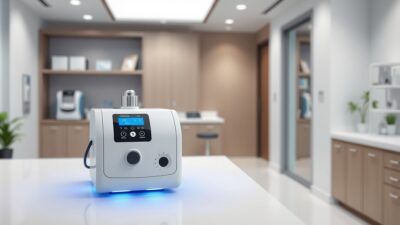
Rectal ozone therapy delivers a mixture of ozone and oxygen gas into the body through the rectum, where it is absorbed through the intestinal lining into the bloodstream. Also called rectal insufflation, it is one of the most common routes for systemic ozone therapy because it avoids needles, is simple to perform, and costs about $75 to $150 per clinic session. Practitioners use it for gut inflammation and systemic immune support, though the clinical evidence remains early-stage.
Key Takeaways
- Rectal ozone therapy delivers an ozone/oxygen gas mix through the rectum for systemic absorption via the intestinal mucosa.
- The proposed mechanism is a controlled, mild oxidative stimulus that activates the Nrf2 antioxidant pathway and modulates NF-kB inflammation signaling.
- Preliminary research shows effects on gut microbiota, inflammatory markers, and immune function, but large randomized controlled trials are lacking.
- Sessions cost about $75 to $150 at a clinic. Home units run $2,500 to $4,000 upfront.
- It is generally well tolerated but should not replace conventional treatment for serious conditions.
The mechanism is well characterized. The clinical outcome data is thinner: mostly small studies, animal models, and case reports rather than large controlled trials.
What is rectal ozone therapy?
Rectal insufflation is one of several delivery routes covered in our main ozone therapy guide. Ozone (O3) is a molecule of three oxygen atoms. It is unstable and highly reactive, which is exactly why it has biological effects. Medical-grade ozone is produced by a generator that converts pure medical oxygen (O2) into a precise ozone/oxygen mixture, typically at concentrations of 20 to 80 micrograms per milliliter (mcg/mL).
In rectal insufflation, this gas mixture is introduced into the rectum through a thin, flexible catheter. The volume is usually 100 to 300 mL per session, delivered slowly over a few minutes. The ozone reacts with the intestinal mucosa almost immediately, generating secondary messengers called ozonides and lipid oxidation products (LOPs) that then enter the bloodstream through the rectal and sigmoid colon vasculature.1
The rectum suits this well because it has a rich blood supply and a large absorptive surface. Much of the venous drainage from the lower rectum bypasses the liver via the inferior rectal veins, so absorbed compounds reach systemic circulation relatively quickly. For how this route fits into a full treatment plan, see our ozone therapy protocols guide.
How does it work? The biochemistry
The rationale rests on hormesis: a small, controlled stress that triggers a disproportionately large protective response.
When ozone contacts biological fluids and tissues, it produces reactive oxygen species (ROS) and lipid oxidation products. At low therapeutic concentrations, these act as signaling molecules rather than causing damage. The key pathways:23
- Nrf2 activation: nuclear factor erythroid 2-related factor 2 is a master regulator of antioxidant defense. Mild oxidative stress activates Nrf2, which triggers protective enzymes including superoxide dismutase (SOD), glutathione peroxidase (GPx), catalase, and heme oxygenase-1 (HO-1).
- NF-kB modulation: at therapeutic doses, ozone can suppress the NF-kB inflammatory pathway, the opposite of what severe oxidative stress does.
- Glutathione system shift: ozone therapy has been shown to raise the ratio of reduced glutathione (GSH) to oxidized glutathione (GSSG), strengthening the body’s main intracellular antioxidant system.4
- Improved oxygen delivery: ozone increases 2,3-diphosphoglycerate (2,3-DPG) in red blood cells, shifting the hemoglobin-oxygen dissociation curve so hemoglobin releases oxygen more readily to tissues.1
The direction of the effect depends on dose. Sagai and Bocci describe how moderate oxidative stress activates Nrf2 and the antioxidant response, while severe oxidative stress instead drives NF-kB and inflammation.3 This is why concentration control matters so much in practice.
What does a session look like?
In a clinic
A typical clinical session takes 15 to 30 minutes:
- You lie on your left side on a treatment table.
- The practitioner inserts a thin, lubricated catheter a few inches into the rectum.
- The generator produces the gas mixture at a set concentration (usually 20 to 30 mcg/mL for new patients).
- 100 to 300 mL of the ozone/oxygen mixture is slowly insufflated over 2 to 5 minutes.
- You hold the gas as long as comfortable, though some absorbs almost immediately.
- Any remaining gas is passed naturally.
Most protocols call for 1 to 3 sessions per week, with an initial series of 6 to 10 sessions. Maintenance schedules range from weekly to monthly depending on the condition.
At home
Rectal ozone therapy is one of the few ozone modalities that can be done at home with medical-grade equipment. A home setup requires:
- A medical ozone generator with precise concentration control (not an air purifier or industrial machine).
- An oxygen source (medical-grade oxygen tank or oxygen concentrator).
- Disposable rectal catheters (usually thin silicone).
- A syringe or bag to collect the gas mixture before insufflation.
Home generators designed for rectal insufflation cost between $2,500 and $4,000. Ongoing costs are mainly oxygen refills and disposable catheters. One caution: concentration matters. Too low and there is no effect; too high and you risk irritating the intestinal lining. Work with an experienced practitioner to set a starting concentration and titration schedule. Self-dosing without guidance is not recommended.
What does the research say?
The honest assessment: rectal ozone therapy has plausible mechanisms, interesting preliminary data, and practitioners who report clinical benefit. What it lacks is the large, randomized, placebo-controlled trials that would move it from promising to proven for specific conditions.
Gut health and microbiome
Animal work suggests rectal ozone can influence the gut. In a mouse model of chronic REM sleep deprivation, Cheng and colleagues found that ozone rectal insufflation improved cognition while reducing inflammation and regulating gut microbiota composition.5 This is an animal study, and the microbiome findings have not been reproduced in a controlled human trial.
Inflammatory bowel disease
A clinical study by Geng and colleagues in 54 patients found that ozone therapy combined with sulfasalazine, delivered via a colon route, outperformed sulfasalazine alone for distal ulcerative colitis, improving symptoms.6 The result is encouraging but comes from a single small study. No large multicenter trial has tested ozone in IBD. Our guide to ozone therapy for ulcerative colitis covers this evidence in more depth.
Immune function
A 2018 study by Díaz-Luis and colleagues in patients with IgA deficiency reported that systemic ozone by rectal insufflation was associated with improvements in immunoglobulin levels and clinical symptoms.7 Small studies like this do not prove efficacy, but they add to the pattern of immune-modulating effects seen in laboratory work.
Anti-inflammatory effects
A 2025 mouse study by Zhu and colleagues showed that rectal ozone insufflation attenuated lung inflammation in a COPD-like model by inhibiting the TLR4/NF-kB pathway and upregulating Nrf2.8 This supports the proposed mechanism but needs human confirmation.
| Condition | Evidence Level | Summary |
|---|---|---|
| Gut microbiota effects | Emerging (animal) | Favorable microbiota shifts in a mouse model |
| Ulcerative colitis | Emerging (small clinical) | Adjunctive benefit with standard therapy |
| Immune modulation | Limited (small study) | Improved markers in IgA deficiency |
| Systemic anti-inflammatory mechanism | Moderate (mechanistic) | Nrf2/NF-kB pathway well characterized |
Rectal ozone vs IV ozone: how do they compare?
IV ozone therapy (major autohemotherapy, or MAH) involves drawing blood, mixing it with ozone, and reinfusing it. It is the most studied route for systemic ozone delivery but requires a trained practitioner and IV access.
| Factor | Rectal Insufflation | IV Ozone (MAH) |
|---|---|---|
| Route | Rectal mucosa absorption | Direct blood contact |
| Needles required | No | Yes (IV access) |
| Home use | Possible with proper equipment | Not recommended at home |
| Cost per session | $75-$150 (clinic) | $200-$350 (clinic) |
| Local gut effects | Yes (direct mucosal contact) | No direct gut effect |
| Systemic absorption | Good (via rectal vasculature) | Direct (full blood exposure) |
| Research base | Growing but limited | More extensively studied |
In his 2006 review, Bocci offered an expert estimate that rectal insufflation is roughly 80% as effective as MAH for systemic effects, while giving superior local gut effects.1 That figure is a clinician’s judgment from a narrative review, not a head-to-head trial result, so treat it as an approximation. Even so, it makes rectal insufflation a reasonable choice for patients who want both systemic and gut-specific effects or who prefer to avoid IV access. For how the costs line up across routes, see our ozone therapy cost breakdown.
How much does rectal ozone therapy cost?
| Option | Cost | Notes |
|---|---|---|
| Single clinic session | $75-$150 | Varies by location and practitioner |
| Initial series (10 sessions) | $750-$1,500 | Some clinics offer package discounts |
| Home ozone generator | $2,500-$4,000 | One-time cost for medical-grade unit |
| Oxygen tank refill | $20-$50 | Lasts many sessions |
| Disposable catheters | $1-$3 each | Single-use recommended |
Insurance does not typically cover ozone therapy. A few integrative practices fold it into broader treatment packages, but expect to pay out of pocket for the ozone component.
Is rectal ozone therapy safe?
Rectal ozone therapy is generally considered safe when performed correctly with medical-grade equipment at appropriate concentrations. Reported side effects are mild and uncommon:
- Cramping or bloating: temporary, usually resolving within 30 minutes. More common at higher gas volumes.
- Urgency to use the bathroom: the gas can stimulate peristalsis. Some patients have loose stools after their first few sessions.
- Die-off reactions: some practitioners report that patients with significant gut dysbiosis get transient worsening (fatigue, headache) early on, attributed to microbial die-off. This is anecdotal rather than documented in clinical literature.
Serious adverse events from rectal ozone insufflation are rare in the published literature. The main risks come from non-medical equipment, incorrect concentrations, or skipping practitioner guidance for home use. For the full picture across all routes, see our ozone therapy safety guide.
Who should avoid rectal ozone therapy
- Patients with active rectal bleeding or hemorrhoids in acute flare.
- Those with recent colorectal surgery.
- People with G6PD (glucose-6-phosphate dehydrogenase) deficiency, since ozone can trigger hemolytic anemia in this group.
- Pregnant women (insufficient safety data).
- Anyone with hyperthyroidism (ozone can stimulate metabolic rate).
Frequently Asked Questions
Is rectal ozone therapy FDA-approved?
No. Ozone therapy of any type is not FDA-approved for any medical condition in the United States. It is legal in most states when administered by a licensed practitioner, but it falls outside conventional medicine’s standard of care. Several European countries, including Germany, Italy, and Spain, have longer histories of clinical use and more established regulatory frameworks.
How quickly do you feel results?
It varies widely. Some patients report more energy after their first session, while others notice gradual improvement over weeks. For gut-specific issues, practitioners typically suggest evaluating after a full initial series of 6 to 10 sessions before judging efficacy. Expectations should stay modest, since the controlled-trial evidence is limited.
Can you do rectal ozone therapy at home?
Yes, with appropriate medical-grade equipment and practitioner guidance on concentration and protocol. Do not use industrial ozone generators, air purifiers, or any device not designed for medical ozone. The ozone source must be pure medical oxygen, not ambient air, which would produce nitrogen oxides.
How does rectal ozone differ from ozone sauna or ear insufflation?
These are different delivery routes. Ozone saunas expose the skin to ozone-infused steam. Ear insufflation delivers small amounts of ozone through the ear canal. Rectal insufflation gives the most direct route to both the gut and systemic circulation among the non-IV methods. Each route has different primary targets and absorption characteristics.
The bottom line
Rectal ozone therapy is a non-invasive route for systemic ozone delivery with growing but still preliminary clinical evidence. The biochemical mechanisms are well characterized (Nrf2 activation, NF-kB modulation, enhanced oxygen delivery), and early research on gut health, inflammation, and immune function is encouraging. But it has not been validated by the large controlled trials that would establish it as a standard treatment for any condition. For patients exploring ozone therapy, rectal insufflation offers a lower-cost, needle-free option with the added benefit of direct gut effects. Work with a knowledgeable practitioner, start at conservative concentrations, and keep expectations realistic about what the current evidence supports.
Sources
- Bocci V. Scientific and medical aspects of ozone therapy. State of the art. Arch Med Res. 2006;37(4):425-435. PMID: 16624639
- Re L, Mawsouf MN, Menendez S, Leon OS, Sanchez GM, Hernandez F. Ozone therapy: clinical and basic evidence of its therapeutic potential. Arch Med Res. 2008;39(1):17-26. PMID: 18067991
- Sagai M, Bocci V. Mechanisms of action involved in ozone therapy: is healing induced via a mild oxidative stress? Med Gas Res. 2011;1:29. PMID: 22185664
- Viebahn-Haensler R, Leon Fernandez OS. Ozone in medicine: the low-dose ozone concept and its basic biochemical mechanisms of action in chronic inflammatory diseases. Int J Mol Sci. 2021;22(15):7890. PMID: 34360655
- Cheng J, et al. Ozone rectal insufflation mitigates chronic rapid eye movement sleep deprivation-induced cognitive impairment through inflammation alleviation and gut microbiota regulation in mice. Med Gas Res. 2024;14(4):213-224. PMID: 39073330
- Geng Y, et al. Ozone therapy combined with sulfasalazine delivered via a colon therapy system for treatment of ulcerative colitis. Nan Fang Yi Ke Da Xue Xue Bao. 2010;30(12):2684-2688. PMID: 21177179
- Diaz-Luis J, et al. Systemic ozone therapy by rectal insufflation for immunoglobulin A deficiency. MEDICC Rev. 2018;20(1):29. PMID: 34229419
- Zhu X, Zhao Q, Wang P, Cao S, Williams JP. Ozone rectal insufflation attenuates lung inflammation by inhibiting the TLR4/NF-kB pathway through upregulation of Nrf2 in mice with COPD-like pathology. Int Immunopharmacol. 2025;167:115676. PMID: 41115352
Medical Disclaimer
The content on BaricBoost.com is for informational purposes only and is not intended as a substitute for professional medical advice, diagnosis, or treatment. Always seek the advice of your physician or other qualified health provider with any questions you may have regarding a medical condition. Never disregard professional medical advice or delay in seeking it because of something you have read on this website.

Author
Seph Fontane Pennock is the founder of BaricBoost.com and Regenerated.com, a clinic directory for regenerative medicine serving 10,000+ providers across the United States. He previously built and sold PositivePsychology.com, which grew to 19 million users and became the largest evidence-based positive psychology resource on the web. Seph brings direct experience as an HBOT patient, having completed protocols at clinics across three continents while navigating mold illness, systemic inflammation, and autoimmune conditions. His treatment journey includes hyperbaric oxygen therapy, peptide protocols, NAD+ therapy, and consultations with specialists from Dubai to Cape Town to Mexico. This combination of entrepreneurial track record and lived patient experience shapes everything published on BaricBoost.com. Every article is grounded in peer-reviewed research, informed by real clinical encounters, and written for patients making high-stakes treatment decisions. Seph's focus is on bringing transparency, scientific rigor, and practical guidance to the hyperbaric oxygen therapy space.