According to the Undersea and Hyperbaric Medical Society, HBOT is recognized for 14 FDA-cleared medical indications, with over 1.5 million treatments administered annually in the United States.
Undersea and Hyperbaric Medical Society (UHMS)
Hyperbaric oxygen therapy in Australia offers the same physiological benefits documented in international research, but the Australian regulatory framework, Medicare coverage rules, and available chamber pressures shape what those benefits mean in practice. This guide covers what the evidence shows, what Medicare covers, and how Australian patients access HBOT.
How Does HBOT Work at the Cellular Level?
Hyperbaric oxygen therapy works by raising atmospheric pressure inside a sealed chamber while the patient breathes 100% oxygen. Under Henry’s Law of physics, the amount of gas dissolved in a liquid is proportional to the pressure above it. At 2.0 ATA with 100% oxygen, plasma-dissolved oxygen rises from the normal 0.3 mL per 100 mL of blood to 6–8 mL per 100 mL, a 20-fold increase.[1]
This dissolved oxygen reaches tissues without relying on red blood cells, penetrating areas of compromised circulation where normal oxygen delivery is inadequate. The cascade of effects extends beyond oxygenation: HBOT stimulates new blood vessel formation (angiogenesis), mobilizes stem cells from bone marrow (up to 8-fold increase after 20–40 sessions), reduces inflammation, and creates an environment hostile to anaerobic bacteria.[1]
Evidence-Based Benefits: What Research Shows
Strong Evidence (FDA-Cleared Indications in the US; Similar Standards Apply Globally)
Diabetic foot ulcers and chronic wounds: HBOT is one of the most evidence-supported adjunctive treatments for chronic non-healing wounds related to poor arterial circulation. Clinical trials consistently show improved closure rates and reduced amputation risk. This is a major HBOT application in Australian hospital wound care programs.
Radiation injury: HBOT stimulates the growth of new blood vessels into radiation-damaged tissue, allowing healing in areas where blood supply was destroyed by radiotherapy. Australian Medicare covers this indication in comprehensive facilities. Studies show response rates of 72–78% for radiation cystitis.[3]
Carbon monoxide poisoning and decompression sickness: Emergency applications with strong evidence. Australia’s diving culture makes decompression sickness particularly relevant. Major Australian coastal hospitals maintain 24-hour hyperbaric capability for exactly these emergencies.
Sudden sensorineural hearing loss: HBOT as adjunct to steroid therapy shows meaningful benefit when started within days of hearing loss onset. Multiple studies support 10–20 sessions. This is available at Australian clinical programs.[4]
Emerging Evidence
Traumatic brain injury: Multiple randomized controlled trials show significant cognitive improvements after 40–60 HBOT sessions. Brain SPECT and MRI studies show measurable increases in cerebral blood flow in previously damaged regions. This is actively researched in Australian institutions.
Long COVID: A 2022 RCT found 40 HBOT sessions significantly improved cognitive function, fatigue, and quality of life in Long COVID patients versus sham treatment. Multiple follow-up trials are underway. Interest from Australian patients has driven expansion of private clinic access.
PTSD: A high-dose protocol (11,400 atmosphere-minutes across 40–60 sessions) produced a 39% reduction in PTSD symptoms persisting for 2 years post-treatment in one study.[5] This is an active research area in Australia given military veteran patient populations.
Soft Chamber vs Clinical HBOT in Australia: What You Are Actually Getting
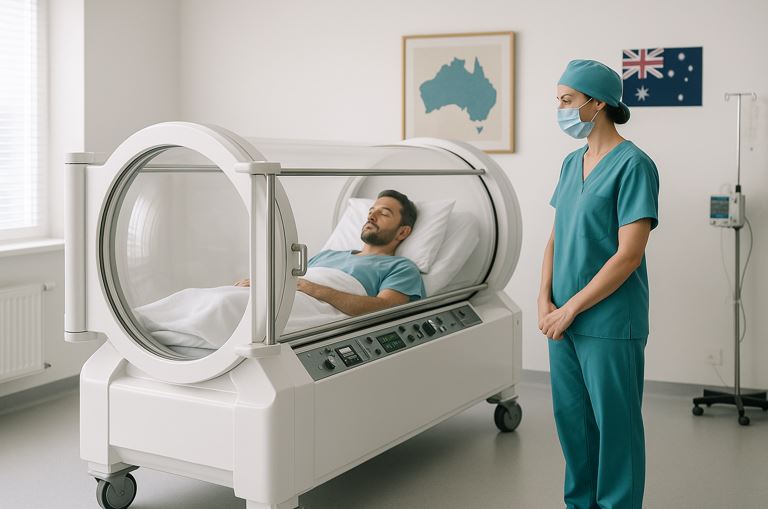
Australia’s wellness HBOT market has expanded significantly, with private clinics offering soft-shell sessions at 1.3–1.5 ATA in major cities. Understanding the difference between this and clinical HBOT matters before committing to a course of treatment.
The physiological effects at 1.3 ATA with concentrated (but not 100%) oxygen are real but significantly less pronounced than those at 2.0+ ATA in a clinical hard-shell chamber. The South African Undersea and Hyperbaric Medicine Association states plainly: “Mild hyperbaric exposures with air deliver no more oxygen to the body than breathing oxygen by mask at sea level pressure.”[2]
For general wellness, sports recovery, and some off-label applications where clinical evidence is early regardless of chamber type, mild HBOT has a reasonable place. For FDA-cleared or clinically-supported indications, the pressures used in Australian hospital programs (2.4–2.8 ATA) are what the research evidence was built on.
What to Expect During a Session
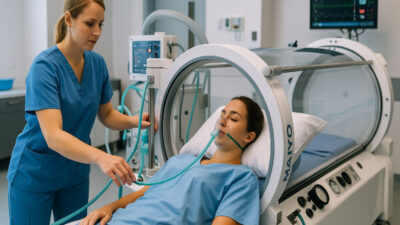
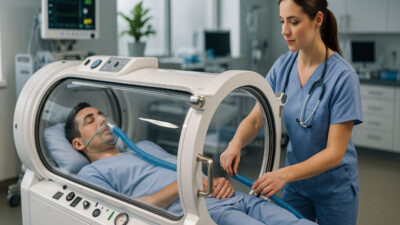
Standard sessions at Australian clinical facilities last 60–90 minutes at pressure, with total time of 1.5–2 hours including compression and decompression. Most protocols use 5-day-per-week schedules for 4–8 weeks. Acute injuries average around 15 sessions; chronic conditions average around 30.[6]
The most common side effect is ear pressure during compression, affecting 9–15% of patients. Most cases are mild and resolve without intervention. Only approximately 1.5% of patients need to discontinue treatment due to ear-related complications.[4] Temporary vision changes (myopia) occur but resolve after treatment ends.
Frequently Asked Questions
Is HBOT effective for Long COVID in Australia?
Research suggests HBOT has genuine benefit for Long COVID symptoms including fatigue, brain fog, and cognitive difficulties. A 2022 RCT showed significant improvements after 40 sessions. Australian clinicians are increasingly offering HBOT for Long COVID patients, though this remains off-label and is not Medicare-rebatable.
How many HBOT sessions do I need?
Depends on the condition. Acute injuries average 15 sessions in Australian clinical practice. Chronic conditions (wound healing, radiation injury) average 30–40 sessions. Off-label wellness protocols typically run 20–40 sessions over 4–8 weeks.[6]
Can home chambers provide the same benefits as clinical HBOT in Australia?
Not for clinical indications. The pressures achieved in home soft-shell chambers (1.3–1.5 ATA) are below what Australian Medicare-rebatable facilities must operate at (2.8 ATA) and below the pressures used in the trials supporting most clinical HBOT indications. For general wellness applications, home chambers offer accessible low-pressure therapy but should not be mistaken for clinical-grade treatment.
References
- Hadanny A, Efrati S. The Hyperoxic-Hypoxic Paradox. Biomolecules. 2020;10(6):958. DOI: 10.3390/biom10060958
- Burman F. Low-pressure fabric hyperbaric chambers. South African Medical Journal. 2019;109(4). PMID: 31084683
- Ajayi OD, et al. Comparison of two HBOT regimens for radiation-induced cystitis. Undersea & Hyperbaric Medicine. 2020;47(2). DOI: 10.22462/10.12.2020.7. PMID: 33227834
- Voigt A, et al. Systematic Review of Otologic Adverse Events in HBOT. Undersea & Hyperbaric Medicine. 2025. DOI: 10.22462/736. PMID: 41429031
- Doenyas-Barak K, Efrati S. Optimizing HBOT for PTSD. Frontiers in Neurology. 2024;15:1447742. DOI: 10.3389/fneur.2024.1447742. PMID: 39391164
- Dias MD, et al. HBOT: types of injury and number of sessions. Undersea & Hyperbaric Medicine. 2008;35(4):259-268. PMID: 18351127
Medical Disclaimer
The content on BaricBoost.com is for informational purposes only and is not intended as a substitute for professional medical advice, diagnosis, or treatment. Always seek the advice of your physician or other qualified health provider with any questions you may have regarding a medical condition. Never disregard professional medical advice or delay in seeking it because of something you have read on this website.

Author
Seph Fontane Pennock is the founder of BaricBoost.com and Regenerated.com, a clinic directory for regenerative medicine serving 10,000+ providers across the United States. He previously built and sold PositivePsychology.com, which grew to 19 million users and became the largest evidence-based positive psychology resource on the web. Seph brings direct experience as an HBOT patient, having completed protocols at clinics across three continents while navigating mold illness, systemic inflammation, and autoimmune conditions. His treatment journey includes hyperbaric oxygen therapy, peptide protocols, NAD+ therapy, and consultations with specialists from Dubai to Cape Town to Mexico. This combination of entrepreneurial track record and lived patient experience shapes everything published on BaricBoost.com. Every article is grounded in peer-reviewed research, informed by real clinical encounters, and written for patients making high-stakes treatment decisions. Seph's focus is on bringing transparency, scientific rigor, and practical guidance to the hyperbaric oxygen therapy space.