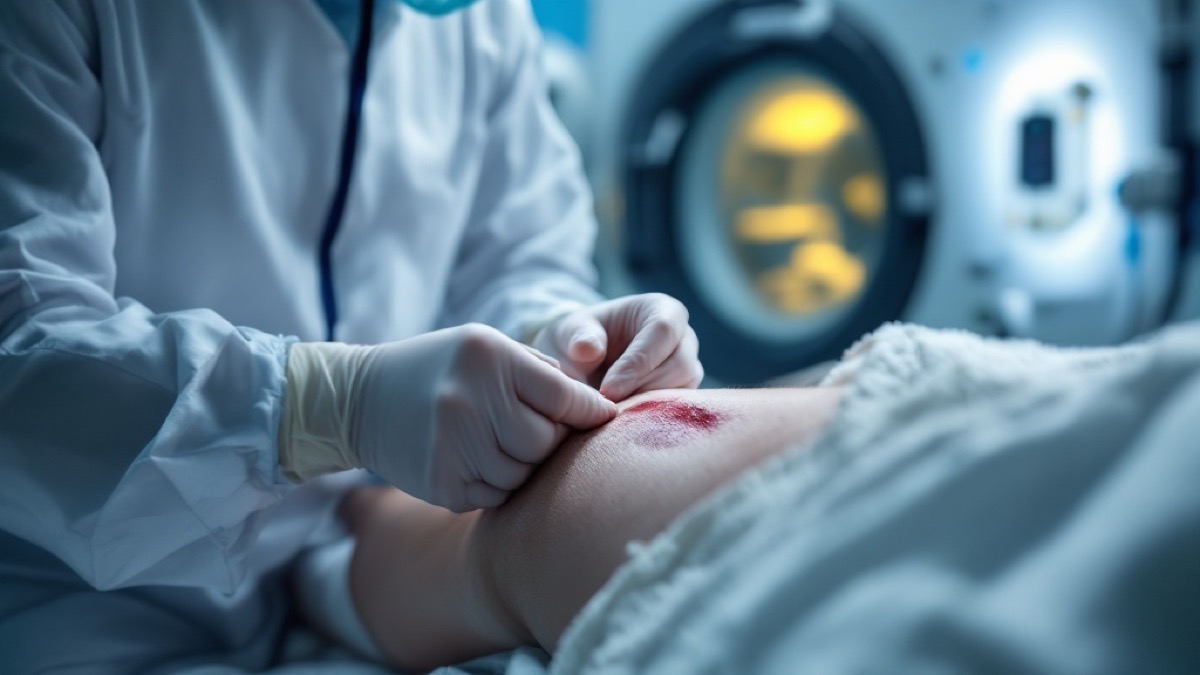
Approximately 2-5% of surgical wounds fail to heal within the expected timeframe, according to data from the National Library of Medicine. Hyperbaric oxygen therapy (HBOT) treats non-healing surgical wounds by increasing tissue oxygen levels 10-15 times above normal, directly addressing the hypoxia that keeps these wounds from closing. HBOT is FDA-cleared for compromised skin grafts and flaps, and it is used off-label for other surgical wound complications including dehiscence, sternal wound infections, and surgical site infections that resist standard management. Clinical data shows healing rates of 60-80% when HBOT is added to standard surgical wound care for refractory cases. This is one of several recovery conditions explored with hyperbaric oxygen gaining attention in clinical practice.
Why Some Surgical Wounds Fail to Heal
Surgical wound healing follows a predictable biological sequence: hemostasis (minutes to hours), inflammation (days 1-4), proliferation (days 4-21), and remodeling (weeks to months). When this sequence stalls at any phase, the result is a chronic non-healing wound. Understanding why surgical wounds fail is essential for determining whether HBOT can help.
Inadequate blood supply. Surgery itself damages local blood vessels through incision, cautery, and tissue manipulation. In patients with pre-existing vascular compromise (diabetes, peripheral arterial disease, atherosclerosis, chronic kidney disease), the remaining vasculature may not deliver enough oxygen and nutrients to support tissue repair. Transcutaneous oximetry values below 40 mmHg at the wound margin confirm tissue hypoxia. This is the primary mechanism HBOT addresses.
Prior radiation therapy. Radiation damages endothelial cells and causes progressive microvascular obliteration through endarteritis obliterans. The damage is dose-dependent and cumulative. Surgical wounds in previously irradiated tissue fail at significantly higher rates. Head and neck surgery after radiation therapy has wound complication rates of 30-60% in published literature. Pelvic surgery after radiation for cervical, rectal, or prostate cancer carries similar risks. The latency between radiation and wound complications can be months to decades.
Infection. Surgical site infections (SSIs) affect approximately 2-4% of all inpatient surgical procedures, according to the CDC. The CDC classifies SSIs as superficial incisional (skin and subcutaneous tissue), deep incisional (fascia and muscle), and organ/space (any part of the anatomy opened during surgery). Deep and organ/space SSIs can prevent wound closure for months. Biofilm formation on suture material, mesh, or orthopedic hardware is particularly resistant to antibiotics alone, often requiring device removal for resolution.
Patient factors. Diabetes (especially poorly controlled, with HbA1c above 8%), active smoking (reduces tissue oxygenation by 30-40%), malnutrition (albumin below 3.0 g/dL), obesity (BMI above 30 increases SSI risk 2-3 fold), immunosuppression (corticosteroids, chemotherapy, biologics), and advanced age all impair wound healing through overlapping mechanisms. Most patients with non-healing surgical wounds have multiple risk factors simultaneously.
Mechanical factors. Excessive tension on wound edges, inadequate dead space management, hematoma or seroma formation, premature removal of sutures or drains, and early return to strenuous activity can mechanically disrupt the healing process. These factors are often correctable without HBOT, which is why mechanical optimization should precede or accompany hyperbaric referral.
How HBOT Promotes Surgical Wound Healing
HBOT addresses non-healing surgical wounds through four well-documented biological mechanisms, each supported by decades of basic science and clinical research:
Angiogenesis (new blood vessel growth). Breathing 100% oxygen at 2.0-2.4 ATA creates a steep oxygen gradient between the hyperoxygenated blood (tissue pO2 above 1,000 mmHg) and the hypoxic wound tissue (pO2 below 20 mmHg). This gradient is the primary trigger for vascular endothelial growth factor (VEGF) production by hypoxic macrophages. VEGF drives new capillary sprouting from existing vessels into the wound bed. Over 20-40 sessions, HBOT stimulates the growth of a new microvascular network that permanently increases local oxygen delivery even after HBOT treatment ends.
Fibroblast activation and collagen synthesis. Collagen is the structural protein that gives wounds tensile strength. Its synthesis requires molecular oxygen at two critical enzymatic steps: prolyl hydroxylase (which stabilizes the collagen triple helix) and lysyl hydroxylase (which enables collagen cross-linking). Both enzymes need tissue oxygen tensions above 20 mmHg to function at normal rates. In hypoxic surgical wounds, fibroblasts are present but unable to produce structurally sound collagen. HBOT provides the oxygen substrate these enzymes require, restoring collagen quality and wound strength.
Enhanced immune function. Neutrophils generate reactive oxygen species (superoxide, hydrogen peroxide, hypochlorous acid) to kill bacteria through the respiratory burst pathway. This process requires oxygen tensions above 30-40 mmHg. In hypoxic wounds, neutrophils arrive at the infection site but cannot generate an effective respiratory burst, resulting in impaired bacterial killing. HBOT restores bactericidal capacity to levels seen in normally oxygenated tissue. It also enhances the activity of certain antibiotics, particularly aminoglycosides and fluoroquinolones, which depend on oxygen-requiring active transport mechanisms for bacterial uptake.
Edema reduction. HBOT causes vasoconstriction in well-perfused tissue (reducing inflow by approximately 20%) while paradoxically increasing oxygen delivery because the 10-15 fold increase in dissolved oxygen more than compensates for reduced flow. This “oxygen window” effect reduces edema in the peri-wound area, decreasing tissue pressure and improving microcirculation. Post-surgical edema is a significant contributor to wound complications, particularly in dependent areas like the lower extremity and in tissue compartments with limited compliance.
Compromised Grafts and Flaps: The FDA-Cleared Indication
Compromised skin grafts and flaps are the one category of surgical wound healing that carries UHMS approval and FDA clearance for HBOT. This indication covers any graft or flap where documented tissue hypoxia is compromising viability:
- Split-thickness and full-thickness skin grafts showing partial or complete failure (patchy necrosis, poor take, blue-black discoloration)
- Pedicled flaps with compromised blood supply (congestion, venous insufficiency, partial necrosis at flap margins)
- Free flaps with early signs of vascular compromise (loss of capillary refill, Doppler signal changes, color changes)
- Any graft or flap placed in a previously irradiated, scarred, or otherwise compromised recipient bed
The key criterion is documented tissue hypoxia. TCOM values below 40 mmHg at the graft or flap margin indicate compromise. When TCOM values rise above 200 mmHg during an oxygen challenge test (breathing 100% oxygen at 1.0 ATA or higher), the tissue is oxygen-responsive and HBOT is likely to help.
Timing is critical for compromised grafts and flaps. Treatment should begin within 24-48 hours of identifying compromise. Every hour of delay allows ischemic damage to progress. The typical protocol is 10-20 daily sessions at 2.0-2.4 ATA, with some centers using twice-daily sessions for the first 3-5 days. Delaying HBOT beyond 72 hours significantly reduces the likelihood of graft or flap salvage because irreversible cellular death progresses rapidly once vascular compromise is established.
Surgical Wound Dehiscence: Off-Label but Common Use
Wound dehiscence (separation of a previously closed surgical incision) is not a standalone FDA-cleared indication for HBOT, but it is one of the most common off-label uses in clinical practice. Dehiscence affects approximately 0.5-3% of abdominal surgical wounds and 1-5% of sternotomies, carrying significant morbidity and mortality.
The rationale for using HBOT in dehiscence is straightforward: the wound opened because local tissue conditions could not support healing, and those conditions (hypoxia, infection, poor vascularity) are exactly what HBOT addresses. Published case series report healing rates of 65-85% when HBOT is added to standard wound management for dehiscence that has failed conventional closure attempts.
Sternal wound dehiscence after cardiac surgery is a particularly well-documented application. Deep sternal wound infections and dehiscence occur in 1-5% of median sternotomies and carry mortality rates of 10-40%. Sternal wounds are particularly vulnerable because the sternum has a limited blood supply, the incision line is under constant respiratory motion, and many cardiac surgery patients have diabetes and vascular disease. A 2007 retrospective study by Siondalski et al. found that adjunctive HBOT reduced mortality and accelerated wound closure in patients with deep sternal wound complications.
Abdominal wound dehiscence (burst abdomen) is another common referral scenario. Risk factors include emergency surgery, malnutrition, obesity, diabetes, chronic corticosteroid use, and abdominal compartment syndrome. HBOT addresses the tissue oxygenation component but cannot correct mechanical factors like fascial weakness or excessive intra-abdominal pressure. For comprehensive wound healing data, our statistics page covers outcomes across wound types.
When Surgeons Refer for HBOT
Most surgical wound referrals to hyperbaric medicine follow a recognizable pattern. Understanding when surgeons typically make the referral helps patients advocate for timely evaluation:
Week 2-4 post-surgery: The surgeon notices the wound is not progressing as expected. Wound edges are not approximating, granulation tissue is pale or absent, or early signs of infection develop despite appropriate antibiotics. At this stage, the surgeon typically optimizes local wound care and modifiable patient factors (glycemic control, nutrition, smoking cessation) before considering HBOT referral.
Week 4-8 post-surgery: If the wound has not improved with optimized care, HBOT referral becomes appropriate. This is the most common referral window. The wound has demonstrated that it cannot heal with standard measures alone, satisfying the clinical (and insurance) requirement for failed conservative management.
Immediate post-operative (within 48 hours): For compromised grafts or flaps, the referral should happen as soon as vascular compromise is identified. This is a true hyperbaric urgency in terms of tissue salvage. Operating rooms at major trauma centers and microsurgical centers often have pre-arranged protocols for emergent HBOT referral when flap compromise is detected.
Pre-operative (2-3 weeks before planned surgery): In planned surgeries on previously irradiated tissue, HBOT is ideally started before surgery (typically 20 sessions over 4 weeks) to pre-condition the tissue with new blood vessel growth. This prophylactic approach, based on the Marx protocol, significantly reduces post-surgical wound complications in irradiated fields. Head and neck surgeons, plastic surgeons, and colorectal surgeons operating in irradiated fields should consider pre-operative HBOT referral as part of surgical planning. Our post-surgery HBOT guide covers pre-operative protocols in detail.
What Does the HBOT Protocol Look Like?
The treatment protocol for non-healing surgical wounds follows the general HBOT wound protocol with adjustments based on wound type and urgency:
- Pressure: 2.0-2.4 ATA (2.0 ATA is standard for most surgical wounds; 2.4 ATA for infected wounds, radiation-compromised tissue, or necrotizing infections)
- Duration: 90 minutes of oxygen breathing per session (with air breaks every 20-30 minutes at most facilities to reduce oxygen toxicity risk)
- Frequency: Daily, five days per week for routine cases. Twice daily for compromised grafts/flaps and necrotizing infections during the acute phase.
- Initial course: 20 sessions with formal reassessment (wound measurements, photographs, TCOM)
- Extended course: 10-20 additional sessions if the wound is responding (at least 15% area reduction)
- Total range: 10-60 sessions depending on wound type and complexity
Compromised grafts and flaps require the shortest protocols (10-20 sessions). Simple surgical dehiscence typically needs 20-30 sessions. Surgical wounds in irradiated tissue require the longest courses (30-60 sessions) because the underlying vascular damage is extensive and neovascularization takes longer to establish.
Throughout HBOT treatment, standard surgical wound care continues: regular debridement of necrotic tissue, appropriate dressing changes, culture-guided antibiotic therapy for infections, nutritional optimization (goal albumin above 3.0 g/dL, pre-albumin above 15 mg/dL), and glycemic management. HBOT never replaces surgical wound care. It enhances the body’s ability to respond to it by providing the oxygen that tissue repair processes require.
Insurance Coverage for Surgical Wound HBOT
Coverage depends on whether the wound falls within an FDA-cleared HBOT indication. This is the most important factor determining whether your surgical wound HBOT will be covered:
Covered (FDA-cleared): Compromised skin grafts and flaps with documented tissue hypoxia. Medicare Part B and most private insurers cover these with prior authorization. The documentation must include TCOM results, photographs, and a physician letter of medical necessity.
Potentially covered: Surgical wounds complicated by osteomyelitis (covered under “chronic refractory osteomyelitis”), necrotizing infection (covered under “necrotizing soft tissue infections”), or radiation injury (covered under “delayed radiation injury”). These are covered under their respective FDA-cleared indications, not as “surgical wound healing” per se. The coding strategy matters: a dehisced abdominal wound with culture-proven osteomyelitis of the pubic symphysis should be coded as chronic refractory osteomyelitis, not as “surgical wound dehiscence.”
Typically not covered: Simple surgical wound dehiscence without an underlying FDA-cleared condition. This is considered off-label use, and most insurers will deny coverage. Out-of-pocket costs for a 20-session course range from $3,000 to $9,000 at freestanding hyperbaric clinics and $5,000 to $12,000 at hospital-based wound centers.
The strongest path to insurance approval for a non-healing surgical wound is to identify the underlying FDA-cleared indication. Working with an experienced hyperbaric medicine physician who understands insurance coding is essential. Many denied claims can be overturned on appeal when the documentation is restructured to emphasize the covered indication rather than the surgical wound itself. For details on coverage and costs, see our comprehensive wound healing guide and FDA-cleared indications page.
Sources
- Thom SR. “Hyperbaric oxygen: its mechanisms and efficacy.” Plastic and Reconstructive Surgery, 2011. PubMed
- Kranke P, Bennett MH, et al. “Hyperbaric oxygen therapy for chronic wounds.” Cochrane Database of Systematic Reviews, 2015. PubMed
- Bennett MH, Feldmeier J, et al. “Hyperbaric oxygen therapy for late radiation tissue injury.” Cochrane Database of Systematic Reviews, 2016. PubMed
- Centers for Disease Control and Prevention. “Surgical Site Infection (SSI).” CDC.gov
- Undersea and Hyperbaric Medical Society. “Indications for Hyperbaric Oxygen Therapy.” UHMS.org
- National Library of Medicine. “Wound Healing.” StatPearls
- Marx RE. “A new concept in the treatment of osteoradionecrosis.” Journal of Oral and Maxillofacial Surgery, 1983. PubMed
- Siondalski P, Keita L, et al. “Hyperbaric oxygen therapy in deep sternal wound infections after cardiac surgery.” Interactive Cardiovascular and Thoracic Surgery, 2007.
Medical Disclaimer
The content on BaricBoost.com is for informational purposes only and is not intended as a substitute for professional medical advice, diagnosis, or treatment. Always seek the advice of your physician or other qualified health provider with any questions you may have regarding a medical condition. Never disregard professional medical advice or delay in seeking it because of something you have read on this website.

Author
Seph Fontane Pennock is the founder of BaricBoost.com and Regenerated.com, a clinic directory for regenerative medicine serving 10,000+ providers across the United States. He previously built and sold PositivePsychology.com, which grew to 19 million users and became the largest evidence-based positive psychology resource on the web. Seph brings direct experience as an HBOT patient, having completed protocols at clinics across three continents while navigating mold illness, systemic inflammation, and autoimmune conditions. His treatment journey includes hyperbaric oxygen therapy, peptide protocols, NAD+ therapy, and consultations with specialists from Dubai to Cape Town to Mexico. This combination of entrepreneurial track record and lived patient experience shapes everything published on BaricBoost.com. Every article is grounded in peer-reviewed research, informed by real clinical encounters, and written for patients making high-stakes treatment decisions. Seph's focus is on bringing transparency, scientific rigor, and practical guidance to the hyperbaric oxygen therapy space.