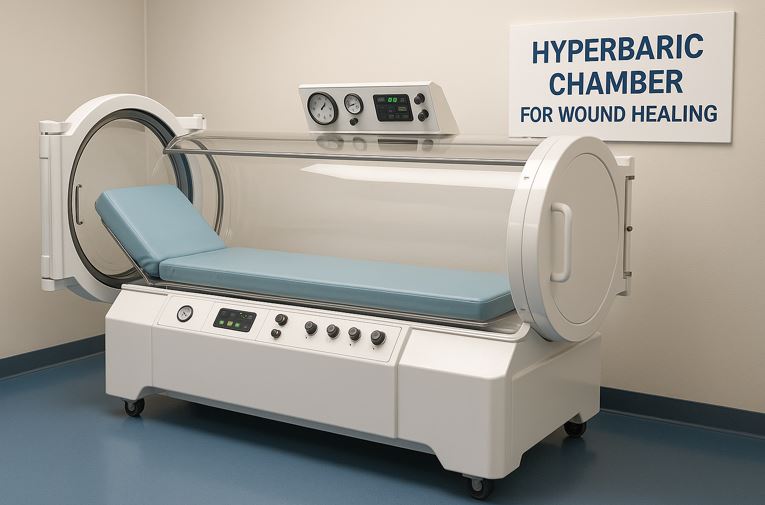
In the double-blind HODFU trial, 52% of diabetic foot ulcers healed completely with hyperbaric oxygen therapy at one year versus 29% with standard care, rising to 61% versus 27% among patients who completed the full course (Londahl et al., Diabetes Care, 2010, n=94). A 2025 network meta-analysis of 34 RCTs and 2,268 patients ranked HBOT first among gas therapies for wound healing. The evidence is strongest for diabetic foot ulcers and radiation-injured tissue, weaker for other wound types, and genuinely mixed on preventing amputation.
How does HBOT speed wound healing?
HBOT delivers 100% oxygen at 2.0 to 2.5 ATA, dissolving enough oxygen directly into blood plasma to reach tissue that red blood cells cannot supply. Tissue oxygen tension during treatment can rise from the 30 to 40 mmHg typical of a chronic wound to above 500 mmHg (Hajhosseini et al., 2020). That oxygen surplus drives the specific repair steps a stalled wound cannot complete.
Chronic wounds stall because they are hypoxic. Damaged or blocked vessels, edema, and scar tissue starve the wound bed of the oxygen every stage of repair depends on. HBOT addresses that deficit through several documented mechanisms:
- Angiogenesis: repeated oxygen gradients upregulate vascular endothelial growth factor (VEGF), stimulating new capillary growth into ischemic tissue (Huang et al., Life Sciences, 2020).
- Fibroblast and collagen activity: fibroblasts require oxygen to proliferate and cross-link collagen, the structural protein that closes a wound (Huang et al., 2020; Thackham et al., 2008).
- Antimicrobial effect: high oxygen tension restores neutrophil oxidative killing and is directly toxic to anaerobic bacteria.
- Edema reduction: hyperoxic vasoconstriction reduces swelling without lowering oxygen delivery.
- Progenitor cell mobilization: HBOT recruits endothelial progenitor cells from bone marrow through a nitric oxide-dependent pathway, adding to the angiogenic response (Thackham et al., 2008).
The key to the effect is intermittency. Sessions create a repeated cycle of high oxygen followed by return to baseline, and it is that oscillation, not steady hyperoxia, that signals the wound to build new vessels. This is often called the hyperoxic-hypoxic paradox: brief, controlled oxygen spikes trigger the same growth-factor cascade the body uses to respond to low oxygen (Hajhosseini et al., 2020). It is also why a single session does nothing lasting and a full course can change a wound.
These are adjunctive effects. HBOT supports standard wound care rather than replacing debridement, offloading, infection control, and glucose management (Thackham et al., 2008).
Which wounds benefit from HBOT?
The strongest evidence is for diabetic foot ulcers that have failed standard care, and for late radiation tissue injury. HBOT is an FDA-cleared and UHMS-approved indication for selected problem wounds, chronic refractory osteomyelitis, compromised skin grafts and flaps, crush injury, and delayed radiation injury (UHMS Approved Indications, 14th edition).
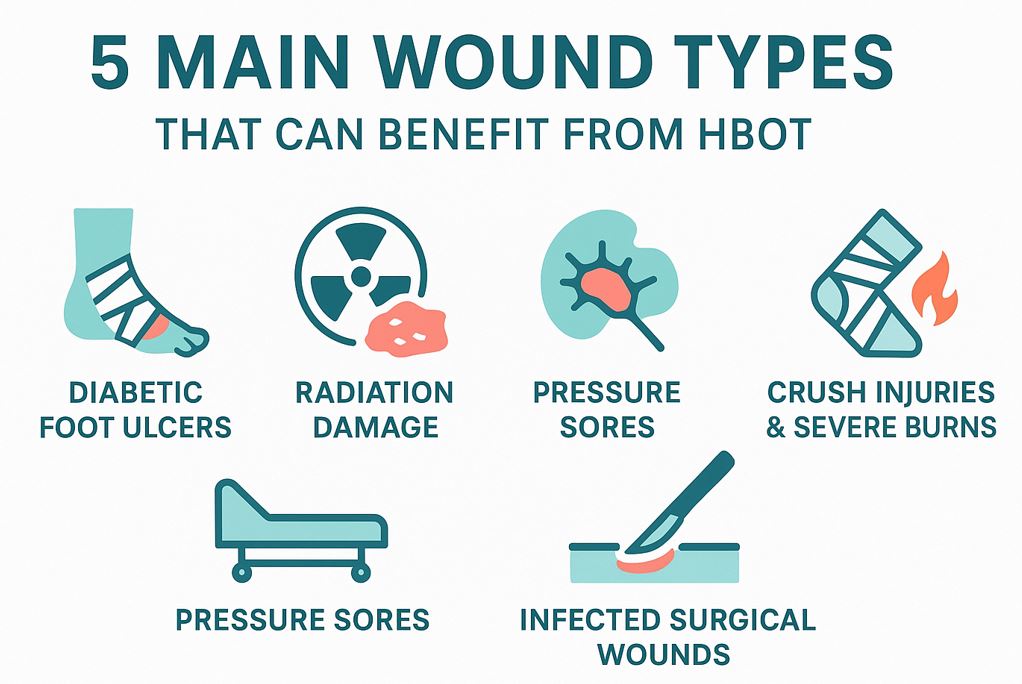
Diabetic foot ulcers are the most studied use. A 2025 network meta-analysis ranked HBOT first among gas therapies for healing rate and second for area reduction across 34 RCTs (Yang et al., 2025). See our diabetic foot ulcer data and HBOT for diabetes pages for the full trial breakdown.
Late radiation tissue injury responds well because HBOT rebuilds the microvasculature radiation destroys. This is covered in depth on our radiation injury pillar.
Chronic refractory osteomyelitis is a covered indication where HBOT is added to surgery and antibiotics for bone infection that has failed standard treatment, and outcome series continue to report remission in a majority of these difficult cases (Jackson et al., 2025). Compromised skin grafts and flaps are also covered, with HBOT used to salvage tissue at risk of ischemic failure.
Crush injuries have some of the best trial evidence of any acute indication. In a double-blind, placebo-controlled RCT of severe limb crush injuries, complete healing occurred in 17 of 18 HBOT patients versus 10 of 18 controls, and fewer HBOT patients needed further surgery (Bouachour et al., 1996). Non-healing surgical wounds can benefit when tissue ischemia is the limiting factor, detailed on our surgical wound page.
Pressure and venous ulcers have weaker, emerging evidence. HBOT is not first-line for these and should follow proven measures like offloading and compression. Our wound types guide ranks each indication by evidence.
How well does HBOT work versus standard care?
For diabetic foot ulcers, controlled trials show HBOT roughly doubles short-term complete healing, and meta-analyses report large reductions in major amputation. The benefit is clearest at six weeks and in non-ischemic Wagner 3+ wounds. The picture on long-term healing and amputation prevention is genuinely mixed, with several rigorous trials and a large cohort finding no benefit.
The positive signal is real. The HODFU double-blind, sham-controlled trial found 52% complete healing with HBOT versus 29% with placebo at one year, and 61% versus 27% among patients completing more than 35 sessions (Londahl et al., 2010). A meta-analysis stratified by Wagner grade found a healing risk ratio of 2.39 and a major amputation risk ratio of 0.31, a 69% relative reduction (Oley et al., 2024). A 14-trial meta-analysis of 768 patients reported a major amputation risk ratio of 0.60 (Sharma et al., 2021). Kalani et al. (2002) followed patients three years and found 76% healed with HBOT versus 48% with standard care.
The null signal is equally real and belongs in any honest assessment. The Cochrane review found that the healing advantage present at six weeks (risk ratio 2.35) was no longer evident at one year (Kranke et al., 2015). The Fedorko double-blind RCT found HBOT did not reduce indications for amputation (Fedorko et al., 2016, n=103). The DAMO2CLES trial found no benefit for ischemic ulcers in healing or limb salvage (Santema et al., 2018, n=120). A large propensity-matched cohort found HBOT neither improved healing nor prevented amputation (Margolis et al., 2013).
HBOT Wound Healing Outcomes by Study
| Study (source) | Design | Patients | Healing or amputation outcome |
|---|---|---|---|
| Londahl 2010 (HODFU) | Double-blind RCT | 94 | 52% vs 29% healed at 1 yr; 61% vs 27% per-protocol |
| Abidia 2003 | Double-blind RCT | 16 | 62.5% vs 12.5% healed |
| Kumar 2020 | RCT | 54 | 78% healed without surgery vs 0% |
| Chen 2017 | RCT | 38 | 25% vs 5.5% healed |
| Fedorko 2016 | Double-blind RCT | 103 | No reduction in amputation indications |
| Santema 2018 (DAMO2CLES) | RCT, ischemic ulcers | 120 | No benefit in healing or limb salvage |
| Oley 2024 | Meta-analysis (by Wagner grade) | Pooled | Healing RR 2.39; major amputation RR 0.31 |
| Yang 2025 | Network meta-analysis | 34 RCTs / 2,268 | Ranked 1st for healing (SUCRA 0.814) |
| Kranke 2015 (Cochrane) | Systematic review | Pooled | Healing RR 2.35 at 6 wks; no benefit at 1 yr |
| Margolis 2013 | Propensity-matched cohort | Large cohort | No improvement in healing or amputation |
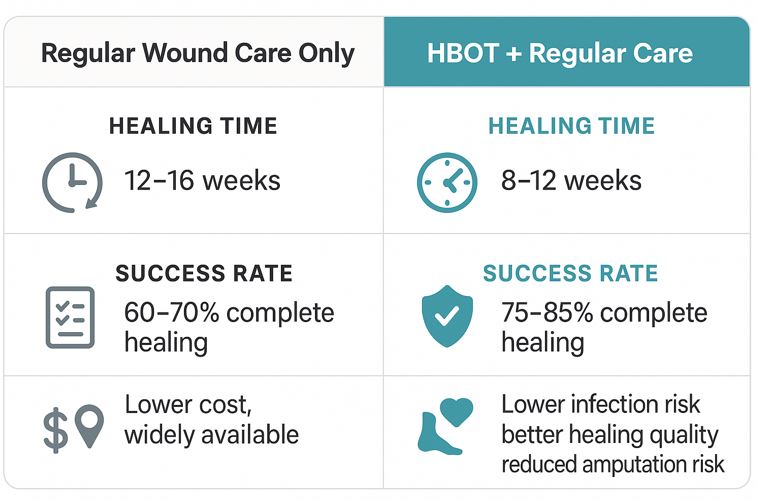
How to reconcile these results: the trials that select ischemic ulcers or measure long-term amputation tend toward null, while trials of non-ischemic Wagner 3+ ulcers measuring short-term healing tend positive. Transcutaneous oximetry helps predict response, since a low in-chamber tissue oxygen reading forecasts HBOT failure (Fife et al., 2002, n=1,144). HBOT works best in wounds that are hypoxic but still perfusable, started before critical infection or deep tissue loss. Our amputation prevention and wound healing statistics pages compile the full outcome data.
How does HBOT compare with other advanced wound therapies?
HBOT is one of several advanced options for a wound that fails standard care, alongside topical oxygen, negative pressure wound therapy, and cellular or tissue-based products. It is the only one that raises oxygen throughout the whole tissue rather than at the surface, which is why it is favored for deep, ischemic, or radiation-injured wounds. It is also the most resource-intensive.
Topical oxygen delivers oxygen to the wound surface at or near normal pressure. Cyclical pressurized topical wound oxygen (TWO2) outperformed standard care in a double-blind RCT, with 41.7% versus 13.5% ulcer closure at 12 weeks (Frykberg et al., 2020). It is cheaper and home-deliverable but does not reach deep tissue the way systemic HBOT does. Our oxygen therapy for diabetic foot ulcers page compares the two directly.
Negative pressure wound therapy (wound vacuum) removes exudate and promotes granulation, and it is often combined with HBOT rather than chosen instead of it; see our HBOT and wound vac combination guide. Cellular and tissue-based products (skin substitutes) address the wound surface biology. In practice these are complementary. HBOT targets the oxygen deficit, the others target moisture, mechanical load, and the wound matrix, and a wound care team sequences them to the specific wound.
How many HBOT sessions do wounds need?
A standard wound-healing course is 20 to 40 sessions, each 90 to 120 minutes at 2.0 to 2.5 ATA, delivered five days a week (Londahl et al., 2010; UHMS indications). The HODFU protocol ran to more than 35 sessions, and its strongest healing results came from patients who completed the full course. Severe wounds may need more.
Progress is monitored throughout, and treatment is adjusted to the wound response. Medicare requires documented signs of healing to authorize continuation, and coverage stops if no measurable improvement appears within a 30-day treatment period (CMS NCD 20.29). Our wound healing session guide and what to expect page walk through a typical treatment day, from ear equalization to in-chamber routine.
Does insurance cover HBOT for wound healing?
Medicare covers HBOT for diabetic lower-extremity wounds under CMS NCD 20.29 when the wound is Wagner grade 3 or higher, the patient has type 1 or type 2 diabetes, and there are no measurable signs of healing after at least 30 days of standard wound care. Most commercial insurers follow the same criteria.
Covered wound indications under the national coverage determination also include chronic refractory osteomyelitis, compromised skin grafts and flaps, and delayed radiation injury. Standard wound care must continue alongside HBOT, and it must include vascular assessment, glucose optimization, debridement, a moist wound bed, offloading, and infection control (CMS NCD 20.29). Continued treatment is not covered if healing does not progress within any 30-day window. Cost-effectiveness modeling from a Canadian health technology assessment estimated an incremental cost of about $2,255 per quality-adjusted life year at 12 years, within the range usually considered cost-effective (Chuck et al., 2008). Our wound healing insurance guide and HBOT insurance overview explain prior authorization and appeals.
Who should not use HBOT for wounds?
The one absolute contraindication is an untreated pneumothorax, where pressure changes can be life-threatening. Certain drugs, including bleomycin, cisplatin, doxorubicin, and disulfiram, can interact dangerously with hyperbaric oxygen. Beyond those, most cautions are relative and managed by an experienced team.
Relative cautions include upper respiratory infection or sinus congestion (barotrauma risk), seizure disorder, COPD with air trapping, high fever, prior ear surgery, uncontrolled diabetes, and claustrophobia, which a multiplace chamber can ease. Insulin users may see blood sugar drop during sessions. Discuss your full history and medication list with the hyperbaric physician first. Serious adverse events are rare with proper protocols; our side effects guide covers the specifics.
Is HBOT right for your wound?
HBOT is worth discussing for a wound that has not improved after four to six weeks of good standard care, especially a diabetic foot ulcer with hypoxic but perfusable tissue, radiation-injured tissue, chronic osteomyelitis, or a failing graft or flap. It is a covered, evidence-supported option for the right wound, not a first-line treatment for every wound.
Outcomes are best when HBOT is combined with the full standard of care and started early, before deep infection or extensive tissue loss. A wound care team can assess whether your tissue is likely to respond, ideally using transcutaneous oximetry. HBOT is one of several recovery applications of hyperbaric oxygen, and it fits within the broader set of FDA-cleared HBOT indications. For the underlying science, see our clinical research overview.
Does HBOT actually prevent amputation in diabetic foot ulcers?
The evidence is mixed. Meta-analyses report large relative reductions in major amputation (risk ratio 0.31 in Oley et al., 2024; 0.60 in Sharma et al., 2021), but two rigorous trials found no benefit (Fedorko et al., 2016; Santema et al., 2018), as did a large cohort study (Margolis et al., 2013). The likely explanation is patient selection: benefit appears in hypoxic but perfusable non-ischemic wounds, not in severely ischemic limbs.
How long before an HBOT-treated wound shows improvement?
Many patients see measurable change within a few weeks, and Medicare requires documented healing progress within each 30-day period to continue coverage (CMS NCD 20.29). The Cochrane review found the clearest healing advantage at six weeks (Kranke et al., 2015). A full course runs 20 to 40 sessions, and the strongest HODFU results came from patients who completed more than 35 (Londahl et al., 2010).
Sources
- Londahl M, Katzman P, Nilsson A, Hammarlund C. Hyperbaric oxygen therapy facilitates healing of chronic foot ulcers in patients with diabetes. Diabetes Care. 2010;33(5):998-1003. PMID 20427683
- Londahl M, Landin-Olsson M, Katzman P. Hyperbaric oxygen therapy improves health-related quality of life in patients with diabetes and chronic foot ulcer. Diabet Med. 2011;28(2):186-190. PMID 21219427
- Faglia E, Favales F, Aldeghi A, et al. Adjunctive systemic hyperbaric oxygen therapy in treatment of severe prevalently ischemic diabetic foot ulcer: a randomized study. Diabetes Care. 1996;19(12):1338-1343. PMID 8941460
- Abidia A, Laden G, Kuhan G, et al. The role of hyperbaric oxygen therapy in ischaemic diabetic lower extremity ulcers: a double-blind randomised-controlled trial. Eur J Vasc Endovasc Surg. 2003;25(6):513-518. PMID 12787692
- Kalani M, Jorneskog G, Naderi N, Lind F, Brismar K. Hyperbaric oxygen (HBO) therapy in treatment of diabetic foot ulcers: long-term follow-up. J Diabetes Complications. 2002;16(2):153-158. PMID 12039398
- Chen CY, Wu RW, Hsu MC, Hsieh CJ, Chou MC. Adjunctive hyperbaric oxygen therapy for healing of chronic diabetic foot ulcers. J Wound Ostomy Continence Nurs. 2017;44(6):536-545. PMID 28968346
- Kumar A, Shukla U, Prabhakar T, Srivastava D. Hyperbaric oxygen therapy as an adjuvant to standard therapy in the treatment of diabetic foot ulcers. J Anaesthesiol Clin Pharmacol. 2020;36(2):213-218. PMID 33013037
- Salama SE, Eldeeb AE, Elbarbary AH, Abdelghany SE. Adjuvant hyperbaric oxygen therapy enhances healing of nonischemic diabetic foot ulcers. Int J Low Extrem Wounds. 2019;18(1):75-80. PMID 30836807
- Nik Hisamuddin NAR, Wan Mohd Zahiruddin WN, Mohd Yazid B, Rahmah S. Use of hyperbaric oxygen therapy (HBOT) in chronic diabetic wound: a randomised trial. Med J Malaysia. 2019;74(5):418-424. PMID 31649219
- Lopes JRA, et al. Hyperbaric oxygen therapy for healing chronic foot wounds in diabetic patients: randomised clinical trial. J Hum Growth Dev. 2024;34(3). DOI: 10.36311/jhgd.v34.16415
- Fedorko L, Bowen JM, Jones W, et al. Hyperbaric oxygen therapy does not reduce indications for amputation in patients with diabetes with nonhealing ulcers of the lower limb: a prospective, double-blind, randomized controlled clinical trial. Diabetes Care. 2016;39(3):392-399. PMID 26740639
- Santema KTB, Stoekenbroek RM, Koelemay MJW, et al. Hyperbaric oxygen therapy in the treatment of ischemic lower-extremity ulcers in patients with diabetes: results of the DAMO2CLES multicenter randomized clinical trial. Diabetes Care. 2018;41(1):112-119. PMID 29074815
- Margolis DJ, Gupta J, Hoffstad O, et al. Lack of effectiveness of hyperbaric oxygen therapy for the treatment of diabetic foot ulcer and the prevention of amputation: a cohort study. Diabetes Care. 2013;36(7):1961-1966. PMID 23423696
- Kranke P, Bennett MH, Martyn-St James M, Schnabel A, Debus SE, Weibel S. Hyperbaric oxygen therapy for chronic wounds. Cochrane Database Syst Rev. 2015;(6):CD004123. DOI: 10.1002/14651858.CD004123.pub4
- Stoekenbroek RM, Santema TB, Legemate DA, Ubbink DT, van den Brink A, Koelemay MJW. Hyperbaric oxygen for the treatment of diabetic foot ulcers: a systematic review. Eur J Vasc Endovasc Surg. 2014;47(6):647-655. PMID 24726143
- Sharma R, Sharma SK, Mudgal SK, Jelly P, Thakur K. Efficacy of hyperbaric oxygen therapy for diabetic foot ulcer, a systematic review and meta-analysis of controlled clinical trials. Sci Rep. 2021;11(1):2189. PMID 33500533
- Oley MH, Oley MC, Kepel BJ, Faruk M, et al. Hyperbaric oxygen therapy for diabetic foot ulcers based on Wagner grading: a systematic review and meta-analysis. Plast Reconstr Surg Glob Open. 2024;12(3):e5692. PMID 38528847
- Yang J, Ning P, Huang J, et al. Comparative efficacy of gas therapy for diabetic foot ulcers using network meta-analysis. PeerJ. 2025;13:e19571. PMID 40538733
- Health Quality Ontario. Hyperbaric oxygen therapy for the treatment of diabetic foot ulcers: a health technology assessment. Ont Health Technol Assess Ser. 2017;17(5):1-142. PMID 28572866
- Chuck AW, Hailey D, Jacobs P, Perry DC. Cost-effectiveness and budget impact of adjunctive hyperbaric oxygen therapy for diabetic foot ulcers. Int J Technol Assess Health Care. 2008;24(2):178-183. PMID 18400121
- Hajhosseini B, Kuehlmann BA, Bonham CA, Kamperman KJ, Gurtner GC. Hyperbaric oxygen therapy: descriptive review of the technology and current application in chronic wounds. Plast Reconstr Surg Glob Open. 2020;8(9):e3136. PMID 33133975
- Huang X, Liang P, Jiang B, et al. Hyperbaric oxygen potentiates diabetic wound healing by promoting fibroblast cell proliferation and endothelial cell angiogenesis. Life Sci. 2020;259:118246. PMID 32791151
- Lalieu RC, Bol Raap RD, Smit C, Dubois EFL, van Hulst RA. Hyperbaric oxygen therapy for nonhealing wounds: a long-term retrospective cohort study. Adv Skin Wound Care. 2023;36(6):304-310. PMID 37017408
- Thackham JA, McElwain DLS, Long RJ. The use of hyperbaric oxygen therapy to treat chronic wounds: a review. Wound Repair Regen. 2008;16(3):321-330. PMID 18471250
- Londahl M. Hyperbaric oxygen therapy as treatment of diabetic foot ulcers. Int J Low Extrem Wounds. 2013;12(2):152-157. PMID 23667103
- Fife CE, Buyukcakir C, Otto GH, et al. The predictive value of transcutaneous oxygen tension measurement in diabetic lower extremity ulcers treated with hyperbaric oxygen therapy: a retrospective analysis of 1,144 patients. Wound Repair Regen. 2002;10(4):198-207. PMID 12191001
- Frykberg RG, Franks PJ, Edmonds M, et al. A multinational, multicenter, randomized, double-blinded, placebo-controlled trial to evaluate the efficacy of cyclical topical wound oxygen (TWO2) therapy in the treatment of chronic diabetic foot ulcers. Diabetes Care. 2020;43(3):616-624. PMID 31619393
- Bouachour G, Cronier P, Gouello JP, Toulemonde JL, Talha A, Alquier P. Hyperbaric oxygen therapy in the management of crush injuries: a randomized double-blind placebo-controlled clinical trial. J Trauma. 1996;41(2):333-339. PMID 8760546
- Jackson JB 3rd, Bakaes Y, Jacques B, et al. Hyperbaric oxygen therapy and outcomes in chronic refractory osteomyelitis. Adv Skin Wound Care. 2025. PMID 39836555
- Centers for Medicare & Medicaid Services. National Coverage Determination (NCD) for Hyperbaric Oxygen Therapy (20.29). CMS Medicare Coverage Database
- Undersea and Hyperbaric Medical Society. Hyperbaric Oxygen Therapy Indications, 14th Edition. UHMS Approved Indications
Medical Disclaimer
The content on BaricBoost.com is for informational purposes only and is not intended as a substitute for professional medical advice, diagnosis, or treatment. Always seek the advice of your physician or other qualified health provider with any questions you may have regarding a medical condition. Never disregard professional medical advice or delay in seeking it because of something you have read on this website.

Author
Seph Fontane Pennock is the founder of BaricBoost.com and Regenerated.com, a clinic directory for regenerative medicine serving 10,000+ providers across the United States. He previously built and sold PositivePsychology.com, which grew to 19 million users and became the largest evidence-based positive psychology resource on the web. Seph brings direct experience as an HBOT patient, having completed protocols at clinics across three continents while navigating mold illness, systemic inflammation, and autoimmune conditions. His treatment journey includes hyperbaric oxygen therapy, peptide protocols, NAD+ therapy, and consultations with specialists from Dubai to Cape Town to Mexico. This combination of entrepreneurial track record and lived patient experience shapes everything published on BaricBoost.com. Every article is grounded in peer-reviewed research, informed by real clinical encounters, and written for patients making high-stakes treatment decisions. Seph's focus is on bringing transparency, scientific rigor, and practical guidance to the hyperbaric oxygen therapy space.