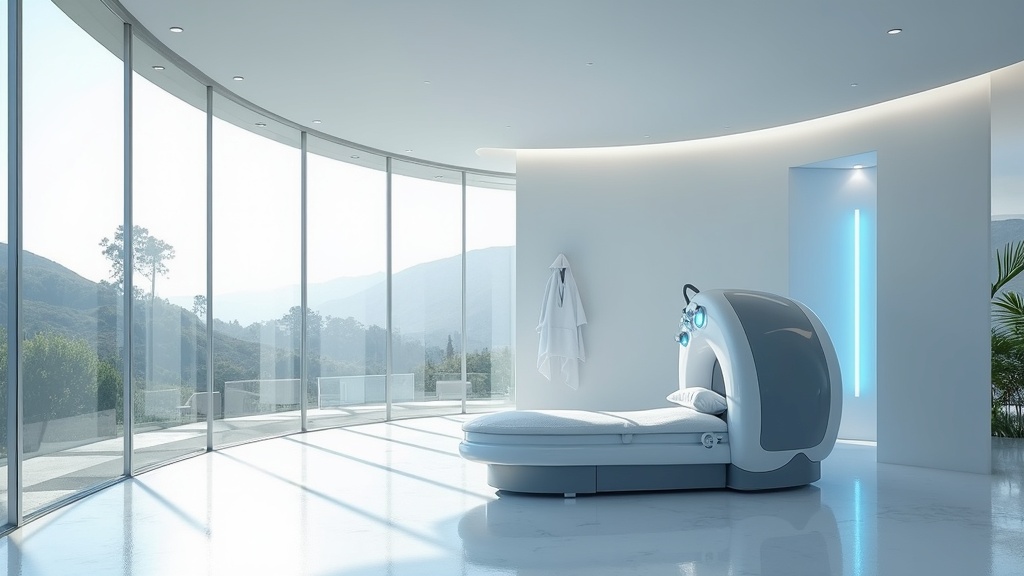
The San Francisco Bay Area has one of the highest concentrations of hyperbaric oxygen therapy providers in the western US, including hospital wound care centers and integrative health clinics. Here is a breakdown of the facilities currently operating in the area, what they treat, and what they charge.
Top HBOT Clinics in San Francisco
Hospital-Based Programs
UCSF Medical Center
The University of California San Francisco operates one of the premier hyperbaric medicine programs on the West Coast. Located at their Parnassus campus, the program treats the full range of FDA-approved conditions including diabetic wounds, gas gangrene, necrotizing fasciitis, and carbon monoxide poisoning. UCSF also maintains 24/7 emergency hyperbaric capability for diving injuries and acute gas embolism. As an academic medical center, their physicians are involved in ongoing HBOT research and clinical trials.
Stanford Health Care
While technically in Palo Alto, Stanford Health Care serves the broader Bay Area and offers hyperbaric medicine through their wound care and surgical departments. Stanford’s research orientation means patients may have access to innovative protocols and clinical trials for conditions still under investigation.
Independent Clinics
Bay Area Hyperbaric
An independent HBOT provider in the Bay Area offering both FDA-approved and off-label treatments. They operate medical-grade monoplace chambers and focus on traumatic brain injury, post-concussion recovery, and neurological conditions. The clinic provides flexible scheduling and works with patients on treatment plans that match their specific goals.
What Makes San Francisco Unique for HBOT
Tech Culture and Biohacking
The Bay Area’s technology and biohacking community has embraced HBOT as part of comprehensive optimization protocols. Many Silicon Valley executives and entrepreneurs use HBOT for cognitive enhancement, recovery, and longevity, driving demand for independent clinics that cater to this population with premium services, flexible hours, and performance-tracking integrations.
What Does the Research Say?
UCSF and Stanford are among the top medical research institutions globally. For patients seeking the most evidence-based approach to HBOT, access to physicians who are both clinicians and active researchers is a meaningful advantage. The Bay Area also has a concentration of integrative medicine practitioners who combine HBOT with other modalities as part of comprehensive treatment plans.
Diving Emergency Access
San Francisco’s proximity to Pacific coastal diving sites makes emergency recompression capability essential. UCSF maintains 24/7 emergency hyperbaric access. In case of a diving emergency, call 911 and the Divers Alert Network at +1-919-684-9111.
How Much Does HBOT Cost?
Independent Bay Area clinics charge $250-$500 per session, reflecting the higher cost of living in the region. Hospital programs at UCSF and Stanford accept insurance for FDA-approved indications. For detailed pricing, see our HBOT cost guide. For information on coverage, see our HBOT insurance guide.
How Many HBOT Facilities Serve the Bay Area
The San Francisco Bay Area has approximately 10 to 15 facilities offering hyperbaric oxygen therapy, spanning San Francisco, the East Bay, and the Peninsula down to Palo Alto. This makes it one of the denser HBOT markets on the West Coast, though still behind the Los Angeles metro area.
California has the third-highest state count at an estimated 120 to 150 HBOT facilities, but with 39 million residents, the per-capita density (roughly 3.1 per million) is actually below the national average. The Bay Area captures a disproportionate share of the state’s providers due to its concentration of academic medical centers, high-income patients willing to pay cash, and the tech industry’s demand for performance and recovery treatments.
The market splits roughly 40/60 between hospital-based wound care programs and independent or integrative clinics. The independent clinic segment is growing faster, driven by demand for off-label applications including traumatic brain injury recovery, cognitive enhancement, and anti-aging protocols.
Typical Pricing in the Bay Area
Bay Area HBOT is among the most expensive in the country, reflecting the region’s high operating costs. Expect:
- Hospital-based programs (UCSF, Stanford): $300 to $500 per session when billed through insurance. Copays for approved indications depend on your plan but typically run $75 to $150 per session after deductible.
- Independent clinics (cash pay): $250 to $500 per session for monoplace treatments. Some premium clinics targeting the tech/biohacking market charge $400 to $600 per session with concierge-level service.
- Package pricing: Multi-session bundles of 20 or 40 sessions are standard at independent clinics, discounted 15 to 25%. A 40-session package at a mid-range clinic runs $8,000 to $14,000.
For national pricing comparisons and what drives cost differences, see our complete HBOT cost guide.
Insurance Coverage in San Francisco
UCSF and Stanford accept most major insurance plans for the 14 UHMS-approved indications. Medicare covers HBOT for qualifying conditions with documentation. Medi-Cal (California Medicaid) covers HBOT for approved indications at participating hospital programs, though access can be limited by prior authorization requirements and referral processes.
Independent Bay Area clinics operate almost exclusively on a cash-pay basis for off-label treatments. California law does not require private insurers to cover off-label HBOT. Some clinics provide superbills for out-of-network reimbursement attempts.
What to Ask When Calling a Bay Area HBOT Provider
Before booking treatment, evaluate providers with these questions:
- Chamber type and pressure: Is this a monoplace or multiplace chamber? What maximum pressure do they operate at? For any of the 14 UHMS-approved conditions, you need 2.0 ATA minimum in a hard shell chamber.
- Physician credentials: Is the supervising physician board-certified in undersea and hyperbaric medicine? UCSF and Stanford have UHM-board-certified physicians. At independent clinics, verify this directly.
- Treatment protocol: How many sessions at what pressure, duration, and frequency? Standard wound care is 30 to 40 sessions at 90 to 120 minutes, 5 days per week. Off-label protocols vary more widely; ask for the clinical rationale behind their specific recommendations.
- Clinical trials: Both UCSF and Stanford run HBOT clinical trials. If your condition is being actively studied, trial participation can provide treatment at reduced or no cost while contributing to the evidence base.
- Full cost projection: At Bay Area prices, a 40-session course can exceed $15,000 out of pocket. Get the complete estimate including any required evaluations, imaging, or follow-up appointments.
Our guide on what to expect during HBOT covers the treatment process from evaluation through completion.
Sources
- UHMS: Approved HBO Indications
- Mayo Clinic: Hyperbaric Oxygen Therapy
- FDA: Hyperbaric Oxygen Therapy Consumer Update
References
- Undersea and Hyperbaric Medical Society. “Hyperbaric Oxygen Therapy Indications.” 14th Edition, 2019. uhms.org
- Thom SR. “Hyperbaric oxygen: its mechanisms and efficacy.” Plastic and Reconstructive Surgery, 2011;127(Suppl 1):131S-141S. DOI: 10.1097/PRS.0b013e3181fbe2bf
- Centers for Medicare & Medicaid Services. “National Coverage Determination for Hyperbaric Oxygen Therapy.” NCD 20.29. cms.gov
Medical Disclaimer
The content on BaricBoost.com is for informational purposes only and is not intended as a substitute for professional medical advice, diagnosis, or treatment. Always seek the advice of your physician or other qualified health provider with any questions you may have regarding a medical condition. Never disregard professional medical advice or delay in seeking it because of something you have read on this website.

Author
Seph Fontane Pennock is the founder of BaricBoost.com and Regenerated.com, a clinic directory for regenerative medicine serving 10,000+ providers across the United States. He previously built and sold PositivePsychology.com, which grew to 19 million users and became the largest evidence-based positive psychology resource on the web. Seph brings direct experience as an HBOT patient, having completed protocols at clinics across three continents while navigating mold illness, systemic inflammation, and autoimmune conditions. His treatment journey includes hyperbaric oxygen therapy, peptide protocols, NAD+ therapy, and consultations with specialists from Dubai to Cape Town to Mexico. This combination of entrepreneurial track record and lived patient experience shapes everything published on BaricBoost.com. Every article is grounded in peer-reviewed research, informed by real clinical encounters, and written for patients making high-stakes treatment decisions. Seph's focus is on bringing transparency, scientific rigor, and practical guidance to the hyperbaric oxygen therapy space.