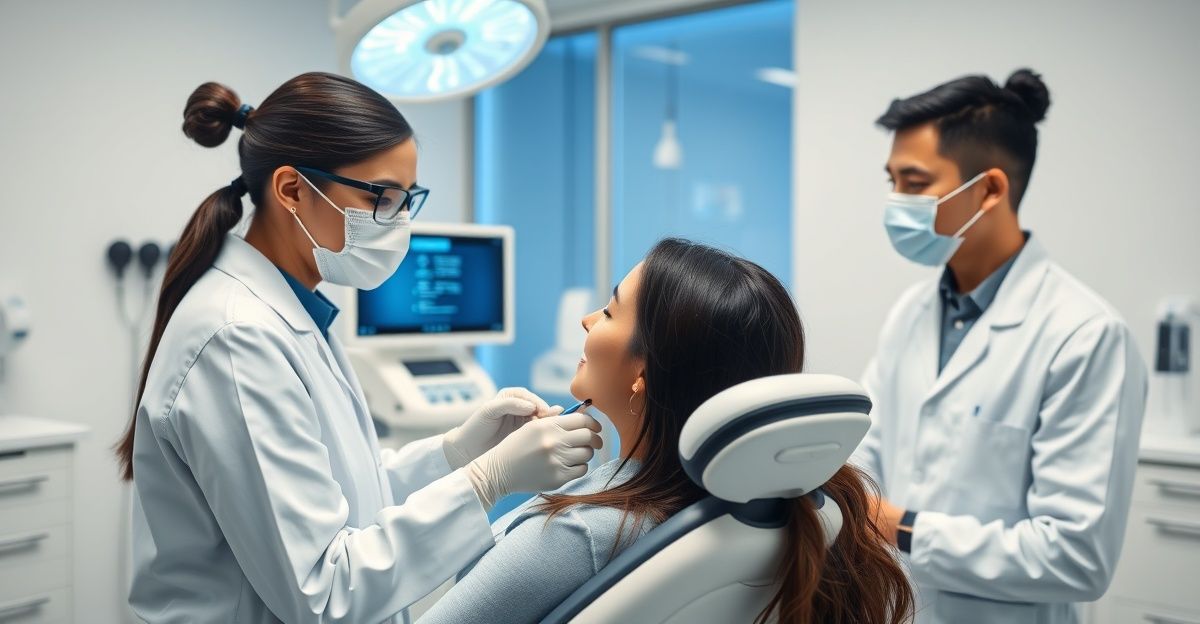
Ozone applied during dental implant placement reduces bacteria at the surgical site and is a documented adjunct for treating peri-implant infection. A randomized clinical study found ozonated water lowered oral mutans streptococci counts as effectively as chlorhexidine (Anumula et al., 2017), and a 2023 systematic review supports ozone as an adjuvant for peri-implantitis (D’Ambrosio et al., 2023). No large trial yet proves ozone raises implant survival, but the disinfection rationale is solid and the added cost is small.
How often do dental implants fail?
Dental implants are among the most reliable procedures in medicine. A 2024 systematic review reported long-term survival above 95%, meaning roughly 1 in 20 implants still fails (Moraschini and Louro, 2024). Early failure, within the first few months, is almost always driven by infection or poor osseointegration, which is exactly where ozone is proposed to help.
Risk factors for implant failure include:
- Residual bacteria in the implant site, often from prior infection or periodontal disease
- Compromised bone quality or quantity
- Smoking
- Uncontrolled diabetes
- Poor oral hygiene
- Peri-implantitis, an infection around an established implant
Ozone therapy targets the first two factors directly, sterilizing the surgical site and, in laboratory and animal models, supporting bone healing.
How is ozone used in dental implant procedures?
Dental ozone is delivered in three primary forms:
| Form | Application | Purpose |
|---|---|---|
| Ozonated water | Irrigation of the implant site before and during placement | Broad-spectrum disinfection without chemical residue |
| Ozone gas | Direct application to the osteotomy (drill hole) and implant surface | Deep disinfection of the prepared site |
| Ozonated oil | Applied over the surgical site after placement | Sustained antimicrobial effect during early healing |
During implant placement
A typical ozone-enhanced protocol runs like this:
- After creating the osteotomy, the site is irrigated with ozonated water to reduce bacteria
- Ozone gas is applied to the osteotomy, commonly at 20 to 40 mcg/mL for 30 to 60 seconds
- The implant is placed in the treated site
- Ozonated oil is applied to the gum tissue and surgical site before suturing
The ozone component adds roughly 5 to 10 minutes to the standard procedure. The mechanism is oxidative: ozone reacts with microbial membranes to kill pathogens on contact and triggers a mild oxidative response that, in Bocci’s model, upregulates the body’s antioxidant and healing pathways (Sagai and Bocci, 2011).
For peri-implantitis
Ozone gas and ozonated water are also used to decontaminate the surface of an established implant during peri-implantitis treatment, without damaging the titanium the way mechanical instruments can. A 2023 systematic review of ozone in periodontal and peri-implant care concluded that ozone is a reasonable adjuvant to conventional debridement, while noting that study quality varies and larger trials are still needed (D’Ambrosio et al., 2023).
What does the research actually show?
The honest read is that ozone’s disinfection benefit is well documented, while its effect on implant success and bone integration rests on smaller and preclinical data.
Disinfection: In a randomized clinical study, an ozonated-water oral rinse reduced mutans streptococci counts comparably to chlorhexidine, the standard antiseptic, without chlorhexidine’s staining and taste drawbacks (Anumula et al., 2017). This supports ozone’s core role of lowering bacterial load at and around the implant site.
Bone healing: In an experimental model comparing ozone therapy with low-level laser therapy on bone healing, ozone accelerated healing relative to untreated controls, on par with laser treatment (Alan et al., 2015). This is promising but preclinical, so improved osseointegration in humans remains unproven.
Peri-implantitis: The 2023 systematic review found ozone-assisted decontamination produced outcomes comparable to other adjunctive methods at lower cost and without thermal risk to surrounding tissue (D’Ambrosio et al., 2023). What the literature does not yet contain is a large randomized trial showing ozone raises long-term implant survival, so that specific claim should be treated as plausible rather than established.
Ozone in implant dentistry is not about changing the procedure. It targets the two biggest early risks, infection and poor bone integration, with a tool that adds little time, cost, or complexity to a well-established protocol.
Is ozone worth the added cost for implants?
Ozone adds relatively little to the overall cost of implant placement:
| Component | Typical Cost |
|---|---|
| Single dental implant (implant, abutment, crown) | $3,000 to $6,000 |
| Ozone treatment add-on | $50 to $200 |
| Treating a failed implant (removal, bone graft, re-implant) | $5,000 to $10,000 |
| Treating peri-implantitis | $500 to $2,000 per episode |
When an implant failure costs $5,000 to $10,000 to remediate, spending $50 to $200 on ozone disinfection is inexpensive risk reduction, even before accounting for the time, pain, and inconvenience of a failed implant. The value case is strongest for higher-risk patients rather than as a universal add-on.
Who benefits most?
While any implant patient could receive ozone-enhanced protocols, the benefit is most plausible for:
- Patients with a history of periodontal disease (higher oral bacterial load)
- Diabetic patients (impaired healing and higher infection risk)
- Smokers (compromised blood supply and healing)
- Immediate-implant patients (placed into fresh extraction sockets with higher infection risk)
- Patients with compromised bone quality
- Patients with existing peri-implantitis on other implants
Finding a dentist who uses ozone
Ozone in dentistry is most often offered by biological or integrative dentists, periodontists who have added it to their surgical toolkit, and oral surgeons in integrative practice. Before committing, ask about the ozone generator they use, their specific protocol for implant cases, how many implant cases they have treated with ozone, and whether they use water, gas, oil, or a combination. Ozone should complement standard sterile technique and antibiotics, not replace them; review the general safety considerations and how ozone is used for dental cavities for context on where the evidence is stronger.
The International Academy of Oral Medicine and Toxicology and the American Academy of Ozone Therapy both maintain provider directories that can help locate ozone-trained dentists.
Sources
- Anumula L, Kumar S, Kumar VS, et al. Antibacterial activity of freshly prepared ozonated water and chlorhexidine on mutans streptococcus when used as an oral rinse: a randomised clinical study. Journal of Clinical and Diagnostic Research, 2017;11(7):ZC05-ZC08. doi:10.7860/JCDR/2017/26708.10129
- D’Ambrosio F, Caggiano M, Acerra A, Pisano M, et al. Is ozone a valid adjuvant therapy for periodontitis and peri-implantitis? A systematic review. Journal of Personalized Medicine, 2023;13(4):646. doi:10.3390/jpm13040646
- Alan H, Vardi N, Ozgur C, et al. Comparison of the effects of low-level laser therapy and ozone therapy on bone healing. Journal of Craniofacial Surgery, 2015;26(5):e396-e400. doi:10.1097/SCS.0000000000001871
- Moraschini V, Louro RS, et al. Long-term survival and success rate of dental implants: a systematic review. Clinical Implant Dentistry and Related Research, 2024. doi:10.1111/cid.13319
- Sagai M, Bocci V. Mechanisms of action involved in ozone therapy: is healing induced via a mild oxidative stress? Medical Gas Research, 2011;1:29. doi:10.1186/2045-9912-1-29
Medical Disclaimer
The content on BaricBoost.com is for informational purposes only and is not intended as a substitute for professional medical advice, diagnosis, or treatment. Always seek the advice of your physician or other qualified health provider with any questions you may have regarding a medical condition. Never disregard professional medical advice or delay in seeking it because of something you have read on this website.

Author
Seph Fontane Pennock is the founder of BaricBoost.com and Regenerated.com, a clinic directory for regenerative medicine serving 10,000+ providers across the United States. He previously built and sold PositivePsychology.com, which grew to 19 million users and became the largest evidence-based positive psychology resource on the web. Seph brings direct experience as an HBOT patient, having completed protocols at clinics across three continents while navigating mold illness, systemic inflammation, and autoimmune conditions. His treatment journey includes hyperbaric oxygen therapy, peptide protocols, NAD+ therapy, and consultations with specialists from Dubai to Cape Town to Mexico. This combination of entrepreneurial track record and lived patient experience shapes everything published on BaricBoost.com. Every article is grounded in peer-reviewed research, informed by real clinical encounters, and written for patients making high-stakes treatment decisions. Seph's focus is on bringing transparency, scientific rigor, and practical guidance to the hyperbaric oxygen therapy space.