The main danger of home oxygen therapy is fire. Oxygen does not burn on its own, but it makes nearby materials ignite faster and burn far hotter. The National Fire Protection Association estimates that home medical oxygen equipment is involved in an average of 228 home fires a year in the United States, causing about 96 deaths annually, with smoking the single leading cause.1 Every other precaution follows from that one fact.
This guide is a reference for anyone using or caring for someone on home oxygen. It covers fire prevention, equipment care, the flow-rate rule that matters most in COPD, safe storage, and travel, each tied to the primary source behind it. For the wider clinical picture, start with our oxygen therapy overview, and check who should not use oxygen at all in our guide to oxygen therapy contraindications.
Home oxygen hazards at a glance
| Hazard | Cause | Prevention rule | If ignored | Source |
|---|---|---|---|---|
| Fire (smoking) | Lit cigarette or vape in an oxygen-enriched zone | No smoking; keep flame 5+ feet away | Rapid, severe facial and airway burns; death | NFPA; ALA |
| Fire (open flame) | Candles, gas stoves, fireplaces, pilot lights | No open flame in the room; cook away from oxygen | Flash fire | NFPA |
| Fire (petroleum products) | Vaseline, oil-based lotions, grease on valves | Use water-based products only; never oil valves | Violent ignition at the source | ALA; OSHA 1910.104 |
| CO2 retention | Flow rate above prescription in COPD | Never change the prescribed liters per minute | Respiratory depression, higher mortality | Austin 2010; BTS 2017 |
| Falls | Long tubing trailing across the floor | Secure or coil tubing; clear walkways | Fractures, head injury | BTS 2017 |
| Improper storage | Cylinders near heat or flammables, or enclosed | Store upright, ventilated, 20+ feet from combustibles | Cylinder overheating, oxygen buildup | OSHA 1910.104 |
Why is fire the main oxygen therapy risk?
Because oxygen is an oxidizer. It does not ignite, but it dramatically accelerates any combustion nearby, turning a small spark that would normally fizzle into a fast, intense fire. In an oxygen-enriched room, clothing, bedding, hair, and furniture that are normally slow to catch can ignite almost instantly and burn much faster than usual.
Oxygen is one leg of the fire triangle, heat, fuel, and oxygen, so raising the oxygen concentration lowers the energy needed to start and sustain a fire.3 The American Lung Association makes the same point in plain terms: while oxygen itself is not flammable, it makes other materials burn more readily, which is why smoking near it is so dangerous.2 The epidemiology backs this up. Smoking is the leading factor in home oxygen fires, implicated in roughly three of every four incidents, and these fires carry an unusually high death rate because the burns are concentrated on the face and airway.1
A note on an older number you may see quoted, including in earlier versions of this page: the figure of roughly 1,190 refers to thermal burns treated in emergency rooms in the NFPA’s 2008 edition, not to the number of home fires. The current fire count is about 228 per year. National burn-center research confirms that smoking while on home oxygen remains a significant and preventable cause of serious burn injury across the United States.10 For how the same chemistry plays out at higher pressures, see our pages on hyperbaric chamber fire risk and documented hyperbaric fire incidents.
The reason these fires are so lethal is where the burns land. When ignition happens at the cannula, the flame is inches from the nose and mouth, so injuries concentrate on the face, airway, and hands, and inhalation injury can be fatal even when the fire itself is small. That is why prevention, not response, is the entire strategy: once an oxygen fire starts on a person, seconds matter.
Who is most at risk of harm from home oxygen?
Four groups carry the highest risk: people who smoke, people with COPD who retain carbon dioxide, people prone to falls, and people with cognitive impairment who may forget the rules. Matching safeguards to the specific risk is more effective than treating every patient identically.
Smokers are the clearest case. Because most patients evaluated for home oxygen are current or former smokers, and oxygen turns a cigarette into a serious burn hazard, several countries treat active smoking as a relative or absolute contraindication, and a 2024 Swedish consensus statement worked through exactly how clinicians should weigh the medical, legal, and ethical factors involved.8 Patients with COPD and CO2 retention face a different danger, covered in the flow-rate section below, where too much oxygen rather than fire is the threat. Older adults on long tubing are at real risk of falls, and people with dementia or delirium may need supervision or automatic shutoff devices because they cannot be relied on to keep flame away. Tell the prescribing team which of these applies; it changes the safeguards they recommend and, in some cases, whether home oxygen is appropriate at all. Our guide to oxygen therapy contraindications covers who should not use it.
How do you prevent oxygen fires at home?
Remove ignition sources and flammable products from wherever oxygen is used. The core rules are simple and non-negotiable: no smoking, no open flame, no petroleum-based products on skin or equipment, and a clear buffer between oxygen and any heat source. Most fatal incidents trace back to breaking the first rule.
| Rule | Why it matters |
|---|---|
| No smoking or vaping near oxygen | The leading cause of oxygen fires. A lit cigarette in oxygen-enriched air can ignite clothing and facial hair instantly.1 |
| Keep flame and heat 5+ feet away | The American Lung Association advises keeping any open flame or heat source at least five feet from the oxygen unit.2 |
| No petroleum-based products | Vaseline, mineral oil, and oil-based lotions can ignite in an oxygen-rich environment. Use water-based alternatives.2 |
| No open flames in the room | Candles, gas stoves, fireplaces, and pilot lights are all ignition sources near concentrated oxygen. |
| Smoke detectors on every floor | Oxygen-fed fires spread fast, so early detection is critical. |
| Keep a fire extinguisher nearby | An ABC-rated extinguisher in the room where oxygen is used. |
| No aerosol sprays near oxygen | Hair spray, deodorant, and cleaning sprays contain flammable propellants. |
Because most patients on home oxygen are current or former smokers, several countries treat active smoking as a relative or absolute contraindication to home oxygen, and a 2024 multidisciplinary consensus reviewed exactly how clinicians should weigh that risk.8 If you or someone in the household smokes, tell the prescribing team; it changes the risk calculation and the safeguards they will recommend.
How should oxygen equipment be maintained?
Well-maintained equipment leaks less, overheats less, and fails less often. Use only prescription, FDA-cleared devices from your supplier, keep them serviced on schedule, and register them so you receive recall and safety notices.6 Maintenance splits across three parts: the concentrator, cylinders, and tubing.
Oxygen concentrators
- Clean or replace the intake filter every two weeks, or per the manufacturer.
- Wipe the exterior with a damp cloth weekly. Never use alcohol or flammable cleaners.
- Keep the unit at least 12 inches from walls and furniture for ventilation, and never cover it or set objects on top.
- Listen for grinding, buzzing, or alarm tones that signal a fault.
- Have it serviced annually by the supplier.
Oxygen cylinders
- Store and use cylinders upright, secured in a stand or cart to prevent tipping.
- Check the regulator and connections with a soapy-water test; bubbles mean a leak.
- Never lubricate valves or regulators with oil or grease.
- Close the valve when the cylinder is not in use, and refill before it fully empties (many suppliers advise refilling at 500 PSI).
- Do not attempt your own repairs. Call the supplier.
Tubing and cannulas
- Replace nasal cannulas every two to four weeks.
- Replace tubing every three to six months, or sooner if it stiffens, cracks, or discolors.
- Keep tubing under 50 feet; longer runs reduce oxygen delivery.
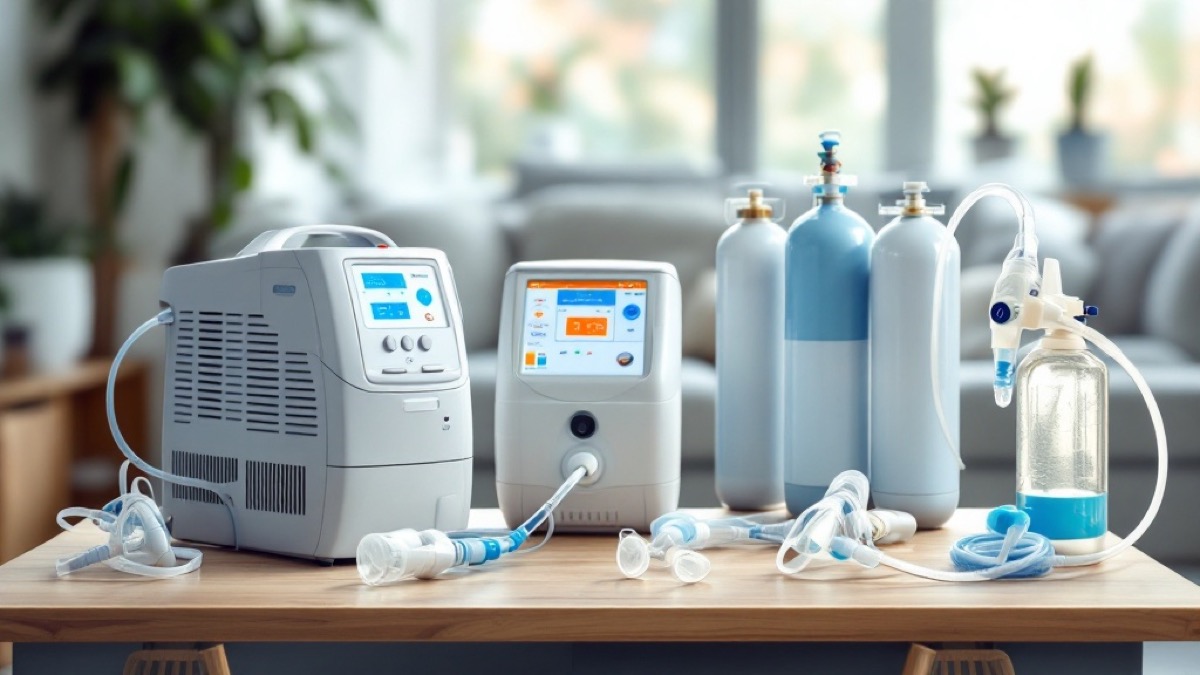
Our oxygen therapy equipment guide covers device types and setup in more depth, and portable oxygen therapy explains concentrator options for mobility.
Which oxygen delivery type is safest?
No home oxygen source is fire-safe, because the hazard is the oxygen itself, not the machine. That said, the three delivery types carry different secondary risks. Concentrators avoid stored high-pressure gas but depend on electricity and can fail or be recalled; cylinders store compressed gas under high pressure; liquid oxygen adds extreme-cold and venting hazards.
Oxygen delivery types compared on safety
| Type | Main secondary risk | Key safeguard | Source |
|---|---|---|---|
| Oxygen concentrator | Electrical fault, overheating, device recall; stops in a power outage | Use FDA-cleared units, register for recalls, keep vents clear, plan backup power | FDA; NFPA |
| Compressed gas cylinder | High-pressure gas; valve failure if oiled or dropped | Secure upright, never oil valves, store 20+ feet from flammables | OSHA 1910.104 |
| Liquid oxygen | Cryogenic burns, oxygen venting and pooling | Ventilate, handle per supplier training, never seal in enclosed spaces | NFPA |
Whatever the source, the fire rules are identical, because all three enrich the surrounding air with oxygen. Concentrators are usually the most practical for continuous home use and the only option approved for flying, while cylinders and liquid systems provide the higher flows some patients need. One practical safety point is redundancy: a patient on a concentrator should keep backup cylinders for outages, and a cylinder user should not let supply run to empty. Match the choice to your prescription and mobility with your supplier, and see our oxygen therapy machine guide for device options.
Why does the prescribed flow rate matter?
Because in some patients, more oxygen is dangerous, not safer. Your physician prescribes a specific flow rate in liters per minute based on your blood oxygen and diagnosis. In people with COPD and other risk factors for carbon dioxide retention, too much oxygen can suppress breathing drive, raise CO2, and increase the risk of death.
This is not theoretical. In a randomized controlled trial of 405 COPD patients treated by paramedics, high-flow oxygen produced significantly higher mortality than oxygen titrated to a target saturation of 88 to 92% (9% versus 4% deaths; relative risk 0.42 favoring titrated oxygen).4 On that evidence, the British Thoracic Society recommends a target saturation of 88 to 92% for patients at risk of hypercapnic respiratory failure, rather than the 94 to 98% used for most other patients.5
| Flow-rate error | Consequence |
|---|---|
| Too high (in at-risk COPD) | Suppressed breathing drive, CO2 retention, respiratory acidosis, higher mortality.4 |
| Too low | Ongoing hypoxemia, fatigue, confusion, and organ strain over time. |
| Intermittent when continuous is ordered | Desaturation during gaps, added strain on heart and lungs. |
If your prescribed rate feels insufficient, contact your physician for reassessment rather than turning it up. Home pulse oximetry helps you monitor your saturation, and our oxygen therapy flow rate chart explains typical settings. For disease-specific detail, see oxygen therapy for COPD.
How do you store oxygen safely?
Store cylinders upright, secured, well ventilated, and well away from anything that can burn. Federal workplace standards set the benchmark most suppliers apply at home: oxygen must be separated from flammable materials by at least 20 feet, or by a noncombustible barrier at least 5 feet high with a half-hour fire rating.9 The same logic rules out closets, car trunks, and other enclosed spaces where leaked oxygen can accumulate.
The 20-foot rule exists because an oxygen leak in a closed space raises the local oxygen concentration, and at higher concentrations even materials that normally resist ignition become easy to light. Ventilation keeps any escaped oxygen from pooling, which is the single most important storage principle. The specific rules follow from it.
- Ventilation. Keep cylinders in well-ventilated rooms. Never store them in closets, car trunks, or sealed spaces.
- Temperature. Keep cylinders out of direct sunlight and away from heat. Typical safe storage is 50 to 120 degrees Fahrenheit.
- Separation. Keep oxygen at least 20 feet from paints, solvents, cleaning products, and other flammables.9
- Quantity. Store only what you need. Check with your local fire department on home storage limits.
Can you travel and fly with oxygen?
Yes, with planning. For air travel, the FAA permits approved portable oxygen concentrators (POCs) on board but bans compressed gas cylinders and liquid oxygen on commercial flights. The device must bear an FAA-conformance label and run on battery, and most airlines require at least 48 hours advance notice.7 Carry your physician’s prescription and enough charged batteries for the full trip plus a margin.
- Air travel. FAA-approved POCs only; no cylinders or liquid oxygen. Notify the airline 48+ hours ahead and bring documentation.7
- Car travel. Keep cylinders in the passenger compartment, secured upright, never in the trunk, with a window cracked. No smoking in the vehicle.
- Hotels. Tell the hotel you are traveling with oxygen, request a non-smoking room, and locate the nearest fire exit.
- Backup supplies. Carry spare batteries, extra cannulas, and your supplier’s emergency contact.
What is a quick oxygen safety checklist?
Run this schedule to keep equipment safe and catch problems early. It condenses the fire, maintenance, flow-rate, and storage rules above into a routine.
| Frequency | Task |
|---|---|
| Daily | Confirm flow-rate setting, check cylinder gauge, inspect tubing for kinks or damage. |
| Weekly | Clean concentrator exterior, check connections for leaks, verify smoke detectors work. |
| Every 2 weeks | Clean or replace the concentrator intake filter; replace nasal cannula. |
| Monthly | Check the fire extinguisher, inspect tubing full length. |
| Every 3-6 months | Replace oxygen tubing. |
| Annually | Professional concentrator service; review the safety plan with the household. |
What should you do in an oxygen emergency?
Know the difference between a supplier call and a 911 call before anything goes wrong. Equipment faults are usually a supplier problem; fire, sudden breathing failure, and signs of CO2 retention are 911 emergencies. Post both numbers where the oxygen is used.
Call your supplier if the concentrator alarms, you hear grinding or buzzing, you smell anything unusual, the cylinder gauge reads unexpectedly low, or a connection leaks (a hissing sound or bubbles on the soapy-water test). Do not try to repair damaged equipment yourself.
Call 911 if a fire starts near the equipment. Get the person and yourself away from the oxygen first, then call, because the enriched air will feed the fire fast. Also call 911 if breathing suddenly worsens despite oxygen flowing, or if you see signs of carbon dioxide retention: severe headache, confusion, unusual drowsiness, or bluish lips and fingertips. These can signal dangerous over-oxygenation in COPD and need urgent assessment.5
Plan for power loss. Concentrators stop working in an outage, so keep backup cylinders sized to your flow rate, know how to switch to them, and tell your utility that you use life-sustaining equipment so your address is prioritized for restoration. Keep charged POC batteries ready, and if you rely on continuous oxygen, ask your supplier about an emergency plan before you need one.
Can you smoke while using oxygen?
No. Smoking is the leading cause of home oxygen fires and the most common reason for fatal oxygen burns.1 Oxygen makes a cigarette burn hotter and can ignite facial hair and clothing in an instant. The American Lung Association advises no smoking anywhere oxygen is used, and keeping any flame at least five feet away.2 If quitting is not immediate, tell your care team so they can add safeguards.
Can you adjust your own oxygen flow rate?
No. In COPD and other conditions with CO2-retention risk, raising the flow rate can suppress breathing and increase mortality. A randomized trial found high-flow oxygen more than doubled COPD deaths versus oxygen titrated to 88 to 92% (relative risk 0.42).4 If your prescribed rate feels too low, call your physician for a reassessment rather than changing it yourself.
How far should oxygen be kept from flames and flammables?
Keep any open flame or heat source at least five feet from the oxygen unit, per the American Lung Association.2 For storage, keep cylinders at least 20 feet from flammable materials, or behind a noncombustible barrier, the separation OSHA sets for oxygen.9 Never store oxygen in closets or car trunks where a leak can pool.
Can you fly with oxygen?
Yes, using an FAA-approved portable oxygen concentrator. Compressed gas cylinders and liquid oxygen are not permitted on commercial flights. The concentrator must carry an FAA-conformance label, run on battery, and most airlines require at least 48 hours notice plus a physician’s prescription.7 Pack enough charged batteries to cover the full journey and delays.
Why is oxygen a fire risk if it does not burn?
Oxygen is an oxidizer, not a fuel. It does not ignite, but it supplies the third leg of the fire triangle and makes other materials burn faster and hotter.3 In an oxygen-enriched room, fabrics and hair that normally resist ignition can catch almost instantly, which is why a small spark near home oxygen can become a serious fire.2
Sources
- Ahrens M. Fires and Burns Involving Home Medical Oxygen. National Fire Protection Association, Fire Analysis and Research Division (current edition, 2017 to 2021 data). nfpa.org
- American Lung Association. Using Oxygen Safely. lung.org
- Cooper BG. Home oxygen and domestic fires. Breathe (Sheff). 2015;11(1):4-12. doi:10.1183/20734735.000815
- Austin MA, Wills KE, Blizzard L, Walters EH, Wood-Baker R. Effect of high flow oxygen on mortality in chronic obstructive pulmonary disease patients in prehospital setting: randomised controlled trial. BMJ. 2010;341:c5462. doi:10.1136/bmj.c5462
- O’Driscoll BR, Howard LS, Earis J, Mak V. BTS guideline for oxygen use in adults in healthcare and emergency settings. Thorax. 2017;72(Suppl 1):ii1-ii90. doi:10.1136/thoraxjnl-2016-209729
- U.S. Food and Drug Administration. Oxygen concentrator fire-hazard recall and MedWatch adverse-event reporting. FDA Medical Device Recalls. fda.gov
- Federal Aviation Administration. Acceptance Criteria for Portable Oxygen Concentrators Used On Board Aircraft. faa.gov
- Ahmadi Z, Bjork J, Gilljam H, et al; Ekstrom M (chair). Smoking and home oxygen therapy: a review and consensus statement from a multidisciplinary Swedish taskforce. Eur Respir Rev. 2024;33(171):230194. doi:10.1183/16000617.0194-2023
- Occupational Safety and Health Administration. 29 CFR 1910.104: Oxygen (storage and separation requirements). osha.gov
- Warner-Levy J, et al. Burns associated with home oxygen therapy: a regional and national study. J Burn Care Res. 2025. PMC11958286
Medical Disclaimer
The content on BaricBoost.com is for informational purposes only and is not intended as a substitute for professional medical advice, diagnosis, or treatment. Always seek the advice of your physician or other qualified health provider with any questions you may have regarding a medical condition. Never disregard professional medical advice or delay in seeking it because of something you have read on this website.

Author
Seph Fontane Pennock is the founder of BaricBoost.com and Regenerated.com, a clinic directory for regenerative medicine serving 10,000+ providers across the United States. He previously built and sold PositivePsychology.com, which grew to 19 million users and became the largest evidence-based positive psychology resource on the web. Seph brings direct experience as an HBOT patient, having completed protocols at clinics across three continents while navigating mold illness, systemic inflammation, and autoimmune conditions. His treatment journey includes hyperbaric oxygen therapy, peptide protocols, NAD+ therapy, and consultations with specialists from Dubai to Cape Town to Mexico. This combination of entrepreneurial track record and lived patient experience shapes everything published on BaricBoost.com. Every article is grounded in peer-reviewed research, informed by real clinical encounters, and written for patients making high-stakes treatment decisions. Seph's focus is on bringing transparency, scientific rigor, and practical guidance to the hyperbaric oxygen therapy space.