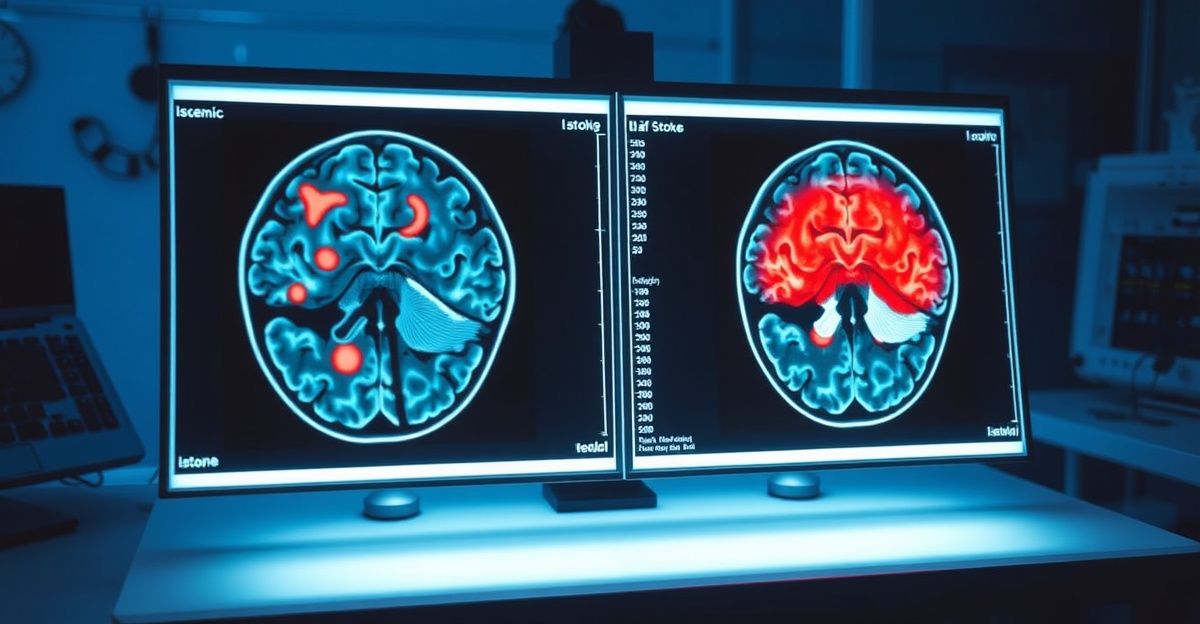
Most Hyperbaric Oxygen Therapy (HBOT) research for stroke has studied ischemic strokes, which account for roughly 87% of all strokes. But a 2020 study of 162 chronic stroke patients found that hemorrhagic stroke patients actually showed greater improvement in information processing speed than ischemic patients after HBOT. The type of stroke matters for understanding the evidence, but it does not necessarily predict who will benefit.
How Ischemic and Hemorrhagic Strokes Differ
The two types of stroke have fundamentally different causes, and this affects how HBOT interacts with each.
Ischemic Stroke
An ischemic stroke occurs when a blood clot blocks an artery supplying the brain. This cuts off oxygen to a region of brain tissue. The core tissue dies, and surrounding tissue (the ischemic penumbra) becomes oxygen-starved but may survive in a dormant state. Approximately 87% of all strokes are ischemic.
HBOT’s proposed mechanism for ischemic stroke targets this penumbral tissue. By delivering 100% medical-grade oxygen at elevated pressure (typically 2.0 ATA, or atmospheres absolute), HBOT increases dissolved oxygen in blood plasma, reaching areas where compromised blood vessels cannot deliver adequate oxygen through normal hemoglobin transport.
Hemorrhagic Stroke
A hemorrhagic stroke occurs when a blood vessel in the brain ruptures, causing bleeding into or around brain tissue. This bleeding damages neurons directly through physical pressure and toxic exposure to blood products. Hemorrhagic strokes account for about 13% of strokes but carry higher mortality rates.
The damage pattern is different. Rather than an ischemic penumbra surrounding a clot, hemorrhagic strokes create damage through hematoma expansion, increased intracranial pressure, and the toxic effects of blood breakdown products on surrounding neurons. After the acute phase resolves (the bleeding stops, the hematoma is absorbed), surrounding tissue may still be viable but suppressed, similar in some respects to the ischemic penumbra.
What Does the Research Say?
The vast majority of HBOT stroke research has focused on ischemic stroke. This is simply because ischemic strokes are far more common.
Acute Ischemic Stroke
The evidence for HBOT during the acute phase of ischemic stroke is not supportive. The 2014 Cochrane Review by Bennett et al. examined 11 randomized controlled trials with 705 patients. The conclusion: no significant difference in case fatality at six months and only 4 of 14 disability measures improved.
A 2024 meta-analysis by Li et al. of 8 RCTs with 493 acute ischemic stroke patients found no significant differences in NIHSS or Barthel index scores. The modified Rankin score showed a small but significant improvement.
Chronic Ischemic Stroke
The chronic phase is where the evidence is more promising. The landmark Efrati et al. 2013 RCT enrolled patients 6 to 36 months post-ischemic stroke and found significant improvements in NIHSS, daily living activities, and quality of life after 40 HBOT sessions at 2.0 ATA. SPECT imaging confirmed reactivation of dormant brain tissue.
The Hadanny et al. 2020 study of 162 patients reported that 74.6% had ischemic strokes. These patients showed significant cognitive improvement across all domains.
What Does the Research Say?
The data for hemorrhagic stroke is much thinner, but what exists is interesting.
Limited But Notable Findings
In the Hadanny 2020 study, the 25.4% of patients with hemorrhagic strokes were analyzed separately. The finding: hemorrhagic stroke patients showed significantly higher improvement in information processing speed compared to ischemic stroke patients (P < 0.05). This was not expected and suggests that the type of stroke may influence which cognitive domains respond to HBOT.
The Khairy et al. 2025 case report documented a 45-year-old man with hemorrhagic stroke who began HBOT 15 months post-event. After 83 sessions, he progressed from wheelchair to cane ambulation. SPECT showed 15.83% increased perfusion in the right motor cortex. DTI imaging showed improved structural connectivity in white matter tracts.
These are encouraging data points, but they come from a retrospective subgroup analysis and a single case report. No randomized trial has been specifically designed to study HBOT in hemorrhagic stroke patients.
Theoretical Considerations for Hemorrhagic Stroke
There are both reasons for optimism and reasons for caution when considering HBOT for hemorrhagic stroke:
Potential benefits:
- HBOT reduces cerebral edema through vasoconstriction while paradoxically improving oxygen delivery. This mechanism could address residual inflammation from hemorrhagic damage.
- HBOT promotes angiogenesis, which could help re-establish blood supply to areas damaged by the hematoma.
- The anti-inflammatory effects of HBOT may help clear residual damage from blood breakdown products.
Potential concerns:
- In the acute phase, increased oxygen levels and pressure could theoretically affect vascular integrity in a brain that has recently experienced a vessel rupture. This is why HBOT during acute hemorrhagic stroke is generally not recommended.
- The risk profile may differ for patients with underlying vascular malformations (aneurysms, arteriovenous malformations) that caused the hemorrhagic stroke in the first place.
- There is simply not enough dedicated research on hemorrhagic stroke patients to draw firm conclusions.
Head-to-Head Comparison: Key Differences
Based on the available evidence, here is how the two stroke types compare for HBOT:
- Volume of research: Ischemic stroke has far more published data. Multiple RCTs, systematic reviews, and meta-analyses exist. Hemorrhagic stroke data is limited to subgroup analyses and case reports.
- Acute phase: HBOT is not well-supported for either type during the acute phase. Standard stroke protocols (tPA and thrombectomy for ischemic, surgical evacuation for hemorrhagic) take priority.
- Chronic phase cognitive outcomes: Both types show improvement. Hemorrhagic stroke patients may show particular gains in information processing speed (Hadanny 2020).
- Motor outcomes: The Khairy 2025 case report (hemorrhagic) showed dramatic motor improvement. The Efrati 2013 trial (predominantly ischemic) showed ADL improvements. Direct comparison is not possible with current data.
- Safety profile: HBOT appears safe for both types in the chronic phase. No differential adverse event rates have been reported between stroke types.
Contraindications Specific to Each Stroke Type
Before pursuing HBOT, certain contraindications should be discussed with your neurologist:
For Ischemic Stroke Patients
- Active anticoagulation therapy may need to be evaluated, as HBOT can affect clotting dynamics.
- Patients with untreated carotid stenosis should discuss vascular risk with their neurologist before starting HBOT.
- Standard HBOT contraindications apply: untreated pneumothorax, certain seizure disorders, and specific medications (bleomycin, cisplatin).
For Hemorrhagic Stroke Patients
- The underlying cause of the hemorrhage matters. If caused by a vascular malformation (aneurysm, AVM), it should be treated or deemed stable before starting HBOT.
- Timing is more critical. HBOT should not be considered until well after the acute phase, when the hemorrhage has fully resolved and any surgical interventions have healed.
- Patients on blood-thinning medications should discuss the interaction with their provider.
What Does the Research Say?
The disparity in research between ischemic and hemorrhagic stroke is not unique to HBOT. It reflects a broader pattern in stroke research. Because ischemic strokes are nearly seven times more common than hemorrhagic strokes, clinical trials naturally enroll more ischemic patients. Hemorrhagic stroke also carries higher acute mortality, meaning fewer patients survive to the chronic phase where HBOT research is most active.
Additionally, the acute management of hemorrhagic stroke is more complex. Surgical evacuation of hematomas, management of intracranial pressure, and treatment of underlying vascular malformations take priority. By the time a hemorrhagic stroke patient is stable enough for an elective therapy like HBOT, months may have passed.
The result is that hemorrhagic stroke patients are underrepresented in HBOT trials. This does not mean HBOT is less effective for hemorrhagic stroke. It means we have less data. The subgroup analysis from Hadanny 2020 showing greater information processing speed improvement in hemorrhagic patients is intriguing but needs to be tested in a dedicated trial.
Mixed Stroke Types and Lacunar Strokes
Not all strokes fall neatly into the ischemic or hemorrhagic category. Some patients experience hemorrhagic transformation of an initially ischemic stroke, where the blocked area begins to bleed after blood flow is restored. Others have lacunar strokes, small deep infarcts caused by occlusion of penetrating arteries, which have their own distinct recovery profile.
The HBOT stroke literature has not specifically addressed hemorrhagic transformation or lacunar strokes as separate categories. However, the Hadanny 2020 finding that there was no significant difference in outcomes between cortical and subcortical strokes is relevant to lacunar stroke patients, since lacunar infarcts are subcortical by definition. These patients appear to respond to HBOT similarly to those with larger cortical strokes.
For patients with hemorrhagic transformation, the key consideration is timing. The hemorrhagic component needs to have fully resolved before HBOT can be safely considered. Brain imaging should confirm that there is no active bleeding or unstable vascular lesion before starting pressurized oxygen therapy.
Mechanism Differences: Why the Biology Matters
Understanding the different damage mechanisms helps explain both the promise and the uncertainty around HBOT for each stroke type.
Ischemic Stroke Damage Pathway
In ischemic stroke, the damage cascade follows a predictable sequence: clot blocks blood flow, oxygen deprivation begins, neurons in the core die within minutes, penumbral neurons become metabolically suppressed, inflammation increases over hours and days, and blood-brain barrier integrity declines. HBOT in the chronic phase targets the end result of this cascade: the dormant penumbra. It bypasses the damaged microvasculature by increasing dissolved oxygen in plasma, which diffuses directly into tissue.
Hemorrhagic Stroke Damage Pathway
In hemorrhagic stroke, the damage mechanism is fundamentally different. Blood escapes from a ruptured vessel, creating a hematoma that physically compresses surrounding tissue. The blood itself is toxic to neurons (iron from hemoglobin generates destructive free radicals). Cerebral edema compounds the pressure damage. Over time, the hematoma is reabsorbed, but the surrounding tissue may remain damaged and inflamed.
HBOT’s anti-inflammatory and anti-edema properties may be particularly relevant here. HBOT causes vasoconstriction (narrowing of blood vessels), which paradoxically reduces cerebral edema while maintaining or improving oxygen delivery through the increased dissolved oxygen in plasma. For hemorrhagic stroke patients in the chronic phase, where residual inflammation and edema may still be suppressing neural function, this mechanism could be especially beneficial.
The greater information processing speed improvement seen in hemorrhagic patients (Hadanny 2020) may relate to this. If hemorrhagic stroke creates more inflammation-mediated suppression of surrounding tissue (as opposed to direct ischemic damage to the penumbra), and HBOT is particularly effective at resolving inflammation, then hemorrhagic patients might indeed have more “unlockable” tissue than ischemic patients.
This is speculative but biologically plausible. It underscores the need for dedicated hemorrhagic stroke HBOT trials.
Current Clinical Practice: How Providers Approach Stroke Type
In practice, most HBOT clinics that treat chronic stroke patients do not refuse treatment based on stroke type. The published evidence, while weighted toward ischemic stroke, does not indicate that hemorrhagic stroke patients are poor candidates. The Hadanny 2020 data actually suggests the opposite for at least one cognitive domain.
Experienced HBOT providers typically evaluate chronic stroke patients based on several factors beyond stroke type: time since event, brain imaging findings (presence of recoverable tissue), overall medical stability, current medications, and the patient’s rehabilitation history and functional goals.
The most cautious approach involves obtaining a current brain MRI and, ideally, a SPECT scan before beginning treatment. These imaging studies help identify whether viable but dormant tissue exists regardless of stroke type. A hemorrhagic stroke patient with clear penumbral tissue on SPECT is likely a better candidate than an ischemic stroke patient whose imaging shows only dead tissue and no recoverable penumbra.
For both stroke types, the standard protocol remains the same: 40 sessions at 2.0 ATA, 90 minutes per session, five days per week. There is no published evidence suggesting that hemorrhagic stroke patients need a different pressure, duration, or number of sessions.
Questions to Ask Your Neurologist
If you are considering HBOT after either type of stroke, bring these questions to your neurologist:
- Based on my brain imaging, is there evidence of viable but dormant tissue that HBOT could potentially reactivate?
- Is my vascular condition stable enough for pressurized oxygen therapy?
- Are there any medications I am taking that could interact with HBOT?
- If my stroke was hemorrhagic, has the underlying cause been identified and addressed?
- What is a realistic expectation for improvement given my specific stroke type, location, and time since event?
For a comprehensive overview, see our guide to HBOT for stroke patients. For the numbers behind these findings, see the HBOT stroke recovery statistics.
Sources
- Hadanny A, et al. “Hyperbaric oxygen therapy improves neurocognitive functions of post-stroke patients.” Restorative Neurology and Neuroscience. 2020;38(1):93-108.
- Efrati S, et al. “Hyperbaric Oxygen Induces Late Neuroplasticity in Post Stroke Patients.” PLoS ONE. 2013;8(1):e53716. DOI: 10.1371/journal.pone.0053716
- Bennett MH, et al. “Hyperbaric oxygen therapy for acute ischaemic stroke.” Cochrane Database of Systematic Reviews. 2014;(11):CD004954. DOI: 10.1002/14651858.CD004954.pub3
- Li X, et al. “Efficacy and safety of hyperbaric oxygen therapy in acute ischaemic stroke.” BMC Neurology. 2024;24:51. DOI: 10.1186/s12883-024-03555-w
- Khairy S, et al. “Anatomical and metabolic brain imaging correlation of neurological improvements following HBOT.” Journal of Medical Case Reports. 2025;19:87. DOI: 10.1186/s13256-025-05577-5
- Iqbal J, et al. “Hyperbaric Oxygen and Outcomes Following the Brain Injury: A Systematic Review.” Journal of Neurology Research Reviews & Reports. 2023;5:178. DOI: 10.47363/jnrrr/2023(5)178
Medical Disclaimer
The content on BaricBoost.com is for informational purposes only and is not intended as a substitute for professional medical advice, diagnosis, or treatment. Always seek the advice of your physician or other qualified health provider with any questions you may have regarding a medical condition. Never disregard professional medical advice or delay in seeking it because of something you have read on this website.

Author
Seph Fontane Pennock is the founder of BaricBoost.com and Regenerated.com, a clinic directory for regenerative medicine serving 10,000+ providers across the United States. He previously built and sold PositivePsychology.com, which grew to 19 million users and became the largest evidence-based positive psychology resource on the web. Seph brings direct experience as an HBOT patient, having completed protocols at clinics across three continents while navigating mold illness, systemic inflammation, and autoimmune conditions. His treatment journey includes hyperbaric oxygen therapy, peptide protocols, NAD+ therapy, and consultations with specialists from Dubai to Cape Town to Mexico. This combination of entrepreneurial track record and lived patient experience shapes everything published on BaricBoost.com. Every article is grounded in peer-reviewed research, informed by real clinical encounters, and written for patients making high-stakes treatment decisions. Seph's focus is on bringing transparency, scientific rigor, and practical guidance to the hyperbaric oxygen therapy space.