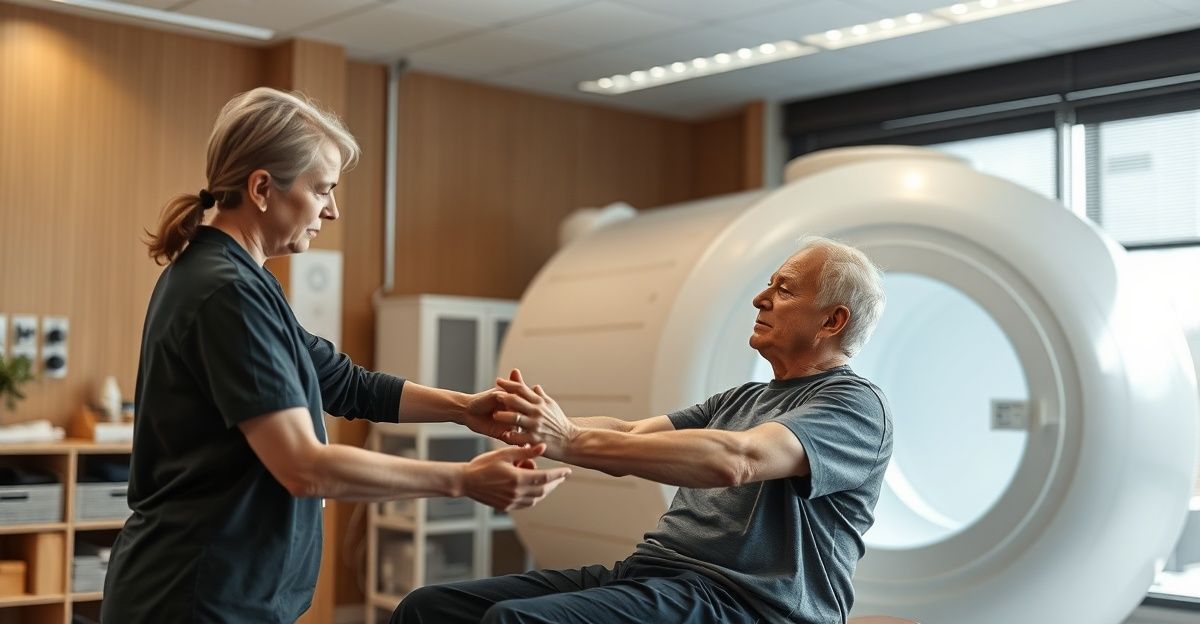
Combining Hyperbaric Oxygen Therapy (HBOT) with physical therapy after stroke may produce better outcomes than either intervention alone. HBOT enhances the brain’s capacity for neuroplasticity by increasing oxygen delivery to dormant neurons. Physical therapy then drives functional recovery through repetition and task-specific practice. A 2013 randomized trial showed that 40 HBOT sessions reactivated dormant brain tissue in chronic stroke patients, while a 2026 pilot study found that HBOT plus conventional physiotherapy improved NIHSS scores from 7.27 to 5.46.
Why the Combination Makes Biological Sense
HBOT and physical therapy target stroke recovery through complementary mechanisms. Understanding each one’s contribution helps explain why combining them is a rational approach.
What HBOT Does
HBOT delivers 100% medical-grade oxygen at elevated pressure, typically 2.0 ATA (atmospheres absolute). This dramatically increases dissolved oxygen in the blood plasma, reaching brain regions where damaged microvasculature limits normal oxygen delivery. In chronic stroke patients, this targets the ischemic penumbra: a zone of neurons that survived the stroke but are metabolically dormant.
The biological effects relevant to rehabilitation include:
- Reactivation of dormant neurons: SPECT imaging from the Efrati 2013 trial showed increased metabolic activity in brain regions with structural integrity but suppressed function.
- Angiogenesis: HBOT promotes the growth of new blood vessels, restoring blood supply to oxygen-starved regions.
- Reduced neuroinflammation: Lower inflammation creates a more favorable environment for neural repair.
- Enhanced mitochondrial function: More oxygen means more cellular energy production in recovering neurons.
What Physical Therapy Does
Physical therapy drives neuroplasticity through repetitive, task-specific practice. When a stroke patient repeatedly practices a movement (walking, reaching, grasping), the brain strengthens the neural pathways supporting that movement. This is Hebbian plasticity: neurons that fire together wire together.
Occupational therapy and speech therapy operate on the same principle for different functional domains. The consistent factor is that the brain needs structured, repetitive input to reorganize effectively.
The Synergy
HBOT creates the biological conditions for neuroplasticity: oxygenated neurons, new blood vessels, reduced inflammation, more cellular energy. Physical therapy provides the structured repetition that tells the brain which pathways to strengthen.
In this model, HBOT is the primer and rehabilitation is the paint. The primer does not create the final product, but without it, the paint does not adhere as well.
What Does the Research Say?
Yadav et al. (2026): HBOT Plus Physiotherapy
A 2026 pilot RCT by Yadav et al. studied 30 patients at 3 to 6 months post-ischemic stroke. The treatment group received 24 HBOT sessions alongside conventional physiotherapy. The control group received physiotherapy alone.
Within the HBOT group, NIHSS scores improved from 7.27 to 5.46, and MMSE (cognitive) scores improved from 24.8 to 26.73. Quality of life measures on the SF-36 also improved significantly in most domains.
The between-group comparison (HBOT plus physiotherapy vs. physiotherapy alone) did not reach statistical significance. This is likely a power issue: with only 15 patients per group, the study was too small to detect a moderate-sized difference. It does not prove that the combination is ineffective, only that the trial was not large enough to confirm a benefit.
Efrati et al. (2013): HBOT After Rehabilitation Plateau
The Efrati 2013 trial provides stronger evidence, though it did not specifically compare HBOT-plus-rehab to rehab alone. All 74 enrolled patients had completed standard rehabilitation and were no longer improving. After 40 HBOT sessions, patients showed significant improvements in neurological function, daily living activities, and quality of life.
The implication is that HBOT produced gains in patients who had already plateaued with rehabilitation alone. This suggests that HBOT adds something that rehabilitation by itself could not achieve: the reactivation of dormant neural tissue.
Rosario et al. (2018): Functional Improvements with HBOT
A 2018 study by Rosario et al. of 7 ischemic stroke patients found that 40 HBOT sessions improved cognition, executive function, gait, sleep quality, and quality of life. Improvements were maintained 3 months after treatment ended. Serum biomarkers for inflammation and neural recovery changed during treatment, though these biomarker changes were more transient than the functional gains.
The gait improvements are particularly relevant: they suggest HBOT can support the kind of motor recovery that physical therapy specifically targets.
Scheduling: Should HBOT Come Before or After Physical Therapy?
There is no definitive research comparing HBOT-before-PT to PT-before-HBOT scheduling. The biological rationale favors HBOT before or immediately before rehabilitation sessions:
- Immediate post-HBOT window: After an HBOT session, dissolved oxygen levels in the brain remain elevated for a period. This may create a window of enhanced neural responsiveness. Performing physical therapy during this window could amplify the training effect.
- Reduced fatigue: Some patients report increased energy and mental clarity after HBOT sessions. Starting PT while this effect is active may allow for more productive rehabilitation.
- Practical consideration: HBOT sessions are 90 minutes, typically in the morning. Scheduling PT for the afternoon of the same day, or within 2 to 4 hours after the HBOT session, is a common clinical approach at centers that offer both.
Some clinicians prefer alternating days (HBOT on Monday/Wednesday/Friday, PT on Tuesday/Thursday) to avoid patient fatigue. The optimal schedule likely varies by patient and should be coordinated between the HBOT provider and the rehabilitation team.
What a Combined Protocol Might Look Like
Based on the published research and common clinical practice, a combined HBOT-rehabilitation program for chronic stroke might follow this structure:
- HBOT protocol: 40 sessions at 2.0 ATA, 90 minutes per session, 5 days per week (8 weeks). This matches the most-studied protocol (Efrati 2013, Hadanny 2020).
- Physical therapy: 3 to 5 sessions per week, 45 to 60 minutes, focusing on task-specific motor retraining. Ideally scheduled within hours of HBOT sessions.
- Occupational therapy: 2 to 3 sessions per week for upper extremity function and daily living skills.
- Speech therapy: As needed, particularly for patients with aphasia or cognitive-communication deficits.
- Duration: 8 to 12 weeks of intensive combined therapy.
Recovery Timelines: What to Expect
Setting realistic expectations is important. Based on published data:
- Cognitive improvements may begin to appear after 20 to 30 HBOT sessions. The Hadanny 2020 study documented improvements after 40 to 60 sessions, with 86% of patients achieving clinically significant cognitive gains.
- Motor improvements are more variable. The Khairy 2025 case required 83 sessions to progress from wheelchair to cane ambulation. More modest motor gains may appear earlier.
- Functional improvements (daily living activities) were documented after 40 sessions in the Efrati 2013 trial.
- Sustained gains: The Rosario 2018 study showed improvements maintained at 3 months post-treatment. Long-term durability beyond 6 months is not well studied.
Patients should plan for a minimum of 40 HBOT sessions to give the protocol a fair evaluation. Some patients require 60 or more sessions to see maximum benefit.
Coordinating Care Between Providers
One practical challenge is that HBOT clinics and rehabilitation centers are often separate facilities with separate medical records. Effective coordination requires:
- Shared treatment goals between the HBOT provider and the rehabilitation team
- Regular communication about patient progress and any adverse effects
- A coordinating physician (typically the neurologist) who oversees the overall recovery plan
- Consistent outcome measurement, ideally using standardized scales (NIHSS, Barthel Index, cognitive assessments) that both teams track
For more on the underlying science, see our article on HBOT for stroke patients. For broader information on HBOT in recovery contexts, see HBOT for recovery.
Types of Rehabilitation That May Benefit from HBOT
Different rehabilitation modalities target different aspects of stroke recovery. Each may interact with HBOT in distinct ways.
Physical Therapy (Gross Motor Function)
Physical therapy focuses on walking, balance, transfers, and lower extremity strength. HBOT may enhance PT outcomes by reactivating motor cortex neurons and promoting angiogenesis in motor-relevant brain regions. The Khairy 2025 case, where a patient progressed from wheelchair to cane ambulation after HBOT, illustrates the potential for motor recovery when oxygenation reaches the right areas.
Occupational Therapy (Fine Motor and Daily Living)
Occupational therapy targets upper extremity function, hand dexterity, and activities of daily living (dressing, eating, grooming). The Efrati 2013 trial showed significant improvement in ADL scores after HBOT, suggesting that the neuroplasticity induced by oxygen therapy can support the fine motor and coordination improvements that OT aims to achieve.
Speech-Language Therapy
For stroke patients with aphasia or dysarthria, speech-language therapy provides structured practice in word finding, sentence construction, and verbal fluency. Cognitive improvements from HBOT (particularly in processing speed and attention documented in Hadanny 2020) may create conditions where speech therapy is more productive because the underlying neural resources for language processing are enhanced.
Cognitive Rehabilitation
Cognitive rehabilitation uses structured exercises to improve memory, attention, and executive function. Since the strongest HBOT stroke data is in the cognitive domain (86% clinically significant improvement in Hadanny 2020), combining HBOT with formal cognitive rehabilitation is perhaps the most evidence-supported pairing. The oxygen-driven reactivation of neural networks responsible for cognition, combined with targeted cognitive exercises, aligns the biological intervention with the behavioral training.
Who Should Coordinate the Combined Plan?
The biggest challenge with combining HBOT and rehabilitation is that these services are typically delivered in different settings by different teams. A stroke survivor may see a neurologist at a hospital, receive HBOT at an independent clinic, and attend physical therapy at a rehabilitation center. None of these providers may be in regular communication with each other.
The ideal coordinator is the patient’s neurologist, who has the medical authority and clinical overview to integrate recommendations from all providers. In practice, the patient or their caregiver often ends up as the coordinator by default.
If you are pursuing combined HBOT and rehabilitation, consider these steps:
- Ask your neurologist to write a comprehensive treatment plan that includes both HBOT and rehabilitation goals.
- Share copies of any brain imaging (SPECT, MRI) with both the HBOT provider and the rehabilitation team.
- Request that the HBOT provider send progress notes to your rehabilitation therapists, and vice versa.
- Keep a personal log of changes you notice, both positive and negative. This helps all providers see the full picture.
- Schedule reassessment at 20 sessions and 40 sessions to track progress objectively.
When Combined Therapy May Not Be Appropriate
Not every stroke patient is a good candidate for combined HBOT and rehabilitation. Situations where the combination may not be appropriate include:
- Medically unstable patients: Active cardiac issues, uncontrolled seizures, or respiratory conditions that are contraindications for HBOT.
- Very early acute phase: During the first weeks after stroke, the focus should be on acute medical management and initial stabilization. HBOT adds complexity that may not be warranted when standard rehabilitation alone is producing rapid gains.
- Fatigue-limited patients: Some patients, particularly older adults or those with significant medical comorbidities, may find the combined schedule (90-minute HBOT sessions plus 45 to 60 minutes of PT) physically exhausting. In these cases, alternating days or reducing the overall intensity may be necessary.
- Financial constraints: If a patient can only afford HBOT or intensive rehabilitation but not both simultaneously, the evidence suggests prioritizing HBOT first (to create the neuroplasticity conditions), then following up with intensive rehabilitation to capitalize on the enhanced brain state.
What Does the Research Say?
Despite the biological logic of combining HBOT and rehabilitation, the direct clinical evidence for the combination is surprisingly thin. No large, multi-site RCT has compared HBOT-plus-rehabilitation to rehabilitation alone in chronic stroke patients with adequate statistical power.
The Yadav 2026 pilot study attempted this comparison but was underpowered at 30 patients. The Efrati 2013 trial demonstrated that HBOT works in patients who had already completed rehabilitation, but it did not test the simultaneous combination. The Rosario 2018 study measured functional outcomes that overlapped with rehabilitation goals (gait, cognition) but did not include a rehabilitation-only control arm.
Key questions that future research needs to answer include: Does simultaneous HBOT and rehabilitation produce better outcomes than sequential approaches (HBOT first, then rehabilitation)? Is there an optimal time interval between an HBOT session and a rehabilitation session on the same day? Are certain types of rehabilitation (cognitive, motor, speech) more synergistic with HBOT than others? What is the minimum number of HBOT sessions needed before rehabilitation benefits are amplified?
Until these questions are answered by rigorous trials, the combination of HBOT and rehabilitation remains a reasonable clinical approach based on biological plausibility and indirect evidence, but not a proven protocol with defined parameters.
Sources
- Efrati S, et al. “Hyperbaric Oxygen Induces Late Neuroplasticity in Post Stroke Patients.” PLoS ONE. 2013;8(1):e53716. DOI: 10.1371/journal.pone.0053716
- Yadav R, et al. “Role of HBOT in Rehabilitation of Stroke Patients: A Randomized Controlled Pilot Study.” Annals of African Medicine. 2026. DOI: 10.4103/aam.aam_804_25
- Hadanny A, et al. “Hyperbaric oxygen therapy improves neurocognitive functions of post-stroke patients.” Restorative Neurology and Neuroscience. 2020;38(1):93-108.
- Rosario ER, et al. “The Effect of HBOT on Functional Impairments Caused by Ischemic Stroke.” Neurology Research International. 2018;2018:3172679. DOI: 10.1155/2018/3172679
- Khairy S, et al. “Anatomical and metabolic brain imaging correlation of neurological improvements following HBOT.” Journal of Medical Case Reports. 2025;19:87. DOI: 10.1186/s13256-025-05577-5
- Gottfried I, Schottlender N, Ashery U. “Hyperbaric Oxygen Treatment – From Mechanisms to Cognitive Improvement.” Biomolecules. 2021;11(10):1520. DOI: 10.3390/biom11101520
Medical Disclaimer
The content on BaricBoost.com is for informational purposes only and is not intended as a substitute for professional medical advice, diagnosis, or treatment. Always seek the advice of your physician or other qualified health provider with any questions you may have regarding a medical condition. Never disregard professional medical advice or delay in seeking it because of something you have read on this website.

Author
Seph Fontane Pennock is the founder of BaricBoost.com and Regenerated.com, a clinic directory for regenerative medicine serving 10,000+ providers across the United States. He previously built and sold PositivePsychology.com, which grew to 19 million users and became the largest evidence-based positive psychology resource on the web. Seph brings direct experience as an HBOT patient, having completed protocols at clinics across three continents while navigating mold illness, systemic inflammation, and autoimmune conditions. His treatment journey includes hyperbaric oxygen therapy, peptide protocols, NAD+ therapy, and consultations with specialists from Dubai to Cape Town to Mexico. This combination of entrepreneurial track record and lived patient experience shapes everything published on BaricBoost.com. Every article is grounded in peer-reviewed research, informed by real clinical encounters, and written for patients making high-stakes treatment decisions. Seph's focus is on bringing transparency, scientific rigor, and practical guidance to the hyperbaric oxygen therapy space.