Affiliate Disclosure
This article contains affiliate links. If you purchase through these links, we may earn a commission at no additional cost to you. This does not influence our evaluations or rankings.
Hyperbaric oxygen therapy does not help during an acute stroke, but a small group of chronic-phase trials points to something more interesting. A 2013 Tel Aviv University randomized trial of 74 chronic-stroke patients found that 40 sessions at 2.0 ATA produced measurable neurological and cognitive gains 6 to 36 months after the event, changes confirmed on SPECT brain imaging.1
Stroke recovery is not one of the 14 conditions the FDA and the Undersea and Hyperbaric Medical Society (UHMS) recognize for hyperbaric oxygen therapy, so any clinic offering it is working off-label.18 That does not make it worthless, but it does mean the evidence deserves a careful read. This guide separates what the research actually supports from what it does not, covers the protocol and costs, and explains how to evaluate a center. For the raw numbers behind these findings, see our HBOT stroke recovery statistics, and for the wider picture, our overview of HBOT for brain and neurological conditions.
Does HBOT work for stroke recovery?
The answer depends entirely on timing. During acute stroke, high-quality evidence shows no benefit. For chronic stroke, months to years after the event, several small studies from a single Israeli research group report meaningful cognitive gains, and brain imaging supports the mechanism. The chronic-phase evidence is promising but has not been replicated independently with sham controls.
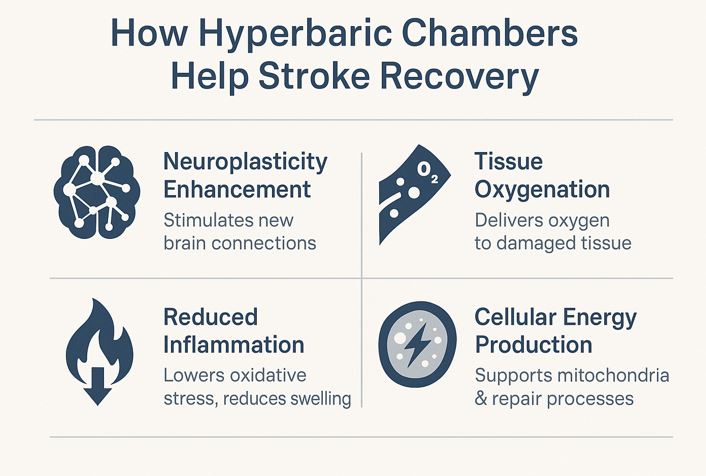
The mechanism most often cited is the ischemic penumbra: a zone of stunned but still-living tissue surrounding the dead stroke core. Under normal conditions these cells sit metabolically dormant. HBOT delivers 100% oxygen at 2.0 ATA, dissolving far more oxygen into plasma than breathing air can, which may raise oxygen delivery to that marginal tissue enough to restart function.13 In the Efrati 2013 trial, SPECT imaging showed increased metabolic activity in previously dormant peri-infarct regions after 40 sessions, and that imaging change tracked with the clinical gains.1
Beyond simply flooding tissue with oxygen, laboratory work points to slower, regenerative effects. Hyperbaric oxygen mobilizes CD34+ bone-marrow stem cells through a nitric-oxide dependent pathway, roughly doubling circulating progenitor cells over a course of treatment.16 In rat stroke models, longer HBOT courses increased neurotrophic factor production, stem-cell migration to the injured brain, and reduced inflammation more than short courses.15 These pathways plausibly explain why the human protocol runs 40 sessions or more rather than a handful. Our page on HBOT and stroke neuroplasticity goes deeper on this mechanism.
Reviews of the stroke literature describe the same set of candidate mechanisms: hyperbaric oxygen maintains the viability of marginal penumbral tissue, reduces mitochondrial dysfunction, and blunts the inflammatory and reperfusion-injury cascades that follow ischemia.1314 In the chronic brain, the emphasis shifts from rescue to repair, with oxygen acting as a signal for angiogenesis, synaptogenesis, and the recruitment of stem and progenitor cells rather than as an emergency supply.12
The trade-off: mechanism is not outcome. A biologically plausible pathway and positive imaging do not prove that patients recover function they would not have recovered anyway, which is exactly why sham-controlled replication matters here. The same protocol has since been tested in a sham-controlled randomized trial for a different condition, post-COVID cognitive impairment, where it improved cognition and attention against a sham arm.19 That lends some external support to the idea that the effect is real rather than pure placebo, but it is not a substitute for a sham-controlled stroke trial, which still does not exist.
Why does timing matter for HBOT after stroke?
Timing is the single most important variable. Trials that treated patients during the acute phase, within hours to two weeks, found no significant benefit. Trials that treated chronic patients, at least three to six months out and plateaued in rehabilitation, are the ones reporting gains. The two bodies of evidence point in opposite directions.
For acute stroke, a Cochrane systematic review pooled 11 randomized controlled trials covering 705 patients and found no significant evidence that HBOT improves clinical outcomes.4 A 2024 meta-analysis in BMC Neurology reached the same conclusion across 8 trials and 493 patients, with no statistically significant difference in NIHSS stroke-severity scores (mean difference -1.41, 95% CI -7.41 to 4.58).5 An earlier systematic review by Carson and colleagues, funded to assess the evidence directly, likewise judged it insufficient to show benefit in any stroke subgroup.6 Standard acute care, thrombolysis and mechanical thrombectomy, remains the established treatment.
For chronic stroke the picture changes. In the Efrati 2013 crossover trial, 74 patients who had plateaued in recovery received 40 sessions at 2.0 ATA; the treated group showed significant improvement in neurological deficit, daily-living, and quality-of-life scores while the same patients had shown no change during a preceding two-month no-treatment control period.1 Why the acute-versus-chronic split exists is not fully settled, but the leading explanation is that acute injury involves active swelling, excitotoxicity, and reperfusion damage where extra oxygen may do little or even harm, whereas the chronic brain has stabilized and retains dormant tissue that oxygen and regenerative signaling might reactivate.12 Our detailed breakdown of HBOT timing after stroke and the case for treating chronic stroke years later cover this split in full.
What does the research actually show for chronic stroke?
The strongest chronic-stroke signal comes from Hadanny and colleagues, who retrospectively analyzed 162 patients treated at least three months after stroke. After 40 to 60 sessions at 2.0 ATA, 86% achieved a clinically significant cognitive improvement, defined as more than a half standard deviation gain in at least one domain, with statistically significant mean gains across every domain measured.2
Cognitive gains after HBOT in chronic stroke (Hadanny 2020, N=162)
| Cognitive domain | Mean change (points ± SD) | Significance | Source |
|---|---|---|---|
| Global cognitive score | +3.53 ± 7.68 | p < 0.0001 | Hadanny 2020 |
| Memory | +6.12 ± 15.46 | p < 0.0001 | Hadanny 2020 |
| Motor skills | +3.96 ± 14.27 | p = 0.001 | Hadanny 2020 |
| Executive function | +2.54 ± 10.37 | p = 0.003 | Hadanny 2020 |
| Information processing speed | +2.34 ± 9.28 | p = 0.005 | Hadanny 2020 |
| Attention | +2.95 ± 12.63 | p = 0.04 | Hadanny 2020 |
These are real measured changes, not before-and-after marketing figures. Two caveats belong next to them. First, this was a retrospective analysis with no control group, so some improvement could reflect practice effects, ongoing spontaneous recovery, or regression to the mean. Second, hemorrhagic strokes showed a larger gain in information processing speed than ischemic strokes (5.39 versus 1.36 points, p = 0.035), the only domain where stroke type mattered, which our page on HBOT for ischemic versus hemorrhagic stroke examines.2
A separate retrospective analysis of 91 chronic-stroke patients by Boussi-Gross and colleagues, using the same protocol, found statistically significant improvement across all memory measures.3 A small within-subject study by Rosario and colleagues (N=7) reported improved gait, executive function, sleep, and quality of life after 40 sessions.7 The consistency is encouraging, but nearly all of this positive chronic-stroke data traces to one research center, and a 2022 systematic review of 42 HBOT cognition studies concluded the field remains controversial and needs larger, better-controlled trials.8
HBOT for stroke: evidence by phase and outcome
| Phase / outcome | Best evidence (N) | Protocol | Result | Evidence grade |
|---|---|---|---|---|
| Acute stroke, functional recovery | Cochrane meta, 11 RCTs (705); Li 2024 meta, 8 trials (493) | Varied, started within days | No significant benefit | Strong evidence of no benefit |
| Chronic stroke, cognition | Efrati 2013 RCT (74); Hadanny 2020 (162); Boussi-Gross 2015 (91) | 40 to 60 sessions, 2.0 ATA, 90 min | Significant cognitive gains; 86% clinically significant improvement | Moderate, single-center |
| Chronic stroke, motor and daily function | Rosario 2018 (7); Efrati 2013 (74) | 40 sessions, 2.0 ATA | Improved gait, ADL and NIHSS in small samples | Emerging |
| Post-stroke depression | Liang 2020 meta, 27 RCTs (2,250); sham RCT 2026 (61) | 20 to 40 sessions, 2.0 ATA | Higher response rate (69.4% vs 51.2%), but low trial quality | Moderate |
It is worth being blunt about what “moderate, single-center” means. The Efrati crossover design is stronger than a simple before-and-after because each patient’s treated period is compared against their own untreated control period, which partly controls for spontaneous recovery. But a crossover is not a sham-controlled parallel trial: patients knew they were being treated, and some outcome measures are subjective or effort-dependent. When a treatment’s evidence base sits almost entirely inside one center’s patient population, independent replication is the missing piece, and until it arrives the honest label is promising, not proven.
Post-stroke depression is the one stroke-related outcome with pooled randomized evidence. A 2020 meta-analysis of 27 trials and 2,250 patients found a higher treatment response with HBOT than standard care (69.4% versus 51.2%, odds ratio 2.51), though the authors warned that the included trials were methodologically weak.10 A 2015 randomized trial found HBOT combined with fluoxetine outperformed either alone,9 and a 2026 randomized, sham-controlled trial in 61 patients linked HBOT to reduced depression scores and higher serum BDNF and beta-NGF.11
What does the stroke HBOT protocol involve?
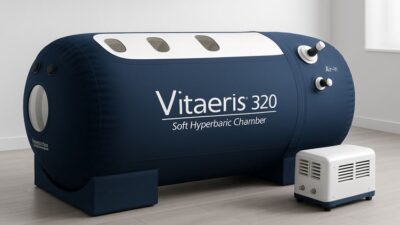
The protocol used in the chronic-stroke research is consistent: 40 to 60 daily sessions, five days a week, 90 minutes each, breathing 100% oxygen at 2.0 ATA in a hard-shell chamber. Soft-shell chambers cannot reach the pressure or oxygen concentration these studies used, so the research does not transfer to home units.
Each session is undramatic. You lie or sit in the chamber while pressure rises over several minutes; ears pop as on an aircraft, which you manage by swallowing or yawning. At depth you breathe pure oxygen, often with short air breaks every 20 minutes to reduce oxygen-toxicity risk. Most patients read, listen to audio, or rest. Before starting, a good program establishes a baseline with cognitive and functional testing so progress can be measured against the numbers rather than impressions. Our guide to what to expect during HBOT walks through a first session in detail, and the Efrati protocol versus the Harch protocol compares the two main approaches.
Total course length matters. At five sessions a week, 40 to 60 sessions runs roughly two to three months of near-daily appointments, a real logistical and financial commitment that is worth weighing honestly before starting. The chronic-stroke studies did not test shorter courses, so a program advertising a quick 10-session package is not delivering the protocol the research supports.
HBOT is not a replacement for conventional rehabilitation. In the trials, patients continued physical, occupational, and speech therapy, and the researchers positioned oxygen as an adjunct that may widen the window for those therapies to work. See HBOT combined with physical therapy after stroke for how the two are sequenced.
Does insurance cover HBOT for stroke?
Almost never. Because stroke recovery is not among the 14 FDA-cleared and UHMS-recognized indications, insurers classify HBOT for stroke as off-label and experimental, and routinely deny it.18 Plan on paying out of pocket. Each session runs roughly $200 to $400, so a 40 to 60 session course typically costs $12,000 to $24,000.
Some hospital-based programs bill covered indications separately, and a minority of plans consider appeals with strong documentation, but neither is reliable. Ask any center for written pricing, whether they offer payment plans, and what their refund policy is if you stop early. Our page on HBOT stroke cost and insurance breaks down the numbers, and the FDA-cleared indications for HBOT lists exactly which conditions do qualify.
How do I choose a stroke HBOT center?
Choose on accreditation, honesty, and coordination. The center should use a hard-shell chamber at 2.0 ATA, employ trained hyperbaric staff, run genuine cognitive and functional baselines, and coordinate with your neurologist and therapists rather than working in isolation. Ideally the facility is UHMS-accredited.
Be skeptical of any center promising dramatic stroke reversal. The chronic-stroke evidence is promising but single-center and unreplicated, and a legitimate provider will say so. Watch for programs that skip baseline testing, push soft-shell home chambers for a 2.0 ATA protocol, or bundle unrelated add-ons. Because the same treatment carries real risks, confirm the center screens for contraindications (covered below) and has emergency procedures for the rare but serious complications any high-oxygen environment can produce. For side-effect rates, see our guide to hyperbaric chamber side effects. Comparable evidence-versus-hype tension exists across brain conditions, which our overview of HBOT for neurological conditions and the data on HBOT for TBI and concussion both address.
Who should not try HBOT?
HBOT is generally safe under trained supervision, but it is not for everyone. In a retrospective safety analysis of 2,334 patients, middle-ear barotrauma occurred in 17.4% of patients, while more serious events including oxygen toxicity, hypoglycemia, and anxiety reactions each occurred in only 0.5% to 1.5%.17 The main absolute barrier is an untreated pneumothorax.
Absolute contraindications
- Untreated pneumothorax (collapsed lung). Pressure changes can expand trapped air and become life-threatening.
- Certain chemotherapy agents. Bleomycin, cisplatin, doxorubicin, and disulfiram can interact dangerously with high-oxygen environments.
Relative contraindications (proceed only with medical clearance)
- Upper respiratory infection or sinus congestion, which makes ear and sinus equalization difficult and raises barotrauma risk.
- Seizure disorder, because high-pressure oxygen can lower the seizure threshold.
- COPD with carbon dioxide retention, which may need a modified protocol.
- High fever, which raises oxygen-toxicity risk.
- Previous ear surgery or chronic ear disease, where equalization may be unsafe.
- Claustrophobia, which may require a multiplace chamber or coaching. See managing claustrophobia in a hyperbaric chamber.
- Pregnancy, given insufficient safety data for routine use.
Tell your provider your full medication list and history before starting, especially if you use insulin (blood sugar can fall during sessions), have a pacemaker or implanted device, or take any of the drugs above. For the full clinical picture, see our HBOT research and evidence hub.
How soon after a stroke can I start HBOT?
The evidence points away from the acute phase and toward the chronic one. A Cochrane review of 11 trials found no acute benefit, while the positive trials treated patients at least three to six months out who had plateaued in standard rehabilitation.4 Efrati’s 2013 study enrolled patients 6 to 36 months post-stroke.1 You should be medically stable, and timing is a decision for your neurologist.
Does HBOT work for both ischemic and hemorrhagic stroke?
The chronic-stroke studies included both types. In Hadanny’s 162-patient analysis, the only domain that differed by stroke type was information processing speed, where hemorrhagic strokes improved more than ischemic (5.39 versus 1.36 points, p = 0.035); overall improvement rates were similar.2 Individual response still varies, and patients with more surviving penumbral tissue tend to respond better.
Is HBOT for stroke approved by the FDA?
No. Stroke recovery is not one of the 14 FDA-cleared and UHMS-recognized HBOT indications, so it is used off-label.18 Off-label use is legal and common in medicine, but it means the treatment has not cleared the regulatory bar for stroke and is almost never covered by insurance.
How many sessions does stroke HBOT require?
The chronic-stroke research used 40 to 60 daily sessions, five days a week, 90 minutes each at 2.0 ATA.2 Shorter courses have not been shown to reproduce the cognitive gains, and animal work suggests longer courses drive more of the regenerative response.15 A center offering a handful of sessions is not following the studied protocol.
Can HBOT help with post-stroke depression?
The evidence here is more favorable than for physical recovery. A meta-analysis of 27 trials and 2,250 patients found a higher response rate with HBOT (69.4% versus 51.2%), and a 2026 sham-controlled trial linked it to lower depression scores and higher BDNF.1011 Trial quality is mixed, so treat it as a promising adjunct to standard depression care, not a replacement.
Sources
- Efrati S, Fishlev G, Bechor Y, et al. Hyperbaric oxygen induces late neuroplasticity in post stroke patients: randomized, prospective trial. PLoS ONE. 2013;8(1):e53716. doi:10.1371/journal.pone.0053716
- Hadanny A, Rittblat M, Bitterman M, et al. Hyperbaric oxygen therapy improves neurocognitive functions of post-stroke patients: a retrospective analysis. Restor Neurol Neurosci. 2020;38(1):93-107. doi:10.3233/RNN-190959
- Boussi-Gross R, Golan H, Volkov O, et al. Improvement of memory impairments in poststroke patients by hyperbaric oxygen therapy. Neuropsychology. 2015;29(4):610-621. doi:10.1037/neu0000149
- Bennett MH, Weibel S, Wasiak J, et al. Hyperbaric oxygen therapy for acute ischaemic stroke. Cochrane Database Syst Rev. 2014;(11):CD004954. doi:10.1002/14651858.CD004954.pub3
- Li X, Lu L, Min Y, et al. Efficacy and safety of hyperbaric oxygen therapy in acute ischaemic stroke: a systematic review and meta-analysis. BMC Neurol. 2024;24:55. doi:10.1186/s12883-024-03555-w
- Carson S, McDonagh M, Russman B, Helfand M. Hyperbaric oxygen therapy for stroke: a systematic review of the evidence. Clin Rehabil. 2005;19(8):819-833. doi:10.1191/0269215505cr907oa
- Rosario ER, Kaplan SE, Khonsari S, et al. The effect of hyperbaric oxygen therapy on functional impairments caused by ischemic stroke. Neurol Res Int. 2018;2018:3172679. doi:10.1155/2018/3172679
- Marcinkowska AB, Mankowska ND, Kot J, Winklewski PJ. Impact of hyperbaric oxygen therapy on cognitive functions: a systematic review. Neuropsychol Rev. 2022;32(1):99-126. doi:10.1007/s11065-021-09500-9
- Yan D, Shan J, Ze Y, Xiao-Yan Z, Xiao-Hua H. The effects of combined hyperbaric oxygen therapy on patients with post-stroke depression. J Phys Ther Sci. 2015;27(5):1295-1297. PMID:26157204
- Liang XX, Hao YG, Duan XM, Han XL, Cai XX. Hyperbaric oxygen therapy for post-stroke depression: a systematic review and meta-analysis. Clin Neurol Neurosurg. 2020;195:105910. PMID:32474256
- Hyperbaric oxygen therapy upregulates neurotrophic factors to ameliorate post-stroke depression: a randomized sham-controlled trial. Neuropsychiatr Dis Treat. 2026. doi:10.2147/NDT.S573494
- Efrati S, Ben-Jacob E. Reflections on the neurotherapeutic effects of hyperbaric oxygen. Expert Rev Neurother. 2014;14(3):233-236. doi:10.1586/14737175.2014.884928
- Sanchez EC. Mechanisms of action of hyperbaric oxygenation in stroke: a review. Crit Care Nurs Q. 2013;36(3):290-298. PMID:23736668
- Cozene B, Sadanandan N, Gonzales-Portillo B, et al. An extra breath of fresh air: hyperbaric oxygenation as a stroke therapeutic. Biomolecules. 2020;10(9):1279. doi:10.3390/biom10091279
- Lee YS, Chio CC, Chang CP, et al. Long course hyperbaric oxygen stimulates neurogenesis and attenuates inflammation after ischemic stroke. Mediators Inflamm. 2013;2013:512978. PMC3595722
- Thom SR, Bhopale VM, Velazquez OC, et al. Stem cell mobilization by hyperbaric oxygen. Am J Physiol Heart Circ Physiol. 2006;290(4):H1378-H1386. doi:10.1152/ajpheart.00888.2005
- Hadanny A, Meir O, Bechor Y, et al. The safety of hyperbaric oxygen treatment: retrospective analysis in 2,334 patients. Undersea Hyperb Med. 2016;43(2):113-122. PMID:27265988
- Undersea and Hyperbaric Medical Society. Hyperbaric oxygen therapy indications (approved UHMS indications). UHMS, 2023. uhms.org
- Zilberman-Itskovich S, Catalogna M, Sasson E, et al. Hyperbaric oxygen therapy improves neurocognitive functions and symptoms of post-COVID condition: randomized controlled trial. Sci Rep. 2022;12:11252. doi:10.1038/s41598-022-15565-0
Medical Disclaimer
The content on BaricBoost.com is for informational purposes only and is not intended as a substitute for professional medical advice, diagnosis, or treatment. Always seek the advice of your physician or other qualified health provider with any questions you may have regarding a medical condition. Never disregard professional medical advice or delay in seeking it because of something you have read on this website.

Author
Seph Fontane Pennock is the founder of BaricBoost.com and Regenerated.com, a clinic directory for regenerative medicine serving 10,000+ providers across the United States. He previously built and sold PositivePsychology.com, which grew to 19 million users and became the largest evidence-based positive psychology resource on the web. Seph brings direct experience as an HBOT patient, having completed protocols at clinics across three continents while navigating mold illness, systemic inflammation, and autoimmune conditions. His treatment journey includes hyperbaric oxygen therapy, peptide protocols, NAD+ therapy, and consultations with specialists from Dubai to Cape Town to Mexico. This combination of entrepreneurial track record and lived patient experience shapes everything published on BaricBoost.com. Every article is grounded in peer-reviewed research, informed by real clinical encounters, and written for patients making high-stakes treatment decisions. Seph's focus is on bringing transparency, scientific rigor, and practical guidance to the hyperbaric oxygen therapy space.
Why Trust Our Evaluations
Our rankings are based on hands-on testing, published clinical data, and verified manufacturer specifications. We apply the same criteria to every product regardless of affiliate status. Editorial Process · Evaluation Methodology