Affiliate Disclosure
This article contains affiliate links. If you purchase through these links, we may earn a commission at no additional cost to you. This does not influence our evaluations or rankings.
A hyperbaric chamber is the definitive treatment for decompression sickness. In a review of 140 civilian divers, HBOT achieved complete recovery in 98% of confirmed cases, including 100% of those with cerebral symptoms. Even delayed treatment works: 76% of divers treated more than 48 hours after surfacing still achieved full recovery. This is one of the original FDA-cleared indications for HBOT.
Table of Contents
What Are “the Bends” and Why They’re Dangerous
Decompression sickness happens when nitrogen bubbles form in your blood and tissues after rapid pressure changes. Think of opening a shaken soda bottle where bubbles suddenly appear when pressure drops quickly. The mechanism is straightforward physics: at depth, nitrogen dissolves into body tissues under pressure. When pressure drops too quickly on ascent, that nitrogen comes out of solution as bubbles, like fizz in a carbonated drink.
This condition most commonly affects scuba divers who ascend too quickly from depth, but it can also occur during rapid altitude changes, working in pressurized environments, or certain medical procedures. The condition gets its nickname “the bends” from the joint pain that often forces people to bend over in discomfort.
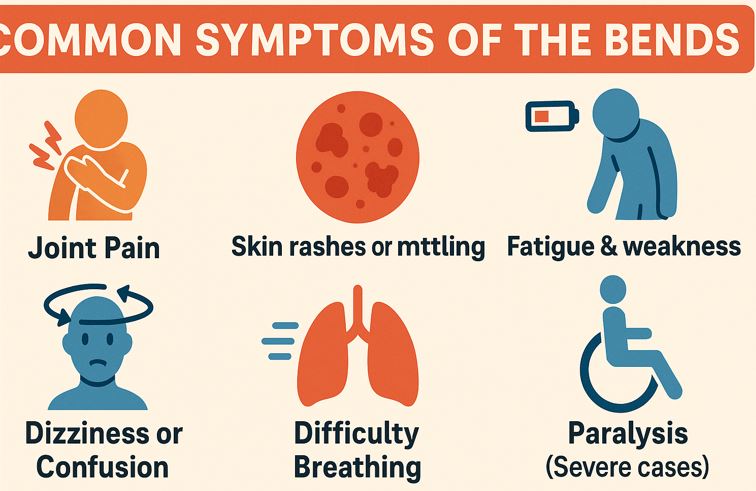
Symptoms can range from mild discomfort to life-threatening complications. Joint pain typically affects the shoulders, elbows, and knees first. You might also experience skin rashes, extreme fatigue, dizziness, confusion, or difficulty breathing. In severe cases, paralysis can occur if bubbles affect the spinal cord. Most cases appear within 24 hours of the pressure change.
How Does a Hyperbaric Chamber Work for the Bends?
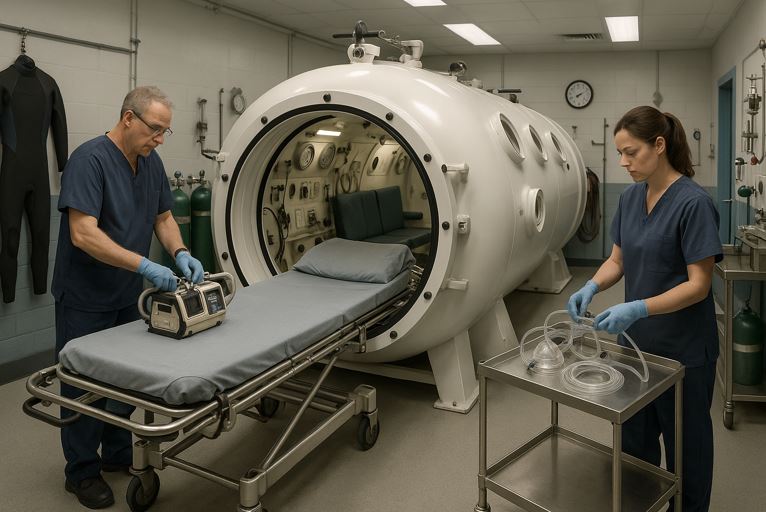
A hard hyperbaric chamber treats the bends by essentially “re-diving” you in a controlled environment. The therapy works through straightforward physics: increased ambient pressure reduces the size of nitrogen bubbles (Boyle’s Law), while breathing 100% oxygen at pressure creates a steep diffusion gradient that accelerates nitrogen washout and delivers oxygen to ischemic tissues.
Pressure Changes: The chamber increases pressure to levels that simulate being 60 feet underwater (US Navy Table 6 operates at 60 feet seawater equivalent, or approximately 2.8 ATA). This increased pressure physically shrinks the nitrogen bubbles in your blood and tissues.
100% Oxygen Breathing: Instead of regular air, you breathe 100% oxygen through a mask. This maximizes the nitrogen washout gradient and provides extra oxygen to tissues that may have been damaged by bubble-induced ischemia.
Gradual Decompression: Chamber pressure is slowly reduced following specific treatment tables, allowing your body to safely eliminate the excess nitrogen without forming new bubbles.
“In a review of 140 civilian divers with decompression sickness, HBOT achieved complete recovery in 98% of confirmed cases, including 100% of those presenting with cerebral symptoms. Even patients treated an average of 93.5 hours after surfacing responded to therapy.”
Cianci & Slade, Aviat Space Environ Med, 2006
Emergency Treatment Protocol for Decompression Sickness
Time is important, but the research is more reassuring on delays than most people realize. While quick treatment is ideal, a retrospective analysis of 204 divers found that even when recompression was delayed more than 48 hours, 76% still achieved complete recovery, compared to 78% in the early treatment group. There was no statistically significant difference in outcome by treatment timing.2
This means that if you cannot reach a chamber immediately, do not give up. Late recompression is still highly effective and should never be withheld based on time delay alone.
First aid while arranging transport to a hard hyperbaric chamber includes 100% oxygen by non-rebreather mask, supine positioning, oral or IV hydration, and urgent contact with DAN (Divers Alert Network) at +1-919-684-9111 for guidance and facility location.
Standard Treatment Protocols
Medical professionals use established US Navy Treatment Tables that specify exactly how much pressure to use, how long to maintain each level, when to breathe oxygen versus air, and how slowly to decompress safely.
The most commonly used protocol is US Navy Treatment Table 6, employed for neurological DCS (Type 2). It involves approximately 4 hours and 45 minutes at depths equivalent to 60 feet seawater, with oxygen breathing and periodic air breaks. For pain-only DCS (Type 1), Table 5 provides a shorter approximately 2-hour treatment. These tables are based on decades of research and clinical experience treating thousands of patients.
What to Expect During Bends Treatment
Before Treatment:
- Medical evaluation and IV fluids
- 100% oxygen therapy while preparing the chamber
- Pain medication if needed
During Treatment: A typical bends hard chamber session lasts 4–6 hours for US Navy Table 6, sometimes longer for severe cases. You’ll lie comfortably in the chamber, breathe oxygen through a tight-fitting mask, experience pressure changes in your ears, and be monitored constantly by medical staff. Multiplace chambers allow a trained attendant to be in the chamber with you.
What It Feels Like: Ear pressure similar to diving or flying, possible temporary worsening of symptoms early in treatment as bubbles shift, gradual improvement as treatment progresses, and fatigue afterward. This is normal.
Success Rates and Recovery Outcomes
The data on DCS recovery with HBOT is consistently positive across large case series:
- In 306 divers treated in Townsville, Australia, 93% achieved good outcomes (no or only minor residual symptoms) with no deaths. Initial disease severity was the only factor associated with poorer outcomes.3
- In a review of 140 civilian divers with delayed treatment (average 93.5 hours to treatment), complete recovery was achieved in 98% of confirmed DCS cases, including 100% of those with cerebral symptoms.1
- Even with delays over 48 hours, 76% of patients achieve complete recovery.2
Factors affecting recovery include initial severity of symptoms (the strongest predictor), time to treatment, age and overall health, and whether complete treatment tables are followed.
Prevention vs. Treatment: The Better Strategy
While hard hyperbaric chambers provide excellent treatment for the bends, prevention through proper diving practices remains far more reliable than counting on treatment after the fact. Smart prevention involves making slow, controlled ascents, following established decompression tables or dive computer guidelines, avoiding diving when unwell, not flying immediately after diving, and staying properly hydrated.
The cost and time involved in emergency hyperbaric treatment also make prevention more attractive. Even successful treatment requires significant time away from normal activities and can be expensive, especially if emergency transport to a facility is needed.
“A retrospective analysis of 204 divers found that even when HBOT was delayed more than 48 hours after surfacing, 76% still achieved complete recovery, proving that late treatment remains clinically valuable and should never be withheld.”
Hadanny et al., PLoS ONE, 2015 (N=204 divers)
The Bottom Line on Hyperbaric Chambers and the Bends
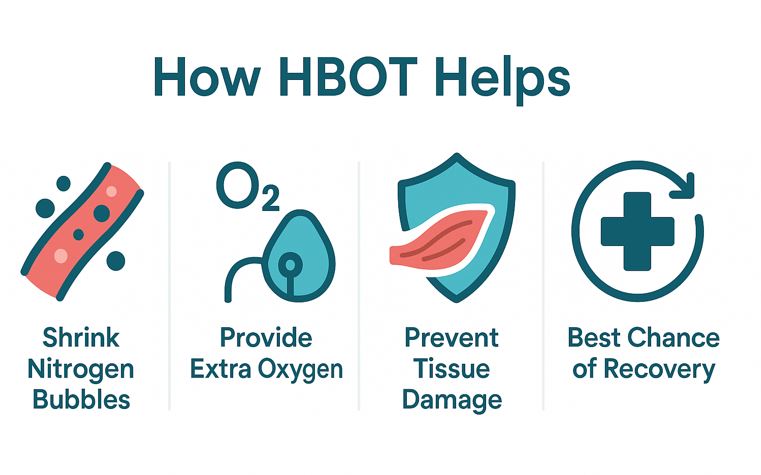
A hard hyperbaric chamber represents the best treatment available for decompression sickness. The treatment can shrink nitrogen bubbles causing symptoms, provide extra oxygen to damaged tissues, prevent further tissue damage in most cases, and give you the best possible chance of full recovery.
Importantly, no randomized controlled trials exist for DCS treatment, and likely never will, because it would be unethical to withhold the definitive treatment from sick patients. The evidence base consists of decades of clinical experience, large case series, and compelling physiological rationale. The consistency across studies treating thousands of divers makes HBOT among the most unambiguous applications in all of hyperbaric medicine.
If you suspect decompression sickness, seek professional medical evaluation immediately rather than hoping symptoms will resolve on their own. Even delayed treatment is usually better than no treatment. Follow up with physicians experienced in diving medicine after completing initial treatment for guidance about returning to diving safely.
Who Should Not Try HBOT
HBOT is generally safe when administered by trained professionals, but it is not appropriate for everyone. Discuss your full medical history with your provider before starting treatment.
Absolute Contraindications
HBOT should not be used if you have:
- Untreated pneumothorax (collapsed lung) – pressure changes can worsen this condition and become life-threatening
- Certain chemotherapy drugs – bleomycin, cisplatin, doxorubicin, and disulfiram may interact dangerously with high-oxygen environments
Relative Contraindications
Your provider may need to take extra precautions or postpone treatment if you have:
- Upper respiratory infection or sinus congestion – difficulty equalizing pressure can cause ear or sinus barotrauma
- Seizure disorder – high-pressure oxygen can lower seizure threshold in susceptible individuals
- Chronic obstructive pulmonary disease (COPD) – altered breathing drive may require modified protocols
- High fever – increases the risk of oxygen toxicity
- History of ear surgery or chronic ear problems – pressure equalization may be difficult or risky
- Claustrophobia – may require sedation or use of a multiplace chamber instead
- Pregnancy – insufficient safety data exists for routine use during pregnancy
Talk to Your Doctor First
Even if you do not have the conditions listed above, always consult your physician before starting HBOT, especially if you take insulin (blood sugar may drop during treatment), have a pacemaker or implanted device, or are currently taking any medications. For a full overview of HBOT side effects and risks, see our detailed guide.
Related Guides
- Home Hyperbaric Chambers – Chambers for diving enthusiasts
- HBOT Treatment Costs – Emergency vs scheduled session pricing
- HBOT for Wound Healing – Related tissue repair application
- HBOT for Athletes – Divers and athletic recovery
References
- Cianci P, Slade JB. Delayed treatment of decompression sickness with short, no-air-break tables: review of 140 cases. Aviat Space Environ Med. 2006;77(10):1003-1008. PMID: 17042243
- Hadanny A et al. Delayed Recompression for Decompression Sickness: Retrospective Analysis. PLoS ONE. 2015;10(4):e0124919. DOI: 10.1371/journal.pone.0124919
- Blake DF et al. Divers treated in Townsville, Australia: worse symptoms lead to poorer outcomes. Diving Hyperb Med. 2024;54(4):308-319. DOI: 10.28920/dhm54.4.308-319
- Wilson S et al. The efficacy of HBOT and 30-day patient outcomes in delayed treatment of DCS. Emerg Med J. 2023;40(12):890. DOI: 10.1136/emj-2023-rcem.51
- Stokes RJ et al. Outcomes in the treatment of inner ear DCS with HBOT: a systematic review. Diving Hyperb Med. 2026;56(1):71-82. DOI: 10.28920/dhm56.1.71-82
- Bennett MH, Lehm JP, Mitchell SJ, Wasiak J. Recompression and adjunctive therapy for decompression sickness. Cochrane Database Syst Rev. 2012. PMC6516885
- Moon RE. Treatment of decompression sickness and arterial gas embolism. Undersea Hyperb Med. 2019. UHMS
Medical Disclaimer
The content on BaricBoost.com is for informational purposes only and is not intended as a substitute for professional medical advice, diagnosis, or treatment. Always seek the advice of your physician or other qualified health provider with any questions you may have regarding a medical condition. Never disregard professional medical advice or delay in seeking it because of something you have read on this website.

Author
Seph Fontane Pennock is the founder of BaricBoost.com and Regenerated.com, a clinic directory for regenerative medicine serving 10,000+ providers across the United States. He previously built and sold PositivePsychology.com, which grew to 19 million users and became the largest evidence-based positive psychology resource on the web. Seph brings direct experience as an HBOT patient, having completed protocols at clinics across three continents while navigating mold illness, systemic inflammation, and autoimmune conditions. His treatment journey includes hyperbaric oxygen therapy, peptide protocols, NAD+ therapy, and consultations with specialists from Dubai to Cape Town to Mexico. This combination of entrepreneurial track record and lived patient experience shapes everything published on BaricBoost.com. Every article is grounded in peer-reviewed research, informed by real clinical encounters, and written for patients making high-stakes treatment decisions. Seph's focus is on bringing transparency, scientific rigor, and practical guidance to the hyperbaric oxygen therapy space.
Why Trust Our Evaluations
Our rankings are based on hands-on testing, published clinical data, and verified manufacturer specifications. We apply the same criteria to every product regardless of affiliate status. Editorial Process · Evaluation Methodology