Affiliate Disclosure
This article contains affiliate links. If you purchase through these links, we may earn a commission at no additional cost to you. This does not influence our evaluations or rankings.
The evidence for hyperbaric chambers in athletes is thinner than the marketing implies. A 2021 meta-analysis by Huang and colleagues found no significant benefit from pre-exercise or post-exercise HBOT, while a 2022 double-blind RCT by Hadanny found 40 sessions at 2.0 ATA raised VO2Max and mitochondrial function in master athletes. The gap is protocol intensity: single sessions do little, long courses show measurable but narrow gains. Celebrity use is popularity, not proof.
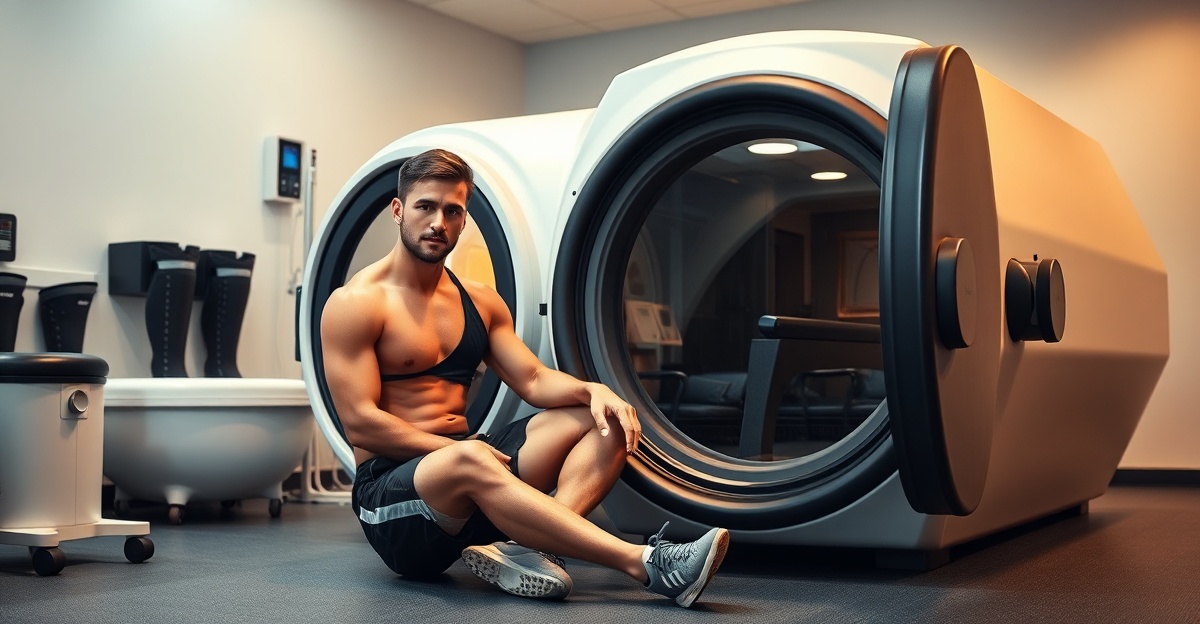
A hyperbaric chamber delivers 100 percent oxygen at pressures above sea level, usually 1.3 to 2.0 atmospheres absolute (ATA). At 2.0 ATA the amount of oxygen dissolved directly in blood plasma rises several-fold beyond what hemoglobin carries at normal pressure, which raises the oxygen gradient into tissue. The proposed recovery mechanisms are higher tissue oxygen tension, reduced swelling through pressure-driven vasoconstriction, and, after repeated sessions, increased mitochondrial mass. Only the last of these has direct human trial support in athletes, and only after dozens of sessions.
Does HBOT actually improve athletic performance?
For acute performance, no. The best meta-analysis found pre-exercise HBOT does not improve subsequent performance, and single sessions do not reliably help. The one signal for long-term gains comes from repeated dosing: 40 sessions raised aerobic capacity in one blinded trial, but that is a training-camp-length commitment, not a race-day boost.
Huang and colleagues (2021, Frontiers in Physiology) pooled the literature into a systematic review and meta-analysis. Across 10 studies (166 participants qualitatively, 6 studies and 69 participants in the quantitative synthesis), pre-exercise HBOT had no significant effect on performance and post-exercise recovery effects were not clear. The one positive finding was narrow: HBOT delivered during exercise improved muscle endurance.2 That is a lab curiosity, not a practical protocol.
The strongest counterweight is Hadanny and colleagues (2022, Sports Medicine – Open), the only double-blind, sham-controlled HBOT trial in athletes. Thirty-seven healthy master athletes aged 40 to 50 received 40 sessions of either HBOT (2.0 ATA, 100 percent oxygen, 60 minutes) or sham (1.02 ATA, air). The HBOT group showed significant increases in VO2Max and oxygen consumption at the anaerobic threshold, attributed to improved mitochondrial respiration and increased mitochondrial mass.1 A 2025 randomized trial in the European Journal of Applied Physiology added low-dose HBOT after sprint interval training in 24 men and found greater anaerobic peak-power gains in the HBOT group (+21.6 percent versus +11.9 percent), though aerobic gains and body composition did not differ between groups.9 The honest read: repeated HBOT may enhance the adaptation to hard training, but it is not a shortcut to performance on its own.
Does HBOT speed muscle recovery?
The recovery evidence is mixed and depends heavily on how it is measured. A 2026 meta-analysis found HBOT reduced exercise-induced muscle injury and soreness, but an older Cochrane review found no benefit for delayed-onset muscle soreness and actually recorded higher early pain. A single post-match session does not meaningfully speed recovery.
Luo and colleagues (2026, Archives of Physical Medicine and Rehabilitation) pooled 10 studies and 299 subjects and concluded HBOT alleviates exercise-induced muscle injury and soreness, with subgroup analysis pointing to specific dosing parameters as the driver.3 That contrasts sharply with the Cochrane review by Bennett and colleagues (2005), which pooled seven DOMS trials and found HBOT started immediately produced significantly higher pain at 48 and 72 hours (mean difference 0.88, 95% CI 0.09 to 1.67) and no benefit for longer-term pain, swelling, or strength.6 When two systematic reviews disagree this directly, the honest verdict is emerging and unsettled, not established.
Single-session studies land on the weak side. Gušić and colleagues (2024, Frontiers in Physiology) ran a double-blind RCT in 20 elite youth footballers: one 60-minute HBOT session after a 90-minute match did not significantly affect recovery or performance, with only a moderate effect on a blood hemolysis marker.5 Mihailović and colleagues (2022, Research Quarterly for Exercise and Sport) found a small positive: in 12 trained cyclists, 75 minutes of post-exercise HBOT at 1.3 ATA improved subsequent cycling power output and heart-rate-variability recovery.4 With only 12 participants, that is a preliminary result. For a realistic sense of how long any effect persists, see the breakdown of how long HBOT effects last, and the wider evidence on HBOT for recovery.
How does HBOT work at the cellular level?
HBOT works by raising the oxygen dissolved directly in blood plasma, which increases the pressure gradient pushing oxygen into tissue. In athletes, the measurable downstream effect after repeated sessions is greater mitochondrial mass and respiration, which is the biological basis for the aerobic gains seen in controlled trials. Single sessions do not produce this adaptation.
At normal pressure almost all oxygen is carried by hemoglobin, which is already nearly saturated, so breathing extra oxygen adds little. Under pressure at 2.0 ATA the amount physically dissolved in plasma rises several-fold, following Henry’s law, and that plasma-borne oxygen reaches tissue independent of red blood cells. Two mechanisms follow. First, the transient hyperoxia acts as a signal: repeated exposure appears to trigger mitochondrial biogenesis, and Hadanny and colleagues measured both increased mitochondrial mass and improved respiration alongside the VO2Max gains in their athlete trial.1 Burgos and colleagues saw the same aerobic improvement without a rise in oxidative-stress markers, which matters because excess reactive oxygen species could otherwise blunt training adaptation.10 Second, the raised pressure causes mild vasoconstriction that can reduce swelling in injured tissue while oxygen delivery is maintained, the rationale Barata and colleagues cite for injury applications.8 The recurring theme is that the adaptations depend on dose: the signaling that drives mitochondrial change needs weeks of repeated sessions at therapeutic pressure, not a one-off visit.
Can HBOT heal sports injuries faster?
Injury-healing evidence is emerging: animal studies consistently show faster soft-tissue repair, but human trials are inconclusive, with some data suggesting short HBOT courses reduce pain and speed return to play after musculoskeletal injury. It is best viewed as an adjunct for specific injuries, not a general accelerant.
Johnson-Arbor (2025, Undersea and Hyperbaric Medicine) reviewed the human and animal literature and concluded that animal models show improved muscle healing after soft-tissue injury, while human studies remain inconclusive; short courses of HBOT may reduce pain and speed return to play in some cases.7 Barata and colleagues (2011, Therapeutic Advances in Musculoskeletal Disease) reached a similar position in their review of HBOT for sports injuries: biologically plausible, promising in select cases, but short of consistent controlled evidence.8 The mechanism is oxygen-dependent: healing tissue with compromised blood supply benefits most, which is why fracture, ligament, and wound applications have more rationale than routine muscle soreness. See the dedicated reviews of HBOT for ligament damage and HBOT after surgery for the injury-specific data.
What the evidence shows, claim by claim
The table below grades each athlete-facing claim against the actual controlled evidence, with sample sizes so readers can weigh the strength themselves. It is the fastest way to see where the research supports the marketing and where it does not.
| Claim | Protocol Tested | Result | Best Study (N) | Evidence Grade |
|---|---|---|---|---|
| VO2Max / mitochondrial gains | 40 sessions, 2.0 ATA | Significant increase vs sham | Hadanny 2022 (37) | Moderate |
| Muscle soreness / DOMS | Post-exercise, various | Conflicting: meta positive, Cochrane null | Luo 2026 (299) vs Bennett 2005 (7 trials) | Emerging |
| Soft-tissue injury healing | Short courses, 2.0-2.4 ATA | Animal positive, human inconclusive | Johnson-Arbor 2025 (review) | Emerging |
| Single-session recovery | One 60-75 min session | No significant effect (small positive in cyclists) | Gušić 2024 (20) | Limited |
| Acute performance enhancement | Pre-exercise HBOT | No significant benefit | Huang 2021 meta (69) | Limited / null |
Burgos and colleagues (2016, Journal of Nutrition and Metabolism) add a nuance for the aerobic column: training under hyperbaric-hyperoxic conditions improved VO2Max and peak power in 12 young soccer players without raising oxidative-stress markers, a small pilot consistent with the Hadanny mitochondrial finding.10 The pattern across all of it is the same: repeated exposure over weeks has more support than any acute use.
What pressure and how many sessions do athletes need?
The protocols with any controlled support use 2.0 ATA with 100 percent oxygen for 60 minutes, repeated 40 times, for aerobic and mitochondrial adaptation. Recovery-focused single sessions use lower pressures (1.3 ATA) but show little measurable benefit. There is no validated protocol for acute performance on competition day.
The dose-response split is the practical core of this topic. The aerobic gains in Hadanny 2022 required 40 clinical sessions at full 2.0 ATA pressure over roughly two months, not a handful of drop-ins. Recovery trials that used one session or low pressures (Gušić 2024, Mihailović 2022) produced null or small effects. Home soft-shell chambers operate at about 1.3 ATA, below the pressures used in the positive aerobic trials, so they cannot be assumed to deliver the same results. Athletes considering the investment should compare protocols against the athletic recovery data and the general longevity and performance evidence before committing to a course.
Can a home chamber deliver the same benefit?
Probably not for the aerobic gains. The controlled athlete trials that showed VO2Max and mitochondrial improvement used hard-shell chambers at 2.0 ATA with 100 percent oxygen. Home soft-shell units operate at roughly 1.3 ATA on concentrated air, below that threshold, so they cannot be assumed to reproduce the same adaptation.
The pressure difference is the whole issue. Hadanny’s positive trial ran at 2.0 ATA, and Huang’s dosage-sensitive meta-analysis reinforces that pressure and protocol, not simply time in a chamber, determine the result.12 A 1.3 ATA soft chamber delivers a fraction of the dissolved-oxygen load of a 2.0 ATA hard chamber, and no athlete trial has shown the aerobic adaptation at that lower pressure. Soft chambers may still suit mild recovery use, where the evidence is weak across the board anyway, but buying one expecting the trial-grade VO2Max effect is not supported. The full comparison of pressures and construction is laid out in the guide to hard-shell versus soft-shell chambers and the review of soft versus hard chamber clinical data. For most athletes the practical choice is a course of clinical sessions during a training block rather than a home purchase.
Is HBOT banned by WADA?
No. Hyperbaric oxygen therapy and supplemental oxygen are not on the World Anti-Doping Agency prohibited list, so athletes may use HBOT without violating anti-doping rules. Individual sport governing bodies can set their own restrictions, so athletes should still confirm with the authority for their event.
WADA reviewed hyperbaric and hypoxic devices and chose not to prohibit them, even after debating whether they enhance performance enough to violate the spirit of sport.11 The Barata review notes the same permitted status.8 Practically, this removes the main regulatory barrier, which is part of why adoption in professional sport has run so far ahead of the evidence.
What does HBOT cost for athletes?
Individual athletes typically pay $200 to $400 per session at medical facilities and $100 to $250 at wellness centers, with home chamber rentals around $50 to $100 per session. Because recovery protocols often run 10 to 40 sessions, total costs reach the low thousands, and insurance does not cover HBOT for athletic use.
Cost is the deciding factor for most athletes, because the protocols with evidence are the expensive ones. A 40-session aerobic protocol at $200 to $400 per medical session lands between $8,000 and $16,000, and insurance will not reimburse it since athletic performance is not an approved indication. Lower-cost wellness-center and home options run at pressures below the trials that showed benefit, so the cheaper the option, the weaker the supporting data. The full HBOT cost breakdown shows how pricing varies by chamber type and region.
Which pro athletes use hyperbaric chambers?
LeBron James, Cristiano Ronaldo, and biohacker Bryan Johnson have all reportedly used hyperbaric chambers as part of their recovery routines, and NFL, MMA, and Olympic programs increasingly keep chambers on site. Widespread elite use is a marketing signal, not evidence of efficacy, and should be read that way.
Reported use by high-profile athletes drives much of the consumer interest in HBOT, but an anecdote from a professional with a full performance staff is not controlled evidence, and endorsements are not outcomes. The deep dives on LeBron James and HBOT and Bryan Johnson’s chamber use lay out what is actually documented versus assumed. Combat-sport athletes sometimes use HBOT after head impacts, but the concussion evidence in athletes is limited, and HBOT should never substitute for proper concussion management; the athlete-specific data is covered in the guide to HBOT for sports concussion.
How should athletes fit HBOT into a recovery plan?
HBOT is an adjunct, not a foundation. The evidence supports two specific uses: a multi-week course during a training block to support aerobic and mitochondrial adaptation, and targeted use for select soft-tissue injuries. It does not replace the recovery basics that have far stronger evidence, and it is not a same-day performance tool.
The trial data point to where HBOT earns its cost. A 40-session block at 2.0 ATA during a training phase is the only protocol with controlled aerobic support (Hadanny 2022), and short courses for a specific injury have some human backing for faster return to play (Johnson-Arbor 2025).17 Outside those cases, the return is uncertain. Sleep, adequate protein and total energy intake, and sensible training-load management remain the highest-evidence recovery levers, and HBOT should sit on top of them rather than substitute for them. Timing matters too: because the aerobic benefit builds over weeks, it fits a base or off-season block better than a competition taper. Athletes tracking their own response can document changes over a course the way the before and after results illustrate, and should judge value against measured outcomes rather than how a session feels. The honest bottom line is that HBOT can be a reasonable, legal, and safe addition for a well-resourced athlete with a clear goal, and a poor use of money for anyone expecting it to work on its own.
What are the risks for athletes?
HBOT is among the safer medical therapies, but it carries real risks. The most common is middle-ear barotrauma from pressure changes, similar to airplane-flight ear pain. Rarer complications include sinus pressure, temporary short-sightedness, and, at higher pressures, oxygen toxicity.
Middle-ear barotrauma is the predominant side effect and is usually mild and self-limiting. Less common complications include sinus squeeze, reversible myopia after long courses, and, uncommonly, pulmonary or central-nervous-system oxygen toxicity at higher pressures. Athletes should avoid HBOT with an active cold or flu, recent ear surgery, or certain lung conditions. Barata and colleagues emphasize supervised use in a properly staffed facility rather than unsupervised home sessions.8
Does hyperbaric oxygen therapy improve athletic performance?
Not acutely. Huang and colleagues’ 2021 meta-analysis found pre-exercise HBOT produced no significant performance benefit. The one exception is long-term dosing: Hadanny’s 2022 double-blind RCT found 40 sessions at 2.0 ATA increased VO2Max and mitochondrial function in master athletes. HBOT appears to support training adaptation over weeks rather than boost performance on competition day.
Is HBOT allowed under anti-doping rules?
Yes. Hyperbaric oxygen therapy and supplemental oxygen are not on the WADA prohibited list, so their use does not breach anti-doping rules. WADA reviewed hyperbaric and hypoxic devices and declined to ban them. Individual sport federations can still impose their own restrictions, so athletes should confirm the rules for their specific event before starting treatment.
How many HBOT sessions do athletes need to see results?
The only aerobic gains shown in a controlled athlete trial required 40 sessions at 2.0 ATA over roughly two months (Hadanny 2022). Single sessions produced no significant recovery benefit in a 2024 football trial by Gušić. For soreness and injury, protocols vary and evidence conflicts. There is no validated short-course protocol for acute performance enhancement.
Sources
- Hadanny A, Hachmo Y, Rozali D, et al. “Effects of Hyperbaric Oxygen Therapy on Mitochondrial Respiration and Physical Performance in Middle-Aged Athletes: A Blinded, Randomized Controlled Trial.” Sports Medicine – Open. 2022;8:22. DOI: 10.1186/s40798-021-00403-w
- Huang X, Wang R, Zhang Z, Wang G, Gao B. “Effects of Pre-, Post- and Intra-Exercise Hyperbaric Oxygen Therapy on Performance and Recovery: A Systematic Review and Meta-Analysis.” Frontiers in Physiology. 2021;12:791872. DOI: 10.3389/fphys.2021.791872
- Luo X, Yu J, Zhang Q, Qi L. “Effects of Hyperbaric Oxygen Therapy on Exercise-Induced Muscle Injury and Soreness: A Systematic Review and Meta-analysis.” Archives of Physical Medicine and Rehabilitation. 2026;107(3):522-532. DOI: 10.1016/j.apmr.2025.07.017
- Mihailović T, Bouzigon R, Bouzid MA, et al. “Post-Exercise Hyperbaric Oxygenation Improves Recovery for Subsequent Performance.” Research Quarterly for Exercise and Sport. 2023;94(2):427-434. PMID: 35389333. DOI: 10.1080/02701367.2021.2002797
- Gušić M, Stantić T, Lazić A, Andrašić S, Roelands B, Bogataj Š. “Effects of hyperbaric oxygen therapy on recovery after a football match in young players: a double-blind randomized controlled trial.” Frontiers in Physiology. 2024;15:1483142. DOI: 10.3389/fphys.2024.1483142
- Bennett M, Best TM, Babul S, Taunton J, Lepawsky M. “Hyperbaric oxygen therapy for delayed onset muscle soreness and closed soft tissue injury.” Cochrane Database of Systematic Reviews. 2005;(4):CD004713. DOI: 10.1002/14651858.CD004713.pub2
- Johnson-Arbor K. “Hyperbaric oxygen therapy for high performance athletes: a narrative review.” Undersea and Hyperbaric Medicine. 2025;52(3):337-347. PMID: 41223395. uhms.org
- Barata P, Cervaens M, Resende R, Camacho Ó, Marques F. “Hyperbaric Oxygen Effects on Sports Injuries.” Therapeutic Advances in Musculoskeletal Disease. 2011;3(2):111-121. DOI: 10.1177/1759720X11399172
- Hu Z, Guo W, Wu H. “Synergistic effects of immediate post-sprint interval training low-dose hyperbaric oxygen on aerobic and anaerobic performance and recovery indicators: a four-week randomized controlled trial.” European Journal of Applied Physiology. 2026;126:1531-1547. PMID: 41015574. DOI: 10.1007/s00421-025-05997-7
- Burgos C, Henríquez-Olguín C, Andrade DC, et al. “Effects of Exercise Training under Hyperbaric Oxygen on Oxidative Stress Markers and Endurance Performance in Young Soccer Players: A Pilot Study.” Journal of Nutrition and Metabolism. 2016;2016:5647407. DOI: 10.1155/2016/5647407
- World Anti-Doping Agency. “The Prohibited List.” WADA International Standard (hyperbaric and supplemental oxygen not prohibited). wada-ama.org/en/prohibited-list
Medical Disclaimer
The content on BaricBoost.com is for informational purposes only and is not intended as a substitute for professional medical advice, diagnosis, or treatment. Always seek the advice of your physician or other qualified health provider with any questions you may have regarding a medical condition. Never disregard professional medical advice or delay in seeking it because of something you have read on this website.

Author
Seph Fontane Pennock is the founder of BaricBoost.com and Regenerated.com, a clinic directory for regenerative medicine serving 10,000+ providers across the United States. He previously built and sold PositivePsychology.com, which grew to 19 million users and became the largest evidence-based positive psychology resource on the web. Seph brings direct experience as an HBOT patient, having completed protocols at clinics across three continents while navigating mold illness, systemic inflammation, and autoimmune conditions. His treatment journey includes hyperbaric oxygen therapy, peptide protocols, NAD+ therapy, and consultations with specialists from Dubai to Cape Town to Mexico. This combination of entrepreneurial track record and lived patient experience shapes everything published on BaricBoost.com. Every article is grounded in peer-reviewed research, informed by real clinical encounters, and written for patients making high-stakes treatment decisions. Seph's focus is on bringing transparency, scientific rigor, and practical guidance to the hyperbaric oxygen therapy space.
Why Trust Our Evaluations
Our rankings are based on hands-on testing, published clinical data, and verified manufacturer specifications. We apply the same criteria to every product regardless of affiliate status. Editorial Process · Evaluation Methodology