Claustrophobia rarely stops anyone from completing HBOT. Across 2,334 patients, anxiety reactions made up just 0.5 to 1.5% of adverse events (Hadanny et al., 2016), and about 2% of patients need specific intervention for anxiety (Camporesi, 2014).14 Most people move from first-session apprehension to comfort within three to five sessions. Understanding the chamber, a few coping tactics, and knowing what to expect handles it for the large majority.
How common is claustrophobia in HBOT?
Claustrophobia in hyperbaric chambers is manageable for most patients, and the numbers are reassuring. In Hadanny et al.’s study of 2,334 patients, anxiety reactions accounted for 0.5 to 1.5% of adverse events.1 Camporesi’s 2014 review found roughly 2% of patients required specific intervention for anxiety.4 Anxiety sits among the milder reactions catalogued alongside the physical hyperbaric chamber side effects.
Anxiety is primarily a first-session phenomenon. A 2021 study by Macinnes et al. found that patients started with limited knowledge of what to expect but, after a few sessions, moved from anxiety to normalcy and comfort, a pattern the authors called “naivety to normalisation.”2
of HBOT patients need specific intervention for claustrophobia or anxiety; most adapt within their first few sessions without it
Camporesi, 2014
Is an HBOT chamber like an MRI?
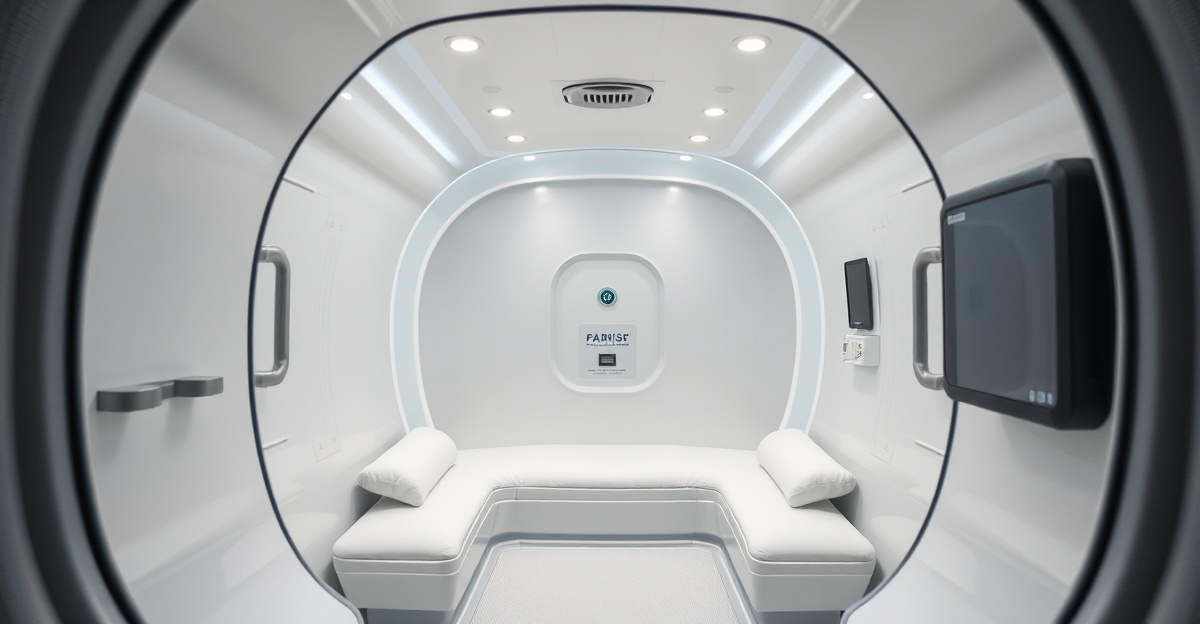
Many patients who felt claustrophobic in an MRI assume an HBOT chamber will feel the same. They differ in ways that matter for anxiety: the chamber is transparent, quiet, and you can communicate and move.
Monoplace HBOT chamber vs MRI
| Feature | Monoplace HBOT chamber | MRI |
|---|---|---|
| Enclosure | Roughly 7 to 8 ft long, about 2 ft wide | Narrow tunnel, often opaque |
| Transparency | Clear acrylic; you see the room and staff | Typically opaque metal bore |
| Noise | Gentle pressurization sound | Loud, repetitive banging |
| Communication | Continuous intercom with staff | Limited, squeeze-ball only |
| Movement | You can shift and raise your head | Must hold still to avoid artifacts |
| Duration | 60 to 90 minutes; many patients nap | 15 to 60 minutes |
For patients with severe claustrophobia who cannot tolerate a monoplace chamber, multiplace chambers are room-sized spaces that hold several patients and staff at once. They feel far less enclosed and let staff stay physically present during treatment. For a fuller walk-through of a first visit, see what to expect during HBOT.
of adverse events were anxiety reactions across 2,334 HBOT patients, one of the least frequent reactions recorded
Hadanny et al., 2016
How can you manage claustrophobia during HBOT?
Before your first session
Preview the chamber: ask to see it beforehand. Lean in, feel the space, and gauge how it actually feels versus how you imagined it. Most patients find the reality less intimidating.
Ask for a trial run: a brief non-treatment run at low or no pressure, three to eight minutes inside, helps calibrate your response before the first real session.
Get informed: Putri et al. (2023) found that access to information significantly reduced anxiety in first-time HBOT patients (p=0.005).3 The more you understand each phase of a session, the less threatening it feels.
During sessions
Controlled breathing: a 4-count inhale, 4-count hold, 4-count exhale activates the parasympathetic nervous system and lowers the physiological anxiety response.
Distraction: Allen et al. (1989) showed that videotaped coping models and film distraction reduced distress and let patients complete more treatments.5 Ask whether your facility can pipe music or audio into the chamber.
Focus on sensation: deliberately noticing the bed texture, the chamber hum, and your breathing redirects attention from the enclosed space to the immediate moment.
Communicate: intercom contact with staff is continuous, and knowing you can speak to someone outside at any moment reduces the sense of isolation.
Preparation checklist
- Visit the facility beforehand to see the chamber in person
- Ask for a brief trial run at minimal or no pressure
- Prepare 1 to 2 audio options to request through the facility system
- Practice the 4-count breathing technique at home first
- Tell the technician about your anxiety before you start; they are trained to support anxious patients
- Remind yourself that you can signal to stop at any time
Planning the schedule ahead of time also helps; our HBOT sessions guide covers session length and frequency.
When is clinical intervention needed?
For the rare patient who cannot manage anxiety with behavioral techniques, clinical options exist. One case report documented successful HBOT completion using desipramine plus relaxation therapy (Hillard, 1990).6 Most clinics prefer non-pharmacological approaches, which work for the majority.
If you have severe pre-existing claustrophobia, discuss it with your prescribing physician before starting HBOT. They can assess whether a multiplace chamber suits you better, arrange a trial session, or discuss a mild anxiolytic for the initial sessions if behavioral techniques are not enough. For the broader risk picture, see our HBOT side effects statistics.
Frequently asked questions
I am severely claustrophobic. Can I do HBOT?
Possibly, with the right support. Many patients who believed their claustrophobia would prevent HBOT complete treatment. The key steps: preview the chamber first, use a multiplace chamber if a monoplace is intolerable, and start with supervised trial sessions. Only a small minority of truly severe cases cannot be accommodated.
Does claustrophobia get worse during HBOT?
The evidence points the other way. Clark et al. (1994) found that post-treatment anxiety was significantly lower than pre-treatment anxiety among adults undergoing their first HBOT session.7 Most patients report anxiety easing within the first few sessions as the experience becomes familiar rather than threatening.
How long does it take to stop feeling claustrophobic in the chamber?
For most patients, three to five sessions. Macinnes et al. (2021) found that patients typically adapted within a few sessions, moving from fear to comfort as the chamber environment became familiar.2
Sources
- Hadanny A, Meir O, Bechor Y, Fishlev G, Bergan J, Efrati S. The safety of hyperbaric oxygen treatment: retrospective analysis in 2,334 patients. Undersea Hyperb Med. 2016. PMID: 27265988
- Macinnes L, Baines C, Bishop A, Ford K. Patient knowledge and experience of hyperbaric oxygen treatment. Diving Hyperb Med. 2021;51(1):72-77. DOI: 10.28920/dhm51.1.72-77 (PMID: 33761544)
- Putri R, Sarmi, Hasina SN, Noventi I. Analysis of factors affecting patient anxiety in hyperbaric oxygen therapy. Bali Medical Journal. 2023;12(3):3357-3360. DOI: 10.15562/bmj.v12i3.4357
- Camporesi EM. Side effects of hyperbaric oxygen therapy. Undersea Hyperb Med. 2014;41(3):253-257. PMID: 24984321
- Allen KD, Danforth JS, Drabman RS. Videotaped modeling and film distraction for fear reduction in adults undergoing hyperbaric oxygen therapy. J Consult Clin Psychol. 1989;57(4):554-558. DOI: 10.1037/0022-006X.57.4.554 (PMID: 2768617)
- Hillard JR, Lobato MP. Severe claustrophobia in a patient requiring hyperbaric oxygen treatment. Psychosomatics. 1990. PMID: 2405446
- Clark C, Rock D, Tackett K. Assessment of the magnitude of anxiety in adults undergoing first hyperbaric oxygen session. Mil Med. 1994;159(5):412-414. PMID: 14620414
Medical Disclaimer
The content on BaricBoost.com is for informational purposes only and is not intended as a substitute for professional medical advice, diagnosis, or treatment. Always seek the advice of your physician or other qualified health provider with any questions you may have regarding a medical condition. Never disregard professional medical advice or delay in seeking it because of something you have read on this website.

Author
Seph Fontane Pennock is the founder of BaricBoost.com and Regenerated.com, a clinic directory for regenerative medicine serving 10,000+ providers across the United States. He previously built and sold PositivePsychology.com, which grew to 19 million users and became the largest evidence-based positive psychology resource on the web. Seph brings direct experience as an HBOT patient, having completed protocols at clinics across three continents while navigating mold illness, systemic inflammation, and autoimmune conditions. His treatment journey includes hyperbaric oxygen therapy, peptide protocols, NAD+ therapy, and consultations with specialists from Dubai to Cape Town to Mexico. This combination of entrepreneurial track record and lived patient experience shapes everything published on BaricBoost.com. Every article is grounded in peer-reviewed research, informed by real clinical encounters, and written for patients making high-stakes treatment decisions. Seph's focus is on bringing transparency, scientific rigor, and practical guidance to the hyperbaric oxygen therapy space.