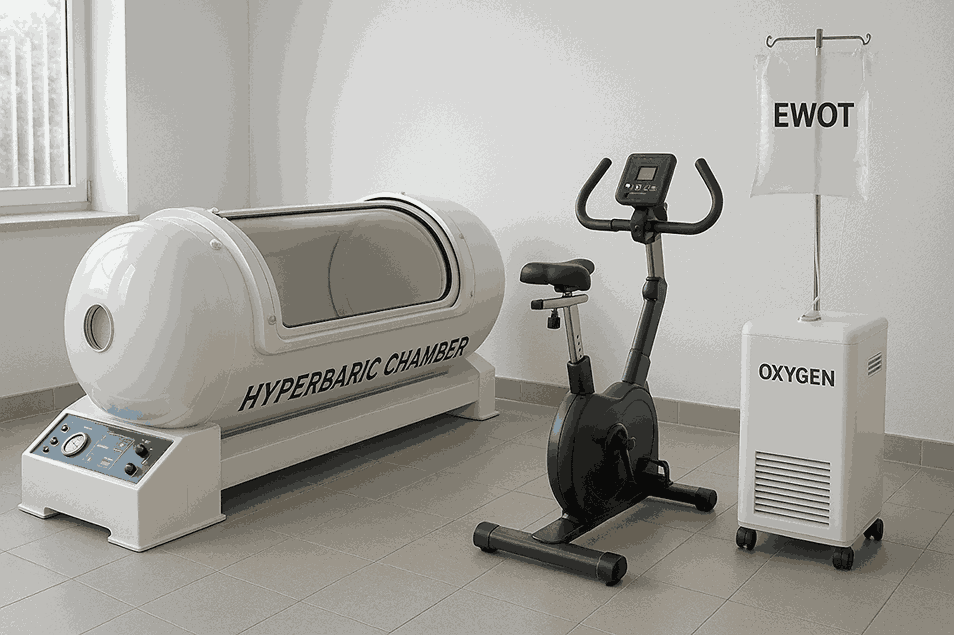
EWOT and HBOT both deliver supplemental oxygen, but the mechanisms are fundamentally different. HBOT operates at 2.0 to 2.4 ATA, dissolving 10 to 15 times more oxygen into blood plasma than EWOT can at ambient pressure. EWOT costs $800 to $5,000 once for home equipment; HBOT runs $150 to $400 per session. This comparison covers the science, the evidence gap, and which one fits different goals.
- 100% O2 at 1.3 to 3.0 ATA under pressure
- 14 FDA-cleared indications
- Reaches hypoxic, avascular tissue
- $150 to $400 per session; $5,000 to $15,000 course
- 90 to 95% O2 via mask during exercise, 1.0 ATA
- No FDA-cleared medical indications
- Relies on cardiovascular circulation only
- $800 to $5,000 one-time equipment cost
A related question, pressurized versus mask-delivered oxygen at rest, is covered in our comparison of HBOT versus normobaric oxygen therapy.
What Is the Real Difference Between EWOT and HBOT?
The difference is pressure. HBOT seals you in a chamber at 1.3 to 3.0 ATA, and that pressure forces oxygen directly into blood plasma independent of hemoglobin, following Henry’s Law. EWOT keeps you at normal atmospheric pressure (1.0 ATA) and pairs high-concentration oxygen with exercise, relying on your heart and circulation to move it. One drives oxygen into tissue by physics; the other relies on blood flow.
| Factor | HBOT (Hyperbaric Oxygen Therapy) | EWOT (Exercise With Oxygen Therapy) |
|---|---|---|
| Mechanism | 100% O2 at 1.3 to 3.0 ATA in a sealed chamber. Pressure forces O2 into plasma per Henry’s Law, independent of hemoglobin. Passive therapy. | Breathing 90 to 95% O2 via mask during exercise at ambient pressure (1.0 ATA). Exercise raises cardiac output and blood flow, driving more oxygenated blood to tissue. |
| Pressure | 1.3 to 3.0 ATA (30 to 200% above atmospheric) | 1.0 ATA (no added pressure) |
| Tissue penetration | Pressure-driven diffusion reaches hypoxic, edematous, and avascular tissue that blood flow alone cannot | Relies on cardiovascular circulation. Good for well-perfused tissue, limited in ischemic or avascular areas |
| Evidence level | Strong. 14 FDA-cleared conditions, hundreds of RCTs, Cochrane reviews | Limited. No RCTs for commercial EWOT. Closest data is supplemental O2 during exercise in COPD (small studies, mixed results) |
| Session duration | 60 to 90 min in chamber, 20 to 60 sessions, 5x per week | 15 to 20 min while exercising, 3 to 5x per week |
| Cost | $150 to $400 per session; full course $5,000 to $15,000; insurance covers FDA-cleared uses | Equipment $800 to $5,000 one-time; per-session cost effectively free after purchase |
| FDA status | Cleared for 14 conditions | Not an FDA-cleared medical device; sold as exercise/wellness equipment |
| Best for | Medical conditions: wounds, radiation injury, decompression, CO poisoning, infections. Off-label: TBI, stroke, inflammation | General wellness, exercise performance, cardiovascular conditioning, affordable home use |
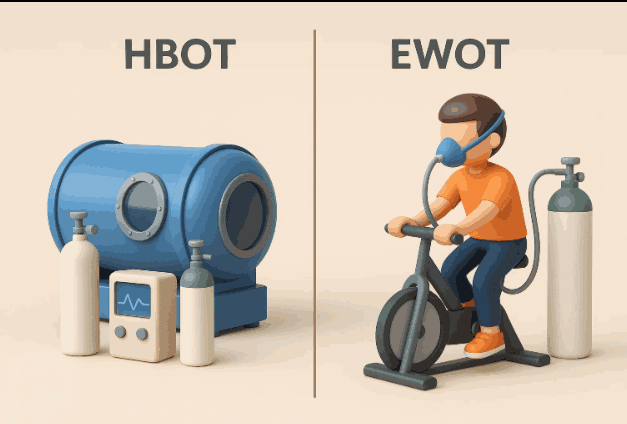
At ambient pressure, hemoglobin is already about 97% saturated with oxygen. Breathing higher concentrations adds only a marginal amount of dissolved O2 to plasma. HBOT bypasses that ceiling through pressure, which is why it dissolves 10 to 15 times more oxygen into plasma and can reach tissue that exercise-driven circulation physically cannot. The plasma-oxygen mechanism behind HBOT is described in detail by Hadanny and Efrati in their 2020 review of the hyperoxic-hypoxic paradox.1
When Is HBOT the Better Choice?
HBOT is the better choice when you are healing something that outpaces normal circulation: a slow-to-close surgical wound, radiation-damaged tissue, or a stubborn soft-tissue injury. Its pressurized environment pushes oxygen into areas where blood flow is impaired, which is why conditions like diabetic ulcers and post-radiation injury are FDA-cleared indications.
Under increased pressure, oxygen dissolves more readily into plasma, giving tissue the raw material it needs to repair. If you want the physics of why pressure matters, our breakdown of hard-shell versus soft-shell chambers covers how pressure ceilings differ across chamber types.
There is also the matter of evidence. Zero published clinical trials have compared EWOT directly to HBOT. The most-cited EWOT source in academic databases is a 2016 opinion piece with no peer review, no control group, and no sample size.2 HBOT, by contrast, has 14 FDA-cleared indications backed by decades of RCTs. HBOT tends to fit:
- Post-surgical patients who cannot afford a slow recovery
- People with ligament or tendon injuries
- Individuals with compromised circulation from chronic illness
The trade-off is time and access. HBOT often requires 60 to 90 minutes per session across a series of sessions before major change appears, and it is a clinic-based commitment.
When EWOT Shines
If your goals are performance, stamina, and general conditioning, EWOT is an efficient tool. You pair oxygen-rich breathing with the natural increase in blood flow that comes from moving your body, so instead of sitting still in a chamber you are actively circulating oxygen while you work out.
The honest caveat is that commercial EWOT has no dedicated clinical trials. The closest supporting data comes from supplemental oxygen during exercise in lung disease. A randomized placebo-controlled trial in COPD patients found that supplemental oxygen during a cycle endurance test improved endurance time by about 106 seconds (723s versus 618s, p=0.025), and a separate 2025 trial in Medicine & Science in Sports & Exercise found supplemental oxygen during exercise training in COPD improved training intensity and outcomes.34 Those findings support the idea that combining oxygen with exercise has physiological merit for specific populations, but they are not studies of commercial EWOT devices in healthy users.
People often choose EWOT because it is cheaper per session, can be done at a gym or at home with the right equipment, and integrates into an existing workout rather than replacing it.
Cost, Access, and Convenience
This is where the decision often gets made, in your budget and your calendar rather than in a medical paper.
- HBOT: $150 to $400 per session at a clinic. Full course $5,000 to $15,000. Insurance covers FDA-cleared indications.
- EWOT: $800 to $5,000 one-time equipment purchase (concentrator, mask, reservoir bag). Ongoing sessions effectively free at home.
If frequent clinic visits feel like a dealbreaker but you still want the depth of hyperbaric oxygen, some people look at at-home chambers. Our hyperbaric chamber rental guide breaks down what to look for, the space you need, and maintenance requirements. If you are weighing other oxygen and adjunct options entirely, the guide to HBOT alternatives compares EWOT, ozone, and related therapies side by side.
Can You Combine EWOT and HBOT?
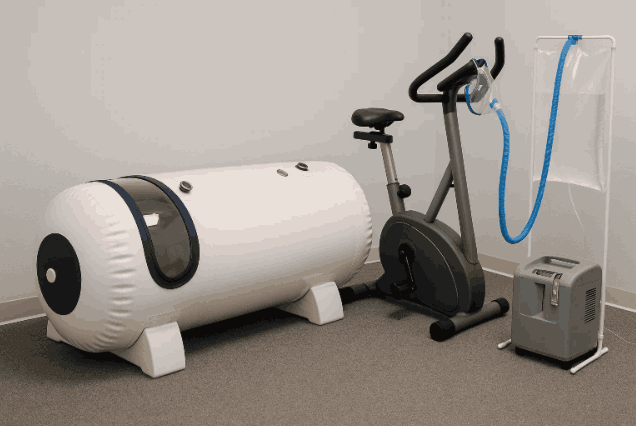
Yes, but it takes some sequencing. Some rehab specialists use HBOT during the healing phase of an injury and EWOT during the conditioning phase once movement is safe, so you get deep-tissue oxygenation from HBOT and a cardiovascular and metabolic stimulus from EWOT.
Do not simply stack them without guidance. Overloading your system, especially after an injury, can slow recovery rather than speed it. A well-timed protocol managed by someone experienced in both therapies makes a real difference.
What Are the Side Effects and Risks?
Both therapies are generally safe when done correctly, but neither is risk-free.
- HBOT risks if unsupervised: ear barotrauma, sinus pressure, and oxygen toxicity (rare, but possible at pressures above 2.5 ATA)
- EWOT risks if unsupervised: overexertion, strain injuries, and dizziness if oxygen delivery is mismanaged
Contraindications matter too. Certain lung diseases, ear problems, or uncontrolled high blood pressure can make HBOT a poor fit. Unstable cardiac issues can make EWOT risky. Either choice should start with screening, ideally from a provider who understands both.
Which One Should You Choose?
There is no universal winner in EWOT versus HBOT, only the therapy that best fits your goal, budget, and schedule. Use this framework:
- Define your goal. Recovery from injury or surgery leans HBOT. Stamina, performance, or a metabolic boost leans EWOT.
- Factor in budget. A short, intensive investment favors HBOT. A long-term moderate investment favors EWOT.
- Consider your schedule. If you can commit to clinic sessions 3 to 5 times a week, HBOT is viable. If you want therapy during your workout, EWOT fits better.
- Get medical clearance. Do not skip this, especially with chronic health conditions.
If you have access to both, the strongest move is often sequencing them: HBOT for repair, EWOT for performance. A middle option worth knowing about is the CVAC pod, which cycles pressure dynamically rather than holding a steady hyperbaric level. Whatever you choose, let the physiological difference guide the decision rather than the marketing.
Frequently Asked Questions
Can I replace HBOT with EWOT for serious injuries?
Not typically. HBOT’s pressurized oxygen delivery works differently and is often necessary for deep-tissue healing. EWOT at ambient pressure cannot replicate the plasma oxygen levels HBOT achieves at 2.0 to 2.4 ATA, and EWOT is not indicated for any of HBOT’s 14 FDA-cleared conditions. For a slow-healing wound, radiation injury, or a serious soft-tissue injury, HBOT is the therapy with clinical backing.
Is EWOT just a cheaper HBOT alternative?
No. It is a different approach. The overlap is oxygen use, but the delivery mechanism and the therapeutic effects differ. EWOT may suit wellness and exercise performance, while HBOT is a pressure-based medical therapy. Commercial EWOT also has no dedicated clinical trials, whereas HBOT has decades of RCTs behind its cleared indications, so the two are not interchangeable on either mechanism or evidence.
How soon can I expect results?
With HBOT, measurable change often appears after 10 to 20 sessions, reflecting the time needed for angiogenesis and tissue repair. With EWOT, stamina and energy changes can show up within a few weeks for people using it as a conditioning tool. Neither is instant, and both work best when tracked against a clear baseline rather than judged by impression alone.
Do I need a doctor’s referral for both?
HBOT often requires a referral for insurance coverage and for FDA-cleared indications, and clinics screen for contraindications first. EWOT generally does not require a referral because it is sold as exercise equipment rather than a medical device. That said, anyone with cardiac, lung, or ear conditions should get medical clearance before starting either therapy.
Sources
- Hadanny A, Efrati S. The Hyperoxic-Hypoxic Paradox. Biomolecules. 2020;10(6):958. DOI: 10.3390/biom10060958
- Rowan R. Multistep Oxygen Therapy (EWOT). 2016. Non-peer-reviewed opinion piece; no control group, no sample size, no DOI.
- Willems E, et al. A randomized placebo-controlled trial on the effects of supplemental oxygen therapy during a cycle endurance test in COPD. ERS Congress. 2025. DOI: 10.1183/13993003.congress-2025.pa4870
- Faggian S, et al. Supplemental Oxygen during Exercise Training in Chronic Obstructive Pulmonary Disease. Med Sci Sports Exerc. 2025. DOI: 10.1249/MSS.0000000000003782
Medical Disclaimer
The content on BaricBoost.com is for informational purposes only and is not intended as a substitute for professional medical advice, diagnosis, or treatment. Always seek the advice of your physician or other qualified health provider with any questions you may have regarding a medical condition. Never disregard professional medical advice or delay in seeking it because of something you have read on this website.

Author
Seph Fontane Pennock is the founder of BaricBoost.com and Regenerated.com, a clinic directory for regenerative medicine serving 10,000+ providers across the United States. He previously built and sold PositivePsychology.com, which grew to 19 million users and became the largest evidence-based positive psychology resource on the web. Seph brings direct experience as an HBOT patient, having completed protocols at clinics across three continents while navigating mold illness, systemic inflammation, and autoimmune conditions. His treatment journey includes hyperbaric oxygen therapy, peptide protocols, NAD+ therapy, and consultations with specialists from Dubai to Cape Town to Mexico. This combination of entrepreneurial track record and lived patient experience shapes everything published on BaricBoost.com. Every article is grounded in peer-reviewed research, informed by real clinical encounters, and written for patients making high-stakes treatment decisions. Seph's focus is on bringing transparency, scientific rigor, and practical guidance to the hyperbaric oxygen therapy space.