Affiliate Disclosure
This article contains affiliate links. If you purchase through these links, we may earn a commission at no additional cost to you. This does not influence our evaluations or rankings.
You cannot wear deodorant in a hyperbaric chamber. Deodorants, antiperspirants, perfumes, and most personal-care products contain alcohol or petroleum compounds that turn into fuel inside a monoplace chamber’s near-100% oxygen atmosphere. This is a fire-safety rule, not a hygiene preference, and it applies to both clinical and home oxygen sessions.
Prohibited vs Allowed Before HBOT
| Product category | Status | Reason |
|---|---|---|
| Deodorant and antiperspirant | Prohibited | Alcohol-based, volatile and flammable in oxygen |
| Petroleum products (Vaseline, lip balm, sunscreen) | Prohibited | Heat of combustion at or above gasoline |
| Makeup, perfume, hair spray, nail polish | Prohibited | Alcohol, solvents, and aerosol static risk |
| Synthetic fabrics (nylon, polyester, spandex) | Prohibited | Build static charge that can ignite |
| 100% cotton garments | Allowed | Low static, facility-approved material |
| Plain water or unscented non-petroleum soap | Allowed | No volatile or petroleum fuel load |
Why is deodorant a fire hazard in a hyperbaric chamber?
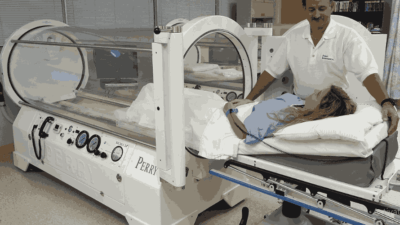
In a monoplace hyperbaric chamber, the atmosphere is close to 100% oxygen at elevated pressure. Fire needs three things: fuel, oxygen, and an ignition source. The chamber supplies abundant oxygen. Personal-care products supply the fuel. Static electricity, friction, or a spark supplies ignition. Remove any one and fire cannot occur, and the product ban exists to remove the fuel you control. It is one of several precautions worth understanding alongside the documented hyperbaric chamber side effects.
McCord et al. (2008), writing in Advances in Skin & Wound Care, tested the flammability of common skin-care products for hyperbaric use and found that petroleum-based products have heat-of-combustion values equal to or exceeding gasoline, making them extremely dangerous in an oxygen-enriched chamber.1 Products that are harmless in ordinary air become fire accelerants under these conditions.
What are the three fire-risk mechanisms?
1. Alcohol volatilization
Most deodorants, antiperspirants, hair sprays, perfumes, and colognes are alcohol-based. Ethanol and isopropyl alcohol are already flammable in ordinary air. In an oxygen-rich environment their autoignition temperature drops and their vapor concentration in the enclosed space climbs, so they reach ignitable levels faster and ignite more readily.
2. Petroleum combustion
Petroleum-based products, including Vaseline, petroleum jelly, lip balm, sunscreen, mineral-oil moisturizers, and oil-based cosmetics, contain hydrocarbons with very high heat of combustion. Harmless in normal air, they behave like fire accelerants in 100% oxygen at pressure, comparable to gasoline in their combustion behavior (McCord et al., 2008).1
3. Static from sprays and synthetic materials
Spraying an aerosol generates static charge. In normal air the static is harmless. In a pressurized, oxygen-rich chamber, even a minor electrostatic discharge can be an ignition source, which is why aerosols are especially dangerous and why synthetic fabrics, which also build static, are prohibited for the same reason.
What is the complete list of prohibited products?
Petroleum-based products:
- Vaseline and petroleum jelly (any brand)
- Lip balm and lip gloss (including ChapStick)
- Oil-based moisturizers and body lotions
- Sunscreen
- Hair oils and dressings
- Baby oil and mineral-oil products
Alcohol-based products:
- Deodorant and antiperspirant (spray, roll-on, stick)
- Perfume, cologne, and body spray
- Hair spray, gel, and mousse
- Nail polish (flammable) and polish remover (highly flammable)
- Alcohol-based hand sanitizer
- Alcohol-based lotions and creams
Other prohibited items:
- All makeup (foundation, mascara, eye shadow, blush)
- Synthetic fabrics (nylon, polyester, spandex, rayon, wool, lycra)
- Wigs and hair extensions (most are synthetic)
- Hard contact lenses (can affect corneal health under pressure)
The same fuel-removal logic covers what you carry in. Electronics are restricted for the same reasons, as covered in our guide to whether you can bring your phone in a hyperbaric chamber.
What can you wear or apply before HBOT?
The approved preparation for any HBOT session:
- Shower using plain water or unscented soap without petroleum ingredients. Rinse thoroughly.
- Do not apply deodorant, body lotion, sunscreen, makeup, hair products, or fragrance afterward.
- Wear 100% cotton underwear to the facility, if personal undergarments are allowed.
- The facility provides approved 100% cotton gowns or scrubs at intake.
Some facilities have approved specific water-based, non-alcohol, non-petroleum moisturizers for patients with very dry skin. Ask your provider before your first session and do not assume any product is approved. For a full walkthrough of the visit, see what to expect from hyperbaric oxygen therapy.
Do these rules apply to soft-shell home chambers?
The product prohibitions apply whenever oxygen is involved, including at home. If you run an oxygen concentrator with your soft-shell chamber, the oxygen concentration in the breathing zone rises well above normal, and all product prohibitions apply. If you use ambient air only, with no concentrator, the oxygen concentration stays near 21% and the fire risk from personal-care products is lower, though caution still applies, especially with petroleum products near any heat source.
What does NFPA 99 require you to wear?
NFPA 99, the Health Care Facilities Code, governs hyperbaric chamber safety in its Chapter 14 on hyperbaric facilities. It restricts chamber garments to approved materials, primarily 100% cotton or specific approved blends, and excludes synthetic fibers such as nylon, polyester, rayon, wool, and Gore-Tex.3 This clothing requirement serves the same fire-safety function as the product ban: removing fuel from an oxygen-enriched space. The record shows why these rules exist. Sheffield and Desautels (1997) analyzed 73 years of hyperbaric and hypobaric chamber fires and found that in nearly every case a prohibited fuel source combined with the oxygen-rich atmosphere.2 Our overview of hyperbaric chamber fire risk covers those incidents in detail.
Can I use a water-based deodorant before HBOT?
Water-based deodorants and antiperspirants still contain compounds beyond water, so discuss any specific product with your provider before your first session. The general recommendation is to shower and arrive product-free. Some facilities have assessed specific products, but most have not, and the safe default is to apply nothing after showering.
What if I forgot to remove nail polish before my appointment?
Many facilities keep acetone-free remover at intake, but bring your own if you can, since acetone is itself a fire hazard and may not be available everywhere. Nail polish is flammable and must be removed before a session. Some facilities will reschedule rather than delay their treatment schedule, so remove it beforehand when possible.
Do these rules apply to home soft-shell chambers?
If you use an oxygen concentrator with a home chamber, yes. The prohibitions exist because of the oxygen-rich environment. With ambient air only, the risk is lower but caution still applies, particularly for petroleum products. The specific NFPA 99 rules are written for clinical facilities, though the underlying fire chemistry is the same at home.
Sources
- McCord DE, Newton BE, Fore J, Chiffoleau G. The selection of skin-care products for use in a hyperbaric chamber may depend on flammability acceptability indices score. Advances in Skin & Wound Care. 2008;21(2):79-84. doi:10.1097/01.ASW.0000305409.20232.af
- Sheffield PJ, Desautels DA. Hyperbaric and hypobaric chamber fires: a 73-year analysis. Undersea & Hyperbaric Medicine. 1997;24(3):153-164. PMID: 9308138
- National Fire Protection Association. NFPA 99: Health Care Facilities Code, Chapter 14 (Hyperbaric Facilities). 2024 Edition. nfpa.org
Medical Disclaimer
The content on BaricBoost.com is for informational purposes only and is not intended as a substitute for professional medical advice, diagnosis, or treatment. Always seek the advice of your physician or other qualified health provider with any questions you may have regarding a medical condition. Never disregard professional medical advice or delay in seeking it because of something you have read on this website.

Author
Seph Fontane Pennock is the founder of BaricBoost.com and Regenerated.com, a clinic directory for regenerative medicine serving 10,000+ providers across the United States. He previously built and sold PositivePsychology.com, which grew to 19 million users and became the largest evidence-based positive psychology resource on the web. Seph brings direct experience as an HBOT patient, having completed protocols at clinics across three continents while navigating mold illness, systemic inflammation, and autoimmune conditions. His treatment journey includes hyperbaric oxygen therapy, peptide protocols, NAD+ therapy, and consultations with specialists from Dubai to Cape Town to Mexico. This combination of entrepreneurial track record and lived patient experience shapes everything published on BaricBoost.com. Every article is grounded in peer-reviewed research, informed by real clinical encounters, and written for patients making high-stakes treatment decisions. Seph's focus is on bringing transparency, scientific rigor, and practical guidance to the hyperbaric oxygen therapy space.
Why Trust Our Evaluations
Our rankings are based on hands-on testing, published clinical data, and verified manufacturer specifications. We apply the same criteria to every product regardless of affiliate status. Editorial Process · Evaluation Methodology