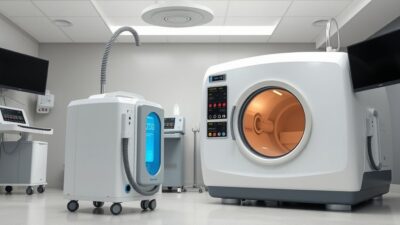
The number of HBOT sessions required for wound healing ranges from 20 to 60, depending on wound type, severity, and patient health. Diabetic foot ulcers typically require 20-40 sessions. Venous leg ulcers average 17-66 sessions in published protocols. Radiation wounds often need 30-60 sessions. Across all wound types, the median in published literature is approximately 40-48 sessions delivered daily, five days per week. The first 10 sessions are critical for establishing whether the wound responds to hyperbaric oxygen. This is one of several other post-treatment recovery uses for HBOT gaining attention in clinical practice.
Diabetic Foot Ulcer Protocol: 20-40 Sessions
Diabetic foot ulcers (DFUs) are the most common wound indication for HBOT and have the most standardized protocols. The UHMS and most wound care centers follow a treatment framework that looks like this:
- Pressure: 2.0-2.4 ATA (most commonly 2.0 ATA for DFUs)
- Duration: 90 minutes of oxygen breathing per session
- Frequency: Daily, five days per week (Monday through Friday)
- Initial course: 20 sessions (4 weeks)
- Reassessment: Wound measurement and TCOM at session 20
- Extension: 10-20 additional sessions if wound is responding
- Maximum: Most centers cap at 40-60 sessions per wound episode
The 2010 Londahl trial in Diabetes Care used 40 sessions at 2.5 ATA as the protocol and found complete healing in 52% of HBOT patients versus 29% of controls. Other landmark trials have used 20-30 sessions at 2.0-2.4 ATA with varying results. There is no single universally agreed number, but 30 sessions represents a reasonable midpoint based on the available evidence.
What determines whether you need 20 or 40 sessions? Wound duration is the strongest predictor. A DFU present for 3 months responds faster than one that has been open for 18 months. Wagner grade also matters: grade III wounds generally require fewer sessions than grade IV-V wounds with significant tissue loss. Comorbidities like end-stage renal disease, poorly controlled diabetes (HbA1c above 9%), and concurrent peripheral arterial disease all extend the expected treatment course.
Medicare approves HBOT for DFUs in blocks. The initial authorization is typically for 20 sessions. If the wound shows measurable improvement (at least 15% area reduction), re-authorization for an additional 20 sessions is usually approved. If no improvement is seen after 20 sessions, Medicare will typically deny further coverage. Our DFU data page breaks down outcomes by wound severity.
Venous Leg Ulcer Protocol: 17-66 Sessions
Venous ulcer protocols vary more widely because the evidence base is smaller and the wound biology differs from DFUs. Published clinical studies have used anywhere from 17 to 66 sessions.
Hammarlund and Sundberg (1994) in a randomized trial published in Plastic and Reconstructive Surgery used 30 sessions at 2.4 ATA and found a 35.7% wound area reduction in the HBOT group versus 2.7% in controls. This remains one of the best-designed studies for venous ulcers and HBOT, though it included only 16 patients.
Other reports describe protocols of 20-40 sessions as standard practice for venous ulcers at specialized wound care centers. The wide range reflects the heterogeneity of venous ulcers. A small ulcer present for 6 months in a patient with mild venous reflux may close in 20 sessions. A large, long-standing ulcer in a patient with severe post-thrombotic syndrome may require 60+ sessions or may not respond to HBOT at all.
Compression therapy remains the foundation of venous ulcer treatment. HBOT is considered when compression alone has failed after at least 60-90 days. Because venous ulcers are not a CMS-approved HBOT indication, insurance coverage is inconsistent, and many patients must pay out of pocket or rely on individual case review for coverage.
Radiation Wound Protocol: 30-60 Sessions
Radiation-induced wounds require longer treatment courses than most other wound types because the underlying vascular damage is extensive and irreversible without neovascularization. The Marx protocol, developed by Dr. Robert Marx for osteoradionecrosis of the jaw, established the framework still used today:
- Pre-surgical protocol: 20 sessions at 2.4 ATA before dental extraction or surgical debridement
- Post-surgical protocol: 10 sessions at 2.4 ATA after the procedure
- Total for surgical cases: 30 sessions
For soft tissue radionecrosis without a surgical component, protocols typically range from 30 to 60 sessions. The extended course is necessary because radiation destroys the existing microvascular network, and HBOT must stimulate entirely new vessel growth (neovascularization) rather than just supporting existing vessels.
Radiation cystitis (bladder damage from pelvic radiation) often requires 40-60 sessions. Published success rates for radiation cystitis range from 72% to 86% resolution of hematuria. Radiation proctitis protocols are similar, with 30-40 sessions as the typical range.
The Cochrane review on HBOT for radiation tissue injury confirmed benefit across multiple tissue types. The number of sessions needed correlates with the severity of radiation damage and the time elapsed since radiation treatment. Patients treated within 6 months of radiation completion typically need fewer sessions than those presenting years later with established fibrosis.
Compromised Graft/Flap Protocol: 10-20 Sessions
Compromised grafts and flaps require the shortest HBOT protocols because the treatment goal is acute: support the graft or flap through the critical 7-14 day window when new blood vessel ingrowth determines survival or failure.
- Timing: Start within 24-48 hours of identifying graft compromise
- Pressure: 2.0-2.4 ATA
- Duration: 90 minutes per session
- Frequency: Daily or twice daily during the acute phase (first 3-5 days)
- Total: 10-20 sessions
Speed of initiation matters more for compromised grafts than for any other wound type. A graft that begins losing viability on day 3 post-surgery needs HBOT started immediately, not after a 2-week referral process. Surgeons who anticipate graft compromise (due to radiation history, diabetes, or recipient-site scarring) should arrange HBOT in advance so that treatment can begin within hours of identifying a problem.
Some centers use twice-daily sessions for the first 3-5 days of compromised graft treatment, then transition to once daily. The rationale is that the acute phase of graft vascularization is time-sensitive, and maximizing oxygen delivery during this window may improve salvage rates.
Why the First 10 Sessions Are Critical
The first 10 HBOT sessions serve as a biological response test. During this window, wound care teams look for measurable signs that the wound is responding to increased oxygenation:
- Improvement in wound-bed granulation tissue (shift from pale, gray, or fibrotic tissue to healthy red granulation)
- Reduction in wound area by at least 10-15% compared to pre-HBOT measurements
- Increase in periwound TCOM values (ideally rising by at least 10-15 mmHg from baseline)
- Reduction in exudate volume and change from purulent to serous character
- Decreased signs of local infection (reduced erythema, warmth, tenderness)
If none of these improvements are observed after 10 sessions, the likelihood of HBOT producing a meaningful outcome is low. A 2014 study in Undersea and Hyperbaric Medicine found that TCOM response after 10 sessions predicted final wound outcome with approximately 75% accuracy. Most clinical guidelines recommend reassessing the treatment plan at this point and considering whether HBOT should be continued, modified, or discontinued.
This early assessment window is not just clinically important. It is also relevant to insurance coverage. Medicare and most private insurers will review treatment progress at the 20-session mark and may deny continued coverage if the wound has not shown measurable improvement. Detailed wound measurements and photographs at sessions 1, 10, and 20 are essential documentation for re-authorization requests.
Daily Sessions vs. Every-Other-Day: Does Frequency Matter?
The standard protocol is daily sessions, five days per week. But what about patients who cannot attend daily due to transportation barriers, work obligations, or health limitations?
A 2009 study by Faglia et al. found no significant difference in final outcomes between 5-day-per-week and 3-day-per-week protocols for diabetic foot ulcers, though the total number of sessions remained similar (the 3-day group simply took longer to complete the course). UHMS guidelines recommend daily treatment when possible but acknowledge that 3 sessions per week is a reasonable minimum frequency.
What does matter is consistency. Stopping and starting HBOT with multi-week gaps erodes the cumulative angiogenic effect. Each session builds on the previous one: HBOT stimulates vascular endothelial growth factor (VEGF) production and fibroblast proliferation over successive exposures. The biological effects are cumulative. Interruptions of more than 5-7 days may require essentially restarting the neovascularization process, wasting the sessions already completed.
Practical considerations for patients who cannot attend daily:
- Three sessions per week (M-W-F or T-Th-Sa) is the minimum effective frequency
- Never go more than 3 days between sessions during active treatment
- If a gap of more than 7 days is unavoidable, the wound care team should reassess whether to continue the current course or plan a treatment break with clear restart criteria
- Transportation assistance programs (Medicaid non-emergency medical transportation, VA travel benefits, hospital charity care) may help daily attendance
For protocol guidance specific to your wound type, our comprehensive sessions guide covers all HBOT indications.
What Happens When You Stop Too Early
Premature discontinuation is one of the most common reasons HBOT fails for wound healing. Patients stop because the wound looks better at the surface, insurance authorization expires or is denied for extension, they get fatigued from daily treatments, or they face logistical barriers (transportation, work, caregiver availability). The problem is that wound closure visible on the surface does not mean deep tissue remodeling is complete.
HBOT promotes angiogenesis (new blood vessel growth), but new capillary networks need time to mature and stabilize. A capillary that forms at session 15 is fragile and dependent on continued HBOT support. Stopping at session 15 when the protocol calls for 30-40 may result in wound recurrence within weeks because the new vascular network was not yet mature enough to sustain tissue oxygenation independently. Capillary maturation requires approximately 3-4 weeks of continuous HBOT exposure after initial sprout formation.
Data from wound care registries shows that patients who complete less than 75% of their prescribed HBOT sessions have wound recurrence rates approximately twice as high as those who complete the full course. If you cannot complete the full course for logistical reasons, discuss a modified maintenance protocol with your wound care team (such as 2 sessions per week for an additional 2-4 weeks) rather than stopping abruptly.
Reassessment Points and Protocol Adjustments
HBOT wound protocols are not rigid prescriptions. They include built-in reassessment points where the care team evaluates progress and adjusts the plan:
- Session 10: Initial response assessment. Is the wound showing any signs of improvement (granulation, size reduction, TCOM change)? If not, consider whether HBOT is appropriate for this wound.
- Session 20: Formal reassessment with wound measurements, photographs, and TCOM testing. This is the primary decision point for continuation versus discontinuation. Insurance re-authorization is typically required at this point.
- Session 30: Extended assessment for wounds that are improving but not yet closed. Decide on final treatment course length. Document ongoing progress with measurements and photographs.
- Session 40+: Re-evaluation for long-course protocols (radiation wounds, severe DFUs). Continued treatment beyond 40 sessions should show clear, measurable progress at each reassessment. Diminishing returns are expected; if the wound healing rate has slowed significantly, the remaining benefit of continued HBOT may be marginal.
If your wound is closing steadily and TCOM values have normalized (above 40 mmHg on room air), your team may end treatment before the maximum session count. If progress has stalled after an initial response, they may recommend a treatment break of 4-6 weeks followed by reassessment. Some wounds will continue healing on their own momentum after HBOT has established adequate vascularity, while others may need a second course. For more data on HBOT wound outcomes and timelines, visit our wound healing statistics page.
Sources
- Londahl M, Katzman P, et al. “Hyperbaric oxygen therapy facilitates healing of chronic foot ulcers in patients with diabetes.” Diabetes Care, 2010. PubMed
- Kranke P, Bennett MH, et al. “Hyperbaric oxygen therapy for chronic wounds.” Cochrane Database of Systematic Reviews, 2015. PubMed
- Bennett MH, Feldmeier J, et al. “Hyperbaric oxygen therapy for late radiation tissue injury.” Cochrane Database of Systematic Reviews, 2016. PubMed
- Hammarlund C, Sundberg T. “Hyperbaric oxygen reduced size of chronic leg ulcers: a randomized double-blind study.” Plastic and Reconstructive Surgery, 1994. PubMed
- Marx RE. “A new concept in the treatment of osteoradionecrosis.” Journal of Oral and Maxillofacial Surgery, 1983. PubMed
- Faglia E, Favales F, et al. “Adjunctive systemic hyperbaric oxygen therapy in treatment of severe prevalently ischemic diabetic foot ulcer.” Diabetes Care, 1996. PubMed
Medical Disclaimer
The content on BaricBoost.com is for informational purposes only and is not intended as a substitute for professional medical advice, diagnosis, or treatment. Always seek the advice of your physician or other qualified health provider with any questions you may have regarding a medical condition. Never disregard professional medical advice or delay in seeking it because of something you have read on this website.

Author
Seph Fontane Pennock is the founder of BaricBoost.com and Regenerated.com, a clinic directory for regenerative medicine serving 10,000+ providers across the United States. He previously built and sold PositivePsychology.com, which grew to 19 million users and became the largest evidence-based positive psychology resource on the web. Seph brings direct experience as an HBOT patient, having completed protocols at clinics across three continents while navigating mold illness, systemic inflammation, and autoimmune conditions. His treatment journey includes hyperbaric oxygen therapy, peptide protocols, NAD+ therapy, and consultations with specialists from Dubai to Cape Town to Mexico. This combination of entrepreneurial track record and lived patient experience shapes everything published on BaricBoost.com. Every article is grounded in peer-reviewed research, informed by real clinical encounters, and written for patients making high-stakes treatment decisions. Seph's focus is on bringing transparency, scientific rigor, and practical guidance to the hyperbaric oxygen therapy space.