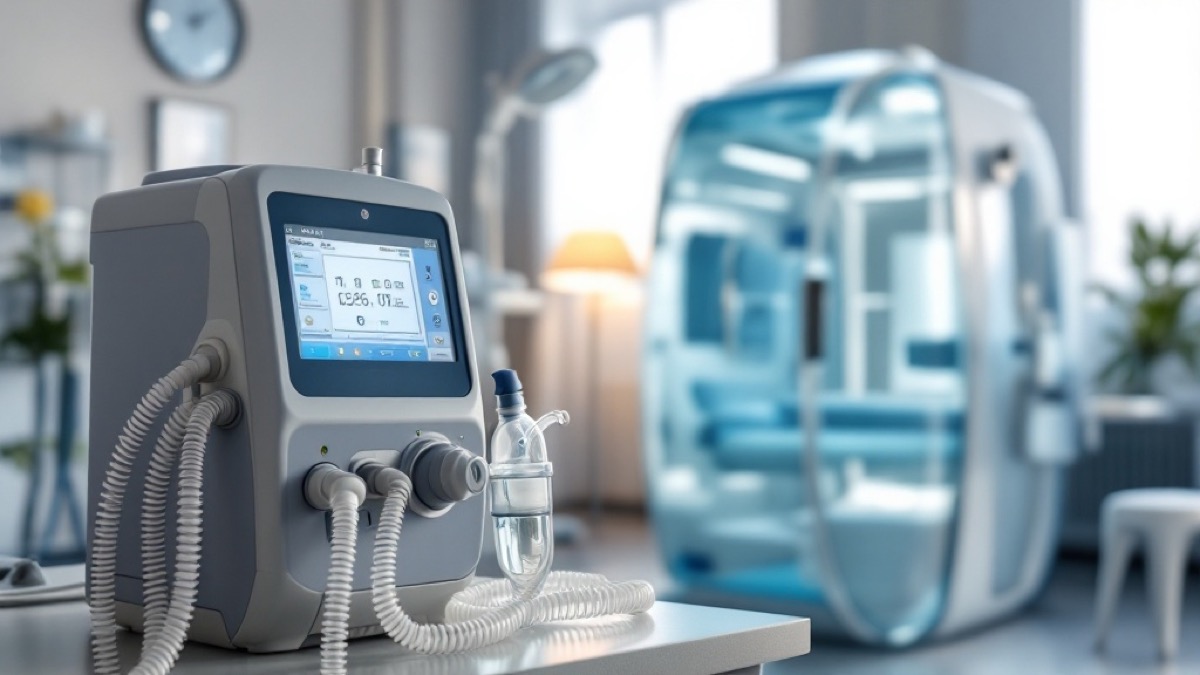
The core difference is one number: dissolved oxygen in your blood plasma. Breathing 100% oxygen at normal sea-level pressure raises arterial oxygen to roughly 400 to 500 mmHg. The same oxygen inside a hyperbaric chamber at 3 atmospheres pushes it past 1,500 mmHg. Pressure, not the oxygen itself, is what multiplies the dose.
Key Takeaways
- Breathing 100% oxygen at 3 ATA raises arterial oxygen tension above 1,500 mmHg, versus about 100 mmHg on room air at sea level (StatPearls, Hyperbaric Physics, 2023).
- In Boerema’s 1959 “Life Without Blood” experiment, piglets survived at 3 ATA with essentially no hemoglobin, kept alive on plasma-dissolved oxygen alone (Boerema, 1959).
- In Weaver’s carbon monoxide trial, 25.0% of the hyperbaric group had cognitive problems at 6 weeks versus 46.1% of the normobaric group (Weaver, NEJM, 2002).
- Normobaric 100% oxygen at 12 to 15 liters per minute made 78% of cluster headache patients pain-free within 15 minutes (Cohen, JAMA, 2009).
- A home oxygen concentrator runs about $595 to $2,000, while a course of 20 to 40 hyperbaric sessions totals $2,000 to $10,000 or more (Elder Life Financial; HBOT cost surveys, 2025).
The Physics of Pressure: Why the Dissolved Oxygen Number Moves
Both therapies deliver oxygen. Only one changes the pressure you breathe it at, and that is the whole story. Nearly all the oxygen your blood carries normally rides on hemoglobin, which saturates at around 97% on room air. Pushing more oxygen through a mask barely moves that number because the hemoglobin seats are already full. What does move is the small fraction dissolved directly in plasma.
Henry’s law states that the amount of a gas dissolved in a liquid rises in direct proportion to the pressure of that gas above the liquid. Double the partial pressure of oxygen and you double the amount that dissolves into plasma. Triple it and you triple it. Hemoglobin has a ceiling; dissolved plasma oxygen does not.
The practical figures make the gap concrete. On room air at sea level, plasma carries roughly 0.3 mL of oxygen per 100 mL of blood. Breathing 100% oxygen at normal pressure lifts that to about 1.5 mL. Inside a chamber at 3 ATA, plasma holds around 6 mL per 100 mL, which is close to the amount resting tissues extract from blood in the first place. That is why Boerema’s exsanguinated piglets survived on pressurized plasma with almost no red cells. Normobaric oxygen cannot reach that territory, because at 1 ATA there is no extra pressure to force more gas into solution. This is the mechanism our oxygen therapy overview describes across every delivery method.
What Normobaric Oxygen Is For
Normobaric oxygen means 100% oxygen at 1 ATA, delivered through a nasal cannula, a non-rebreather mask, or a high-flow system. No chamber, no pressurization. It is the oxygen on the wall of every hospital room and the concentrator in millions of homes, and for its indications it is the correct tool, not a weaker substitute.
Its core job is treating low blood oxygen. In COPD, long-term oxygen keeps arterial saturation up, and the landmark NOTT and MRC trials showed it extends survival in patients with chronic hypoxemia. It supports pneumonia, respiratory failure, and recovery after surgery. As a first response to carbon monoxide poisoning, high-flow 100% oxygen at the scene starts clearing carbon monoxide from hemoglobin immediately, well before any chamber is available.
It also has one striking non-respiratory use. For acute cluster headache attacks, 100% oxygen at 12 to 15 liters per minute through a non-rebreather mask aborts the attack in a majority of patients within about 15 minutes. No pressure required. In these situations the oxygen is doing the work, and adding a chamber would add cost and complexity for no measurable gain.
What Only Hyperbaric Pressure Achieves
Some effects depend on driving oxygen into tissues that ordinary circulation cannot reach, and those belong to hyperbaric oxygen therapy alone. When plasma oxygen climbs high enough, oxygen diffuses into poorly perfused or swollen tissue on its own pressure gradient, independent of red cell delivery.
That drives the effects normobaric oxygen cannot reproduce. Sustained tissue hyperoxia stimulates angiogenesis, the growth of new capillaries, and boosts fibroblast activity and collagen cross-linking, which is why hyperbaric oxygen helps stubborn wounds such as diabetic foot ulcers close. It rebuilds blood supply in tissue damaged by radiation months or years earlier. In decompression sickness and arterial gas embolism, pressure physically shrinks nitrogen bubbles while oxygen dissolves them, an effect no amount of sea-level oxygen can produce. These are among the conditions on our list of FDA-cleared indications for HBOT, and they sit inside a sealed chamber. To see how the equipment creates and holds that pressure, our guide to what a hyperbaric chamber is walks through the hardware.
Head-to-Head Evidence: Where the Two Have Been Compared Directly
Direct trials pitting pressure against no pressure are rare, which makes the ones that exist worth reading closely.
The strongest head-to-head sits in carbon monoxide poisoning. Weaver and colleagues ran a quadruple-blind randomized trial published in the New England Journal of Medicine in 2002. Patients received either three hyperbaric sessions in 24 hours or one normobaric oxygen session plus sham chamber time. At 6 weeks, cognitive problems appeared in 25.0% of the hyperbaric group versus 46.1% of the normobaric group, and the benefit persisted at 12 months. The trial supports hyperbaric oxygen for acute symptomatic poisoning, though the evidence is contested. Later reviewers, including a Cochrane analysis, note that other trials found no clear benefit, so guidelines still vary by center. This is a case where the pressure appears to add something, but the picture is not unanimous.
Cluster headache runs the other way. Here normobaric oxygen has clean supporting evidence, while hyperbaric oxygen has only weak, low-quality data and no practical advantage for aborting an attack. The Cochrane review on oxygen for headache concluded that neither can prevent future attacks, but for stopping an active cluster attack, the simple high-flow mask is the established option.
Wound care shows no contest at all. The healing signal in diabetic foot ulcers, reduced amputation rates and higher complete-healing rates, comes from hyperbaric pressure. Normobaric oxygen has no comparable body of evidence for closing chronic wounds, because the mechanism it would need, deep tissue hyperoxia, is exactly what it cannot deliver.
| Feature | Normobaric Oxygen Therapy | Hyperbaric Oxygen Therapy (HBOT) |
|---|---|---|
| Delivery | Nasal cannula, non-rebreather mask, high-flow system | Sealed chamber, 100% oxygen under pressure |
| Pressure | 1 ATA (normal sea level) | 2 to 3 ATA |
| Arterial oxygen (approx.) | 400 to 500 mmHg on 100% O2 | Above 1,500 mmHg at 3 ATA |
| Best-fit conditions | COPD, hypoxemia, pneumonia, cluster headache, CO first response | Diabetic foot ulcers, radiation injury, decompression sickness, gas embolism, severe CO poisoning |
| Typical cost | $0 to $50 per session; concentrator $595 to $2,000 to own | $150 to $600 per session; $2,000 to $10,000+ per course |
| Setting | Home, clinic, hospital, ambulance | Hospital or specialized hyperbaric clinic |
Cost Comparison
The money gap follows the equipment gap. A home oxygen concentrator is a one-time purchase, generally $595 to $2,000 for a new stationary unit and less used, or a Medicare-covered rental of roughly $35 per day. That single device supplies daily oxygen for years, which is why normobaric therapy scales so cheaply for chronic respiratory patients.
Hyperbaric oxygen is priced per session because it needs a chamber, trained staff, and a facility. Individual sessions run about $250 to $600 in hospitals and $100 to $250 in private clinics. Since most protocols call for 20 to 40 sessions, a full course lands between $2,000 and $10,000 or more. Our hyperbaric chamber cost guide breaks down where the money goes and what insurance covers. The takeaway is not that one is cheaper. It is that they price differently because they are built differently, and the pressure is what carries the cost.
Risks of Each
Both are oxygen, so both share oxygen’s hazards, but the pressure changes the risk profile. Normobaric oxygen at high concentration over long periods can cause pulmonary oxygen toxicity and, in some patients with chronic lung disease, blunt the drive to breathe. Its biggest everyday danger is fire, since oxygen makes flames spread fast, which is why open flames and smoking near a concentrator are strictly off limits.
Hyperbaric oxygen adds the risks that come with pressure itself. Barotrauma to the ears and sinuses is the most common issue during compression. Rarely, high oxygen pressure can trigger seizures, and temporary short-sightedness can develop over a long course before it typically resolves. The chamber environment also raises fire risk, which is why staff control what enters. We cover the full list in our oxygen therapy safety precautions. Neither therapy is casual, and hyperbaric treatment in particular belongs under medical supervision.
Which One You Actually Need
Match the therapy to the mechanism the condition requires, not to the stronger-sounding name.
Choose normobaric oxygen when the problem is low blood oxygen or an active cluster headache. COPD, pneumonia, respiratory failure, and hypoxemia all call for keeping saturation up, and a mask or concentrator does that at a fraction of the cost. A cluster attack responds to 12 to 15 liters per minute of 100% oxygen, and pressure adds nothing there. For carbon monoxide, start high-flow oxygen immediately, whatever comes next.
Choose hyperbaric oxygen when the goal is forcing oxygen into tissue that circulation cannot supply. Non-healing diabetic wounds, radiation tissue injury, decompression sickness, arterial gas embolism, and severe symptomatic carbon monoxide poisoning all depend on the deep tissue hyperoxia only pressure delivers. If the condition needs new blood vessels grown or bubbles dissolved, no mask will substitute. When the mechanism is oxygen delivery to blood, normobaric wins on cost and simplicity. When it is oxygen delivery to starved tissue, only the chamber does the job. This is a clinical decision, so bring it to a physician who can match the therapy to your specific case.
Frequently Asked Questions
Is hyperbaric oxygen just stronger than a regular oxygen mask?
Not exactly. It is oxygen under pressure, which is a different thing. A mask can saturate your hemoglobin, but only pressure forces large amounts of oxygen into blood plasma and then into poorly supplied tissue. For low blood oxygen, a mask is enough. For deep tissue hyperoxia, only pressure reaches it.
Can I get hyperbaric benefits from a home oxygen concentrator?
No. A concentrator delivers oxygen at normal room pressure, so it cannot raise dissolved plasma oxygen the way a chamber does. It is excellent for treating low blood oxygen at home, but the wound healing and decompression effects of hyperbaric therapy depend on pressure a concentrator cannot produce.
Which one treats carbon monoxide poisoning?
Both, at different stages. High-flow normobaric oxygen is the immediate first response and starts clearing carbon monoxide right away. For severe or symptomatic cases, hyperbaric oxygen may follow, since Weaver’s 2002 trial found fewer cognitive problems in patients treated with three chamber sessions, though guidelines still vary.
Does normobaric oxygen help wounds heal?
Not the way hyperbaric oxygen does. Chronic wound healing in conditions like diabetic foot ulcers relies on driving oxygen deep into tissue with poor blood supply, which needs pressure. Normobaric oxygen keeps blood oxygen up but does not create the tissue hyperoxia that stimulates new blood vessel growth in damaged wounds.
Sources
- StatPearls, Hyperbaric Physics (2023): https://www.ncbi.nlm.nih.gov/books/NBK448104/
- StatPearls, Hyperbaric Therapy in Blood Loss Anemia (Boerema “Life Without Blood”): https://www.ncbi.nlm.nih.gov/books/NBK459379/
- Weaver LK et al., Hyperbaric Oxygen for Acute Carbon Monoxide Poisoning, NEJM (2002): https://www.nejm.org/doi/full/10.1056/NEJMoa013121
- Buckley NA et al., Hyperbaric oxygen for carbon monoxide poisoning, Cochrane Review: https://www.cochranelibrary.com/cdsr/doi/10.1002/14651858.CD002041.pub3/references
- Bennett MH et al., Normobaric and hyperbaric oxygen therapy for migraine and cluster headache, Cochrane Review: https://www.cochranelibrary.com/cdsr/doi/10.1002/14651858.CD005219.pub3/full
- Cohen AS et al., High-flow oxygen for treatment of cluster headache, JAMA (2009): https://neurologytoday.aan.com/doi/10.1097/01.NT.0000368123.59783.c4
- Hyperbaric oxygen therapy for nonischemic diabetic ulcers, systematic review, PMC: https://pmc.ncbi.nlm.nih.gov/articles/PMC7079107/
- FDA-Approved Indications for Hyperbaric Oxygen Therapy: https://myaurelius.org/hbot-guide/fda-approved-indications-for-bhot
- Best Oxygen Concentrators for Home Use 2025, Elder Life Financial: https://www.elderlifefinancial.com/financial-resources/product-reviews/best-oxygen-concentrators-for-home-use/
- HBOT Cost Guide 2025, HBOT Blog: https://www.hbotblog.com/hyperbaric-oxygen-therapy-cost-hbot-price-explained/
Medical Disclaimer
The content on BaricBoost.com is for informational purposes only and is not intended as a substitute for professional medical advice, diagnosis, or treatment. Always seek the advice of your physician or other qualified health provider with any questions you may have regarding a medical condition. Never disregard professional medical advice or delay in seeking it because of something you have read on this website.

Author
Seph Fontane Pennock is the founder of BaricBoost.com and Regenerated.com, a clinic directory for regenerative medicine serving 10,000+ providers across the United States. He previously built and sold PositivePsychology.com, which grew to 19 million users and became the largest evidence-based positive psychology resource on the web. Seph brings direct experience as an HBOT patient, having completed protocols at clinics across three continents while navigating mold illness, systemic inflammation, and autoimmune conditions. His treatment journey includes hyperbaric oxygen therapy, peptide protocols, NAD+ therapy, and consultations with specialists from Dubai to Cape Town to Mexico. This combination of entrepreneurial track record and lived patient experience shapes everything published on BaricBoost.com. Every article is grounded in peer-reviewed research, informed by real clinical encounters, and written for patients making high-stakes treatment decisions. Seph's focus is on bringing transparency, scientific rigor, and practical guidance to the hyperbaric oxygen therapy space.