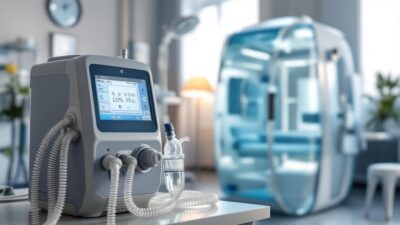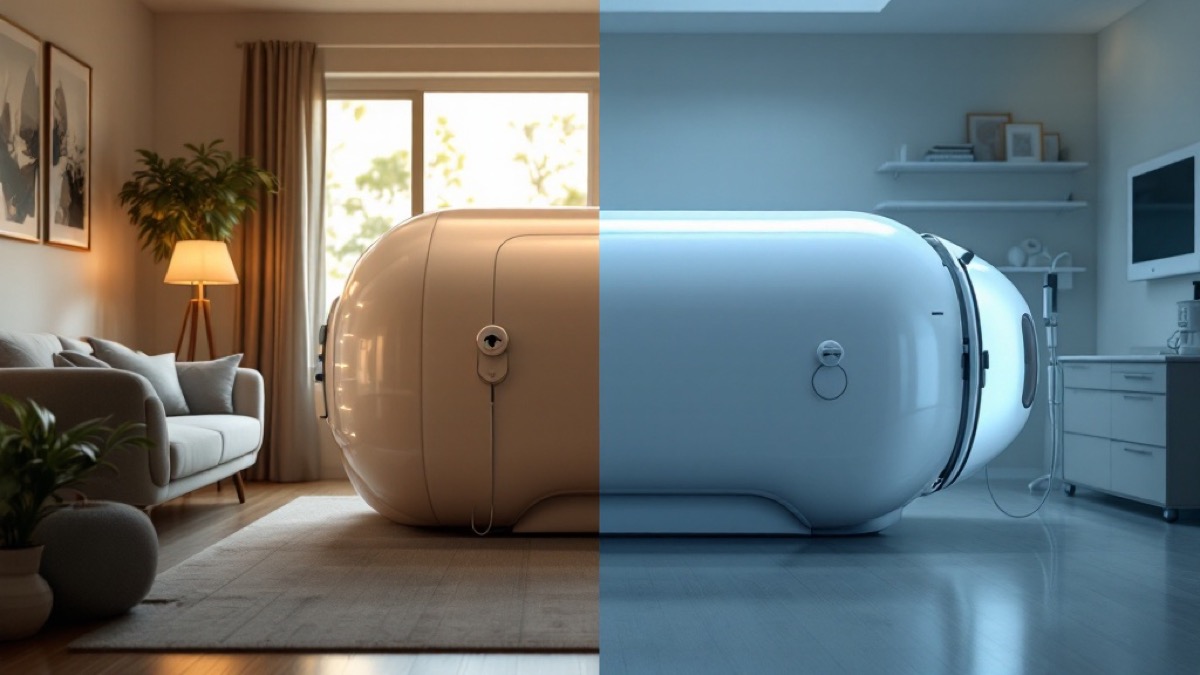
Mild HBOT delivers therapy at 1.3 to 1.5 ATA, usually in a soft chamber with air or masked concentrator oxygen. Clinical HBOT delivers 2.0 to 3.0 ATA with 100 percent oxygen in a hard chamber. The core difference is dose: arterial oxygen reaches roughly 230 mmHg at 1.3 ATA versus about 1,824 mmHg at 2.4 ATA, an eightfold gap.
Key Takeaways
- Arterial oxygen is roughly eight times higher under clinical pressure: about 1,824 mmHg at 2.4 ATA versus 230 mmHg at 1.3 ATA, per Burman, S Afr Med J, 2019.
- Oxygen becomes bacteriostatic only above 1.5 ATA, a threshold mild protocols at 1.3 ATA cannot reach (UHMS consumer guidance).
- All 14 UHMS-approved indications were established using hard chambers at 2.0 ATA or higher; soft chambers are FDA-cleared for acute mountain sickness only (FDA, 2021).
- For mild traumatic brain injury, the Harch systematic review (2022) found four Level 1 RCTs at 1.5 ATA with 100 percent oxygen, while 1.3 ATA with air produced mixed results.
- Mild sessions run about $75 to $150; physician-supervised clinical sessions run about $200 to $600 (industry cost surveys, 2026).
This is a comparison of the therapy, not the tackle. If you want the device teardown, see our guide to hard shell vs soft shell chambers and our breakdown of what a mild hyperbaric chamber delivers. Here the question is what each pressure protocol does inside the body, what the studies support, and which one fits a given goal.
What Counts as Mild vs Clinical
The line is drawn by pressure. Mild hyperbaric oxygen therapy, often shortened to mHBOT, runs at 1.3 to 1.5 ATA. Most portable soft chambers cap at 1.3 ATA, so mHBOT in practice usually means 1.3 ATA with room air or a concentrator delivering 90 to 95 percent oxygen by mask. Clinical HBOT runs at 2.0 to 3.0 ATA with 100 percent medical-grade oxygen, either filling a monoplace chamber or delivered by mask inside a pressurized multiplace chamber.
That single number drives everything downstream: the dissolved oxygen dose, the regulatory status, the evidence base, and the cost. The hardware differences follow from the physics, which is why the two categories rarely overlap. For the underlying mechanics, our explainer on what a hyperbaric chamber is covers how pressure and oxygen concentration combine.
The Oxygen Dose Difference
Hyperbaric benefit comes from dissolving extra oxygen into blood plasma, over and above what hemoglobin carries. The amount dissolved rises with both pressure and the oxygen fraction breathed, so small changes in either move the dose substantially.
At 1.3 ATA breathing air, the arterial oxygen partial pressure lands near 230 mmHg. At 2.4 ATA breathing 100 percent oxygen, it reaches roughly 1,824 mmHg. Those figures, reported by Burman in the South African Medical Journal in 2019, describe an eightfold difference in delivered oxygen. A separate tissue-level measurement in wound patients found transcutaneous oxygen averaging 161 mmHg at 1.4 ATA versus 333 mmHg at 2.0 ATA, more than double, which shows the same pattern at the tissue where healing happens.
The practical takeaway: mild and clinical protocols are not two settings on one dial that produce more or less of the same effect. They cross physiological thresholds. Some biological responses only switch on above a certain oxygen tension, which is why the evidence does not scale smoothly from one to the other.
What the Evidence Supports for Each
Clinical HBOT has the deeper record. Every one of the 14 conditions approved by the Undersea and Hyperbaric Medical Society, including diabetic wounds, radiation tissue injury, gas gangrene, carbon monoxide poisoning, and decompression sickness, was validated in hard chambers at 2.0 ATA or higher, supported by hundreds of peer-reviewed studies. Our summary of FDA-cleared HBOT indications lists them in full.
Mild HBOT has a thinner but not empty record. A 2011 study in 15 healthy volunteers reported an 11 percent drop in oxidative stress markers and improved fatigue scores at 1.3 ATA, but it used no control group. A 2018 study in 10 participants measured oxygen saturation without any clinical endpoint. The signals are suggestive, and small uncontrolled studies cannot carry a treatment claim.
The most instructive case is mild traumatic brain injury. Harch’s 2022 systematic review found four randomized controlled trials meeting Level 1 evidence criteria at 1.5 ATA with 100 percent oxygen, while 1.3 ATA with air produced one positive and one negative study, and 2.4 ATA produced negative results for that condition. The review concluded that pressure within a narrow range mattered more than raw oxygen concentration. In other words, more pressure is not automatically better, and the effective window is condition-specific rather than a simple ladder.
Conditions Where Clinical Pressure Matters vs Where Mild May Help
For the UHMS indications, clinical pressure is not optional. Oxygen becomes bacteriostatic, meaning it suppresses bacterial and fungal growth, only above 1.5 ATA. That is why wound healing, necrotizing infection, and gas gangrene are treated exclusively at 2.0 ATA and up. A soft chamber at 1.3 ATA cannot reach the threshold under any oxygen configuration, so it is the wrong tool for these problems.
Mild HBOT is generally used off-label for wellness goals: recovery, fatigue, general inflammation, and cognitive support in people without a diagnosed condition that requires clinical dosing. The mTBI data at 1.5 ATA is the strongest case that a lower-pressure protocol can produce measured clinical change, though 1.5 ATA sits at the top edge of the mild range and above what most 1.3 ATA soft chambers deliver. For anything on the approved list, mild protocols should not be treated as a substitute.
Cost per Session and per Protocol
Mild sessions in wellness settings typically run $75 to $150. Physician-supervised clinical HBOT runs about $200 to $600 per session, reflecting medical-grade equipment, hyperbaric-certified staff, and oxygen handling. Our full hyperbaric chamber cost guide breaks down clinic pricing and home ownership.
Protocols compound those numbers. A standard course is often 20 to 40 sessions. At clinical rates, a 40-session course can reach $8,000 to $24,000, and it is usually covered by insurance only for approved indications. A 40-session mild course at a wellness clinic lands nearer $3,000 to $6,000 and is rarely reimbursed. Home ownership shifts the math again: entry-level FDA-cleared soft chambers start near $4,000, which can beat repeat clinic visits for long-term wellness use.
Safety Differences
Lower pressure carries lower risk. A 2023 safety study of 175 patients at 1.45 ATA reported a 7.1 percent adverse event rate per session with zero cases of objective barotrauma, notably lower than rates seen at 2.0 ATA and above. Soft chambers running air rather than a concentrated oxygen atmosphere also carry very low fire risk.
Clinical HBOT is safe under proper supervision but carries a heavier risk profile: ear and sinus barotrauma from faster or higher compression, temporary vision changes, and rare oxygen toxicity, which is why 100 percent oxygen environments follow strict fire protocols. Both protocols share common minor effects like ear pressure. Our guide to hyperbaric chamber side effects covers what to expect and how to reduce risk.
How to Choose
Start from the goal, not the machine. If you have a diagnosed condition on the UHMS list, clinical HBOT at 2.0 ATA or higher is the evidence-backed path, and it belongs in a supervised facility. If your aim is general wellness, recovery, or accessible home use without a specific medical target, a mild protocol offers a favorable safety profile and a lower cost of entry, with the honest caveat that its evidence base is small.
Two rules keep expectations calibrated. First, do not use a mild chamber as a stand-in for a clinical indication. Second, hold onto the pressure window finding: for at least one condition, 1.5 ATA outperformed both 1.3 and 2.4, so higher is not reliably better. Match the protocol to the target and the evidence, then decide between a clinic and home use.
Mild vs Clinical HBOT at a Glance
| Factor | Mild HBOT | Clinical HBOT |
|---|---|---|
| Pressure (ATA) | 1.3 to 1.5 | 2.0 to 3.0 |
| Arterial oxygen | ~230 mmHg (1.3 ATA, air) | ~1,824 mmHg (2.4 ATA, 100% O2) |
| FDA status | Cleared for acute mountain sickness only | Used for 14 UHMS-approved indications |
| Typical setting | Home or wellness clinic | Hospital or specialist HBOT center |
| Cost per session | $75 to $150 | $200 to $600 |
| Evidence level | Limited; small studies, few RCTs | Extensive; hundreds of peer-reviewed studies |
Frequently Asked Questions
Is mild HBOT as effective as clinical HBOT?
Not for approved medical conditions. Every UHMS-approved indication was validated at 2.0 ATA or higher, and mild pressure cannot reach the bacteriostatic threshold above 1.5 ATA. Mild HBOT shows promising but limited signals for wellness goals, backed mostly by small studies without control groups rather than randomized trials.
Why is 1.5 ATA sometimes better than higher pressure?
For mild traumatic brain injury, Harch’s 2022 review found the strongest results at 1.5 ATA with 100 percent oxygen, while 2.4 ATA was negative. The response appears to depend on a narrow pressure window rather than maximum oxygen, so higher pressure is not automatically more effective for every condition.
Can I treat a wound with a mild home chamber?
No. Wound healing relies on oxygen becoming bacteriostatic above 1.5 ATA and on tissue oxygen levels that only clinical pressure reaches. A 1.3 ATA soft chamber cannot deliver either, so diabetic wounds and infections need supervised clinical HBOT at 2.0 ATA or higher.
Does insurance cover either protocol?
Clinical HBOT is often covered when used for an approved indication like diabetic wounds or radiation injury, though coverage varies by plan and requires documentation. Mild HBOT used off-label for wellness is rarely reimbursed, so most people pay out of pocket or buy a home chamber.
Sources
- Burman F. Low-pressure fabric hyperbaric chambers. S Afr Med J. 2019. South African Medical Journal, 2019
- Harch PG. Systematic review and dosage analysis: hyperbaric oxygen therapy in mild traumatic brain injury. 2022. PMC8968958
- Undersea and Hyperbaric Medical Society. Approved indications and consumer guidance. uhms.org
- U.S. Food and Drug Administration. Hyperbaric oxygen therapy: get the facts. fda.gov
- Hyperbaric oxygen therapy cost surveys, 2026. regenerated.health/hbot-cost
Medical Disclaimer
The content on BaricBoost.com is for informational purposes only and is not intended as a substitute for professional medical advice, diagnosis, or treatment. Always seek the advice of your physician or other qualified health provider with any questions you may have regarding a medical condition. Never disregard professional medical advice or delay in seeking it because of something you have read on this website.

Author
Seph Fontane Pennock is the founder of BaricBoost.com and Regenerated.com, a clinic directory for regenerative medicine serving 10,000+ providers across the United States. He previously built and sold PositivePsychology.com, which grew to 19 million users and became the largest evidence-based positive psychology resource on the web. Seph brings direct experience as an HBOT patient, having completed protocols at clinics across three continents while navigating mold illness, systemic inflammation, and autoimmune conditions. His treatment journey includes hyperbaric oxygen therapy, peptide protocols, NAD+ therapy, and consultations with specialists from Dubai to Cape Town to Mexico. This combination of entrepreneurial track record and lived patient experience shapes everything published on BaricBoost.com. Every article is grounded in peer-reviewed research, informed by real clinical encounters, and written for patients making high-stakes treatment decisions. Seph's focus is on bringing transparency, scientific rigor, and practical guidance to the hyperbaric oxygen therapy space.