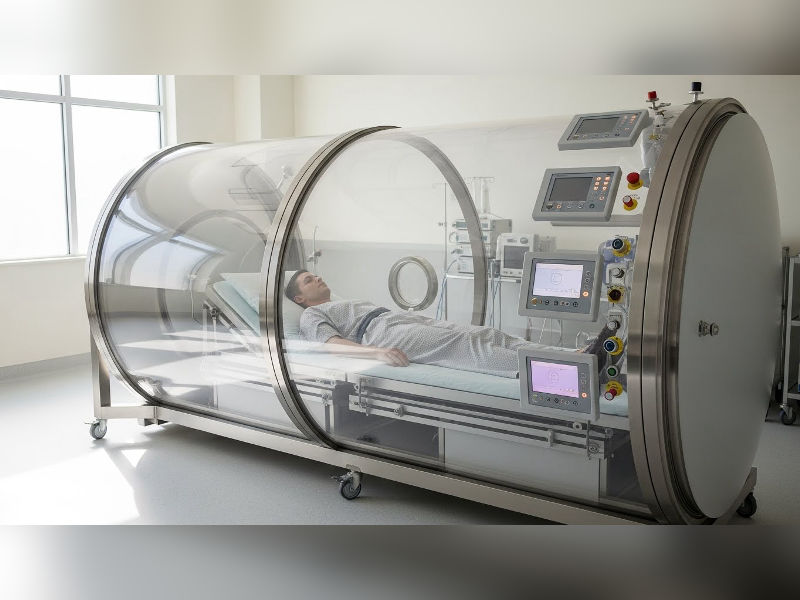
More than 1,000 hyperbaric oxygen therapy (HBOT) programs operate across the United States, split between hospital wound care centers and independent standalone clinics, according to the Undersea and Hyperbaric Medical Society. Finding the right one near you starts with matching your condition to the pressure and oversight it requires, then verifying the facility’s accreditation before you book a course of treatment.
The kind of clinic you need depends on your diagnosis. A Wagner Grade 3 diabetic foot ulcer belongs in an accredited program that bills insurance under FDA-cleared indications. A wellness or recovery goal points toward a standalone clinic. This guide covers how to count your options, tell hospital programs from private ones, verify credentials, and spot the facilities to walk away from. For the national picture, see our data on how many HBOT clinics operate in the US and how many hyperbaric chambers are installed nationwide.
How many HBOT clinics are there in the US?
More than 1,000 hyperbaric programs run in the US as of early 2025 per UHMS tracking. Roughly 800 to 1,000 are hospital-based wound care centers, with an estimated 350 to 500 freestanding clinics and a smaller number of integrative, military, and dive-medicine facilities. Accounting for multiple chambers per program, the installed base is an estimated 1,500 to 2,000 clinical-grade chambers.
The hospital figure dominates because most HBOT in the US is billed for wound care. Medicare and private insurers reimburse the treatment for a defined list of conditions, and hospital wound centers are built around that reimbursement. Freestanding clinics cluster in larger metro areas and skew toward cash-pay and wellness use. Rural coverage is thin, which is why proximity matters so much for a protocol that can run 20 to 40 sessions. For a sense of true access, our breakdown of HBOT clinic counts by facility type separates verified private clinics from the hospital network, and emergency hyperbaric locations maps the centers equipped for acute cases like carbon monoxide poisoning and decompression sickness.
Program count is not the same as chamber count. A single multiplace program may run one large chamber that seats several patients, while a monoplace wound center may operate four or more single tubes. The 1,500 to 2,000 chamber estimate is a derived figure, not an official census, so treat any “chambers near me” total as an approximation.
Hospital vs standalone HBOT clinic: which do you need?
Choose a hospital-based program if your condition is an FDA-cleared indication such as a diabetic foot ulcer, radiation tissue injury, or a non-healing surgical wound, since these need insurance billing, physician oversight, and emergency backup. Choose a standalone clinic for cash-pay wellness, athletic recovery, or off-label goals, accepting that oversight and complication management are usually lighter.
Hospital wound centers integrate HBOT into a broader care plan. They coordinate with your surgeon, vascular team, and infectious disease specialists, and they can manage a seizure or a pneumothorax on site. That matters for the sickest patients and for the 14 conditions UHMS recognizes as FDA-cleared indications (Weaver, UHMS 14th edition). Diabetic foot ulcers are the clearest example: a randomized controlled trial by Löndahl and colleagues (Diabetes Care, 2010) found HBOT improved healing of chronic diabetic foot ulcers versus hyperbaric air placebo. Honest caveat: a later double-blind RCT by Fedorko and colleagues (Diabetes Care, 2016) found HBOT did not reduce the need for amputation, so the benefit is real but bounded. A hospital program is the setting that manages that nuance.
Standalone clinics trade oversight for flexibility. Appointment times are easier, the setting feels less clinical, and many focus on recovery or performance. The trade-off is fewer resources if something goes wrong and, often, cash-pay pricing because off-label uses are rarely covered. Not every hospital has a chamber at all; our guide to whether every hospital has a hyperbaric chamber explains why coverage is patchier than most people assume. Use the table below to match your situation to the right setting.
Hospital-Based Program vs Standalone HBOT Clinic
| Factor | Hospital-based program | Standalone clinic | Source |
|---|---|---|---|
| Emergency capability | On-site physician and code team; can manage seizure, pneumothorax, decompression sickness | Limited; typically transfers to ER for complications | Camporesi 2014; Heyboer 2017 |
| Pressure and indications | 2.0 to 3.0 ATA, 100% oxygen; all 14 FDA-cleared indications | Often 1.3 to 2.0 ATA; frequently off-label and wellness use | UHMS 14th ed.; FDA 510(k) |
| Typical cost per session | Billed to insurance for covered conditions; patient owes copay or coinsurance | Commonly $150 to $600 cash-pay for off-label use | CMS NCD 20.29 |
| Scheduling flexibility | Weekday clinic hours, wound-center intake process | More flexible; evening and same-week slots common | Facility practice |
| Insurance coordination | Built-in; prior authorization handled by the center | Usually none; patient self-pays and seeks reimbursement | CMS NCD 20.29 |
| Best-fit patient | FDA-cleared indication, complex or acute case, insured | Cash-pay wellness, recovery, or off-label goal, medically stable | Mathieu 2017 |
How do you verify an HBOT clinic’s credentials?
Verify three things: UHMS facility accreditation, physician supervision by a trained hyperbaric provider, and technicians certified by the National Board of Diving and Hyperbaric Medical Technology (NBDHMT). Ask for the facility’s accreditation status directly, confirm a physician is on site during treatments, and check that chambers have current inspection and maintenance logs before you commit to a course.
UHMS runs a voluntary accreditation program that audits safety, staffing, and equipment against published standards. Accredited facilities meet the same operational bar that hospital wound centers are held to, and you can ask any clinic whether it holds current UHMS accreditation. Technician certification comes from the NBDHMT, founded in 1981, which issues the Certified Hyperbaric Technologist (CHT) and Certified Hyperbaric Registered Nurse (CHRN) credentials to staff who complete formal training and a preceptorship. A clinic that cannot name its accreditation or its techs’ certifications is telling you something.
Beyond credentials, ask about equipment upkeep. Chambers should have documented pressure tests, valve service, and fire-safety drills. Fire is the catastrophic failure mode in hyperbaric medicine: a 73-year analysis by Sheffield and Desautels (Undersea and Hyperbaric Medicine, 1997) found that documented fatal chamber fires occurred in oxygen-enriched environments with prohibited ignition sources present. That history is why prohibited-item protocols and inspection logs are non-negotiable. Staff should also be able to explain the mechanism plainly; hyperbaric oxygen works by dissolving oxygen into plasma under pressure and triggering downstream repair signaling (Thom, Plastic and Reconstructive Surgery, 2011). The checklist below is what a well-run clinic will pass without hesitation.
HBOT Clinic Evaluation Checklist
| Checkpoint | What to confirm | Why it matters | Source |
|---|---|---|---|
| UHMS accreditation | Facility holds current UHMS accreditation | Audited against national safety and staffing standards | UHMS |
| Certified technologists | CHT or CHRN-certified staff run sessions | Formal training plus supervised preceptorship | NBDHMT |
| Physician on site | A trained hyperbaric physician supervises treatment | Complications like seizure or barotrauma need clinical response | Camporesi 2014 |
| Chamber inspection logs | Documented pressure tests, servicing, fire drills | Chamber fires occur with lax protocols and ignition sources | Sheffield 1997 |
| Realistic-expectations test | Discusses evidence and limits, never guarantees a cure | Guaranteed results signal a marketing operation, not medicine | Miller 2015 |
What questions should you ask before your first session?
Ask five questions: Is my condition one you treat under an FDA-cleared indication? How many sessions will my protocol require and at what pressure? Is a physician present during treatment? What are your emergency protocols? And what is the total cost, including any prior authorization? Clear, specific answers signal a legitimate program. Vague answers or pressure to decide fast are warning signs.
Session count depends on the condition. A review of 1,506 cases by D’Agostino Dias and colleagues (Undersea and Hyperbaric Medicine, 2008) found acute injuries average roughly 15 sessions while chronic conditions average around 30, most run five days a week. That volume is why proximity and scheduling belong in your first conversation: missing sessions undercuts a protocol built on daily, repeated exposure. Ask how the clinic handles missed appointments and whether it offers early or late slots.
Also ask what to expect physically. Standard sessions last 60 to 90 minutes at pressure, and the main sensation is ear pressure during compression, similar to an airplane descent. Middle ear barotrauma is the most common side effect, reported in a meaningful minority of patients and usually mild and self-resolving (Heyboer et al., Advances in Wound Care, 2017). A good clinic teaches ear-clearing techniques before your first descent and tells you to speak up the moment you cannot equalize. If you are weighing a home unit against a clinic course, our guide to the portable hyperbaric chamber explains why low-pressure home chambers cannot match clinical protocols.
What are the red flags of a bad HBOT clinic?
The clearest red flags are guaranteed cures, claims that HBOT treats conditions with no supporting evidence, no physician on site, unaccredited chambers, and pressure to prepay for large session packages. Legitimate providers discuss evidence honestly, set realistic expectations, and never promise miracles for conditions where the research is unsettled or negative.
The traumatic brain injury market is the clearest test case. Small trials such as Boussi-Gross and colleagues (PLoS ONE, 2013) reported cognitive gains in chronic post-concussion patients, but a large Department of Defense sham-controlled randomized trial by Miller and colleagues (JAMA Internal Medicine, 2015) found no benefit of HBOT over sham for persistent post-concussion symptoms in service members. A clinic that advertises HBOT as a proven TBI cure is ignoring the strongest evidence. The same skepticism applies to marketing for autism, Lyme disease, and anti-aging, where controlled data is thin. For the full contested picture, see our coverage of FDA-cleared versus off-label HBOT indications.
Be wary of chambers running without medical supervision and of any facility that will not produce inspection records. Soft-shell home units exist for personal wellness, but only three portable brands (OxyHealth, Summit to Sea, and Newtowne Hyperbarics) hold FDA 510(k) clearance, and only for altitude sickness. A clinic selling low-pressure soft-chamber sessions as equivalent to clinical HBOT is overstating what the equipment can deliver. Watch, too, for outdated equipment: ask when the chamber was last inspected and serviced, and treat a clinic that cannot answer as a pass.
What will HBOT cost near you?
For FDA-cleared indications billed to insurance, you typically owe a copay or coinsurance rather than the full session price. For off-label or cash-pay use, sessions commonly run $150 to $600 depending on region, chamber type, and clinic. A full course of 20 to 40 sessions is the real budget line, so confirm total cost and coverage before you start.
Medicare covers HBOT only for its defined conditions and only under specific criteria. Under CMS National Coverage Determination 20.29, a diabetic wound must be Wagner Grade 3 or higher with documented failure of 30 days of standard wound care before HBOT is covered, and coverage stops if there are no measurable signs of healing within any 30-day period. Private insurers follow similar medical-necessity rules and frequently deny off-label uses such as brain injury or Lyme disease. Confirm prior authorization in writing so a denial does not surprise you mid-protocol. Our state-by-state data on HBOT session cost by state shows what providers actually charge, and our HBOT insurance guide walks through coverage and appeals.
Do not assume higher price means better care. A hospital wound center billing insurance and a cash-pay wellness clinic are pricing two different services. Match the setting to your diagnosis first, then compare cost within that category. If you are paying out of pocket, ask about package pricing and financing, but never prepay for a large block of sessions with a clinic you have not verified.
How do I know if a hyperbaric clinic near me is accredited?
Ask the clinic directly whether it holds current UHMS facility accreditation, and confirm its technologists are CHT or CHRN-certified through the NBDHMT. Accreditation means the facility has been audited against national safety and staffing standards. A clinic that cannot state its accreditation status or name its staff certifications should not run your treatment (UHMS; NBDHMT).
Does insurance cover HBOT at a clinic near me?
Medicare and most private plans cover HBOT only for FDA-cleared indications, such as diabetic foot ulcers meeting Wagner Grade 3 criteria after 30 days of failed standard care, per CMS National Coverage Determination 20.29. Off-label uses like brain injury, autism, or Lyme disease are usually denied. Get prior authorization in writing before starting a course (CMS NCD 20.29).
How many HBOT sessions will I need?
It depends on your condition. A review of 1,506 cases found acute injuries average about 15 sessions and chronic conditions average around 30, usually five days a week (D’Agostino Dias et al., 2008). Because the protocol relies on daily repeated exposure, a nearby clinic makes finishing the full course far more realistic than a distant one.
Sources
- Weaver LK (ed). “Hyperbaric Oxygen Therapy Indications.” 14th Edition. Undersea and Hyperbaric Medical Society. uhms.org
- Undersea and Hyperbaric Medical Society. “Hyperbaric Facility Accreditation.” uhms.org
- National Board of Diving and Hyperbaric Medical Technology. “Certified Hyperbaric Technologist (CHT) Certification.” nbdhmt.org
- Jokinen-Gordon H, Barry RC, Watson B, Covington DS. “A Retrospective Analysis of Adverse Events in Hyperbaric Oxygen Therapy (2012-2015): Lessons Learned From 1.5 Million Treatments.” Advances in Skin & Wound Care, 2017;30(3):125-129. PMID: 28198743. pubmed.ncbi.nlm.nih.gov/28198743
- Mathieu D, Marroni A, Kot J. “Tenth European Consensus Conference on Hyperbaric Medicine.” Diving and Hyperbaric Medicine, 2017;47(1):24-32. PMC6147755
- Thom SR. “Hyperbaric oxygen: its mechanisms and efficacy.” Plastic and Reconstructive Surgery, 2011;127(Suppl 1):131S-141S. PMID: 21200283. doi.org/10.1097/PRS.0b013e3181fbe2bf
- Centers for Medicare & Medicaid Services. “National Coverage Determination for Hyperbaric Oxygen Therapy (20.29).” cms.gov
- Löndahl M, Katzman P, Nilsson A, Hammarlund C. “Hyperbaric Oxygen Therapy Facilitates Healing of Chronic Foot Ulcers in Patients With Diabetes.” Diabetes Care, 2010;33(5):998-1003. PMID: 20427683. pubmed.ncbi.nlm.nih.gov/20427683
- Fedorko L, Bowen JM, Jones W, et al. “Hyperbaric Oxygen Therapy Does Not Reduce Indications for Amputation in Patients With Diabetes With Nonhealing Ulcers of the Lower Limb: A Prospective, Double-Blind, Randomized Controlled Clinical Trial.” Diabetes Care, 2016;39(3):392-399. doi.org/10.2337/dc15-2001
- Weaver LK, Hopkins RO, Chan KJ, et al. “Hyperbaric Oxygen for Acute Carbon Monoxide Poisoning.” New England Journal of Medicine, 2002;347(14):1057-1067. doi.org/10.1056/NEJMoa013121
- Miller RS, Weaver LK, Bahraini N, et al. “Effects of hyperbaric oxygen on symptoms and quality of life among service members with persistent postconcussion symptoms: a randomized clinical trial.” JAMA Internal Medicine, 2015;175(1):43-52. PMID: 25401463. pubmed.ncbi.nlm.nih.gov/25401463
- Boussi-Gross R, Golan H, Fishlev G, et al. “Hyperbaric Oxygen Therapy Can Improve Post Concussion Syndrome Years after Mild Traumatic Brain Injury: Randomized Prospective Trial.” PLoS ONE, 2013;8(11):e79995. doi.org/10.1371/journal.pone.0079995
- Heyboer M, Sharma D, Santiago W, McCulloch N. “Hyperbaric Oxygen Therapy: Side Effects Defined and Quantified.” Advances in Wound Care, 2017;6(6):210-224. doi.org/10.1089/wound.2016.0718
- Camporesi EM. “Side effects of hyperbaric oxygen therapy.” Undersea and Hyperbaric Medicine, 2014;41(3):253-257. PMID: 24984321. pubmed.ncbi.nlm.nih.gov/24984321
- Sheffield PJ, Desautels DA. “Hyperbaric and hypobaric chamber fires: a 73-year analysis.” Undersea and Hyperbaric Medicine, 1997;24(3):153-164. PMID: 9308138. pubmed.ncbi.nlm.nih.gov/9308138
- D’Agostino Dias M, Fontes B, Poggetti RS, Birolini D. “Hyperbaric oxygen therapy: types of injury and number of sessions, a review of 1506 cases.” Undersea and Hyperbaric Medicine, 2008;35(1):53-60. PMID: 18351127. pubmed.ncbi.nlm.nih.gov/18351127
- US Food and Drug Administration. “510(k) Premarket Notification Database.” accessdata.fda.gov
Medical Disclaimer
The content on BaricBoost.com is for informational purposes only and is not intended as a substitute for professional medical advice, diagnosis, or treatment. Always seek the advice of your physician or other qualified health provider with any questions you may have regarding a medical condition. Never disregard professional medical advice or delay in seeking it because of something you have read on this website.

Author
Seph Fontane Pennock is the founder of BaricBoost.com and Regenerated.com, a clinic directory for regenerative medicine serving 10,000+ providers across the United States. He previously built and sold PositivePsychology.com, which grew to 19 million users and became the largest evidence-based positive psychology resource on the web. Seph brings direct experience as an HBOT patient, having completed protocols at clinics across three continents while navigating mold illness, systemic inflammation, and autoimmune conditions. His treatment journey includes hyperbaric oxygen therapy, peptide protocols, NAD+ therapy, and consultations with specialists from Dubai to Cape Town to Mexico. This combination of entrepreneurial track record and lived patient experience shapes everything published on BaricBoost.com. Every article is grounded in peer-reviewed research, informed by real clinical encounters, and written for patients making high-stakes treatment decisions. Seph's focus is on bringing transparency, scientific rigor, and practical guidance to the hyperbaric oxygen therapy space.