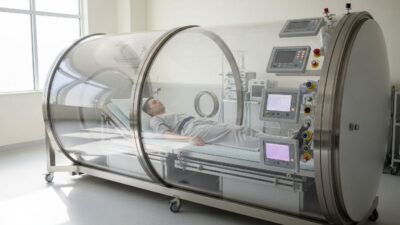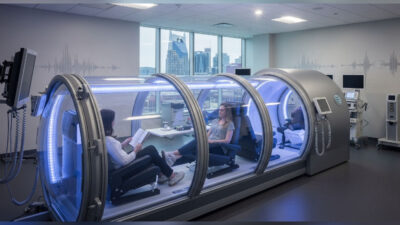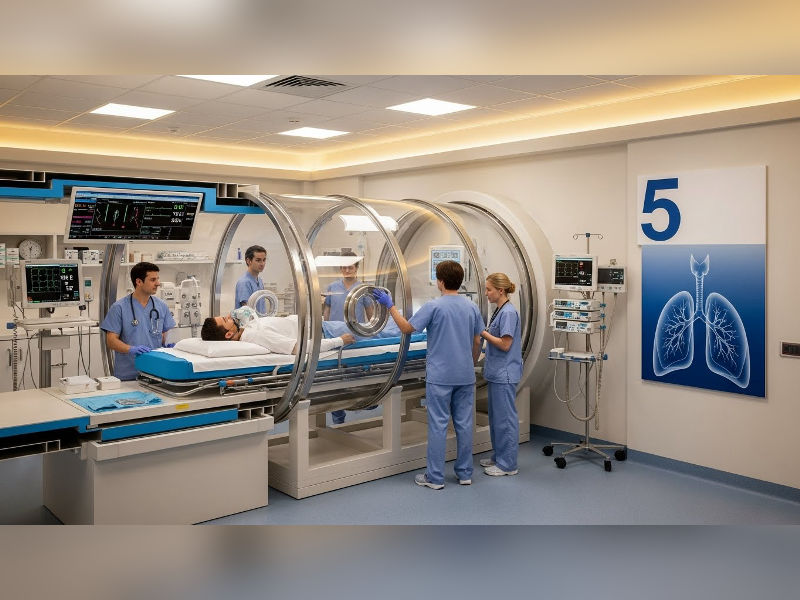
Hospital hyperbaric chambers are clinical-grade pressure vessels that deliver 100% medical-grade oxygen at 2.0 to 3.0 ATA, meeting the standards required for all 14 UHMS-approved medical indications. They are FDA-registered devices manufactured to ASME PVHO-1 and ISO 13485 specifications, operated by trained hyperbaric technicians and supervised by hyperbaric physicians.1
Understanding what hospital chambers offer, and how they differ from home and wellness devices, helps patients make informed decisions about when clinic-based treatment is warranted versus when home HBOT may be adequate.
What Hospital Chambers Deliver
At 2.4 ATA with 100% O₂, arterial oxygen reaches approximately 1,824 mmHg, nearly 8 times the level achievable in a home soft chamber at 1.3 ATA.2 This level of oxygen dissolves directly into plasma, enabling diffusion into ischemic tissues, wounds, and infected areas that inadequate circulation cannot otherwise oxygenate. It is the mechanism behind HBOT’s effectiveness for wound healing, radiation injury, and decompression illness.
A 2023 clinical study directly measuring tissue oxygenation found that TcPO₂ at 1.4 ATA averaged 161 mmHg while at 2.0 ATA it averaged 333 mmHg (p<0.001) in chronic wound patients. The authors found no evidence that 1.4 ATA benefits chronic ulcer patients.3
Hospital vs Home Chamber: The Clinical Gap
| Feature | Hospital Chamber | Home Soft Chamber |
|---|---|---|
| Pressure | 2.0–3.0 ATA | 1.3 ATA max |
| Oxygen source | 100% medical-grade O₂ | Ambient air or ~90–95% O₂ via concentrator |
| Arterial O₂ | ~1,824 mmHg at 2.4 ATA | ~230 mmHg at 1.3 ATA |
| UHMS indications covered | All 14 | None |
| Bacteriostatic capability | Yes, exceeds 1.5 ATA threshold | No |
| Medical supervision | Trained technicians and physicians | Self-administered |
| FDA status | FDA-registered clinical device | Cleared for altitude sickness only |
| Cost per session | $200–$500 | ~$10–$25 amortized over chamber life |
The 14 UHMS-Approved Indications
Hospital HBOT is the only appropriate treatment when targeting any of the UHMS-approved indications. These include diabetic foot ulcers, chronic radiation injury (osteoradionecrosis, radiation cystitis, proctitis), gas gangrene, necrotizing soft tissue infections, decompression illness, gas embolism, CO poisoning, refractory osteomyelitis, compromised skin grafts, and sudden sensorineural hearing loss.
All clinical evidence supporting UHMS-approved HBOT indications comes from studies using hard shell chambers at 2.0 ATA or higher. No study has established benefit for these conditions at soft chamber pressures.
Adverse Events in Hospital Settings
At clinical pressures, adverse events are well-characterized and manageable. A 2024 UHMS member survey found the most common events were temporary myopia (24.4%), ear barotrauma (14.9%), and confinement anxiety (11.5%).4 Oxygen toxicity seizures occur at a rate of approximately 1 in 10,000 sessions at standard clinical pressures. The presence of trained staff during sessions enables rapid response to any adverse event.
A 2024 UHMS survey found that 27.1% of clinicians use 2.0 ATA exclusively, 35% use 2.4 ATA, and 26% vary pressure by condition.4 Adverse events increase at higher pressures, a 2026 study comparing 2.0 and 2.5 ATA for radiation cystitis found similar efficacy but more adverse events at 2.5 ATA.5
Types of Hospital Chambers
Most hospital facilities use monoplace chambers (one patient, 100% O₂ atmosphere) or multiplace chambers (multiple patients plus inside attendant in compressed air). Perry Baromedical and Sechrist Industries are the leading US manufacturers, both FDA-registered, with ISO 13485:2016 or ASME PVHO-1 certification.
For the complete breakdown of clinical chamber configurations and what they cost, see the hard hyperbaric chamber guide. For understanding when home HBOT may be appropriate as maintenance after clinical treatment, see the home hyperbaric chamber guide.
FAQs
Is hospital HBOT covered by insurance?
Medicare and most private insurers cover HBOT for UHMS-approved indications. Coverage requires a qualifying diagnosis, documented clinical justification, and treatment at a certified facility.
How many sessions does a typical clinical course require?
Most courses involve 20 to 40 sessions at 5 sessions per week. Wound healing protocols commonly use 30 to 40 sessions. Decompression illness may require a single emergency session or a short course.
What is the difference between hospital HBOT and home HBOT?
Hospital HBOT uses 2.0 to 3.0 ATA with 100% medical oxygen, supervised by trained staff. Home HBOT uses 1.3 ATA with ambient air or concentrator-supplied oxygen. The oxygen delivery difference is approximately 8x.
References
References
- UHMS Indications for Hyperbaric Oxygen Therapy. 14th edition. Undersea and Hyperbaric Medical Society. 2021.
- Burman F. Low-pressure fabric hyperbaric chambers. S Afr Med J. 2019;109(4). PMID: 31084683. https://doi.org/10.7196/SAMJ.2019.v109i4.13934
- Sack RA et al. Transcutaneous oximetry in chronic ulcer patients at 1.4 vs 2.0 ATA. Undersea Hyperb Med. 2023. PMID: 38615347.
- Laspro M et al. HBOT regimens, treated conditions, and adverse effect profile: UHMS survey. Undersea Hyperb Med. 2024. PMID: 39821765.
- Soriano VH et al. Outcomes of HBOT at 2.0 vs 2.5 ATA for hemorrhagic radiation cystitis. Neurourol Urodyn. 2026. PMID: 41603214.
When Hospital HBOT Is the Only Appropriate Choice
For certain conditions and patient profiles, hospital-based HBOT is not just preferred but clinically necessary:
- Any of the 14 UHMS-approved indications: All evidence supporting these indications comes from studies using hard shell chambers at 2.0 ATA or higher. No study has demonstrated efficacy for approved conditions at soft chamber pressures (1.3 ATA). A patient with a diabetic foot ulcer, radiation injury, or chronic osteomyelitis needs hospital-grade equipment.
- Emergency conditions: Carbon monoxide poisoning, gas embolism, and decompression sickness require immediate treatment at clinical pressures. Emergency HBOT is time-sensitive; delays of hours can worsen outcomes. Only hospital programs with 24/7 capability handle these cases.
- Patients with comorbidities: Anyone with uncontrolled diabetes, cardiac conditions, seizure disorders, or respiratory compromise needs physician-supervised HBOT with monitoring capability. The controlled hospital environment allows real-time response to adverse events.
- Post-surgical applications: Compromised skin grafts and flaps, radiation-damaged tissue prior to dental surgery, and preparation of irradiated tissue for implant placement all require clinical-grade HBOT under surgical team coordination.
Hospital HBOT Program Structure
Understanding how hospital HBOT departments operate helps patients navigate the process:
- Referral pathway: Most hospital programs require a physician referral. The referring doctor sends clinical documentation to the hyperbaric medicine team, who evaluates whether HBOT is indicated. Expect 1 to 3 weeks from referral to first treatment.
- Pre-treatment evaluation: A hyperbaric physician examines the patient, reviews imaging and lab work, and obtains medical clearance. Chest X-ray is standard to rule out pneumothorax risk. Patients with implanted devices need manufacturer clearance for pressure exposure.
- Treatment schedule: Standard protocols call for daily sessions (Monday through Friday) for 4 to 8 weeks, totaling 20 to 40 treatments. Each session runs 90 to 120 minutes total, including pressurization and depressurization. Some conditions (radiation cystitis, osteomyelitis) may require 40 to 60 sessions.
- Staffing: Certified Hyperbaric Technicians (CHT) or Certified Hyperbaric Registered Nurses (CHRN) operate the chamber and monitor patients. A hyperbaric physician supervises treatment and is available for emergencies. Larger programs may have respiratory therapists and wound care nurses integrated into the team.
Cost of Hospital HBOT Programs
Hospital HBOT is the most expensive setting for treatment, but also the most likely to be covered by insurance:
- Per-session facility charges: $200 to $500, depending on the hospital and region. Academic medical centers (UCSF, Mayo Clinic, Johns Hopkins) charge at the higher end.
- Full treatment course: A 40-session course at facility charges runs $8,000 to $20,000 before insurance. Medicare data shows the average 40-session facility cost at $19,488 (2022 figure).
- Insurance coverage: Medicare, Medicaid, and most private insurers cover hospital HBOT for UHMS-approved indications with proper documentation. Patient copays typically run $40 to $150 per session after deductible.
- Out-of-pocket maximum: For insured patients, annual out-of-pocket maximums cap total exposure. A patient hitting their $8,000 annual max early in a 40-session course pays nothing for remaining sessions.
Compare hospital costs to home chamber economics: a home soft chamber costs $5,000 to $8,000 as a one-time purchase, amortizing to roughly $10 to $25 per session over its lifespan. But this comparison only holds for conditions where 1.3 ATA is adequate. For any UHMS-approved indication, the hospital is the only evidence-based option. See our HBOT cost guide for a full comparison across settings.
Medical Disclaimer
The content on BaricBoost.com is for informational purposes only and is not intended as a substitute for professional medical advice, diagnosis, or treatment. Always seek the advice of your physician or other qualified health provider with any questions you may have regarding a medical condition. Never disregard professional medical advice or delay in seeking it because of something you have read on this website.

Author
Seph Fontane Pennock is the founder of BaricBoost.com and Regenerated.com, a clinic directory for regenerative medicine serving 10,000+ providers across the United States. He previously built and sold PositivePsychology.com, which grew to 19 million users and became the largest evidence-based positive psychology resource on the web. Seph brings direct experience as an HBOT patient, having completed protocols at clinics across three continents while navigating mold illness, systemic inflammation, and autoimmune conditions. His treatment journey includes hyperbaric oxygen therapy, peptide protocols, NAD+ therapy, and consultations with specialists from Dubai to Cape Town to Mexico. This combination of entrepreneurial track record and lived patient experience shapes everything published on BaricBoost.com. Every article is grounded in peer-reviewed research, informed by real clinical encounters, and written for patients making high-stakes treatment decisions. Seph's focus is on bringing transparency, scientific rigor, and practical guidance to the hyperbaric oxygen therapy space.