Affiliate Disclosure
This article contains affiliate links. If you purchase through these links, we may earn a commission at no additional cost to you. This does not influence our evaluations or rankings.
A hyperbaric chamber bed is any hyperbaric chamber you use lying down, from clinical acrylic monoplace beds to home recumbent soft-shell chambers. Home lie-down models run $4,495 to about $23,000. Clinical monoplace bed chambers cost $100,000 or more and are usually accessed per session at a clinic instead of purchased.
What Is a Hyperbaric Chamber Bed?
The term has no formal definition. In practice it describes any chamber designed for the lying-down position, as opposed to sitting upright or semi-reclined. People searching for a “hyperbaric chamber bed” usually mean one of three things.
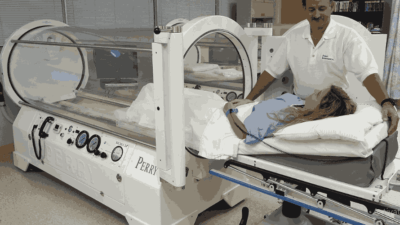
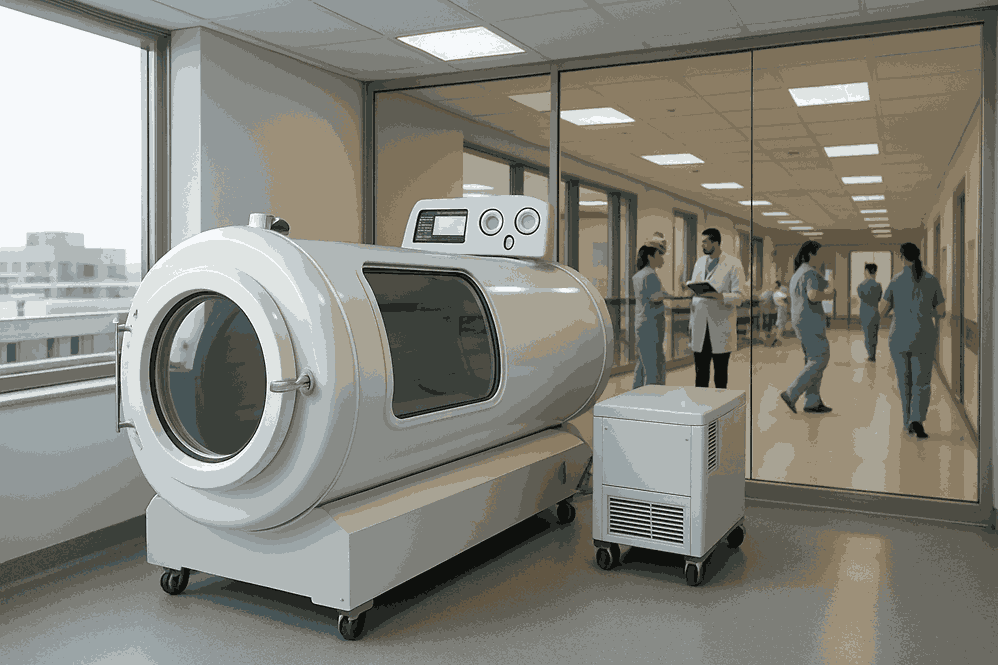
First, the clinical monoplace chamber. This is the clear acrylic tube you see in hospitals and wound-care centers. The patient lies on a padded gurney that rolls into the chamber, which then pressurizes with 100% oxygen to 2.0 to 3.0 ATA. It is a bed in the most literal sense.
Second, the home recumbent soft-shell chamber. These are inflatable urethane and nylon tubes with zipper entry. You lie on a mattress or foam pad inside while the chamber holds 1.3 ATA of pressurized ambient air, with oxygen delivered by mask from a concentrator. Most of the home market is recumbent by design, since sessions last 60 to 90 minutes and lying flat is far easier to sustain than sitting.
Third, hard-shell lie-down chambers that sit between the two, such as the OxyHealth Fortius 420. These reach clinical pressures in a horizontal format but are prescription devices aimed at physicians and clinics, not casual home buyers. If you want an upright hard-shell option instead, the portable hyperbaric chamber guide covers sit-in cabins.
The therapy delivered depends on pressure and oxygen delivery, not posture. A recumbent chamber at 1.3 ATA delivers the same dose as a sitting chamber at 1.3 ATA. For the basics of how pressure and oxygen work together, see the guide to what a hyperbaric chamber is.
Clinical Monoplace vs Home Recumbent: What Is the Difference?
These two categories look similar in photos. In every way that matters, they are different machines: the clinical unit reaches 3.0 ATA under physician supervision, while the home unit tops out at 1.3 ATA for self-directed wellness use.
Clinical monoplace chambers
A monoplace chamber like the Sechrist 3600H or Perry Baromedical Sigma series is a Class II medical device operated under physician supervision. The Sechrist 3600H has a 35.5-inch internal diameter, a 90-inch internal length, and a maximum operating pressure of 3.0 ATA. The entire chamber fills with 100% oxygen, so no mask is needed. At a clinical pressure of 2.4 ATA on 100% oxygen, arterial oxygen rises from roughly 100 mmHg at rest to well over 1,800 mmHg, because the excess oxygen dissolves directly into blood plasma.2
These chambers treat the 14 conditions recognized by the Undersea and Hyperbaric Medical Society, including diabetic wounds, radiation injury, and carbon monoxide poisoning.8 Insurance often covers those indications. You do not buy one for your house. Used units list for roughly $107,000 to $129,000, new systems cost more, and they require oxygen infrastructure, fire-safety protocols, and trained staff.9
Home recumbent chambers
Home soft-shell chambers operate at 1.3 ATA with ambient air, plus concentrator oxygen through a mask. At that pressure, arterial oxygen rises far less than in a clinical chamber: a meaningful increase over baseline, but a fraction of the clinical dose. The FDA has cleared these devices for one indication only, acute mountain sickness. Every other use is off-label wellness use, not medical treatment.1
The trade-off is access. A home chamber costs less than a single course of 40 clinic sessions in many cities, fits in a spare room, and lets you run daily sessions on your own schedule. The structural differences between the two builds are covered in detail in the hard shell vs soft shell comparison.
Which Lie-Down Chamber Models Can You Buy?
The table below covers the main lie-down options across both categories. Home chamber prices are manufacturer or authorized-dealer list prices; clinical prices reflect the used and refurbished market, since new monoplace systems are quoted case by case.
Recumbent Chamber Models Compared
| Model | Clinical or Home | Max Pressure | Interior Dimensions | Warranty | Price Range |
|---|---|---|---|---|---|
| Newtowne C4-27 | Home (soft shell) | 1.3 ATA | 27 in diameter x 7.5 ft | 2 years | $4,495 |
| Newtowne C4-34 | Home (soft shell) | 1.3 ATA | 34 in diameter | 2 years | $7,495 |
| Summit to Sea The Dive | Home (soft shell) | 1.3 ATA | 33 in diameter | 2 years | $7,995 |
| Newtowne C4-40 | Home (soft shell) | 1.3 ATA | 40 in diameter x 108 in | 2 years | $10,995 |
| OxyHealth Respiro 270 | Home (soft shell) | 1.3 ATA | 27 in diameter | 5 years | $12,000 to $16,000 |
| Summit to Sea Grand Dive | Home (soft shell) | 1.3 ATA | 40 in diameter | 2 years | $13,995 |
| OxyHealth Vitaeris 320 | Home (soft shell) | 1.3 ATA | 32 in diameter | 5 years | $18,000 to $23,000 |
| Sechrist 3600H | Clinical (acrylic monoplace) | 3.0 ATA | 35.5 in diameter x 90 in | Service contract | $107,000 to $129,000 used |
| OxyHealth Fortius 420 | Clinical (hard shell) | 3.0 ATA | 42 in diameter | Service contract | From $136,100 |
| Perry Baromedical Sigma 34/40 | Clinical (acrylic monoplace) | 3.0 ATA | 33.5 to 40.5 in diameter | Service contract | Quote based, typically $100,000+ |
Among home options, OxyHealth stands out for support: the company has distributed over 18,000 chambers in 28 years and backs its products with a 5-year warranty, two to three times longer than the 2-year coverage typical of Newtowne and Summit to Sea.4 Newtowne wins on price per inch of diameter. A full ranking with buying guidance is in the best hyperbaric chamber for home use roundup. If two people plan to share sessions, the 40-inch models are the entry point; the 2-person hyperbaric chamber guide covers that tier in detail.
What Comfort Features Matter for a 60-90 Minute Session?
Over a 60 to 90 minute session, small design details decide whether you use the chamber daily or let it gather dust. Four things carry most of the weight: mattress quality, interior diameter, entry style, and visibility.
Mattress and padding
Soft-shell chambers place you on the chamber floor, so the pad is doing all the work. Some brands include a foam mattress; others sell it as an accessory. Check before buying. A 3 to 4 inch memory-foam pad cut to the chamber footprint solves most comfort complaints. Clinical monoplace chambers use a padded hospital gurney, which is generally more comfortable than any soft-shell floor pad.
Interior diameter
A 27-inch chamber fits one average adult but limits movement. You can shift position, but you cannot roll over freely or prop yourself up to read. At 32 to 34 inches, side sleeping and reading become practical. At 40 inches, a second person fits. Length matters too: your height plus 12 to 18 inches keeps your feet off the end wall.
Entry style
Most recumbent soft chambers use a long side zipper or top zipper. Side entry is easier for people with joint pain, post-surgical limitations, or balance issues, since you sit on the edge and swing your legs in rather than crawling through an end opening. Some chambers can be entered while deflated and then inflated around you. Clinical monoplace beds are the easiest of all: you lie on the gurney and it rolls in.
Visibility and communication
Look for at least one side viewing window, ideally two or more. Windows reduce the closed-in feeling and let someone outside check on you. Dual compressors are worth having for redundancy, since one compressor failure then does not end the session. Your phone works inside a soft chamber at 1.3 ATA, which handles communication; clinical chambers have built-in intercoms.
Will Claustrophobia Be a Problem in a Lie-Down Chamber?
Claustrophobia is the most common reason people quit hyperbaric therapy, and lying inside a tube for over an hour is exactly the trigger. Chamber choice and session setup both help.
Chamber choice matters most. A clear acrylic monoplace chamber offers a nearly 360-degree view, which many anxious users find easier than an opaque fabric tube with small windows. Among home chambers, bigger diameter and more windows directly reduce the shut-in feeling. The Vitaeris 320’s multiple windows are a real advantage here over budget models with a single porthole.
The session itself follows a predictable arc. Pressurization takes 10 to 15 minutes, and this is when you feel ear pressure, similar to an airplane descent. Swallowing, yawning, or the Valsalva maneuver equalizes it. Lying flat changes ear equalization slightly; users who struggle can raise their head on a pillow during pressurization. Once at pressure, there is nothing to feel except the hum of the compressor. Most people read, listen to audio, or nap. Depressurization takes another 10 minutes.
Sessions should be attended. Someone in the house should know you are in the chamber and be able to respond if you want out early. Mild ear discomfort is the dominant side effect: a 2023 prospective study by Monge et al. of 175 patients at 1.45 ATA logged adverse events in 7.1% of sessions, all subjective earache, with zero cases of objective barotrauma.7 The full risk picture, including the rarer clinical-pressure risks, is covered in the hyperbaric chamber side effects guide.
Should You Buy a Chamber or Pay Per Session?
The buy-or-visit math depends on how many sessions you realistically expect to do. A $4,495 home chamber breaks even against a $150 wellness-center session in about 30 sessions; a $20,000 chamber takes far longer.
Clinic pricing in the US runs roughly $75 to $150 per session for soft-shell mild HBOT at wellness centers and $200 to $600 per session for hard-shell clinical or hospital chambers treating insurance-covered indications.9 Most protocols people pursue involve 20 to 40 sessions, and many users continue with maintenance sessions after that.
Against those rates, a $4,495 Newtowne C4-27 breaks even against a $150 wellness center in about 30 sessions, or six weeks of daily use. A $20,000 Vitaeris 320 needs roughly 130 sessions at the same rate, which still lands within a year for a committed daily user, and much sooner if two family members share it. Factor in $500 to $1,500 for an oxygen concentrator if one is not bundled, plus electricity and occasional zipper or valve maintenance.
The reverse logic applies to clinical monoplace chambers. Nobody buys a $110,000 Sechrist for personal use; if your condition needs 2.0 ATA or higher, you pay per session at a clinic and often insurance pays for you. A complete breakdown of purchase, rental, and session pricing is in the hyperbaric chamber cost guide.
FAQ
Is a hyperbaric chamber bed different from a regular hyperbaric chamber?
No. It is a regular chamber built for the lying-down position. The therapy depends on pressure and oxygen delivery, not posture, so a recumbent chamber at 1.3 ATA delivers the same dose as a sitting chamber at 1.3 ATA. The difference is comfort, entry ease, and floor space. Clinical monoplace beds reach 3.0 ATA under supervision; home recumbent chambers cap at 1.3 ATA for wellness use.
Can I sleep in a hyperbaric chamber bed?
Napping during an attended session is common and fine. Sleeping overnight is not recommended. Sessions should run 60 to 90 minutes with someone nearby who can help you exit, and no home chamber is cleared for unattended overnight use. Set a timer and treat it as a session, not a bed.
What size do I need?
For one user up to 6 feet tall, a 27-inch diameter and 7.5-foot length is the workable minimum. Choose 32 to 34 inches if you want to read or shift position comfortably. Two users need 40 inches. Allow a 4 by 8 foot floor area for even the smallest recumbent model.
Will insurance pay for a hyperbaric chamber bed?
Not for a home purchase. Insurance covers clinical HBOT sessions for FDA-recognized indications like diabetic wounds and radiation injury, delivered in monoplace or multiplace chambers under physician supervision. Home soft-shell chambers are cleared only for acute mountain sickness, and buyers pay out of pocket.
Sources
- US Food and Drug Administration. “Hyperbaric Oxygen Therapy: Get the Facts.” fda.gov. Accessed August 2026.
- Mahmoud O, Yu M. “Oxygen Therapy.” StatPearls, NIH/NCBI Bookshelf, 2023. ncbi.nlm.nih.gov/books/NBK551617. Arterial PaO2 rises above 1,800 mmHg at 2.4 ATA on 100% oxygen.
- Sechrist Industries. “H-Series Monoplace Hyperbaric Chambers feature overview.” Manufacturer specifications. Sechrist H-Chamber spec sheet. Accessed August 2026.
- OxyHealth. “Vitaeris 320 and Fortius 420 product specifications and warranty.” oxyhealth.com. Accessed August 2026.
- Perry Baromedical. “Sigma monoplace hyperbaric chamber series.” perrybaromedical.com. Accessed August 2026.
- Burman F. “Low-pressure fabric hyperbaric chambers.” South African Medical Journal, 2019;109(4):238-240. PMID: 31084683
- Monge G, Otto-Yáñez M, Norambuena N, Martínez V, Retamales D, Torres-Castro R. “Safety of Hyperbaric Oxygenation Treatment and Evaluation of Associated Clinical Parameters.” International Journal of Translational Medical Research and Public Health, 2023. DOI: 10.21106/ijtmrph.430
- Undersea and Hyperbaric Medical Society. Indications for Hyperbaric Oxygen Therapy, 14th ed. uhms.org. Accessed August 2026.
- BaricBoost. “Hyperbaric Chamber Cost Guide and Price Index.” Used clinical monoplace pricing and per-session survey data. baricboost.com/hyperbaric-chamber-price-index. Accessed August 2026.
Medical Disclaimer
The content on BaricBoost.com is for informational purposes only and is not intended as a substitute for professional medical advice, diagnosis, or treatment. Always seek the advice of your physician or other qualified health provider with any questions you may have regarding a medical condition. Never disregard professional medical advice or delay in seeking it because of something you have read on this website.

Author
Seph Fontane Pennock is the founder of BaricBoost.com and Regenerated.com, a clinic directory for regenerative medicine serving 10,000+ providers across the United States. He previously built and sold PositivePsychology.com, which grew to 19 million users and became the largest evidence-based positive psychology resource on the web. Seph brings direct experience as an HBOT patient, having completed protocols at clinics across three continents while navigating mold illness, systemic inflammation, and autoimmune conditions. His treatment journey includes hyperbaric oxygen therapy, peptide protocols, NAD+ therapy, and consultations with specialists from Dubai to Cape Town to Mexico. This combination of entrepreneurial track record and lived patient experience shapes everything published on BaricBoost.com. Every article is grounded in peer-reviewed research, informed by real clinical encounters, and written for patients making high-stakes treatment decisions. Seph's focus is on bringing transparency, scientific rigor, and practical guidance to the hyperbaric oxygen therapy space.
Why Trust Our Evaluations
Our rankings are based on hands-on testing, published clinical data, and verified manufacturer specifications. We apply the same criteria to every product regardless of affiliate status. Editorial Process · Evaluation Methodology