Affiliate Disclosure
This article contains affiliate links. If you purchase through these links, we may earn a commission at no additional cost to you. This does not influence our evaluations or rankings.
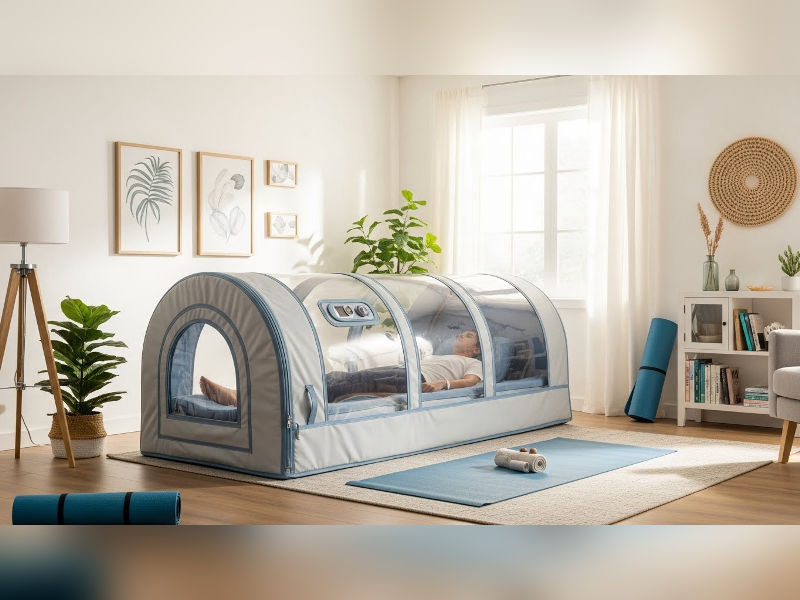
A mild hyperbaric chamber is a soft-shell device operating at 1.3 ATA, the lowest pressure commonly used in commercial HBOT equipment. The term “mild” is literal: these chambers produce modest pressure and modest oxygen elevation. They are FDA-cleared Class II devices, but cleared only for acute mountain sickness, so every other use is off-label. That does not make them useless. It sets the honest boundary for what the research supports.
What does 1.3 ATA actually deliver?
At 1.3 ATA with ambient air (about 21% oxygen), the partial pressure of oxygen in the lungs reaches roughly 0.27 ATA. Breathing supplemental oxygen by mask at sea level achieves approximately the same increase in dissolved oxygen without any pressurization at all, per Burman’s review of low-pressure fabric chambers.1 Adding a concentrator that supplies 90 to 95% oxygen by mask improves the dose, but it still falls well below the 2.0 ATA and 100% oxygen used for any UHMS-approved indication.1 For how 1.3 ATA results compare with clinical pressures, see our mild vs clinical HBOT comparison.
| Pressure | O₂ Partial Pressure (100% O₂) | Significance |
|---|---|---|
| 1.3 ATA (mild) | 1.3 ATA | Altitude sickness clearance only; below the clinical standard |
| 1.4 ATA | 1.4 ATA | Roughly half the tissue oxygen delivery of 2.0 ATA in Sack et al |
| 1.5 ATA | 1.5 ATA | Level with the strongest mTBI RCT evidence (Harch, Boussi-Gross) |
| 2.0 ATA | 2.0 ATA | Standard clinical pressure; most UHMS indications |
Does a mild hyperbaric chamber work?
For altitude sickness, yes, and that is the only cleared use. For anything else, the evidence at 1.3 ATA is limited to small studies without control groups, and the strongest signals in the research come from higher pressures. The single most useful analysis is the 2022 Harch systematic review of HBOT for mild traumatic brain injury (mTBI) and persistent post-concussion syndrome, which separated results by dose.
Harch found mixed results for 1.3 ATA with ambient air: one positive study and one negative. By contrast, 1.5 ATA with 100% oxygen produced multiple positive randomized trials that met Level 1 evidence criteria. The review concluded that “increased pressure within a narrow range appears to be the more important effect than increased oxygen, which is effective over a broad range.”2 In other words, the step up from 1.3 to 1.5 ATA appears to matter more than most home-chamber marketing suggests.
The Boussi-Gross 2013 trial in PLOS ONE shows what a higher mild pressure can do. In a prospective randomized crossover trial of 56 mTBI patients 1 to 5 years after injury, 40 sessions of HBOT at 1.5 ATA on 100% oxygen improved cognitive function and quality of life versus a control period.3 That is the closest comparator for what “real” mild HBOT pressure achieves, and it sits above the 1.3 ATA ceiling of standard soft chambers.
The positive signals reported at 1.3 ATA itself come from uncontrolled work. A 2011 study of 15 healthy volunteers found that sessions at 1.3 ATA with ambient air reduced an oxidative-stress marker by 11% (p = 0.006) and lowered white blood cell count, but it included no comparison group and measured no clinical endpoint.4 Small uncontrolled studies like this generate hypotheses. They do not establish that 1.3 ATA treats any specific condition.
Is a mild hyperbaric chamber safe?
The safety profile at 1.3 ATA is favorable, which is the strongest practical argument for these chambers. A 2023 prospective cohort of 175 patients treated at 1.45 ATA reported only minor adverse events and zero cases of objective barotrauma across the study.5 Adverse-event rates at these low pressures are lower than at the 2.0 ATA and higher used in clinical HBOT, where ear and sinus barotrauma are more common. The main risk at 1.3 ATA is ear barotrauma from improper equalization, which is manageable with slow pressurization and proper technique.
Is a mild hyperbaric chamber worth it for home use?
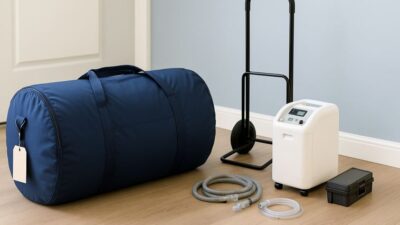
For the right buyer, yes. Mild chambers offer real practical advantages even with the clinical limits. They are portable and foldable, typically under 100 lbs, and require no oxygen-supply infrastructure beyond a standard electrical outlet and an air compressor. Entry-level FDA-cleared models start at roughly $4,000 to $4,500 (Newtowne C4-27, Summit to Sea Shallow Dive).
For athletes, biohackers, and wellness users who are not targeting a specific diagnosed condition, a mild chamber offers accessible hyperbaric exposure with a favorable safety profile. Buyers who want to treat a diagnosed condition should weigh the Harch and Boussi-Gross evidence and consider whether a higher-pressure chamber is the better fit. For a full comparison of home options at different pressures, see the home hyperbaric chamber buying guide, and for the pressure trade-off see hard shell vs soft shell. For a documented look at the clinical data by pressure, see soft vs hard chamber clinical data.
Which mild chamber brands are FDA-cleared?
Only three brands hold FDA 510(k) clearance for mild soft chambers: OxyHealth, Summit to Sea, and Newtowne Hyperbarics. All operate at 1.3 ATA maximum. For higher-pressure home chambers at 1.5 ATA, OxyRevo and Zeugma offer CE-certified options that are not FDA-cleared and sit at higher prices. If you want a genuine step up in pressure, the 1.5 ATA hyperbaric chamber is the next tier.
Is a mild hyperbaric chamber the same as clinical HBOT?
No. Clinical HBOT uses 2.0 to 3.0 ATA with 100% medical-grade oxygen, while mild chambers use 1.3 ATA with ambient air. The UHMS does not classify mild chamber sessions as HBOT, and per SAUHMA (Burman 2019) exposure below 2.0 ATA on air does not meet the definition of therapeutic hyperbaric oxygen therapy.1
What conditions is a mild chamber cleared for?
Acute mountain sickness only. All other uses, including recovery, brain health, and inflammation, are off-label. The FDA 510(k) clearance held by OxyHealth, Summit to Sea, and Newtowne covers acute mountain sickness at 1.3 ATA, and no mild chamber is cleared for any other indication.
Is 1.3 ATA safe for regular home use?
Yes. The safety profile at 1.3 ATA is favorable, and adverse-event rates are lower than at higher clinical pressures. A 2023 cohort of 175 patients at 1.45 ATA reported only minor events and zero objective barotrauma.5 The main risk is ear barotrauma from improper equalization, which slow pressurization and proper technique largely prevent.
Sources
- Burman F. Low-pressure fabric hyperbaric chambers (SAUHMA position statement). S Afr Med J. 2019;109(4). PMID: 31084683. doi:10.7196/SAMJ.2019.v109i4.13524
- Harch PG. Systematic review and dosage analysis: hyperbaric oxygen therapy efficacy in mild traumatic brain injury persistent postconcussion syndrome. Front Neurol. 2022;13:815056. doi:10.3389/fneur.2022.815056
- Boussi-Gross R, et al. Hyperbaric oxygen therapy can improve post concussion syndrome years after mild traumatic brain injury: randomized prospective trial. PLoS One. 2013;8(11):e79995. PMID: 24260334. doi:10.1371/journal.pone.0079995
- Kim S, et al. The effect of mild-pressure hyperbaric therapy (Oasis O2) on fatigue and oxidative stress. Health. 2011;3(7):432-436. doi:10.4236/health.2011.37071 (uncontrolled study, n = 15)
- Monge G, et al. Safety of hyperbaric oxygenation treatment and evaluation of associated clinical parameters: a single-institutional prospective cohort study. Int J Transl Med Res Public Health. 2023. doi:10.21106/ijtmrph.430
- Sack RA, et al. Transcutaneous oximetry values in chronic ulcer patients during hyperbaric treatment at 1.4 ATA compared to 2 ATA. Undersea Hyperb Med. 2024 (First Quarter). PMID: 38615347
Medical Disclaimer
The content on BaricBoost.com is for informational purposes only and is not intended as a substitute for professional medical advice, diagnosis, or treatment. Always seek the advice of your physician or other qualified health provider with any questions you may have regarding a medical condition. Never disregard professional medical advice or delay in seeking it because of something you have read on this website.

Author
Seph Fontane Pennock is the founder of BaricBoost.com and Regenerated.com, a clinic directory for regenerative medicine serving 10,000+ providers across the United States. He previously built and sold PositivePsychology.com, which grew to 19 million users and became the largest evidence-based positive psychology resource on the web. Seph brings direct experience as an HBOT patient, having completed protocols at clinics across three continents while navigating mold illness, systemic inflammation, and autoimmune conditions. His treatment journey includes hyperbaric oxygen therapy, peptide protocols, NAD+ therapy, and consultations with specialists from Dubai to Cape Town to Mexico. This combination of entrepreneurial track record and lived patient experience shapes everything published on BaricBoost.com. Every article is grounded in peer-reviewed research, informed by real clinical encounters, and written for patients making high-stakes treatment decisions. Seph's focus is on bringing transparency, scientific rigor, and practical guidance to the hyperbaric oxygen therapy space.
Why Trust Our Evaluations
Our rankings are based on hands-on testing, published clinical data, and verified manufacturer specifications. We apply the same criteria to every product regardless of affiliate status. Editorial Process · Evaluation Methodology