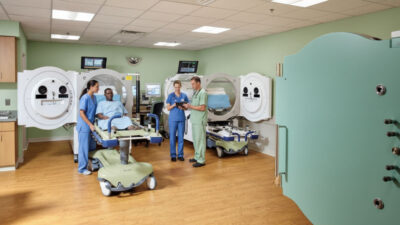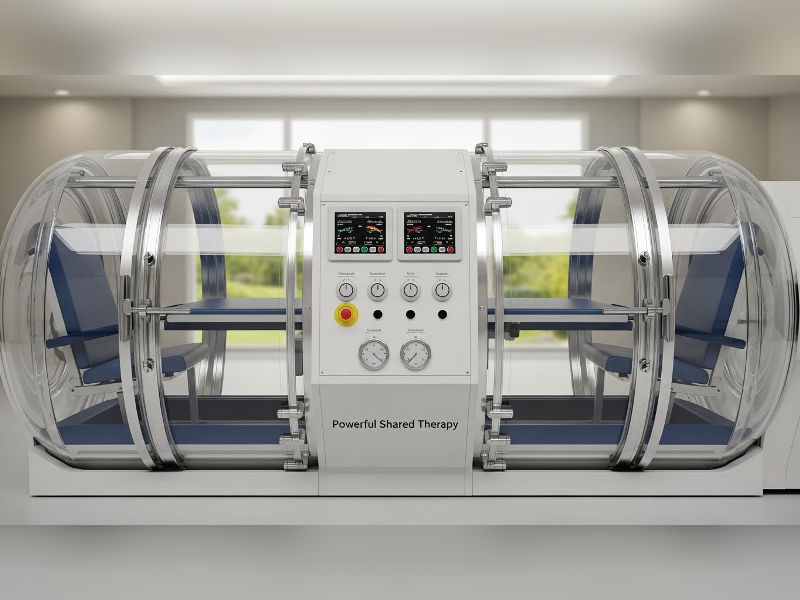
A 2 person hyperbaric chamber is a pressurized enclosure large enough for two people to complete hyperbaric sessions at the same time. Soft shell models run at 1.3 ATA and cost about $9,900 to $22,000, with premium two-user models reaching $36,000. Hard shell dual-capacity units reach 1.5 to 2.0 ATA and typically cost $26,500 to $46,000.
The meter grades what a soft 1.3 ATA dual chamber is actually cleared and evidenced to do. Sharing the chamber does not change any of it. The 14 recognized clinical indications are treated at higher pressures with 100% oxygen in medical chambers, not soft home units.
What a 2 person hyperbaric chamber is
A 2 person chamber lets two users complete sessions at once, useful for couples, parent-child use, or clinics serving higher patient volumes. The clinical value is the same as single-person use at the same pressure. The capacity difference affects cost efficiency and convenience, not the physiology of oxygen delivery.
The oxygen delivery physics are identical to single-person chambers at the same pressure. At 1.3 ATA breathing ambient air, both users receive roughly the same modest rise in arterial oxygen (on the order of 230 mmHg), far below clinical HBOT’s roughly 1,800 mmHg at 2.4 ATA with 100% oxygen. As the SAUHMA position on low-pressure fabric chambers notes, mild air-filled chambers deliver little more oxygen than breathing supplemental oxygen at sea level.1 Sharing the chamber changes none of the treatment parameters for either user. If you are still deciding between chamber categories, the best home hyperbaric chamber guide covers the full market, single and dual occupancy.
- Both users: ~230 mmHg arterial O2
- FDA-cleared for acute mountain sickness
- Portable, home use
- Shared session = cost efficiency
- ~1,800 mmHg arterial O2 at 2.4 ATA
- Clinical staff can attend inside
- 14 UHMS-approved indications
- Hospital/clinic setting required
Who a 2 person chamber is for
Dual-occupancy chambers serve specific use cases where sharing a session adds practical value:
- Parent and child: Children undergoing HBOT for conditions like cerebral palsy, autism research protocols, or post-concussion recovery often tolerate sessions better with a parent present. A 2 person chamber makes this possible without the cost and complexity of a multiplace clinical chamber. Review the extra precautions in our guide to a hyperbaric chamber for children first.
- Couples pursuing concurrent treatment: Partners with complementary goals (injury recovery, general wellness, or shared long COVID symptoms) can complete sessions together, cutting total daily time commitment roughly in half.
- Small clinics optimizing throughput: A single 2 person chamber effectively doubles patient capacity per hour versus a monoplace unit, at a fraction of the cost of adding a second chamber. For clinics running 8 to 10 sessions per day, that advantage is significant.
- Home users with two family members who both benefit: If two household members use HBOT regularly, one dual chamber at $10,000 to $22,000 costs less than two mid-range individual chambers and takes up less floor space.
If only one person will ever use the chamber, buy a single-occupancy model instead. You get a smaller footprint, a cheaper compressor, and faster pressurization for the same money.
2 person hyperbaric chamber models compared
These are the main dual-capacity models sold in the US market as of mid-2026. Prices are ranges pulled from manufacturer and authorized dealer listings. Exact quotes vary with accessories, compressors, and freight.
| Model | Type | Max pressure | Interior size | Weight capacity | Price range |
|---|---|---|---|---|---|
| Newtowne C4-40 | Soft shell | 1.3 ATA | 40 in x 108 in | Not published | $9,900 to $11,000 |
| Summit to Sea Grand Dive | Soft shell | 1.3 ATA | 40 in diameter | Not published | $12,000 to $14,000 |
| Summit to Sea Grand Dive Pro Plus | Soft shell | 1.3 ATA | 60 in x 103 in | Wheelchair rated; limit not published | $19,000 to $22,000 |
| OxyNova 9 | Soft shell | 1.3 ATA | 36 in x 108 in | Not published | $33,000 to $36,000 |
| OxyHealth Fortius 420 | Rigid portable | Rated to 3.0 ATA (run lower at home) | 42 in diameter | Not published | $25,000 to $30,000, quote based |
| Macy-Pan ST2200 and sitting series | Soft or hard sitting | 1.3 to 1.5 ATA soft; 1.5 to 1.8 ATA hard | Two-seat cabin | Not published | $9,000 to $15,000 soft; from $26,500 hard |
| OxyRevo Space60 | Hard shell sitting | 1.5 to 2.0 ATA | 79 x 34 x 60 in | One adult chair; adult plus child configurations via dealers | $43,000 to $46,000 |
A few notes on the table. The Newtowne C4-40 is the value pick: a 40 inch, 1.3 ATA chamber with a 120 liter per minute compressor at around $10,000. The Summit to Sea Grand Dive Pro Plus is the space pick: at 60 inches in diameter and 103 inches long it fits two seated adults or a wheelchair, and Summit to Sea lists it from about $21,495 with dealers around $19,995. The OxyNova 9 is a Canadian-built premium inflatable rated for two users such as a parent and child, listed around $35,950. OxyHealth sells the Fortius 420 through quotes only; dealers commonly cite $25,000 to $30,000 for new units. The OxyRevo Space60 is a hard sitting chamber that reaches 2.0 ATA; the manufacturer specs it for one adult in a reclining chair, and some dealers configure it for an adult with a child, so treat its two-person use as conditional.
The bottom line on capacity: a 2-person chamber delivers the same oxygen therapy to each user as a single-person chamber at the same pressure. The benefit is cost efficiency and the ability to complete sessions together, not better clinical outcomes.
How much space does a 2 person hyperbaric chamber need?
A 40 inch diameter chamber requires approximately 5 x 10 feet of floor space. A 60 inch diameter chamber requires 6 x 10 feet or more. Ceiling height is not typically a constraint at standard 8 foot ceilings. Add another 2 to 3 feet of clearance for the compressor and oxygen concentrators, which should sit outside the chamber footprint where the air intake stays cool.
Check three things before ordering. First, the delivery path: a rolled soft chamber fits through a standard door, but rigid units like the Fortius 420 weigh over 1,000 pounds and may need ground floor placement and a wide entry. Second, power: most home chambers run on a standard 120V 15 amp outlet, but two concentrators plus a compressor on one circuit can trip a breaker, so plan a second circuit. Third, compressor output: dual chambers need compressors rated at 110 to 160 liters per minute, versus 70 to 90 LPM for single-person units. Pressurization time also increases with volume, typically adding 3 to 5 minutes to reach target pressure.
Comfort is the most underestimated factor. A 40 inch diameter chamber fits two adults, but not comfortably for 60 to 90 minute sessions. The 54 to 60 inch models provide adequate space for two adults to sit or recline without physical contact. Before purchasing, test the chamber with both intended users inside at pressure for at least 30 minutes.
Should you buy a soft or hard shell 2 person chamber?
The tradeoff is the same one that applies to single chambers, amplified by price. Soft shell dual chambers top out at 1.3 ATA, roll up for storage, and cost $9,900 to $36,000. Hard shell dual-capacity units reach 1.5 to 2.0 ATA, hold pressure with rigid walls and real doors, and cost $26,500 to $46,000. The full comparison lives in the hard shell vs soft shell guide.
Pressure is the deciding question. If your protocol calls for 2.0 ATA, no soft chamber will get you there regardless of size, and the options narrow to sitting hard shells like the Space60 and Macy-Pan hard series. The 2.0 ATA chamber guide covers what that pressure tier actually requires. For any clinical indication treated at 2.0+ ATA with 100% oxygen, the correct setting is a hospital or clinic multiplace chamber, which starts around $500,000 and includes inside attendant capability. Consumer dual chambers are wellness equipment, not a substitute.
One honest note on regulatory status. Soft shell chambers are FDA-cleared as Class II devices for one indication: acute mountain sickness.2 Marketing that implies clearance for recovery, autism, longevity, or anything else overstates the record. People buy them for those uses anyway, which is legal off-label use of a cleared device, but you should know that is what you are doing. The recognized clinical indication list (14 conditions) is maintained by the Undersea and Hyperbaric Medical Society and applies to medical chambers running higher pressures with 100% oxygen.3
Running costs
Purchase price is most of the lifetime cost, but not all of it. Budget for these:
- Electricity: A dual-chamber compressor plus two 10 LPM oxygen concentrators draws roughly 1.5 to 2 kW while running. At average US rates that works out to about $0.30 to $0.60 per 90 minute session, or $10 to $20 per month with daily use.
- Oxygen concentrators: Two users need two concentrators and two mask setups. If they are not bundled, add $1,000 to $2,500 per concentrator.
- Maintenance: Compressor intake filters every 3 to 6 months, mask and tubing replacement, and zipper or valve service on soft chambers. Plan $100 to $300 per year.
- Warranty differences: Newtowne and Summit to Sea typically include 2 to 3 year warranties; OxyHealth runs 5 years on some models. On a $20,000+ purchase the warranty term matters.
Two people sharing one chamber is where the math gets favorable. A clinic session for one person costs $150 to $600. Two people doing 40 shared home sessions each amortize a $12,000 chamber in under a year compared to clinic pricing. Full numbers across every category are in the hyperbaric chamber cost guide.
Safety considerations
Two occupants change the safety picture in specific ways:
- CO2 buildup is faster with two people breathing. Chambers with built-in CO2 scrubbers or adequate ventilation flow handle this automatically. For chambers without active CO2 management, session duration may need limiting or the valve system monitored more carefully. Confirm the ventilation spec is rated for two occupants, not one.
- Both users need medical screening. Untreated pneumothorax is an absolute contraindication. Certain lung conditions, recent ear surgery, and some medications require physician review before any session.
- Ear equalization matters for both occupants, especially children, who may need coaching to clear their ears during compression. Descend slowly and stop if either person cannot equalize.
- Fire discipline applies to both users: no electronics with lithium batteries, no petroleum-based lotions or hair products, cotton clothing preferred, especially when supplemental oxygen is flowing.
- Never exceed the rated pressure, and never modify valves or compressors to push a 1.3 ATA chamber higher.
Mild chambers have a strong safety record when used as directed. The realistic risks, ear barotrauma first among them, are covered in the hyperbaric chamber side effects guide.
FAQ
Does a 2 person chamber deliver better treatment than a 1 person chamber?
No. The treatment parameters are identical at the same pressure, and both users receive the same physiological exposure whether one or two people are inside. The benefit is time efficiency, shared cost, and the ability to complete sessions together, none of which changes oxygen delivery to either occupant.
Can a parent and child use a 2 person chamber together?
Yes, this is one of the most common use cases, and models like the OxyNova 9 and Grand Dive Pro Plus are marketed for it. Confirm the chamber length accommodates both heights, screen the child for contraindications, and coach ear equalization carefully, since children have a harder time clearing their ears.
How much does a 2 person hyperbaric chamber cost?
Expect $9,900 to $22,000 for mainstream soft shell models at 1.3 ATA, $25,000 to $36,000 for premium two-user models from OxyHealth and OxyNova, and $26,500 to $46,000 for hard shell dual-capacity units reaching 1.5 to 2.0 ATA. Add $2,000 to $5,000 for a second concentrator, accessories, and freight if not bundled.
What size chamber do two adults actually need?
A 40 inch internal diameter is the workable minimum, and a 54 to 60 inch diameter is what two adults need for comfortable 60 to 90 minute sessions. At 60 inches, chambers like the Grand Dive Pro Plus allow two seated adults or a wheelchair user plus companion. Test with both users inside before committing.
Sources
- Burman F. Low-pressure fabric hyperbaric chambers. S Afr Med J. 2019;109(4):12574. PMID: 31084683
- US Food and Drug Administration. Follow Instructions for Safe Use of Hyperbaric Oxygen Therapy Devices: Letter to Health Care Providers. fda.gov
- Undersea and Hyperbaric Medical Society. UHMS-approved indications for hyperbaric oxygen therapy. uhms.org
- Summit to Sea. Grand Dive and Grand Dive Pro Plus hyperbaric chambers. summit-to-sea.com
- Newtowne Hyperbarics. C4-40 dual hyperbaric chamber. newtownehyperbarics.com
- OxyHealth. Fortius 420 hyperbaric chamber. oxyhealth.com
- OxyRevo. Space60 hard shell hyperbaric chamber. oxyrevo.com
- Macy-Pan. Hyperbaric chamber product line. macypan.com
Medical Disclaimer
The content on BaricBoost.com is for informational purposes only and is not intended as a substitute for professional medical advice, diagnosis, or treatment. Always seek the advice of your physician or other qualified health provider with any questions you may have regarding a medical condition. Never disregard professional medical advice or delay in seeking it because of something you have read on this website.

Author
Seph Fontane Pennock is the founder of BaricBoost.com and Regenerated.com, a clinic directory for regenerative medicine serving 10,000+ providers across the United States. He previously built and sold PositivePsychology.com, which grew to 19 million users and became the largest evidence-based positive psychology resource on the web. Seph brings direct experience as an HBOT patient, having completed protocols at clinics across three continents while navigating mold illness, systemic inflammation, and autoimmune conditions. His treatment journey includes hyperbaric oxygen therapy, peptide protocols, NAD+ therapy, and consultations with specialists from Dubai to Cape Town to Mexico. This combination of entrepreneurial track record and lived patient experience shapes everything published on BaricBoost.com. Every article is grounded in peer-reviewed research, informed by real clinical encounters, and written for patients making high-stakes treatment decisions. Seph's focus is on bringing transparency, scientific rigor, and practical guidance to the hyperbaric oxygen therapy space.