Affiliate Disclosure
This article contains affiliate links. If you purchase through these links, we may earn a commission at no additional cost to you. This does not influence our evaluations or rankings.
Across seven randomized trials pooled in the 2012 Cochrane review, hyperbaric oxygen therapy cut traumatic brain injury mortality by 31% (relative risk 0.69), a number needed to treat of 7.3 HBOT raises oxygen delivery to damaged brain tissue by 10 to 15 times normal levels, and a 2025 double-blind randomized trial1 confirmed measurable neurobehavioral gains even in patients years past injury. It is one of several brain and neurological conditions where the HBOT evidence is now substantial rather than speculative.
How Does a Hyperbaric Chamber Help Brain Injury?
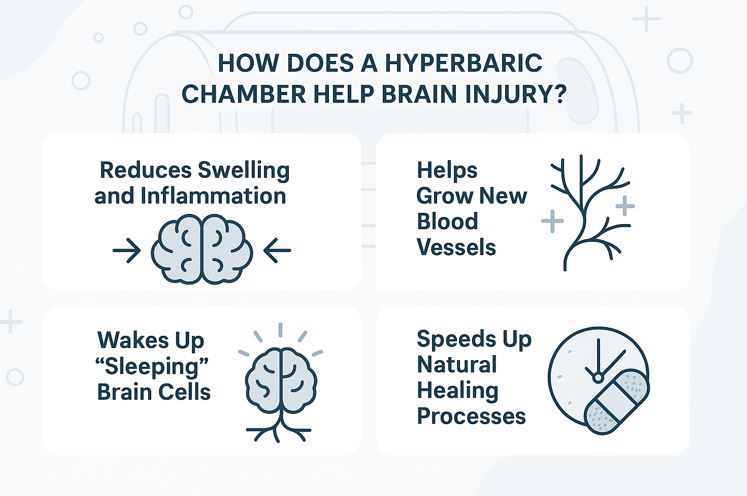
After a brain injury, some tissue is destroyed outright, but a surrounding zone of cells is starved of oxygen without being dead. During a session, you breathe 100% oxygen at 1.5 to 2.0 ATA, and the elevated pressure forces oxygen deep into blood plasma and brain tissue, reaching areas where damaged vessels have cut off normal supply.3
The extra oxygen reduces swelling and inflammation around injured areas, supports new blood vessel growth, and can reactivate cells that are dormant but not dead. Researchers call this zone the ischemic penumbra, cells in a suspended state that respond to renewed oxygen delivery.4 The response is gradual, accumulating over weeks of sessions rather than appearing at once.
What Does the Research Say About HBOT for TBI?
The clinical evidence is stronger than for most off-label HBOT uses. In the largest double-blind trial to date, Weaver and colleagues found HBOT patients improved their neurobehavioral symptom scores nearly three times more than those receiving sham treatment (10.6 vs 3.6 points, p=0.01).1
The 2012 Cochrane review pooled 7 randomized trials with 571 patients and found HBOT reduced TBI mortality by 31% (RR 0.69, 95% CI 0.54 to 0.88, p=0.003), with a number needed to treat of 7.3 A 2016 meta-analysis of 8 prospective studies confirmed a pooled Glasgow Coma Scale improvement of 3.13 points (95% CI 2.34 to 3.92, p<0.001).4
A 2025 randomized controlled trial in moderate TBI added to this picture. After 10 daily sessions at 1.4 ATA, the HBOT group scored 14.37 vs 13.40 on the Glasgow Coma Scale at discharge (p<0.001) and had significantly better outcomes at 3 months (GOS-E 7.62 vs 6.40, p<0.001).2 A 2025 meta-analysis tracking cognitive domains found HBOT improved memory (MD 10.13, p<0.00001), attention (MD 7.99, p<0.00001), executive function (MD 7.16, p=0.002), and processing speed (MD 7.48, p=0.01) across 4 studies and 250 patients.5
Responses are not uniform. The evidence is stronger for acute moderate-to-severe TBI than for chronic mild TBI, and pressure matters: 1.5 ATA protocols have shown benefit in published trials, while 2.0 ATA protocols in military populations did not outperform sham. For a fuller survey, see our HBOT research overview and the Efrati versus Harch protocol comparison.
What Does HBOT Treatment for Brain Injury Involve?
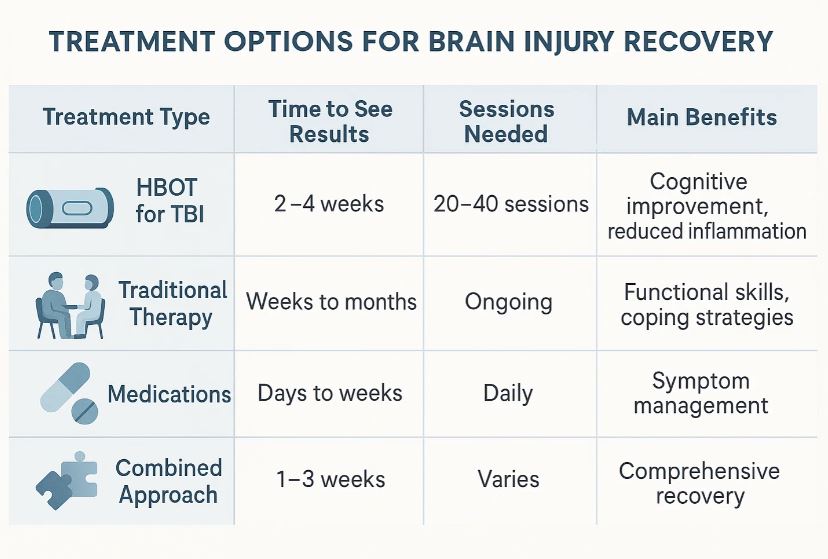
Treatment starts with a full medical evaluation and baseline cognitive testing, plus medical clearance to confirm HBOT is safe for you. Most protocols run 60 to 90 minute sessions, five days per week, for a total of about 40 sessions. Chamber pressure typically sits between 1.5 and 2.0 ATA. The 1.5 ATA range has consistently shown benefit in published TBI trials, including the Weaver 2025 study, while the Efrati group uses 2.0 ATA for cognitive protocols.17
During each session you lie in a hard chamber and breathe normally while the oxygen does its work. Your ears may pop like on an airplane as pressure changes. Most patients report no pain or discomfort and rest, listen to music, or sleep.
What Improvements Do TBI Patients Report After HBOT?
Patients most often report clearer thinking and memory, with less of the brain fog that follows injury, along with better concentration and faster mental processing. The 2025 Shahid meta-analysis documented significant improvement across all major cognitive domains (memory, attention, executive function, and processing speed) in 250 TBI patients.5
Physical symptoms often improve alongside cognition. Headaches can become less frequent, sleep tends to improve, and some patients notice better balance and more stable mood. These are reported outcomes and vary with injury severity, time since injury, and overall health.
Treatment Comparison by TBI Type
| TBI type | Evidence level | Best available study | Key finding |
|---|---|---|---|
| Acute severe TBI | Moderate-Strong | Bennett, Cochrane 2012 | Mortality benefit (NNT=7) |
| Acute moderate TBI | Strong | Chaturvedi 2025 | GCS +1 at discharge, better 3-month outcomes (p<0.001) |
| Chronic mild TBI / PCS | Mixed | Weaver 2025 / Harch 2020 | Positive at 1.5 ATA |
| Military PCS | Weak-Null | Walker 2014 | No benefit over sham at 2.0 ATA |
| Pediatric PCS | Moderate | Hadanny 2022 | Significant cognitive and behavioral gains (sham-controlled) |
Does Insurance Cover HBOT for Brain Injury?
Most insurance plans do not cover HBOT for brain injury because they classify it as off-label. Clinical sessions typically cost $200 to $300 each, and a full course runs $6,000 to $18,000. Home chambers range from $15,000 to over $100,000, but soft chambers do not deliver medical-grade therapeutic pressure and no published TBI research has validated home use.
Veterans may have coverage through VA benefits, and workers’ compensation sometimes covers injuries that happened at work. Get written pre-authorization before starting, and expect to pay out of pocket for most or all of the cost. Our guides to HBOT insurance coverage and HBOT session costs break down the numbers.
What Are the Side Effects and Risks?
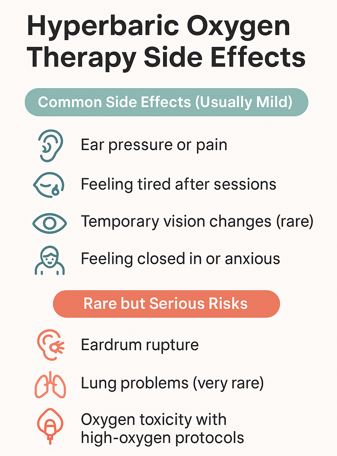
HBOT is among the safer medical procedures, but it carries real risks. The Cochrane review found pulmonary impairment in 13% of HBOT patients versus 0% in controls, so supervision matters.3 Most side effects are minor and temporary: ear pressure similar to flying, transient and reversible vision changes, and post-session fatigue. Some people feel claustrophobic in the enclosed chamber.
Serious risks are rare. People with lung disease can develop a collapsed lung, seizure disorders can raise seizure risk, and the oxygen-rich environment makes fire safety protocols essential in hard chambers. The only absolute contraindication is an untreated collapsed lung. Recent ear surgery, certain lung diseases, active upper respiratory infections, and some medications also require review before starting.
Frequently Asked Questions
Can HBOT help old brain injuries?
Yes. The Boussi-Gross 2013 trial enrolled patients 1 to 5 years post-injury and found significant cognitive improvements that correlated with increased brain activity on SPECT imaging.9 The brain retains neuroplasticity long after the initial injury, which is why chronic cases can still respond.
How long do the benefits last?
Improvements can persist for months after sessions end. The Harch 2020 trial found gains that held at least 2 months post-treatment.10 Some patients do periodic maintenance sessions, though there is no standardized maintenance protocol.
Can I combine HBOT with other therapies?
Yes, and the best evidence uses it that way. The Chaturvedi 2025 trial applied HBOT as an adjunct to standard care, not a replacement.2 It is commonly combined with physical therapy, occupational therapy, and counseling. See our overview of HBOT alternatives and complementary options.
Is it safe for children with TBI?
HBOT has been studied in children. A 2022 sham-controlled trial by Hadanny and colleagues found significant cognitive and behavioral improvements in children aged 8 to 15 with post-concussion syndrome.6 Pediatric brain injury specialists should be involved in any decision.
Who Should Not Try HBOT
HBOT is generally safe under trained supervision, but it is not appropriate for everyone. The absolute contraindications are untreated pneumothorax (a collapsed lung, which pressure changes can make life-threatening) and certain drugs (bleomycin, cisplatin, doxorubicin, disulfiram). Relative contraindications, where a provider may modify or postpone treatment, include upper respiratory infection or sinus congestion, seizure disorder, COPD, high fever, prior ear surgery or chronic ear problems, claustrophobia, and pregnancy. Always review your full history, including insulin use and implanted devices, before starting. Our HBOT side effects and risks guide covers this in detail.
Sources
- Weaver LK, Ziemnik R, Deru K, Russo AA. A double-blind randomized trial of hyperbaric oxygen for persistent symptoms after brain injury. Scientific Reports. 2025;15. DOI: 10.1038/s41598-025-86631-6. PMID: 40011516.
- Chaturvedi J, Mago V, Gupta M, et al. Hyperbaric oxygen therapy in moderate traumatic brain injury: a randomized controlled trial. Asian Journal of Neurosurgery. 2025. DOI: 10.1055/s-0044-1791997. PMID: 40041595.
- Bennett MH, Trytko BE, Jonker B. Hyperbaric oxygen therapy for the adjunctive treatment of traumatic brain injury. Cochrane Database Syst Rev. 2012;12:CD004609. DOI: 10.1002/14651858.CD004609.pub3.
- Wang F, Wang Y, Sun T, Yu HL. Hyperbaric oxygen therapy for the treatment of traumatic brain injury: a meta-analysis. Neurological Sciences. 2016;37:693-701. DOI: 10.1007/s10072-015-2460-2.
- Shahid S, et al. Hyperbaric oxygen therapy for neurocognitive deficits following traumatic brain injury: a systematic review and meta-analysis. Annals of Medicine and Surgery. 2025. DOI: 10.1097/MS9.0000000000003902. PMID: 41180753.
- Hadanny A, Catalogna M, Yaniv S, et al. Hyperbaric oxygen therapy in children with post-concussion syndrome. Scientific Reports. 2022;12:15233. DOI: 10.1038/s41598-022-19395-y.
- Raj S, et al. Role of hyperbaric oxygen therapy in traumatic brain injury: a systematic review of randomized controlled trials. Indian Journal of Neurotrauma. 2024. DOI: 10.1055/s-0044-1782609.
- Biggs AT, Dainer HM, Littlejohn LF. Effect sizes for symptomatic and cognitive improvements in traumatic brain injury following hyperbaric oxygen therapy. J Appl Physiol. 2021;130(5):1594-1603. DOI: 10.1152/japplphysiol.01084.2020.
- Boussi-Gross R, Golan H, Fishlev G, et al. Hyperbaric oxygen therapy can improve post concussion syndrome years after mild traumatic brain injury: randomized prospective trial. PLoS ONE. 2013;8(11):e79995. DOI: 10.1371/journal.pone.0079995.
- Harch PG, Andrews SR, Rowe CJ, et al. Hyperbaric oxygen therapy for mild traumatic brain injury persistent postconcussion syndrome: a randomized controlled trial. Medical Gas Research. 2020;10(1):8-20. DOI: 10.4103/2045-9912.279978.
- Walker WC, Franke LM, Cifu DX, Hart BB. Randomized, sham-controlled, feasibility trial of hyperbaric oxygen for service members with postconcussion syndrome. Neurorehabilitation and Neural Repair. 2014;28(9):850-861. DOI: 10.1177/1545968313516869.
Medical Disclaimer
The content on BaricBoost.com is for informational purposes only and is not intended as a substitute for professional medical advice, diagnosis, or treatment. Always seek the advice of your physician or other qualified health provider with any questions you may have regarding a medical condition. Never disregard professional medical advice or delay in seeking it because of something you have read on this website.

Author
Seph Fontane Pennock is the founder of BaricBoost.com and Regenerated.com, a clinic directory for regenerative medicine serving 10,000+ providers across the United States. He previously built and sold PositivePsychology.com, which grew to 19 million users and became the largest evidence-based positive psychology resource on the web. Seph brings direct experience as an HBOT patient, having completed protocols at clinics across three continents while navigating mold illness, systemic inflammation, and autoimmune conditions. His treatment journey includes hyperbaric oxygen therapy, peptide protocols, NAD+ therapy, and consultations with specialists from Dubai to Cape Town to Mexico. This combination of entrepreneurial track record and lived patient experience shapes everything published on BaricBoost.com. Every article is grounded in peer-reviewed research, informed by real clinical encounters, and written for patients making high-stakes treatment decisions. Seph's focus is on bringing transparency, scientific rigor, and practical guidance to the hyperbaric oxygen therapy space.
Why Trust Our Evaluations
Our rankings are based on hands-on testing, published clinical data, and verified manufacturer specifications. We apply the same criteria to every product regardless of affiliate status. Editorial Process · Evaluation Methodology