Affiliate Disclosure
This article contains affiliate links. If you purchase through these links, we may earn a commission at no additional cost to you. This does not influence our evaluations or rankings.
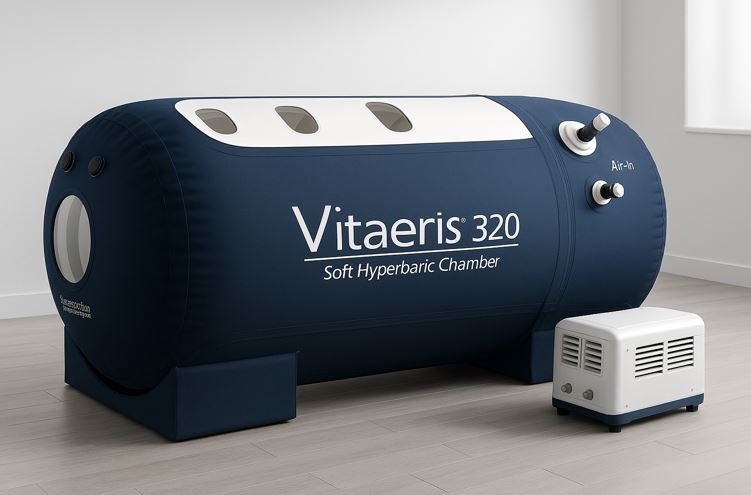
The OxyHealth Vitaeris 320 is a 1.3 ATA soft-shell hyperbaric chamber that sells for roughly $18,000 to $23,000, two to three times the price of comparable FDA-cleared units. You pay the premium for a 44 oz double-sided bladder, 0.01-micron filtration, tamper-proof redundant regulators, and a 5-year warranty, not for higher pressure. Every FDA-cleared soft chamber, this one included, tops out at 1.3 ATA.
Vitaeris 320 Full Specifications
Vitaeris 320 street price (2025-2026)
Warranty on chamber and compressor
Internal diameter (100-inch length)
OxyHealth Vitaeris 320 Specifications
| Specification | Detail |
|---|---|
| Internal diameter | 32 inches |
| Length | 100 inches |
| Maximum pressure | 1.3 ATA |
| Bladder construction | Double-sided 44 oz urethane-coated polyester |
| Compressor | 1/2 hp double-headed oil-less |
| Air filtration | Inline, 0.01 microns |
| Viewing windows | 3 patient viewing windows |
| Pressure control | Tamper-proof redundant regulators; dual valves |
| Capacity | 1-2 adults |
| Warranty | 5 years (chamber and compressor) |
| Origin | Made in USA |
| FDA status | 510(k) cleared (acute mountain sickness) |
Specifications are drawn from OxyHealth’s product documentation.1 The chamber is 510(k) cleared under the FDA hyperbaric chamber device classification, and like every soft-sided unit its cleared indication is acute mountain sickness only.2
Is the Vitaeris 320 worth the price?
For a buyer who will use it hard for years, the construction is where the money goes, not the pressure. The 44 oz double-sided bladder over a rigid internal frame is a more robust build than the fabric-only construction of lower-priced competitors, and it is the main reason the unit carries a 5-year warranty rather than the 2 years typical of the category. How it stacks up against the field is covered in our roundup of the best hyperbaric chambers for home use.
The 0.01-micron inline filtration is a specification most competitors do not publish. For users with respiratory sensitivities, or running the chamber in a less-than-clean air environment, it is a practical difference rather than a marketing line. The tamper-proof redundant regulators matter most for clinic settings where multiple operators use the same unit.
OxyHealth states its chambers are used by organizations including US Special Forces units and Olympic training programs, and that it has distributed more than 18,000 chambers since the company was founded.1 These are manufacturer-stated figures from OxyHealth’s own materials, not independently audited, so weigh them as reputation signals rather than verified performance data.
What conditions can a 1.3 ATA chamber treat?
The Vitaeris 320 operates at a maximum of 1.3 ATA, the standard ceiling for all FDA-cleared soft chambers. That ceiling defines what it can and cannot do, and it is the single most important thing to understand before buying.
- At 1.3 ATA with ambient air, arterial oxygen reaches roughly 230 mmHg.
- At clinical 2.4 ATA with 100% oxygen, arterial oxygen reaches roughly 1,824 mmHg, close to an 8x difference.3
- Oxygen only becomes bacteriostatic at the tissue levels produced above about 1.5 ATA, which a 1.3 ATA chamber cannot reach.3
- The FDA clears soft chambers for acute mountain sickness only; all other uses are off-label.2
None of this is unique to the Vitaeris. It applies to every OxyHealth model and every FDA-cleared soft chamber. If your goal is a condition with clinical evidence generated at 1.5 to 2.4 ATA, a soft chamber of any brand is the wrong tool. For the full pressure and oxygen breakdown, see hard-shell vs soft-shell chambers.
How does the Vitaeris 320 compare to the Summit to Sea Grand Dive?
The clearest value comparison is against the Summit to Sea Grand Dive, which delivers the same 1.3 ATA and the same FDA clearance at a fraction of the price. The Vitaeris costs two to three times as much and wins on build quality, filtration, and warranty. The Grand Dive wins on value and interior room.
Vitaeris 320 vs Comparable Alternatives
| Chamber | Price | Pressure | FDA Cleared | Warranty | Diameter |
|---|---|---|---|---|---|
| OxyHealth Vitaeris 320 | $18,000-$23,000 | 1.3 ATA | Yes (altitude sickness) | 5 years | 32 inches |
| Summit to Sea Grand Dive | $6,500-$8,500 | 1.3 ATA | Yes (altitude sickness) | 2 years | 40 inches |
| OxyHealth Respiro 270 | $12,000-$16,000 | 1.3 ATA | Yes (altitude sickness) | 5 years | 27 inches |
The Vitaeris costs 2 to 3 times what the Summit to Sea Grand Dive does. Both deliver 1.3 ATA with FDA clearance for altitude sickness. The Vitaeris wins on the 44 oz bladder, 0.01-micron filtration, tamper-proof regulators, and the longer warranty. The Grand Dive is the wider chamber (40 inches vs 32) and the value pick. If the deciding factor is pressure or price rather than build, the extra $10,000-plus is hard to justify.
What maintenance and warranty does the Vitaeris 320 need?
Soft chambers are low-maintenance but not maintenance-free. The compressor draws ambient air through the 0.01-micron inline filter, which is the component most owners replace on a schedule; running the unit in a dusty room shortens filter life. The bladder and zipper are the wear points that determine longevity, which is why the double-sided 44 oz construction and the 5-year warranty are the Vitaeris’s core selling points over a 2-year competitor.
Amortized over heavy use, the warranty math is the honest case for the premium. A unit used daily for years is more likely to see a bladder, zipper, or compressor issue, and OxyHealth’s 5-year coverage on both the chamber and compressor is 2.5 times the category norm. For a light user running occasional sessions, that protection is worth far less, and a cheaper unit with a 2-year warranty may be the rational buy. Full purchase and running-cost figures are in our cost to buy a hyperbaric chamber guide.
Who should and should not buy the Vitaeris 320?
The Vitaeris 320 is the right choice for:
- Clinic and wellness-center operators where institutional build quality and the 5-year warranty are justified by daily commercial use.
- High-frequency home users planning years of near-daily sessions, where construction quality pays back over time.
- Buyers who want US-made, FDA-cleared equipment and are not price-sensitive.
It is the wrong choice for:
- Budget-conscious buyers. The Summit to Sea Grand Dive delivers the same pressure and FDA clearance, with a wider interior, for $10,000 or more less.
- Anyone who needs higher pressure. The 1.3 ATA ceiling applies to the Vitaeris exactly as it does to every OxyHealth model, so it cannot reach clinical HBOT pressures at any price.
- Buyers chasing a specific medical outcome. If the condition’s evidence was generated at 1.5 to 2.4 ATA, no soft chamber reproduces it.
Sources
- OxyHealth LLC. “Vitaeris 320 product specifications.” oxyhealth.com. Accessed August 2026. (Manufacturer specifications and manufacturer-stated client figures.)
- U.S. Food and Drug Administration. “Hyperbaric Oxygen Therapy: Don’t Be Misled” and 510(k) device classification for hyperbaric chambers (product code CBF, 21 CFR 878.5650). Link
- Burman F. “Low-pressure fabric hyperbaric chambers.” South African Medical Journal. 2019;109(4):232-233. PMID: 31084683.
- Undersea and Hyperbaric Medical Society. “Hyperbaric Oxygen Therapy Indications” (approved indications list). Link
- Summit to Sea. “Grand Dive hyperbaric chamber specifications” (40-inch diameter, 1.3 ATA, 2-year warranty), retailer product documentation. Accessed August 2026.
Medical Disclaimer
The content on BaricBoost.com is for informational purposes only and is not intended as a substitute for professional medical advice, diagnosis, or treatment. Always seek the advice of your physician or other qualified health provider with any questions you may have regarding a medical condition. Never disregard professional medical advice or delay in seeking it because of something you have read on this website.

Author
Seph Fontane Pennock is the founder of BaricBoost.com and Regenerated.com, a clinic directory for regenerative medicine serving 10,000+ providers across the United States. He previously built and sold PositivePsychology.com, which grew to 19 million users and became the largest evidence-based positive psychology resource on the web. Seph brings direct experience as an HBOT patient, having completed protocols at clinics across three continents while navigating mold illness, systemic inflammation, and autoimmune conditions. His treatment journey includes hyperbaric oxygen therapy, peptide protocols, NAD+ therapy, and consultations with specialists from Dubai to Cape Town to Mexico. This combination of entrepreneurial track record and lived patient experience shapes everything published on BaricBoost.com. Every article is grounded in peer-reviewed research, informed by real clinical encounters, and written for patients making high-stakes treatment decisions. Seph's focus is on bringing transparency, scientific rigor, and practical guidance to the hyperbaric oxygen therapy space.
Why Trust Our Evaluations
Our rankings are based on hands-on testing, published clinical data, and verified manufacturer specifications. We apply the same criteria to every product regardless of affiliate status. Editorial Process · Evaluation Methodology