EBOO stands for Extracorporeal Blood Oxygenation and Ozonation, and it is the most intensive form of ozone blood therapy available. Unlike standard ozone IV treatments that process a small batch of blood, EBOO runs your blood through a continuous circuit: out one arm, through a filtration and ozonation unit, and back in through the other arm.
This guide covers how EBOO works, what the evidence says, how it compares to MAH and 10-pass ozone therapy, and what to expect in terms of cost and access.
Key Takeaways
- EBOO uses a continuous extracorporeal circuit with a dialysis-type membrane to filter and ozonate blood simultaneously.
- Sessions last 45-60 minutes and treat up to 4,800 mL of blood, far more than standard MAH (100-250 mL).
- The strongest clinical evidence comes from a controlled trial showing significant improvement in peripheral artery disease.
- Cost ranges from to ,500 per session. Very few clinics in the US offer true EBOO.
- EBOO is not FDA-approved and is considered experimental. It has a strong safety profile in published studies.
What Is EBOO?
EBOO was developed in the late 1990s by Italian nephrologist Dr. Nicola Di Paolo and ozone therapy researcher Professor Velio Bocci. The original name reflected exactly what the procedure does: blood is oxygenated and ozonated outside the body (extracorporeally) through a specialized apparatus.1
You may also see EBOO written as EBO2 or referred to as “ozone dialysis.” These terms describe the same core technology: a continuous-flow system that uses semi-permeable membranes to expose blood to ozone while simultaneously filtering it.
The procedure was originally designed for patients with severe vascular disease who were not responding to conventional treatments. Over a ten-year development period, Di Paolo’s team refined the apparatus and tested it in clinical settings before publishing their findings.1
How EBOO Works
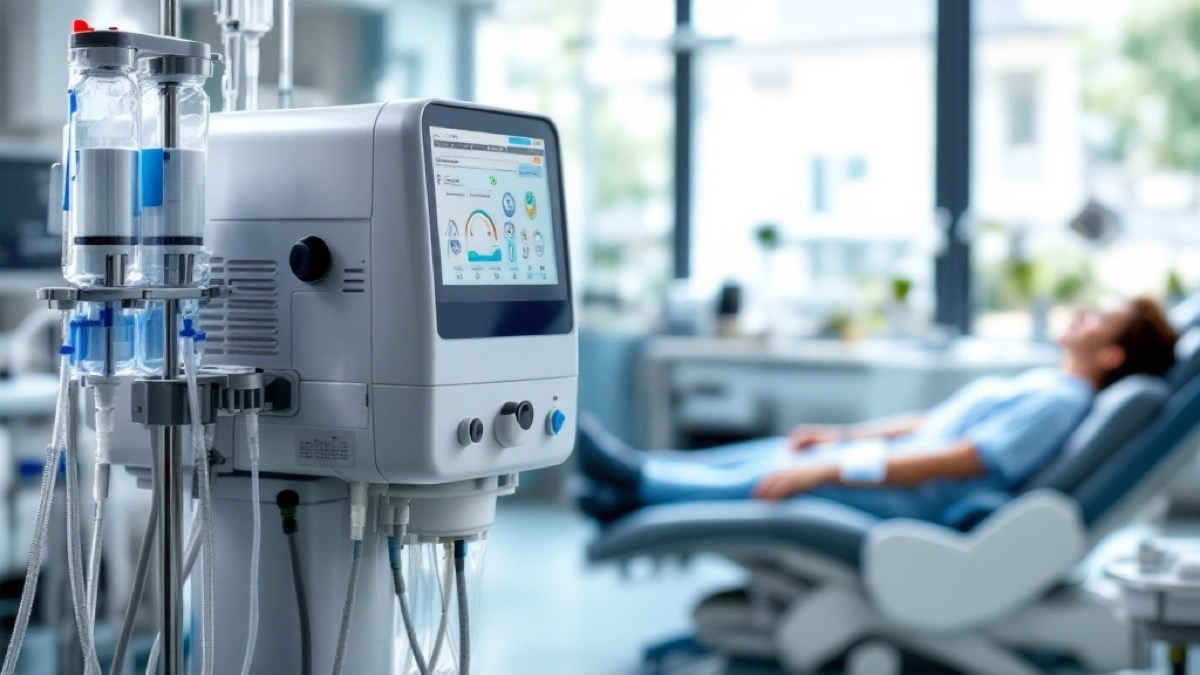
EBOO uses principles borrowed from kidney dialysis, but instead of filtering waste through a dialysis solution, it exposes blood to ozone gas through a semi-permeable membrane.
The Circuit
Two IV lines are placed: one in each arm. Blood flows out from one arm, passes through the EBOO device, and returns through the other arm. The circuit is continuous, meaning blood is constantly flowing, unlike standard MAH where a fixed batch is drawn, ozonated, and returned.
The Membrane
Inside the device, blood passes along one side of a semi-permeable polysulfone membrane. Ozone gas flows along the other side. The membrane allows ozone molecules to contact the blood without the gas entering the bloodstream directly. This is a key safety feature. Direct injection of ozone gas into a vein is dangerous. The membrane prevents that.
A newer generation of EBOO devices uses countercurrent flow, where blood and ozone move in opposite directions along the membrane. Research published in 2022 found that this countercurrent design delivers at least 3 times more ozone uptake compared to other forms of blood ozone administration.2
Filtration
One feature that sets EBOO apart from other ozone therapies is the visible filtration effect. As blood passes through the membrane unit, certain waste products and inflammatory byproducts collect in a separate waste compartment. Patients and practitioners often observe this waste layer, which ranges from pale yellow to dark brown depending on the individual.
It is worth noting that while this filtration is visually striking, the exact composition of what is being filtered and its clinical significance have not been rigorously characterized in peer-reviewed studies.
What a Session Looks Like
Here is a step-by-step walkthrough of a typical EBOO session.
1. Pre-Treatment Assessment (10 minutes)
Vital signs are taken. If it is your first session, the practitioner will review your health history, medications, and check for contraindications. A G6PD test should have been performed before your first ozone treatment of any kind.
2. IV Placement (5-10 minutes)
Two IV lines are placed, typically one in each arm. Some clinics use the antecubital veins (inside of the elbows); others use hand veins. Heparin or another anticoagulant is administered to prevent clotting in the circuit.
3. Treatment (45-60 minutes)
The EBOO device is started. Blood begins flowing through the circuit at a controlled rate. The practitioner monitors flow rate, ozone concentration, and your vitals throughout. You sit or recline during the treatment. Most patients describe the sensation as similar to donating blood: no pain, just the feeling of the IV lines.
4. Completion (5-10 minutes)
The circuit is flushed with saline to return as much blood as possible. IV lines are removed. Total time in the clinic is approximately 60-90 minutes.
EBOO vs. MAH vs. 10-Pass: How They Compare
All three are forms of ozone blood therapy, but they differ significantly in scale, equipment, and cost.
| Feature | MAH (Single-Pass) | 10-Pass | EBOO |
|---|---|---|---|
| Method | Batch (bottle/bag) | Pressurized repeat cycles | Continuous circuit + membrane |
| Blood Volume | 100-250 mL | ~2,000 mL | Up to 4,800 mL |
| Ozone Contact | Direct mixing | Direct mixing (pressurized) | Membrane-mediated |
| Filtration | None | None | Yes (semi-permeable membrane) |
| Session Duration | 30-60 min | 60-90 min | 45-60 min |
| IV Lines Required | 1 | 1 | 2 |
| Cost per Session | $200-$300 | $800-$1,500 | $900-$1,500 |
| Clinical Evidence | Moderate | Limited | Limited (1 controlled trial) |
“Over 1,200 EBOO treatments were performed in 82 patients, treating up to 4,800 mL of heparinized blood, without technical or clinical problems.”
Di Paolo et al., International Journal of Artificial Organs, 2005
What Does the Research Say?
The clinical evidence for EBOO is limited but notable. Here are the key published studies.
Peripheral Artery Disease (Controlled Trial)
The strongest evidence comes from a controlled trial by Di Paolo et al. (2005). Twenty-eight patients with peripheral artery disease were randomized to receive either EBOO or intravenous prostacyclin (a standard pharmaceutical treatment). The EBOO group showed highly significant regression of skin lesions compared to the prostacyclin group. Pain, pruritus, heaviness in the legs, and overall well-being also improved significantly.3
This study was published in the International Journal of Artificial Organs and remains the only controlled trial of EBOO against an active pharmaceutical comparator.
Preliminary Clinical Data
Di Paolo’s earlier preliminary report (2000) described the initial development and testing of the EBOO apparatus. Patients with Madelung disease and atherosclerotic vasculopathy showed clinical improvement, and the researchers concluded that EBOO was “clinically valid, without side-effects and worthy of testing in various diseases.”1
Ozone Uptake Efficiency
A 2022 study in Medical Gas Research compared ozone delivery across different blood ozone methods. The researchers found that the countercurrent membrane design used in modern EBOO/ozone dialysis devices delivered at least 3 times more ozone to the blood than comparable single-pass or multi-pass methods.2
Gaps in the Evidence
Despite promising results, the evidence base has significant limitations:
- Only one controlled trial exists (28 patients, single condition)
- No large-scale randomized controlled trials have been published
- Most published data comes from a single research group in Italy
- The filtration component has not been independently characterized
- Long-term outcome data is lacking
EBOO is not FDA-approved for any condition. It is considered experimental.
What Conditions Is EBOO Used For?
Clinics offering EBOO typically market it for conditions that involve systemic inflammation, circulatory problems, or toxic burden. Common applications include:
- Chronic infections: Lyme disease, viral reactivations (EBV, CMV), chronic sinusitis
- Vascular conditions: Peripheral artery disease, diabetic microvascular complications
- Autoimmune conditions: Rheumatoid arthritis, multiple sclerosis, lupus
- Environmental illness: Mold toxicity, chemical sensitivities
- Post-viral syndromes: Long COVID, chronic fatigue syndrome
- General detoxification: Some practitioners position EBOO as a “blood cleansing” procedure
For most of these conditions, the evidence is based on clinical observation and the broader ozone therapy literature rather than EBOO-specific studies.
Side Effects and Safety
EBOO has a strong published safety profile. Di Paolo’s group performed over 1,200 treatments across 82 patients with no reported technical or clinical problems.3
Potential side effects are similar to other ozone blood therapies:
- Bruising at IV insertion sites
- Temporary fatigue or lightheadedness
- Herxheimer-type reactions (temporary worsening of symptoms as the body processes released toxins)
- Mild nausea in some patients
The same contraindications that apply to MAH apply to EBOO: G6PD deficiency, uncontrolled hyperthyroidism, pregnancy, active hemorrhage, and severe cardiovascular instability.4
Cost and Access
EBOO sessions cost between and ,500 in the United States. Treatment plans typically involve 3-10 sessions, making the total cost ,700 to ,000.
Insurance does not cover EBOO. It is an out-of-pocket expense at all clinics.
Access is limited compared to MAH. The equipment is significantly more expensive than a standard ozone generator and IV setup, and the procedure requires more training. Fewer than 100 clinics in the US are estimated to offer genuine EBOO (with the membrane-based extracorporeal circuit), though exact numbers are difficult to verify.
Be Cautious About “EBOO” Marketing
Some clinics market high-dose MAH or 10-pass treatments as “EBOO” or “EBOO-like.” True EBOO requires a membrane-based extracorporeal circuit with two IV lines. If a clinic uses a single IV line and a glass bottle or syringe, that is MAH, not EBOO, regardless of what they call it.
Ask directly: “Does this procedure use a semi-permeable membrane and two IV lines?” If the answer is no, you are getting a different (and usually less expensive) treatment.
Who Is a Good Candidate for EBOO?
EBOO is typically recommended for patients who:
- Have already tried standard MAH and want a more intensive approach
- Are dealing with chronic, complex conditions (Lyme, mold illness, autoimmune disease)
- Have the budget for a more expensive treatment
- Are medically stable enough for the procedure (healthy veins, no contraindications)
It is not usually the first-line ozone therapy a new patient receives. Most practitioners start with MAH and escalate to EBOO or 10-pass based on treatment response.
The Bottom Line
EBOO is the most advanced form of ozone blood therapy currently available. It treats the largest volume of blood, uses membrane-based filtration, and has a clean safety record across published studies. The evidence, while limited, is encouraging.
The main drawbacks are cost, limited availability, and a thin evidence base compared to standard MAH. If you are considering EBOO, make sure the clinic uses genuine extracorporeal membrane technology and that the practitioner has specific EBOO training.
For a broader overview of all ozone treatment methods, see our complete guide to ozone therapy.
Sources
- Di Paolo N, Bocci V, Garosi G, et al. “Extracorporeal Blood Oxygenation and Ozonation (EBOO) in Man. Preliminary Report.” Int J Artif Organs. 2000;23(2):131-141. doi:10.1177/039139880002300212
- Smith NL, Wilson AL, Gandhi J, et al. “Ozone dialysis delivers three or more times the ozone than other forms of ozone blood treatment.” Med Gas Res. 2022;12(4):156-161. doi:10.4103/2045-9912.337993
- Di Paolo N, Bocci V, Salvo DP, et al. “Extracorporeal Blood Oxygenation and Ozonation (EBOO): A Controlled Trial in Patients with Peripheral Artery Disease.” Int J Artif Organs. 2005;28(10):1039-1050. doi:10.1177/039139880502801012
- Viebahn-Hansler R, Leon Fernandez OS, Fahmy Z. “The Potential Toxicity of Ozone: Side Effects and Contraindications of Ozonetherapy.” Ozone: Science & Engineering. 2012;34(3):210-221.
Medical Disclaimer
The content on BaricBoost.com is for informational purposes only and is not intended as a substitute for professional medical advice, diagnosis, or treatment. Always seek the advice of your physician or other qualified health provider with any questions you may have regarding a medical condition. Never disregard professional medical advice or delay in seeking it because of something you have read on this website.

Author
Seph Fontane Pennock is the founder of BaricBoost.com and Regenerated.com, a clinic directory for regenerative medicine serving 10,000+ providers across the United States. He previously built and sold PositivePsychology.com, which grew to 19 million users and became the largest evidence-based positive psychology resource on the web. Seph brings direct experience as an HBOT patient, having completed protocols at clinics across three continents while navigating mold illness, systemic inflammation, and autoimmune conditions. His treatment journey includes hyperbaric oxygen therapy, peptide protocols, NAD+ therapy, and consultations with specialists from Dubai to Cape Town to Mexico. This combination of entrepreneurial track record and lived patient experience shapes everything published on BaricBoost.com. Every article is grounded in peer-reviewed research, informed by real clinical encounters, and written for patients making high-stakes treatment decisions. Seph's focus is on bringing transparency, scientific rigor, and practical guidance to the hyperbaric oxygen therapy space.