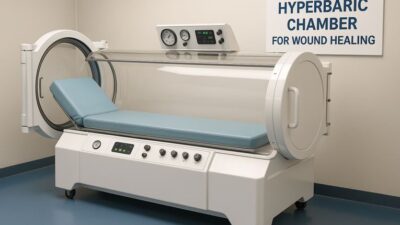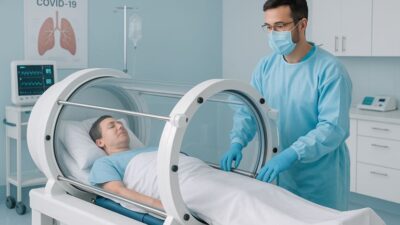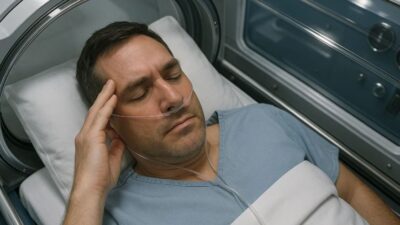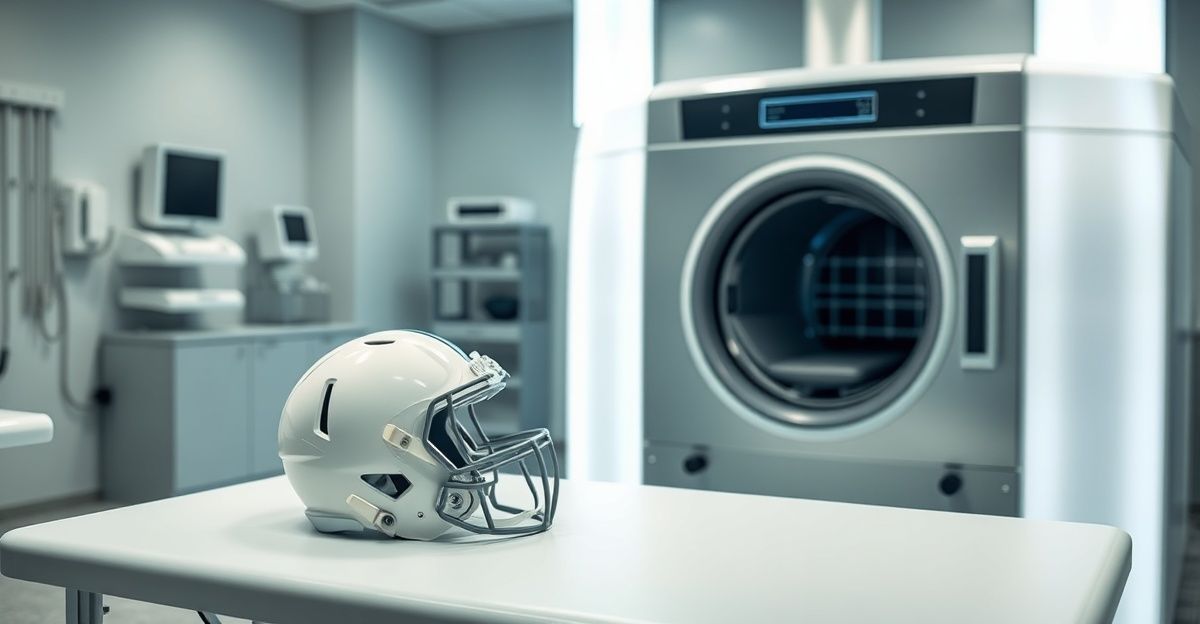
Multiple NFL players have publicly credited hyperbaric oxygen therapy with their cognitive recovery after repeated concussions, including Joe Namath, whose SPECT imaging showed improved cerebral blood flow after HBOT treatment. Sports concussions account for roughly 300,000 emergency department visits annually in the U.S. among athletes under 19 (CDC estimates). Despite growing use among professional athletes, HBOT is absent from major sports concussion guidelines, and return-to-play protocols still default to rest and graded exertion as the sole management strategy. It is one of several other cognitive and neurological conditions where HBOT is used currently being explored in clinical research.
NFL players and HBOT: who is using it and what they report
The most visible HBOT advocates in professional football are former players dealing with the cognitive aftermath of careers spent absorbing repeated head impacts.
Joe Namath is the highest-profile case. The Hall of Fame quarterback underwent SPECT brain imaging that showed significant perfusion deficits consistent with chronic repetitive brain trauma. After a course of HBOT, follow-up SPECT showed measurable improvement in cerebral blood flow. Namath has been publicly vocal about the treatment and has funded HBOT access for other former players through the Joe Namath Neurological Research Center at Jupiter Medical Center in Florida.
Tony Dorsett, Leonard Marshall, and other former players have spoken publicly about using HBOT for post-career cognitive symptoms. Their accounts are consistent: persistent headaches, memory problems, mood changes, and difficulty concentrating that improved after HBOT. These are anecdotal reports, not controlled data, but they have brought significant public attention to the treatment.
Among active players and recently retired athletes, HBOT use is less publicly discussed but reportedly widespread. Several NFL teams have relationships with HBOT providers, and players increasingly use HBOT as part of recovery protocols for both concussions and musculoskeletal injuries. The treatment is also used by athletes in the NHL, UFC, boxing, and rugby. For the general evidence on how athletes use HBOT, see our HBOT for athletes guide and our athletic recovery data review.
Youth concussion epidemic: the scale of the problem
The term “epidemic” is used deliberately. Concussion in youth sports has reached a scale that warrants that language.
The CDC estimates 1.6 to 3.8 million sports-related concussions per year in the United States, with the majority occurring in athletes under 18. Football accounts for the largest share in male athletes, followed by soccer, basketball, and lacrosse. In female athletes, soccer and basketball are the leading causes.
Youth brains are more vulnerable to concussion than adult brains, as discussed in our concussion overview. The developing brain has less myelination, the skull is thinner, and neck musculature is weaker. Recovery takes longer in adolescents than in adults. A JAMA Pediatrics study found median recovery time of 28 days in children versus 10 to 14 days in adults.
The cumulative effect of multiple concussions is particularly concerning in youth athletes. Each subsequent concussion increases the risk of prolonged recovery and persistent symptoms. Athletes who sustain three or more concussions have significantly higher rates of depression, cognitive impairment, and earlier onset of neurodegenerative symptoms later in life. The developing brain, repeatedly injured during critical growth periods, may carry the damage into adulthood in ways that a mature brain does not.
Return-to-play protocols: what the guidelines say (and what they miss)
Current sports concussion management in the U.S. follows the Consensus Statement on Concussion in Sport (updated at the 6th International Conference on Concussion in Sport, Amsterdam 2022). The return-to-play protocol is a stepwise process:
- Symptom-limited activity (daily activities that do not provoke symptoms)
- Light aerobic exercise (walking, swimming, stationary cycling)
- Sport-specific exercise (running drills, no head impact)
- Non-contact training drills (more complex drills, may start resistance training)
- Full-contact practice (after medical clearance)
- Return to competition
Each stage requires a minimum of 24 hours symptom-free before progressing to the next. If symptoms return, the athlete drops back one stage. The protocol is conservative by design and has reduced premature return-to-play, which is a genuine safety improvement over pre-protocol era practices.
What the protocol does not address is active treatment of the injured brain. The framework assumes that rest (initial phase) followed by graded exertion (subsequent phases) is sufficient for brain recovery. For most concussions, it is. For the 15% to 30% who develop persistent symptoms, the protocol offers no next step beyond referral to specialists who manage symptoms individually.
HBOT is not mentioned in any major sports concussion guideline. This is not because the evidence has been evaluated and rejected. It is because HBOT has not been submitted for inclusion, and the guideline committees have not reviewed it. The gap between athlete use (widespread) and guideline inclusion (absent) reflects the disconnect between clinical practice in professional sports and formal evidence-based medicine.
Rest-only vs. active recovery: the shifting paradigm
The dominance of rest-based concussion management is being challenged by emerging evidence favoring early active recovery. A 2018 review by Leddy et al. in Current Sports Medicine Reports presented the “Exercise is Medicine for Concussion” framework, arguing that prescribed sub-symptom-threshold aerobic exercise actually accelerates recovery compared to strict rest.
This shift matters for the HBOT discussion because it demonstrates that the concussion field is already moving beyond passive rest toward active interventions. If prescribed exercise can accelerate recovery (as the evidence suggests), then other active interventions targeting brain physiology deserve evaluation rather than reflexive dismissal.
HBOT fits logically within an active recovery model. Where exercise increases cerebral blood flow through cardiovascular demand, HBOT increases tissue oxygenation through dissolved oxygen delivery. The mechanisms are complementary, not competing. Some forward-thinking concussion programs already combine graded exercise with HBOT, though no controlled trial has evaluated this combination specifically.
Why sports medicine has been slow to adopt HBOT
Several factors explain the gap between professional athlete use and formal adoption in sports medicine.
Evidence standards: Sports medicine, like all medical specialties, relies on randomized controlled trials and systematic reviews for guideline development. The HBOT TBI evidence base, while positive, has the sham-control controversy that prevents clear-cut guideline-level recommendations. Clinicians trained in evidence-based medicine are understandably cautious about recommending a treatment that has not cleared this bar.
Liability concerns: Team physicians and sports medicine practitioners face legal exposure if they recommend treatments outside established guidelines. Recommending HBOT for a concussed athlete, when HBOT is not in any guideline, creates potential liability that most team doctors prefer to avoid, even if they privately believe the treatment has merit.
Access and logistics: HBOT requires specialized equipment and 60 to 90 minutes per session. Integrating this into a sports team’s medical infrastructure is logistically complex. Unlike ice baths, compression therapy, or even neurofeedback, HBOT cannot be delivered on-site at most training facilities.
Cost without insurance: At $150 to $300 per session for a 40-session protocol, HBOT costs $6,000 to $12,000. Professional teams can absorb this cost for high-value players. Youth sports programs, high school athletic departments, and individual families often cannot. The cost barrier disproportionately limits access at the levels where concussion incidence is highest.
Cultural inertia: Sports medicine has been slow to adopt novel treatments historically. Platelet-rich plasma (PRP) injections, for example, were used by elite athletes for years before being formally studied and integrated into practice guidelines. HBOT may follow a similar trajectory: adoption driven by professional athlete demand, followed eventually by formal study and guideline inclusion.
What the controlled evidence actually shows for sports concussion
No randomized controlled trial has been conducted exclusively in sports concussion patients. The evidence is extrapolated from the broader mild TBI literature, which includes sports concussion patients alongside blast TBI, fall injuries, and motor vehicle accident survivors.
The most relevant studies for sports concussion are those enrolling patients with mild TBI and persistent postconcussion symptoms, the profile that maps most closely to a concussed athlete who has not recovered on the standard timeline.
The Boussi-Gross 2013 trial enrolled patients with post-concussion syndrome regardless of injury mechanism. The Hadanny 2022 pediatric trial included sports concussions among its participants. Both showed significant cognitive improvement with HBOT at 1.5 ATA.
A sports-specific HBOT trial would need to address unique questions: Does HBOT accelerate return-to-play in acute concussion (within the first 7 to 14 days)? Does HBOT reduce the risk of developing persistent PCS after sports concussion? Does HBOT after repeated concussions reduce cumulative neurological risk? None of these questions have been tested in a controlled setting. The answers would determine whether HBOT has a role in acute sports concussion management (where the potential impact is largest) or only in chronic PCS management (where the current evidence applies).
Until those trials are conducted, the evidence supports HBOT for athletes with persistent symptoms after concussion (the PCS population), based on extrapolation from the general mild TBI literature. For the full evidence base, see our HBOT for TBI clinical data review.
Sources
- Boussi-Gross R, Golan H, Fishlev G, et al. “Hyperbaric oxygen therapy can improve post concussion syndrome years after mild traumatic brain injury.” PLoS One. 2013;8(11):e79995. DOI: 10.1371/journal.pone.0079995
- Hadanny A, Catalogna M, Yaniv S, et al. “Hyperbaric oxygen therapy in children with post-concussion syndrome improves cognitive and behavioral function.” Scientific Reports. 2022;12:15233. DOI: 10.1038/s41598-022-19395-y
- Harch PG, Andrews SR, Rowe CJ, et al. “Hyperbaric oxygen therapy for mild traumatic brain injury persistent postconcussion syndrome: a randomized controlled trial.” Medical Gas Research. 2020;10(1):8-20. DOI: 10.4103/2045-9912.279978
- Leddy JJ, Haider MN, Ellis MJ, Willer BS. “Exercise is Medicine for Concussion.” Current Sports Medicine Reports. 2018;17(8):262-270. DOI: 10.1249/JSR.0000000000000505
- Harch PG. “Systematic Review and Dosage Analysis: Hyperbaric Oxygen Therapy Efficacy in Mild Traumatic Brain Injury Persistent Postconcussion Syndrome.” Frontiers in Neurology. 2022;13:815056. DOI: 10.3389/fneur.2022.815056
- Biggs AT, Dainer H, Littlejohn LF. “Effect Sizes for Symptomatic and Cognitive Improvements in Traumatic Brain Injury Following Hyperbaric Oxygen Therapy.” Journal of Applied Physiology. 2021. DOI: 10.1152/japplphysiol.01084.2020
- Weaver LK, Ziemnik R, Deru K, Russo AA. “A double-blind randomized trial of hyperbaric oxygen for persistent symptoms after brain injury.” Scientific Reports. 2025;15. DOI: 10.1038/s41598-025-86631-6
- Davis GA, et al. “Sport concussion assessment tool, 6th edition.” British Journal of Sports Medicine. 2023;57(11):622-631. DOI: 10.1136/bjsports-2023-106922
- Centers for Disease Control and Prevention. “Traumatic Brain Injury & Concussion: Data and Statistics.” cdc.gov
Medical Disclaimer
The content on BaricBoost.com is for informational purposes only and is not intended as a substitute for professional medical advice, diagnosis, or treatment. Always seek the advice of your physician or other qualified health provider with any questions you may have regarding a medical condition. Never disregard professional medical advice or delay in seeking it because of something you have read on this website.

Author
Seph Fontane Pennock is the founder of BaricBoost.com and Regenerated.com, a clinic directory for regenerative medicine serving 10,000+ providers across the United States. He previously built and sold PositivePsychology.com, which grew to 19 million users and became the largest evidence-based positive psychology resource on the web. Seph brings direct experience as an HBOT patient, having completed protocols at clinics across three continents while navigating mold illness, systemic inflammation, and autoimmune conditions. His treatment journey includes hyperbaric oxygen therapy, peptide protocols, NAD+ therapy, and consultations with specialists from Dubai to Cape Town to Mexico. This combination of entrepreneurial track record and lived patient experience shapes everything published on BaricBoost.com. Every article is grounded in peer-reviewed research, informed by real clinical encounters, and written for patients making high-stakes treatment decisions. Seph's focus is on bringing transparency, scientific rigor, and practical guidance to the hyperbaric oxygen therapy space.