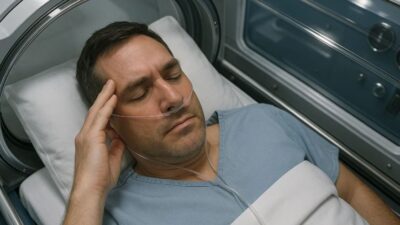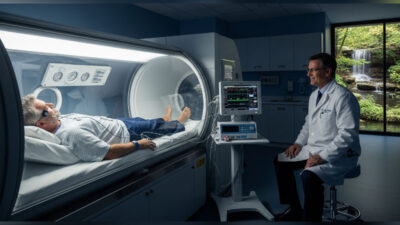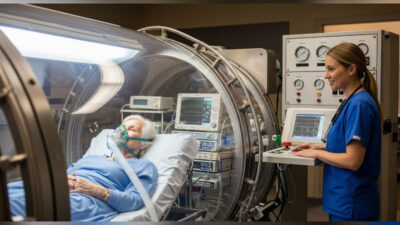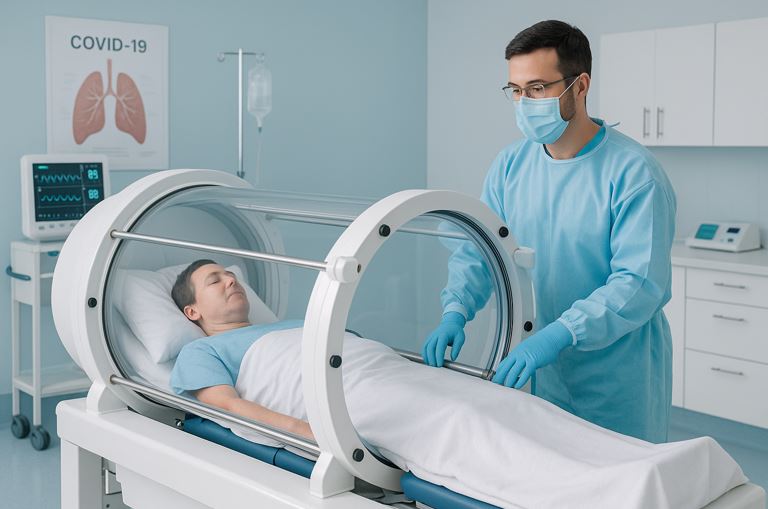
A 2022 double-blind RCT of 73 long COVID patients found that 40 sessions of HBOT at 2.0 ATA improved cognitive function (d=0.50), reduced pain interference (d=0.74), and increased energy (d=0.52) versus sham. Brain MRI confirmed increased perfusion in frontal and insular regions. Follow-up data shows these gains held 1.3 years post-treatment. Here is what the clinical evidence actually supports.
What Does the Research Say?
The strongest evidence comes from a 2022 sham-controlled RCT of 73 patients1 showing 40 sessions of HBOT at 2.0 ATA significantly improved cognitive function, fatigue, psychiatric symptoms, and pain. A 2025 registry of 232 patients5 found 56-63% experienced meaningful improvement, though 13-19% reported worsening. Two 2025 trials using only 10 sessions found no benefit,8,9 which points to dose as the deciding factor.
Long COVID HBOT Trials at a Glance
| Trial | N | Sessions | Pressure | Result |
|---|---|---|---|---|
| Zilberman-Itskovich 2022 (RCT) | 73 | 40 | 2.0 ATA | Positive |
| Hadanny 2024 (follow-up) | 31 | same cohort | 2.0 ATA | Gains held at 1.3 yrs |
| van Berkel 2025 (registry) | 232 | varies | varies | 56-63% better, 13-19% worse |
| HOT-LoCO 2025 (RCT) | 80 | 10 | 2.4 ATA | Null |
| D’hoore 2025 (RCT) | 101 | 10 | low-dose | Null |
The Tel Aviv RCT: The Key Study
The most rigorous evidence comes from Zilberman-Itskovich and colleagues at Tel Aviv University.1 Their randomized, double-blind, sham-controlled trial enrolled 73 patients with long COVID symptoms lasting more than 3 months. The HBOT group received 40 daily sessions at 2.0 ATA, 90 minutes each. The sham group received sessions in the same chamber at ambient pressure. Neither group knew which treatment they received.
“HBOT improved global cognitive function (d=0.50), psychiatric symptoms (d=0.64), pain interference (d=0.74), and energy and fatigue (d=0.52) compared to sham in 73 long COVID patients. Brain MRI confirmed increased cerebral perfusion in frontal and insular regions.”
Zilberman-Itskovich et al., Scientific Reports, 2022
Brain MRI with perfusion sequences showed increased cerebral blood flow in the HBOT group in regions associated with cognition and emotion: the supramarginal gyrus, insula, frontal cortex, and corona radiata. The sham group showed no such changes. This imaging data provides an objective biological correlate for the clinical improvements.
One-Year Follow-Up: Do Improvements Last?
A 2024 longitudinal follow-up assessed 31 patients from the original Tel Aviv cohort an average of 486 days after completing HBOT.2 Quality of life improvements persisted at the same magnitude as short-term outcomes. Sleep improvements maintained effect sizes of 0.47-0.79, and pain interference remained at an effect size of 0.83. This is the first evidence that HBOT benefits for long COVID last at least one year, though it tracks a single cohort from one research group.
“Quality of life improvements after HBOT for long COVID were maintained at the same magnitude 1.3 years after treatment ended. Pain interference persisted at effect size 0.83, and sleep improvements held across all five domains.”
Hadanny et al., Scientific Reports, 2024
Do You Need 40 Sessions or Will 10 Work?
Two 2025 randomized trials using only 10 sessions found no significant benefit over sham. The HOT-LoCO trial (n=80) at 2.4 ATA8 and the Belgian D’hoore trial (n=101)9 both returned null results. The only positive sham-controlled RCT used 40 sessions. This dose-response pattern is the most important clinical insight in the long COVID HBOT literature: 10 sessions appears to be insufficient, and clinics offering short courses are not running the protocol that produced results.
The Largest Real-World Registry
A 2025 prospective registry tracked 232 long COVID patients who received HBOT.5 At 3-month follow-up, 56-63% experienced clinically meaningful improvement in quality of life scores, with cognitive symptoms responding most strongly. However, 13-19% experienced clinically meaningful deterioration. Registry data lacks a control group, so some of both the improvement and the worsening reflects the natural course of the illness.
How HBOT Might Help Long COVID
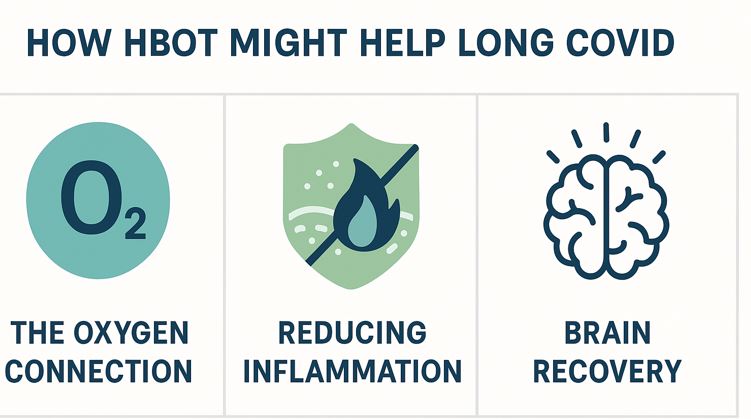
Improved cerebral perfusion: The Tel Aviv RCT showed measurable increases in cerebral blood flow in frontal, temporal, and insular regions after 40 HBOT sessions.1 These are regions repeatedly implicated in the brain fog and attention problems patients report.
Reduced neuroinflammation: A 2026 biomarker analysis by Soedarsono and colleagues reported that HBOT lowered pro-inflammatory cytokines including IL-6 and TNF-alpha while raising the anti-inflammatory cytokine IL-10 in long COVID patients.7 This may explain why multiple symptom domains improve together.
Neuroplasticity: Brain MRI with diffusion tensor imaging in the Tel Aviv cohort showed microstructural changes in white matter tracts after HBOT,1 which suggests the therapy drives tissue-level change rather than just temporary oxygen delivery. That is a plausible reason benefits persist at one year.
What Patients Actually Report
Many patients report gradual improvements rather than dramatic changes. Some notice better sleep or less brain fog after 20-30 sessions. Others see nothing until the full course is complete. In the van Berkel registry, 13-19% experienced worsening.5 This risk should be part of any informed decision before starting treatment.
Hard Chamber or Soft Chamber for Long COVID?
The only positive sham-controlled RCT for long COVID used a hard chamber at 2.0 ATA with 100% oxygen via mask.1 Soft chambers at 1.3-1.5 ATA deliver significantly less oxygen and have not been studied for long COVID. The soft versus hard chamber clinical data makes the pressure gap concrete. When the evidence points to a specific protocol, matching it matters.
Some patients consider portable hyperbaric chambers for home use. These soft-shell units operate at lower pressures and have not been studied for long COVID. They may have a role in maintenance after clinical treatment, but they are not a substitute for the 40-session, 2.0 ATA protocol studied in the positive RCT. The home chamber guide covers what these units can and cannot do.
How Do You Find a Qualified Center?
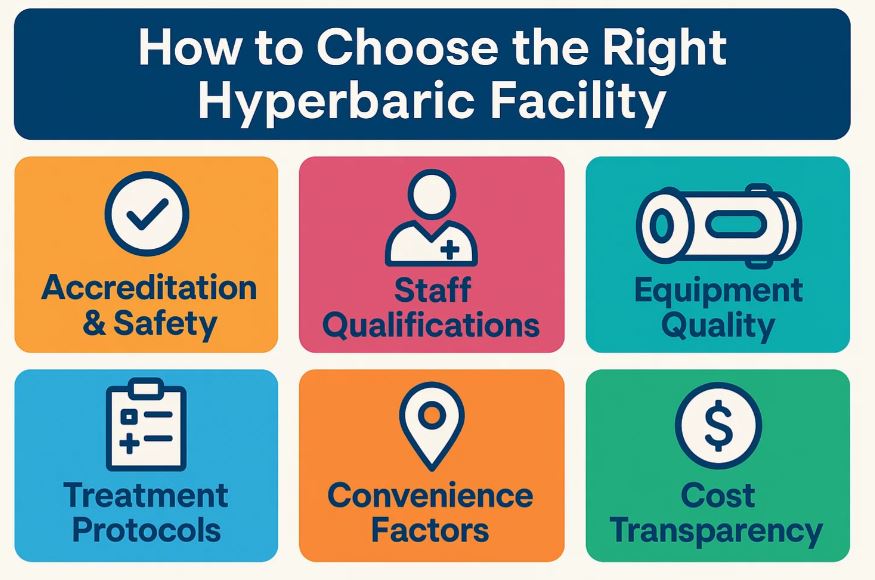
Look for facilities with a hard chamber capable of reaching 2.0 ATA, qualified medical supervision, and experience treating neurological conditions. Ask specifically whether their chamber reaches 2.0 ATA with 100% oxygen via mask. Centers offering only soft-chamber sessions at 1.3 ATA are not running the protocol that produced positive results in clinical trials.
Does Insurance Cover HBOT for Long COVID?
No. HBOT is not FDA-approved for long COVID and is not covered by any major insurer as of 2026. Treatment typically costs $200-$400 per session at medical centers. For a 40-session course, total costs range from $8,000 to $16,000 out of pocket. Some patients use HSA or FSA accounts to help cover costs. The hyperbaric chamber cost guide breaks down what drives the per-session price.
Is HBOT Worth Trying for Long COVID?
The honest picture: one well-designed sham-controlled RCT with positive results (n=73, 40 sessions, 2.0 ATA), one follow-up showing those results persist at one year, a large registry showing majority improvement but meaningful minority worsening, and two 2025 trials showing no benefit with 10-session protocols. Positive results come primarily from one research group in Tel Aviv, and the dose threshold makes the picture more complicated than most clinic marketing suggests. For the full trial-by-trial breakdown, see the HBOT long COVID clinical data page.
Working with a physician who understands both long COVID and hyperbaric medicine can help you assess whether the time and cost commitment is appropriate for your situation.
Who Should Not Try HBOT
HBOT is generally safe when administered by trained professionals, but it is not appropriate for everyone. Discuss your full medical history with your provider before starting treatment.
Absolute Contraindications
- Untreated pneumothorax
- Certain chemotherapy drugs (bleomycin, cisplatin, doxorubicin, disulfiram)
Relative Contraindications
- Upper respiratory infection or sinus congestion
- Seizure disorder
- COPD
- High fever
- History of ear surgery or chronic ear problems
- Claustrophobia
- Pregnancy
Sources
- Zilberman-Itskovich S, Catalogna M, Sasson E, et al. Hyperbaric oxygen therapy improves neurocognitive functions and symptoms of post-COVID condition: randomized controlled trial. Sci Rep. 2022;12:11252. DOI: 10.1038/s41598-022-15565-0. PMID: 35821512.
- Hadanny A, Zilberman-Itskovich S, Catalogna M, et al. Long term outcomes of hyperbaric oxygen therapy in post covid condition: longitudinal follow-up of a randomized controlled trial. Sci Rep. 2024;14:3604. DOI: 10.1038/s41598-024-53091-3. PMID: 38360929.
- Robbins T, Gonevski M, Clark CCT, et al. Hyperbaric oxygen therapy for the treatment of long COVID: early evaluation of a highly promising intervention. Clin Med (Lond). 2021;21(6):e629-e632. DOI: 10.7861/clinmed.2021-0462. PMID: 34862223.
- Wu BQ, Liu DY, Shen TC, et al. Effects of Hyperbaric Oxygen Therapy on Long COVID: A Systematic Review. Life. 2024;14(4):438. DOI: 10.3390/life14040438. PMID: 38672710.
- van Berkel J, Lalieu RC, Joseph D, et al. Hyperbaric oxygen therapy for long COVID: a prospective registry. Sci Rep. 2025. DOI: 10.1038/s41598-025-11539-0. PMID: 40759992.
- Leitman M, Fuchs S, Tyomkin V, et al. The effect of hyperbaric oxygen therapy on myocardial function in post-COVID-19 syndrome patients. Sci Rep. 2023;13:9579. DOI: 10.1038/s41598-023-36570-x. PMID: 37301934.
- Soedarsono S, Wijaya RA, Biutifasari V. Potential Biomarkers and Inflammatory Modulation of Hyperbaric Oxygen Therapy in Long COVID. Jurnal Respirasi. 2026;12(1):90-96. DOI: 10.20473/jr.v12-i.1.2026.90-96.
- Kjellberg A, Abdel-Halim L, Hassler A, et al. Ten sessions of hyperbaric oxygen versus sham treatment in patients with long covid (HOT-LoCO): a randomised, placebo-controlled, double-blind, phase II trial. BMJ Open. 2025;15(4):e085432. PMID: 40228859.
- D’hoore L, Germonpre P, Hassler A, et al. Effect of normobaric and hyperbaric hyperoxia treatment on symptoms and cognitive capacities in Long COVID patients. Diving Hyperb Med. 2025;55(2):104-113. DOI: 10.28920/dhm55.2.104-113. PMID: 40544138.
Medical Disclaimer
The content on BaricBoost.com is for informational purposes only and is not intended as a substitute for professional medical advice, diagnosis, or treatment. Always seek the advice of your physician or other qualified health provider with any questions you may have regarding a medical condition. Never disregard professional medical advice or delay in seeking it because of something you have read on this website.

Author
Seph Fontane Pennock is the founder of BaricBoost.com and Regenerated.com, a clinic directory for regenerative medicine serving 10,000+ providers across the United States. He previously built and sold PositivePsychology.com, which grew to 19 million users and became the largest evidence-based positive psychology resource on the web. Seph brings direct experience as an HBOT patient, having completed protocols at clinics across three continents while navigating mold illness, systemic inflammation, and autoimmune conditions. His treatment journey includes hyperbaric oxygen therapy, peptide protocols, NAD+ therapy, and consultations with specialists from Dubai to Cape Town to Mexico. This combination of entrepreneurial track record and lived patient experience shapes everything published on BaricBoost.com. Every article is grounded in peer-reviewed research, informed by real clinical encounters, and written for patients making high-stakes treatment decisions. Seph's focus is on bringing transparency, scientific rigor, and practical guidance to the hyperbaric oxygen therapy space.