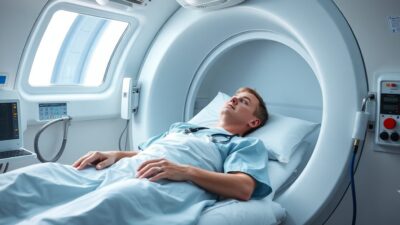
ACL tears take 6 to 12 months to heal because ligaments are poorly vascularized. A 2025 systematic review of 13 studies and 693 participants found HBOT generally enhanced ligament and tendon healing compared with controls, but the human data is observational and no randomized trial confirms faster return to sport (Babel, 2025). In animal models collagen matures earlier, but human proof is still missing.
Hyperbaric oxygen therapy has drawn attention in sports medicine as a way to speed ligament recovery by raising tissue oxygen at above-normal pressure. The biological rationale is sound and the animal data is consistent, but the clinical evidence in humans is still developing. Here is what the research actually shows and where the honest limits are.
Why do ligaments heal so slowly?
Ligaments connect bone to bone and stabilize joints, but they are relatively avascular, which limits the oxygen and nutrients that reach the injury. When a ligament tears, healing unfolds in three phases (inflammatory, proliferative, and remodeling), and each requires adequate oxygen; hypoxia at any stage slows the process. The collagen that repairs a ligament is also biologically different from the original: scar tissue lays down disorganized collagen that is weaker and less elastic, so anything that improves the quality and organization of collagen deposition can meaningfully improve outcomes.
HBOT targets exactly this oxygen limitation. By dramatically increasing plasma oxygen, it reaches the poorly vascularized interior of healing tissue, supporting oxygen-dependent collagen synthesis by fibroblasts. It also stimulates growth factors (TGF-beta, PDGF, and VEGF) that drive fibroblast activity and angiogenesis, and its anti-inflammatory effects may limit the excessive inflammation that increases scarring.
Does HBOT actually speed ligament healing?
The strongest evidence is in animals, not humans. Studies in rats and rabbits with ligament and tendon injuries have shown earlier vascularization, faster collagen maturation, and improved tensile strength with HBOT. Ishii and colleagues documented improved ligament healing in rats with hyperbaric oxygen (2002) and earlier showed HBOT raised procollagen mRNA and collagen synthesis in healing rat tendon (1999). In rabbits, Yeh and colleagues (2007) found HBOT improved tendon graft and tendon-to-bone integration in the bone tunnel, which is directly relevant to ACL reconstruction, where the graft must integrate and mature.
HBOT ligament evidence by source type
| Evidence type | Finding | Strength |
|---|---|---|
| Animal (rat/rabbit ACL, MCL, tendon) | Earlier vascularization, faster collagen maturation, better tensile strength and graft integration | Moderate (for animals) |
| Athletic case reports | Faster return to sport reported anecdotally | Limited |
| Small clinical studies | Reduced pain and swelling, better early function post-op | Emerging |
| Human RCT for ligament repair | None exist | None |
Human evidence is limited and largely observational. Case reports describe elite athletes using HBOT during rehabilitation after ACL reconstruction, some reporting faster return to sport, but these athletes also receive extensive supportive care, so HBOT’s specific contribution cannot be isolated. A small number of clinical studies after orthopedic procedures found improvements in pain and swelling, but none were powered or controlled well enough to confirm that HBOT alters the ligament-healing trajectory. The 2025 Babel review, which pooled 13 studies across animal and human data, concluded HBOT enhanced healing versus controls and called for larger studies and a standardized protocol before firm clinical claims can be made. A 2023 review by Leite and colleagues on HBOT in knee injuries reached a similar position: plausible mechanisms, promising early signals, insufficient high-quality human trials.
What HBOT protocol is used after ligament surgery?
There is no established protocol for ligament repair. Athletes and patients who use HBOT after ACL surgery typically begin within days to weeks and complete 20 to 40 sessions of 60 to 90 minutes at 1.5 to 2.4 ATA. The rationale for starting early is that the initial vascular and inflammatory phases are when added oxygen might matter most, but that timing is based on tissue biology rather than controlled human trials.
The most defensible application is post-surgical. The graft used in ACL reconstruction undergoes ligamentization, gradually transforming into ligament-like tissue over months through phases of avascularity, and HBOT’s support for healing during avascular phases is biologically relevant to that process. This overlaps with the broader post-surgery recovery and general recovery topics, and the same collagen-dependent biology applies to tendon injuries and to bone healing. HBOT’s practical downsides are real: sessions run 60 to 90 minutes five days a week, the cost is out of pocket (insurance does not cover off-label ligament use), and no large trial validates it for this purpose. The session guide explains the process and the cost guide helps with planning. Return-to-sport decisions should still rest on functional testing and tissue-maturity assessment, not on an assumption that HBOT has compressed the timeline beyond what testing can confirm.
Frequently Asked Questions
Can I use HBOT instead of ACL surgery for a complete tear?
No. A completely torn ACL does not have the biological capacity to heal through conservative measures in most cases, and certainly not through HBOT alone. Surgery followed by rehabilitation is the standard of care for complete ACL tears in athletes. HBOT may play a supporting role after surgery, but it is not a replacement for the reconstruction, and no evidence suggests it can heal a full tear on its own.
How soon after ligament surgery should HBOT start?
Proponents recommend starting as soon as practical, often within the first one to two weeks, to influence the early inflammatory and vascular phases of healing. This timing is based on tissue biology and animal data rather than human trials establishing an optimal window, so it should be coordinated with the surgical team rather than treated as a proven protocol.
Will HBOT reduce recovery time after ACL reconstruction?
Possibly, but it has not been proven in controlled human trials. Animal studies support faster collagen maturation and the biological mechanisms are plausible, yet no randomized trial has shown that HBOT meaningfully shortens human return-to-sport timelines. The 2025 systematic review found no such trial and called for larger studies before firm claims can be made.
Is HBOT used by professional athletes for ligament injuries?
Some professional athletes and teams use HBOT as part of injury-recovery protocols, and it has been reported across various sports. That adoption reflects the perception of benefit and the ability to afford private treatment, not regulatory approval or confirmed efficacy from clinical trials. Case reports from elite athletes are anecdotal and cannot separate HBOT’s effect from the extensive supportive care they also receive.
Sources
- Babel S, Bosco G, Camporesi E. “Efficacy and safety of hyperbaric oxygen therapy in ligament and tendon injuries: a systematic review.” European Journal of Translational Myology, 2025. doi.org/10.4081/ejtm.2025.14016
- Ishii Y, et al. “Effects of different exposures of hyperbaric oxygen on ligament healing in rats.” Journal of Orthopaedic Research, 2002. PMID 11918316
- Ishii Y, et al. “Effects of hyperbaric oxygen on procollagen messenger RNA levels and collagen synthesis in the healing of rat tendon laceration.” Tissue Engineering, 1999. PMID 10434074
- Yeh WL, et al. “Effects of hyperbaric oxygen treatment on tendon graft and tendon-bone integration in bone tunnel: biochemical and histological analysis in rabbits.” Journal of Orthopaedic Research, 2007. PMID 17278150
- Leite CBG, et al. “Revisiting the role of hyperbaric oxygen therapy in knee injuries: Potential benefits and mechanisms.” Journal of Cellular Physiology, 2023. PMID 36649313
- Moghadam N, et al. “Hyperbaric Oxygen Therapy in Sports Musculoskeletal Injuries.” Medicine & Science in Sports & Exercise, 2020. PMID 31876671
Medical Disclaimer
The content on BaricBoost.com is for informational purposes only and is not intended as a substitute for professional medical advice, diagnosis, or treatment. Always seek the advice of your physician or other qualified health provider with any questions you may have regarding a medical condition. Never disregard professional medical advice or delay in seeking it because of something you have read on this website.

Author
Seph Fontane Pennock is the founder of BaricBoost.com and Regenerated.com, a clinic directory for regenerative medicine serving 10,000+ providers across the United States. He previously built and sold PositivePsychology.com, which grew to 19 million users and became the largest evidence-based positive psychology resource on the web. Seph brings direct experience as an HBOT patient, having completed protocols at clinics across three continents while navigating mold illness, systemic inflammation, and autoimmune conditions. His treatment journey includes hyperbaric oxygen therapy, peptide protocols, NAD+ therapy, and consultations with specialists from Dubai to Cape Town to Mexico. This combination of entrepreneurial track record and lived patient experience shapes everything published on BaricBoost.com. Every article is grounded in peer-reviewed research, informed by real clinical encounters, and written for patients making high-stakes treatment decisions. Seph's focus is on bringing transparency, scientific rigor, and practical guidance to the hyperbaric oxygen therapy space.