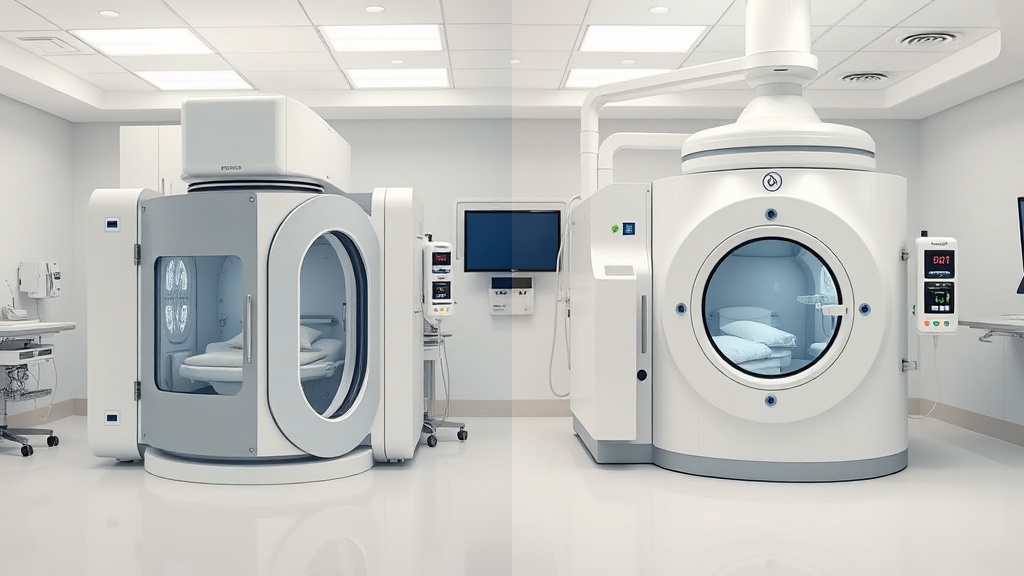
The Efrati protocol uses 2.0 ATA with 100% oxygen for 90 minutes per session across 60 sessions, with intermittent air breaks designed to trigger regenerative gene expression. The Harch protocol uses 1.5 ATA with continuous 100% oxygen for 60 minutes per session across 40 sessions, targeting chronic neurological conditions at a lower pressure. Standard wound care HBOT typically uses 2.0 to 2.4 ATA for 90 to 120 minutes across 20 to 60 sessions, focused on tissue oxygenation and angiogenesis. Which protocol matters for you depends on your condition.
Why Do HBOT Protocols Differ So Much?
- 2.0 ATA, 100% O2 with air breaks
- 90 min/session, 60 total sessions
- ~$20,000-$60,000 full program
- Best for: PTSD, TBI, longevity
- 1.5 ATA, 100% O2 continuous
- 60 min/session, 40 total sessions
- ~$8,000-$16,000 full program
- Best for: TBI/PCS, chronic neurological
Not all hyperbaric oxygen therapy (HBOT) is the same treatment. The pressure, oxygen concentration, session duration, number of sessions, and even the use of air breaks all affect outcomes. Two patients walking into two different clinics for HBOT might receive fundamentally different treatments, and neither the patients nor sometimes the clinics themselves understand the distinction.
Three protocols dominate the clinical HBOT landscape: the Efrati protocol out of Tel Aviv University (used at Aviv Clinics), the Harch protocol from Dr. Paul Harch at LSU in New Orleans, and the standard wound care protocols used in UHMS-accredited hospital programs. Each was developed for different conditions and works on different physiological principles.
Protocol Comparison at a Glance
| Parameter | Efrati Protocol | Harch Protocol | Standard Wound Care |
|---|---|---|---|
| Developer | Prof. Shai Efrati, Sagol Center for Hyperbaric Medicine, Tel Aviv University | Dr. Paul Harch, Louisiana State University, New Orleans | UHMS guidelines |
| Pressure | 2.0 ATA | 1.5 ATA | 2.0-2.4 ATA |
| Oxygen delivery | 100% O2 via mask WITH air breaks: 20 min O2, 5-min air break, repeated 3x per session | 100% O2 continuous via mask or oral-nasal delivery | 100% O2 continuous |
| Session duration | 90 minutes total (including air breaks) | 60-90 minutes at depth | 90-120 minutes at depth |
| Total sessions | 60 (5x/week for 12 weeks) | 40 (over 30 days, sometimes escalated to 80-100+) | 20-60 (varies by condition) |
| Total treatment hours | ~90 hours | ~40-60 hours standard | Varies |
| Key mechanism innovation | Hyperoxic-hypoxic paradox: air breaks create relative hypoxia triggering regenerative gene expression, stem cell mobilization, and telomere elongation | Low-pressure oxygenation for cerebral blood flow improvement; dose-response framework using total atmosphere-minutes | Pressure-driven O2 dissolution for tissue repair and angiogenesis |
| Chamber type | Medical-grade multiplace chambers only. Efrati warns against home/soft chambers. | Monoplace hard chambers acceptable. More accessible setup. | Hard chamber (monoplace or multiplace) |
| Primary conditions | PTSD (treatment-resistant), post-stroke, TBI, age-related cognitive decline, fibromyalgia, longevity/anti-aging | TBI/PCS, PTSD (military), stroke, chronic neurological conditions | 14 FDA-cleared indications (diabetic ulcers, radiation injury, CO poisoning, etc.) |
| Evidence level | Multiple RCTs in peer-reviewed journals; long-term follow-up data | Phase I study (n=16); systematic review; no large blinded RCT published | Strong; the basis for FDA clearance and insurance coverage |
| Approximate cost | $20,000-$60,000+ (Aviv Clinics full program) | $8,000-$16,000 (40 sessions at typical clinic pricing) | Often insurance-covered for approved indications |
Key Terms Used in This Comparison
| Term | Definition |
|---|---|
| Hyperoxic-hypoxic paradox | Cycling between high oxygen and relative oxygen reduction (during air breaks) generates a regenerative signal that continuous oxygen alone does not |
| ATA (atmospheres absolute) | The total pressure inside the chamber. 2.0 ATA is about twice sea-level pressure; 1.5 ATA is one and a half times |
| Atmosphere-minutes | A dose measure combining pressure and time at depth, used in the Harch framework to compare total oxygen exposure across protocols |
The Efrati Protocol: 2.0 ATA with Intentional Air Breaks
How Does the Efrati Air-Break Protocol Work?
Developed by Prof. Shai Efrati at the Sagol Center for Hyperbaric Medicine and Research at Tel Aviv University, this protocol is defined by its use of intentional air breaks during each session. Patients breathe 100% oxygen at 2.0 ATA for 20 minutes, then switch to ambient air for 5 minutes, repeated three times per 90-minute session. These breaks are not a safety measure. They are the therapy.
The physiological rationale is the hyperoxic-hypoxic paradox: the repeated shifts between high oxygen (hyperoxia) and relative oxygen reduction (during air breaks) create a stronger regenerative signal than continuous hyperbaric oxygen alone. Each air break at depth creates a state of relative hypoxia that activates hypoxia-inducible factor (HIF-1) pathways, triggering stem cell mobilization, angiogenesis, and neuroplasticity gene expression. This cycling mechanism is supported by published data showing telomere elongation and senescent cell clearance.4
What Does the Research Say?
- PTSD with 2-year follow-up (Doenyas-Barak & Efrati, 2024): Combat veterans treated with 60 sessions at 2.0 ATA with air breaks. Sustained PTSD symptom reduction of 39% at 2-year follow-up, with improved social and occupational function.3
- Aging/longevity (Hachmo et al., 2020): 60 sessions at 2.0 ATA with air breaks. Telomere length increased by roughly 20% on average, and senescent cells decreased by 11 to 37%. This was the first published intervention shown to shift these two biological aging markers in humans.4
- Physical performance in older adults (Hadanny et al., 2024): 60 sessions at 2.0 ATA. VO2max improved by 1.91 ml/kg/min, with increased cardiac perfusion.2
- COVID-19 RCT (Hadanny, Efrati et al., 2021 preprint): Prospective RCT, n=31, with 8 HBOT sessions given twice daily. Reported improvements in oxygen saturation, CRP, and LDH.5
Where to Get It
The Efrati protocol is primarily available through Aviv Clinics (locations in The Villages, Florida and Dubai). Aviv runs a comprehensive program that includes HBOT alongside cognitive and physical training, so the cost is significantly higher ($20,000 to $60,000+) than standalone HBOT sessions. The specific intermittent oxygen fluctuation component is proprietary to Aviv. Any clinic with a hard chamber operating at 2.0 ATA can deliver 60 sessions of hyperbaric oxygen, but whether steady-state 2.0 ATA matches the results of the air-break protocol has not been tested head-to-head.
Limitations
Much of the research comes from Efrati’s own center, which raises the potential for bias. The air-break mechanism has not been independently replicated at scale. The high cost and limited facility availability make access difficult for most patients, and the 60-session protocol requires a 12-week commitment at 5 sessions per week.
The core innovation of the Efrati approach is treating air breaks not as a safety precaution but as a therapeutic tool, on the premise that the relative hypoxia during breaks triggers regenerative gene expression that continuous oxygen alone does not (Hachmo et al., 2020).
The Harch Protocol: 1.5 ATA for Chronic Neurological Conditions
How Does the Harch 1.5 ATA Protocol Work?
Dr. Paul Harch, Clinical Professor of Medicine at LSU School of Medicine in New Orleans, has investigated lower-pressure HBOT for chronic neurological conditions since 1989. His primary protocol uses 1.5 ATA with 100% oxygen for 60 minutes per session across 40 sessions, typically compressed into 30 days. Our profile of Dr. Paul Harch’s HBOT treatment and research covers his career and dosing framework in more depth.
The rationale is that 1.5 ATA is sufficient to activate the gene expression changes that drive neuroplasticity and tissue repair without the higher oxidative stress associated with 2.0-plus ATA. Harch frames his approach using a dose-response model based on total atmosphere-minutes, arguing that the gene and cellular responses critical for brain healing can be triggered at lower pressures. At 1.5 ATA with 100% oxygen, plasma O2 reaches approximately 1,200 mmHg, substantially higher than normal but below the roughly 1,800 mmHg achieved at 2.0 ATA.
What Does the Research Say?
- Phase I military TBI/PTSD study (Harch et al., 2012): n=16 military subjects with chronic blast-induced TBI. 40 sessions at 1.5 ATA over 30 days. Full-scale IQ improved by 14.8 points (p<0.001). Working memory improved (WMS-IV, p=0.003). PTSD symptoms improved (PCL-M, p<0.001). Depression improved (PHQ-9, p<0.001). Post-concussion symptoms improved (Rivermead PCSQ, p=0.0002). 64% of subjects on psychoactive or narcotic medications reduced or eliminated them. SPECT imaging showed diffuse improvements in cerebral blood flow.6
- Systematic review (Harch, 2022): Reviewed evidence across multiple trials and concluded that 40 sessions at 1.5 ATA meets Level 1 evidence standards for mild TBI with persistent post-concussion syndrome. Published in Frontiers in Neurology, this is Harch’s own dosage analysis, so the conclusion should be read alongside the negative military trials discussed below.8
Where to Get It
The 1.5 ATA protocol is widely available at independent HBOT clinics across the US that operate hard chambers. Any clinic capable of reaching 1.5 ATA can deliver it, which makes it far more accessible and typically less expensive than the Efrati protocol ($200 to $400 per session, or $8,000 to $16,000 for 40 sessions).
Limitations
The Phase I study was unblinded with no control group, which creates significant opportunity for placebo effect. Department of Defense RCTs that compared HBOT to sham (1.2 ATA air) found no significant difference between groups, though Harch argues the sham itself was a therapeutic dose rather than a true placebo. No large randomized blinded trial has confirmed the Phase I results, and long-term follow-up data comparable to the 2-year Efrati PTSD data does not exist for the Harch protocol.
Standard Wound Care HBOT: 2.0-2.4 ATA
How Does Standard Wound-Care HBOT Work?
This is the HBOT most people encounter in hospital settings. Standard protocols follow UHMS guidelines for the 14 FDA-cleared indications, typically using 2.0 to 2.4 ATA with 100% oxygen for 90 to 120 minutes. The number of sessions varies by condition: decompression sickness may need only a few sessions, while diabetic foot ulcers often require 30 to 60 sessions.
The mechanism is straightforward. Sharply increasing dissolved oxygen in plasma (up to 1,800-plus mmHg versus 100 mmHg at sea level) promotes angiogenesis, enhances white blood cell bacterial killing, reduces edema, and supports tissue repair in oxygen-starved wounds. A 2020 retrospective study comparing 2.0 ATA with 2.4 ATA for radiation cystitis (n=126) found no significant difference in overall response rates (72.7% vs 78.3%, p=0.74), though the lower pressure required more sessions on average.1
What Does the Research Say?
This is the most extensively studied form of HBOT, with decades of clinical evidence supporting its use for diabetic foot ulcers, radiation tissue damage, carbon monoxide poisoning, decompression sickness, gas gangrene, and compromised skin grafts. That evidence base is the reason these indications are FDA-cleared and covered by insurance.
Limitations
Standard wound care HBOT was not designed for neurological conditions, cognitive enhancement, or anti-aging. Hospital-based programs generally do not treat off-label conditions. If you are seeking HBOT for long COVID, TBI, or longevity, a hospital wound care center is typically not the right provider, even though it may have superior equipment and safety protocols.
What About Mild HBOT (mHBOT) at 1.3 ATA?
None of the three major protocols above use 1.3 ATA. Mild HBOT at 1.3 ATA is what soft chambers deliver, and it is a fundamentally different treatment. At 1.3 ATA with ambient air (not 100% oxygen), blood oxygen levels reach approximately 230 mmHg, compared to 1,200-plus mmHg at 1.5 ATA with 100% oxygen and 1,800-plus mmHg at 2.0 ATA with 100% oxygen.
Some patients report subjective benefits from mild HBOT, but rigorous evidence for it remains limited. The major clinical studies on HBOT for long COVID, TBI, aging, and wound healing all used hard chambers at 1.5 ATA or above with 100% oxygen. Extrapolating those results to soft chamber treatment at 1.3 ATA is not supported by the evidence. The Efrati anti-aging telomere study specifically used 2.0 ATA with 100% oxygen across 60 sessions, and there is no published evidence showing telomere lengthening or senescent cell reduction from mild HBOT.
Put simply: Efrati’s protocol is 60 sessions at 2.0 ATA with intentional air breaks, and Harch’s protocol is 40 sessions at 1.5 ATA with continuous oxygen. It is the same broad therapy applied with fundamentally different approaches to pressure, dose, and mechanism.
How to Choose the Right Protocol
| If your goal is | Consider | Why |
|---|---|---|
| Long COVID recovery | Efrati protocol (2.0 ATA, 60 sessions, with air breaks) | Only protocol with a published RCT for long COVID, with one-year follow-up data |
| Chronic TBI / post-concussion | Harch protocol (1.5 ATA, 40 sessions) | Most accessible and affordable; Phase I data shows significant cognitive improvement; widely available at independent clinics |
| Anti-aging / cognitive enhancement | Efrati protocol (2.0 ATA, 60 sessions) | Only protocol with published telomere and senescent cell data; long-term PTSD follow-up data |
| Diabetic wound healing | Standard wound care (2.0-2.4 ATA) | FDA-cleared, insurance-covered, strongest evidence base for wound indications |
| Radiation injury | Standard wound care (2.0-2.4 ATA) | FDA-cleared, well-established protocols |
| PTSD with longest outcome data | Efrati protocol (2.0 ATA, 60 sessions) | 39% sustained symptom reduction at 2 years in combat veterans, the only protocol with 2-year follow-up |
| General wellness / recovery | Harch-range (1.5 ATA) if hard chambers accessible; mild HBOT (1.3 ATA) if not | Lower cost of entry and a reasonable safety profile; no need for the full Efrati program for wellness goals |
Frequently Asked Questions
Can I get the Efrati protocol outside of Aviv Clinics?
The standard 2.0 ATA, 60-session, 100% oxygen component is available at many hard chamber clinics. The specific intermittent air-break component is how Aviv delivers the protocol. Whether the air breaks are essential to the results, or whether steady-state 2.0 ATA HBOT produces similar outcomes, is an open question that has not been tested head-to-head in a controlled trial.
Is 1.5 ATA enough for neurological conditions?
Harch’s systematic review argues yes for mild TBI, claiming Level 1 evidence at 1.5 ATA.8 The Efrati group’s neurological and aging studies use 2.0 ATA and show robust results with long-term follow-up. The optimal pressure for neurological conditions is not settled. If cost is a constraint, 1.5 ATA is a reasonable evidence-based starting point.
Why do the military HBOT trials show negative results?
Several Department of Defense trials found HBOT was no better than sham for post-concussion symptoms. Harch and others argue the sham control (typically 1.2 ATA air) was itself a therapeutic dose, meaning both groups received active treatment. This sham problem is unique to HBOT research and remains one of the most debated methodological issues in the field.7
Does the Efrati telomere study apply to soft chamber HBOT?
No. The Efrati anti-aging study used 2.0 ATA with 100% oxygen in a hard chamber across 60 sessions with air breaks. Soft chambers at 1.3 ATA with ambient air deliver a fraction of the oxygen dose. There is no published evidence showing telomere lengthening or senescent cell reduction from mild HBOT.
How does pressure affect outcomes? Is more always better?
Not necessarily. For radiation cystitis, 2.0 ATA and 2.4 ATA showed similar response rates, though the lower pressure required more sessions.1 For sudden hearing loss, one study found 2.5 ATA superior at low frequencies while 2.0 ATA was better at high frequencies.9 A 2024 UHMS practitioner survey found wide variation in the pressures clinicians use, with a substantial share using 2.4 ATA and others 2.0 ATA.10 The right pressure depends on the condition.
Sources
- Ajayi OD, et al. A comparison of two hyperbaric oxygen regimens for radiation cystitis. Undersea Hyperb Med. 2020. DOI: 10.22462/10.12.2020.7
- Hadanny A, Sasson E, Copel L, et al. Physical enhancement of older adults using hyperbaric oxygen: a randomized controlled trial. BMC Geriatr. 2024;24:537. DOI: 10.1186/s12877-024-05146-3
- Doenyas-Barak K, Efrati S. Optimizing hyperbaric oxygen therapy for PTSD: 2-year follow-up in combat veterans. Front Neurol. 2024;15:1447742. DOI: 10.3389/fneur.2024.1447742
- Hachmo Y, Hadanny A, Abu Hamed R, et al. Hyperbaric oxygen therapy increases telomere length and decreases immunosenescence in isolated blood cells: a prospective trial. Aging (Albany NY). 2020;12(22):22445-22456. DOI: 10.18632/aging.202188
- Hadanny A, Efrati S, et al. Hyperbaric oxygen therapy for COVID-19 patients: a prospective, randomized controlled trial (preprint). SSRN. 2021. DOI: 10.2139/SSRN.3745115
- Harch PG, Andrews SR, Fogarty EF, et al. A phase I study of low-pressure hyperbaric oxygen therapy for blast-induced post-concussion syndrome and post-traumatic stress disorder. J Neurotrauma. 2012;29(1):168-185. DOI: 10.1089/neu.2011.1895
- Harch PG. Hyperbaric oxygen therapy in the treatment of chronic mild-moderate blast-induced TBI PCS and PTSD. DTIC Report. 2013. DOI: 10.21236/ada605018
- Harch PG. Systematic review and dosage analysis: hyperbaric oxygen therapy efficacy in mild traumatic brain injury persistent postconcussion syndrome. Front Neurol. 2022;13:815056. DOI: 10.3389/fneur.2022.815056
- Krajcovicova Z, et al. Hyperbaric oxygen therapy pressure comparison for sudden sensorineural hearing loss. Undersea Hyperb Med. 2019. DOI: 10.22462/10.12.2019.12
- Laspro M, et al. Hyperbaric oxygen therapy regimens, treated conditions, and adverse effects: a survey of UHMS members. Undersea Hyperb Med. 2024. PMID: 39821765
Medical Disclaimer
The content on BaricBoost.com is for informational purposes only and is not intended as a substitute for professional medical advice, diagnosis, or treatment. Always seek the advice of your physician or other qualified health provider with any questions you may have regarding a medical condition. Never disregard professional medical advice or delay in seeking it because of something you have read on this website.

Author
Seph Fontane Pennock is the founder of BaricBoost.com and Regenerated.com, a clinic directory for regenerative medicine serving 10,000+ providers across the United States. He previously built and sold PositivePsychology.com, which grew to 19 million users and became the largest evidence-based positive psychology resource on the web. Seph brings direct experience as an HBOT patient, having completed protocols at clinics across three continents while navigating mold illness, systemic inflammation, and autoimmune conditions. His treatment journey includes hyperbaric oxygen therapy, peptide protocols, NAD+ therapy, and consultations with specialists from Dubai to Cape Town to Mexico. This combination of entrepreneurial track record and lived patient experience shapes everything published on BaricBoost.com. Every article is grounded in peer-reviewed research, informed by real clinical encounters, and written for patients making high-stakes treatment decisions. Seph's focus is on bringing transparency, scientific rigor, and practical guidance to the hyperbaric oxygen therapy space.